CBSE Class 7 > Class 7 Notes > English Grammar > Mind Map: The Noun Gender
Mind Map: The Noun Gender

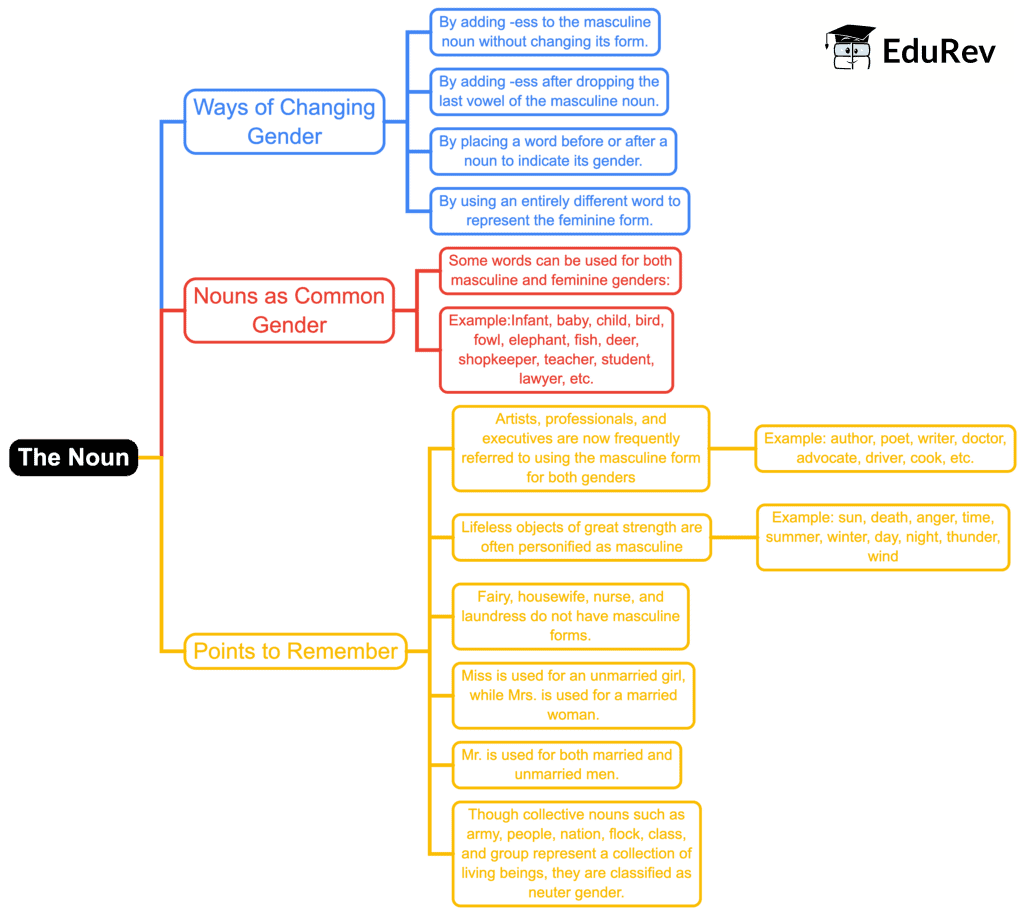
The document Mind Map: The Noun Gender is a part of the Class 7 Course English Grammar Class 7.
All you need of Class 7 at this link: Class 7
FAQs on Mind Map: The Noun Gender
| 1. What is noun gender and why is it important in English? |  |
Ans. Noun gender refers to the classification of nouns based on their biological or grammatical gender. In English, nouns can generally be categorized as masculine, feminine, or neuter. Understanding noun gender is important because it helps in constructing grammatically correct sentences and enhances clarity in communication.
| 2. How do I identify the gender of a noun? | |
Ans. To identify the gender of a noun, you can look at the meaning of the noun itself. Masculine nouns often refer to male beings (like 'man' or 'father'), feminine nouns refer to female beings (like 'woman' or 'mother'), and neuter nouns refer to objects or concepts that do not have a gender (like 'table' or 'idea'). Additionally, some nouns can be gender-neutral, meaning they can refer to any gender (like 'person').
| 3. Are there exceptions to noun gender rules in English? | |
Ans. Yes, there are exceptions to noun gender rules in English. Some nouns do not fit neatly into masculine or feminine categories, such as 'child' or 'parent.' Furthermore, certain professions like 'doctor' or 'teacher' can be used for any gender, and the context often determines the noun's gender usage.
| 4. How do noun genders differ in other languages compared to English? | |
Ans. In many languages, such as Spanish or French, nouns have grammatical gender assigned to them, which affects articles, adjectives, and pronouns. Unlike English, which has a simpler gender classification, these languages often require agreement in gender between nouns and their modifiers, making it more complex to learn.
| 5. Can the gender of nouns change over time? | |
Ans. Yes, the gender of nouns can change over time due to social changes and language evolution. For instance, terms that were once gender-specific may become more neutral as society evolves, reflecting a broader acceptance of gender diversity. Additionally, new terms emerge that are gender-neutral to promote inclusivity.
About this Document

4.74/5 Rating

Apr 19, 2026 Last updated
Related Exams
Document Description: Mind Map: The Noun Gender for Class 7 2026 is part of English Grammar Class 7 preparation. The notes and questions for Mind Map: The Noun Gender have been prepared according to the Class 7 exam syllabus. Information about Mind Map: The Noun Gender covers topics like and Mind Map: The Noun Gender Example, for Class 7 2026 Exam. Find important definitions, questions, notes, meanings, examples, exercises and tests below for Mind Map: The Noun Gender.
Introduction of Mind Map: The Noun Gender in English is available as part of our English Grammar Class 7 for Class 7 & Mind Map: The Noun Gender in Hindi for English Grammar Class 7 course. Download more important topics related with notes, lectures and mock test series for Class 7 Exam by signing up for free. Class 7: Mind Map: The Noun Gender
Description
Mind Map: The Noun Gender of English Grammar Class 7 provides you one-page visual summary of the chapter covering all the important topics. Download the PDF from EduRev.
Information about Mind Map: The Noun Gender
In this doc you can find the meaning of Mind Map: The Noun Gender defined & explained in the simplest way possible. Besides explaining types of Mind Map: The Noun Gender theory, EduRev gives you an ample number of questions to practice Mind Map: The Noun Gender tests, examples and also practice Class 7 tests



Related Searches
MCQs, Previous Year Questions with Solutions, Extra Questions, Semester Notes, ppt, Mind Map: The Noun Gender, Summary, past year papers, Sample Paper, study material, Exam, Mind Map: The Noun Gender, mock tests for examination, Objective type Questions, pdf , Free, video lectures, Mind Map: The Noun Gender, practice quizzes, shortcuts and tricks, Important questions, Viva Questions;