CBSE Class 7 > Class 7 Notes > English Grammar > Mind Map -2: Modal Auxiliaries
Mind Map -2: Modal Auxiliaries

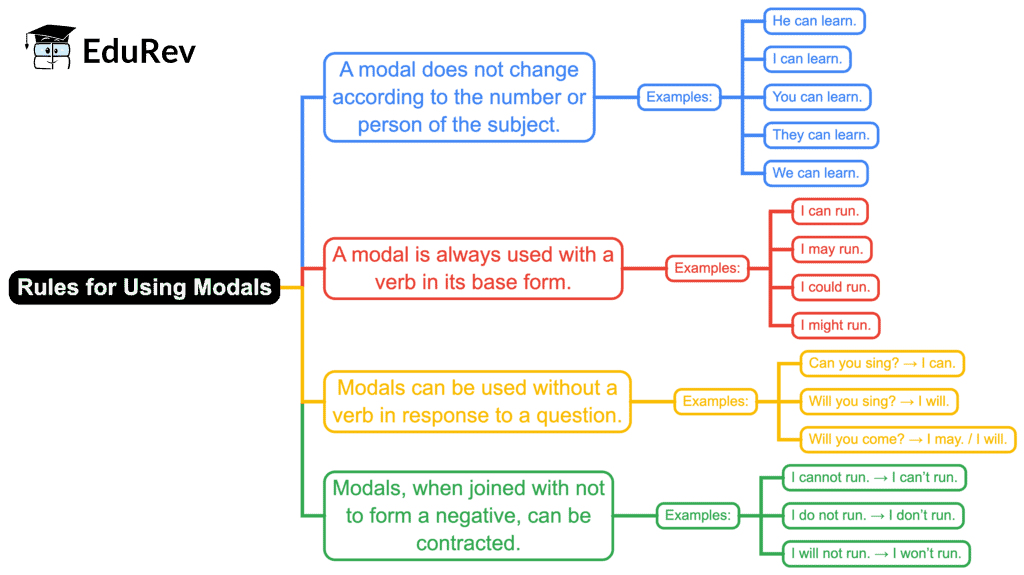
The document Mind Map -2: Modal Auxiliaries is a part of the Class 7 Course English Grammar Class 7.
All you need of Class 7 at this link: Class 7
FAQs on Mind Map -2: Modal Auxiliaries
| 1. What are modal auxiliaries and why are they important in English? |  |
Ans. Modal auxiliaries, often referred to simply as modals, are helping verbs that express necessity, possibility, permission, or ability. They are important in English because they help convey the speaker's attitude toward the action of the main verb, allowing for more nuanced communication. For example, "can" indicates ability, while "must" expresses necessity.
| 2. Can you provide examples of the most common modal auxiliaries? | |
Ans. Yes, some of the most common modal auxiliaries include: - Can: indicates ability (e.g., "I can swim.") - Could: indicates past ability or a polite request (e.g., "Could you help me?") - May: indicates permission or possibility (e.g., "You may leave now.") - Might: indicates a weaker possibility (e.g., "It might rain.") - Must: indicates necessity or strong obligation (e.g., "You must finish your homework.")
| 3. How do modal auxiliaries change the meaning of a sentence? | |
Ans. Modal auxiliaries change the meaning of a sentence by altering the level of certainty, ability, permission, or obligation. For instance, "You can go" implies permission, while "You must go" implies obligation. The choice of modal affects how the listener interprets the speaker's intent and the action's necessity.
| 4. Are there any rules for using modal auxiliaries in sentences? | |
Ans. Yes, there are some basic rules for using modal auxiliaries: - They are always followed by the base form of the main verb (e.g., "She can dance," not "She can dances"). - They do not change form according to the subject (e.g., "He can" and "They can" use the same form). - They are used to express various moods and tenses, but do not have past forms (though some have past equivalents, like "could" for "can").
| 5. How can I practice using modal auxiliaries in my writing? | |
Ans. To practice using modal auxiliaries in writing, you can: - Write sentences using each modal in different contexts (e.g., making requests, expressing ability, or stating obligations). - Create dialogues or short stories that incorporate various modals. - Complete exercises or worksheets focused on modals to reinforce your understanding and application of them in writing.
About this Document

4.60/5 Rating

Apr 26, 2026 Last updated
Related Exams
Document Description: Mind Map -2: Modal Auxiliaries for Class 7 2026 is part of English Grammar Class 7 preparation. The notes and questions for Mind Map -2: Modal Auxiliaries have been prepared according to the Class 7 exam syllabus. Information about Mind Map -2: Modal Auxiliaries covers topics like and Mind Map -2: Modal Auxiliaries Example, for Class 7 2026 Exam. Find important definitions, questions, notes, meanings, examples, exercises and tests below for Mind Map -2: Modal Auxiliaries.
Introduction of Mind Map -2: Modal Auxiliaries in English is available as part of our English Grammar Class 7 for Class 7 & Mind Map -2: Modal Auxiliaries in Hindi for English Grammar Class 7 course. Download more important topics related with notes, lectures and mock test series for Class 7 Exam by signing up for free. Class 7: Mind Map -2: Modal Auxiliaries
Description
Mind Map of English Grammar Class 7 provides you one-page visual summary of the chapter covering all the important topics. Download the PDF from EduRev.
Information about Mind Map -2: Modal Auxiliaries
In this doc you can find the meaning of Mind Map -2: Modal Auxiliaries defined & explained in the simplest way possible. Besides explaining types of Mind Map -2: Modal Auxiliaries theory, EduRev gives you an ample number of questions to practice Mind Map -2: Modal Auxiliaries tests, examples and also practice Class 7 tests



Related Searches
Sample Paper, MCQs, Previous Year Questions with Solutions, study material, Semester Notes, video lectures, Extra Questions, Important questions, Viva Questions, mock tests for examination, Mind Map -2: Modal Auxiliaries, Summary, shortcuts and tricks, Mind Map -2: Modal Auxiliaries, Free, Mind Map -2: Modal Auxiliaries, practice quizzes, Objective type Questions, Exam, past year papers, ppt, pdf ;