CBSE Class 7 > Class 7 Notes > English Grammar > Mind Map: The Direct & Indirect Speech
Mind Map: The Direct & Indirect Speech

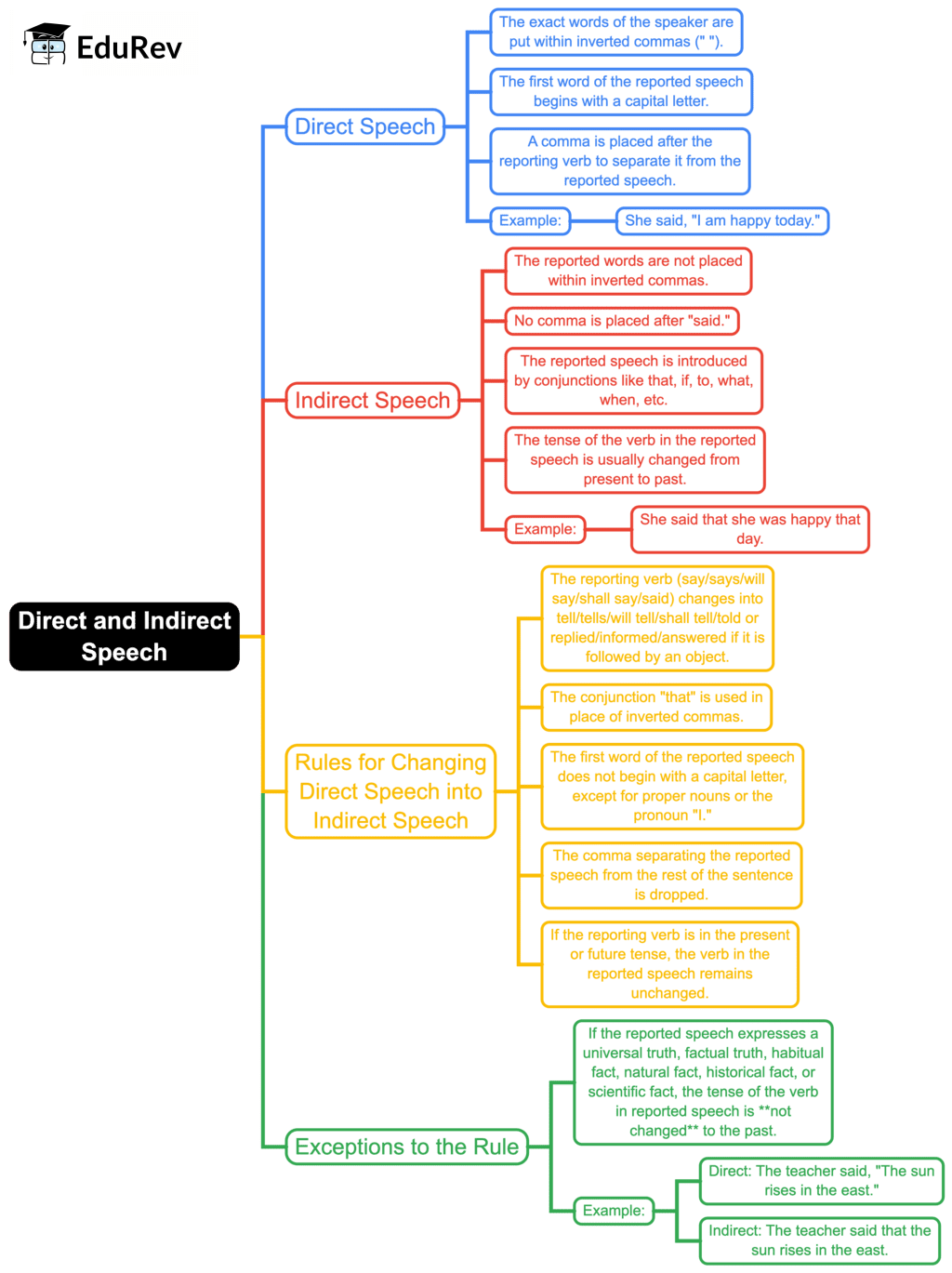
The document Mind Map: The Direct & Indirect Speech is a part of the Class 7 Course English Grammar Class 7.
All you need of Class 7 at this link: Class 7
FAQs on Mind Map: The Direct & Indirect Speech
| 1. What is the difference between direct and indirect speech? |  |
Ans. Direct speech refers to quoting the exact words spoken by a person, usually enclosed in quotation marks. For example, she said, "I am going to the market." In contrast, indirect speech reports what someone has said without quoting their exact words, often using phrases like "said that" or "told that." For example, she said that she was going to the market.
| 2. How do we change tenses when converting from direct to indirect speech? | |
Ans. When converting from direct to indirect speech, the tense usually shifts back one step. For instance, present simple changes to past simple (e.g., "He says, 'I like ice cream'" becomes "He said that he liked ice cream"). However, there are exceptions, such as when the reporting verb is in the present tense or when expressing general truths.
| 3. Are there any punctuation changes when converting from direct to indirect speech? | |
Ans. Yes, when changing from direct to indirect speech, we remove the quotation marks and often change the punctuation. For example, direct speech "She exclaimed, 'What a beautiful day!'" becomes indirect speech "She exclaimed that it was a beautiful day." The exclamation mark is removed, and the sentence structure is adjusted accordingly.
| 4. What are some common reporting verbs used in indirect speech? | |
Ans. Common reporting verbs used in indirect speech include "said," "told," "asked," "explained," and "warned." Each verb may require a specific structure; for example, "told" is often followed by an object (e.g., "He told me that..."), while "asked" typically introduces a question (e.g., "He asked if...").
| 5. How do we convert questions from direct to indirect speech? | |
Ans. To convert questions from direct to indirect speech, we often change the structure from interrogative to declarative. We remove the question marks and use the appropriate reporting verb. For example, "He asked, 'Are you coming?'" becomes "He asked if I was coming." The subject and verb order also change to fit the statement format.
About this Document

4.75/5 Rating

Apr 26, 2026 Last updated
Document Description: Mind Map: The Direct & Indirect Speech for Class 7 2026 is part of English Grammar Class 7 preparation. The notes and questions for Mind Map: The Direct & Indirect Speech have been prepared according to the Class 7 exam syllabus. Information about Mind Map: The Direct & Indirect Speech covers topics like and Mind Map: The Direct & Indirect Speech Example, for Class 7 2026 Exam. Find important definitions, questions, notes, meanings, examples, exercises and tests below for Mind Map: The Direct & Indirect Speech.
Introduction of Mind Map: The Direct & Indirect Speech in English is available as part of our English Grammar Class 7 for Class 7 & Mind Map: The Direct & Indirect Speech in Hindi for English Grammar Class 7 course. Download more important topics related with notes, lectures and mock test series for Class 7 Exam by signing up for free. Class 7: Mind Map: The Direct & Indirect Speech
Description
Mind Map: The Direct & Indirect Speech of English Grammar Class 7 provides you one-page visual summary of the chapter covering all the important topics. Download the PDF from EduRev.
Information about Mind Map: The Direct & Indirect Speech
In this doc you can find the meaning of Mind Map: The Direct & Indirect Speech defined & explained in the simplest way possible. Besides explaining types of Mind Map: The Direct & Indirect Speech theory, EduRev gives you an ample number of questions to practice Mind Map: The Direct & Indirect Speech tests, examples and also practice Class 7 tests



Related Searches
Mind Map: The Direct & Indirect Speech, pdf , Semester Notes, Mind Map: The Direct & Indirect Speech, ppt, Extra Questions, mock tests for examination, Sample Paper, shortcuts and tricks, Objective type Questions, past year papers, Free, Exam, Previous Year Questions with Solutions, Summary, practice quizzes, video lectures, MCQs, Important questions, study material, Viva Questions, Mind Map: The Direct & Indirect Speech;