Simplification: Important Formula


Simplification and approximation are crucial topics in quantitative aptitude, commonly tested in competitive examinations. Mastering these formulas and techniques helps you reduce calculation time and improve accuracy in problem solving.
1. Basic arithmetic operations
Addition and subtraction
- Commutative property of addition: a + b = b + a
- Commutative property of subtraction: a - b ≠ b - a (subtraction is not commutative)
- Associative property of addition: (a + b) + c = a + (b + c)
Use these properties to reorder or regroup terms to make mental calculation easier. For example, 27 + 13 + 73 = (27 + 73) + 13 = 100 + 13 = 113.
Multiplication and division
- Commutative property of multiplication: a × b = b × a
- Division is not commutative: a ÷ b ≠ b ÷ a
- Associative property of multiplication: (a × b) × c = a × (b × c)
- Distributive property: a × (b + c) = a × b + a × c and a × (b - c) = a × b - a × c Apply the distributive property to simplify expressions before calculating. Example: 25 × 16 = 25 × (10 + 6) = 250 + 150 = 400.
2. Order of operations (BODMAS)
Follow the sequence below when evaluating an expression:
- B - Brackets ( ), [ ], { }
- O - Orders (powers and roots)
- D - Division ÷
- M - Multiplication ×
- A - Addition +
- S - Subtraction -
Example: Evaluate 5 + 3 × (8 ÷ 2)²
Follow the order strictly:
3 × (8 ÷ 2)²
8 ÷ 2 = 4
(8 ÷ 2)² = 4² = 16
3 × 16 = 48
5 + 48 = 53
3. Percentage formulas
- x% of y = $\left(\frac{x}{100}\right) \times y$
- y is what % of x = $ \left(\frac{y}{x}\right) \times 100$
- Percentage increase/decrease = $\left( \frac{\text{New value} - \text{Original value}}{\text{Original value}} \right) \times 100$
Example: Original price = ₹800, new price = ₹920. Percentage increase = $\frac{920 - 800}{800} \times 100 = \frac{120}{800} \times 100 = 15\%$.
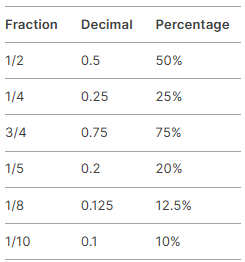
4. Fraction, decimal and percentage conversions
Convert between fraction, decimal and percentage using these relations:
- Fraction to decimal: divide numerator by denominator $(e.g., \frac{3}{4} = 0.75)$
- Decimal to percentage: multiply by 100 (e.g., 0.75 = 75%)
- Percentage to fraction: $x\% = \frac{x}{100}$ (simplify if possible)
5. Approximation techniques
- Rounding off numbers:Look at the digit immediately after the required place.
- If that digit is ≥ 5, round up the last retained digit by 1.
- If that digit is < 5, keep the last retained digit unchanged (round down).
- Estimating sums/differences: Round each addend to a convenient value and then add/subtract. Example: 498 + 372 ≈ 500 + 370 = 870.
- Estimating products: Round factors to near tens or hundreds. Example: 49 × 31 ≈ 50 × 30 = 1500.
- Use significant figures when required to present answers with appropriate precision.
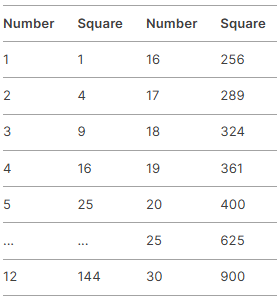
6. Squares and cubes-shortcuts and tables
Squares (useful up to 30)
Memorise squares of small numbers and use patterns: (a ± b)² = a² ± 2ab + b². Examples: 25² = (20 + 5)² = 400 + 200 + 25 = 625; 29² = (30 - 1)² = 900 - 60 + 1 = 841.
Cubes (1-10)
| Number | Cube |
|---|---|
| 1 | 1 |
| 2 | 8 |
| 3 | 27 |
| 4 | 64 |
| 5 | 125 |
| 6 | 216 |
| 7 | 343 |
| 8 | 512 |
| 9 | 729 |
| 10 | 1000 |
7. Square-root and cube-root approximations
- √2 ≈ 1.414
- √3 ≈ 1.732
- √5 ≈ 2.236
- √10 ≈ 3.162
- Cube root of 2 ≈ 1.26
- Cube root of 3 ≈ 1.442
Use these approximations to quickly estimate expressions involving roots. For example, √50 ≈ √(49) = 7 (so √50 ≈ 7.071), which is close enough for many competitive questions where exact precision is not required.
8. Algebraic identities to simplify expressions
- (a + b)² = a² + 2ab + b²
- (a - b)² = a² - 2ab + b²
- a² - b² = (a + b)(a - b)
- (a + b)³ = a³ + 3a²b + 3ab² + b³
- (a - b)³ = a³ - 3a²b + 3ab² - b³
Apply these identities to expand or factor expressions quickly. Example: 102² = (100 + 2)² = 10000 + 400 + 4 = 10404.
9. Divisibility rules (quick checks)
| Number | Rule |
|---|---|
| 2 | Last digit is even (0, 2, 4, 6, 8) |
| 3 | Sum of digits divisible by 3 |
| 4 | Last two digits divisible by 4 |
| 5 | Ends with 0 or 5 |
| 6 | Divisible by both 2 and 3 |
| 8 | Last three digits divisible by 8 |
| 9 | Sum of digits divisible by 9 |
| 10 | Ends with 0 |
| 11 | Difference between sum of digits in odd places and sum of digits in even places is divisible by 11 |
Use divisibility rules to test factors quickly before attempting long division or factorisation.
Final tips
- Practice mental arithmetic daily to increase speed and reduce dependence on paper or calculator.
- Use approximation when exact values are not necessary or when it helps eliminate options quickly in multiple-choice questions.
- Memorise key squares, cubes and common roots (up to at least 30² and 10³) to save time in calculations.
- Use algebraic identities and properties to transform expressions into easier forms before computing.
- When solving stepped calculations, write intermediate results clearly to avoid careless errors.
This guide presents essential formulas and techniques for simplification and approximation. Regular practice of these methods-together with timed problem solving-will improve both speed and accuracy.
FAQs on Simplification: Important Formula
| 1. What are the most important formulas I need to memorize for IBPS PO simplification questions? |  |
| 2. How do I simplify expressions with multiple brackets and operators without making silly mistakes? | |
| 3. Why do approximation methods matter in Bank Exams when I could just calculate exact answers? | |
| 4. What's the difference between simplification formulas and algebraic identities I should know for Bank Exams? | |
| 5. Are there any common calculation traps in simplification that trick IBPS PO candidates? | |