Commerce Exam > Commerce Notes > Accountancy Class 12 > Mind Map: Accounting for Partnerships Basic Concepts
Mind Map: Accounting for Partnerships Basic Concepts

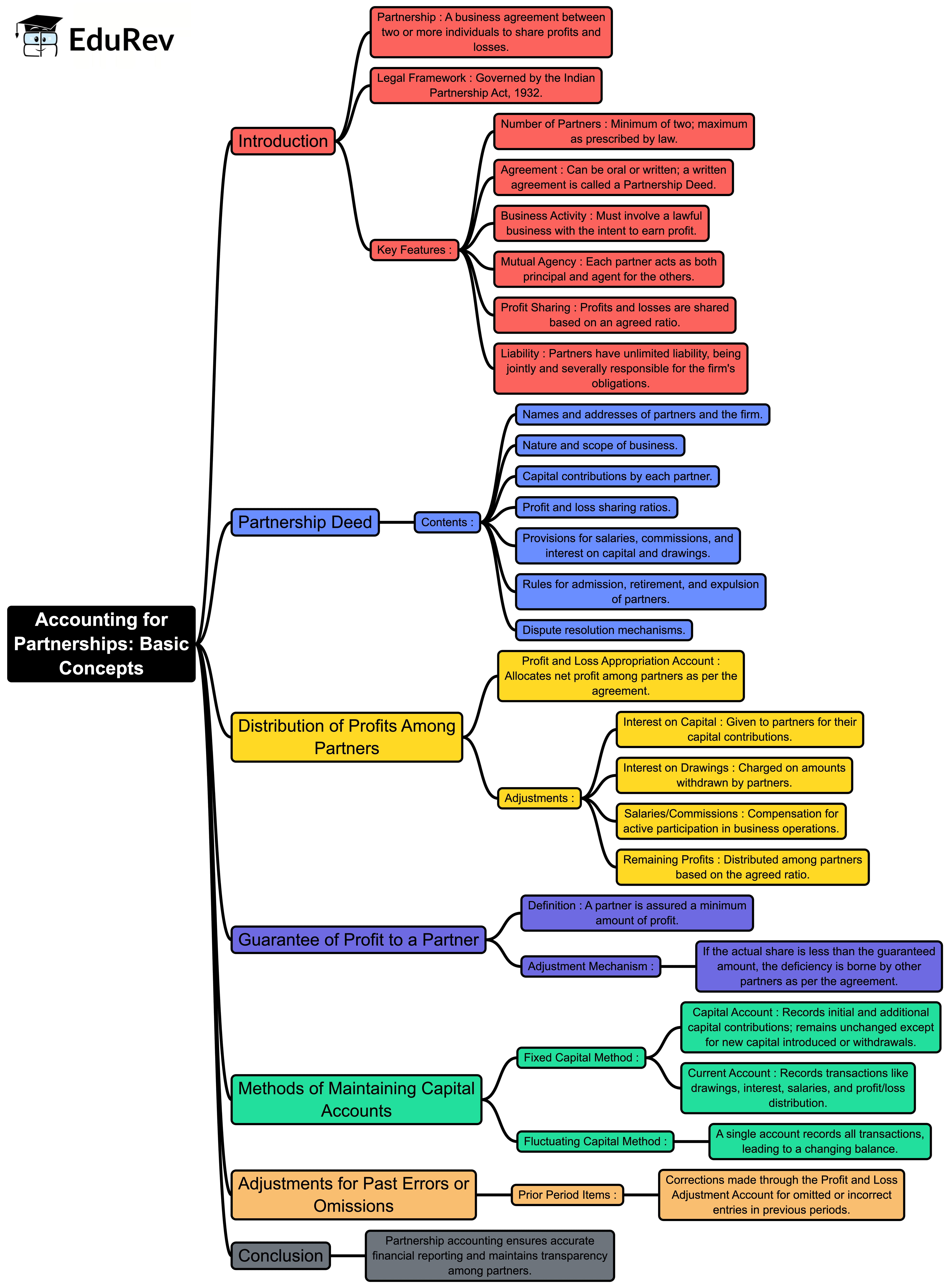
The document Mind Map: Accounting for Partnerships Basic Concepts is a part of the Commerce Course Accountancy Class 12.
All you need of Commerce at this link: Commerce
FAQs on Mind Map: Accounting for Partnerships Basic Concepts
| 1. What is the difference between capital and drawings in partnership accounting? |  |
Ans. Capital represents a partner's initial investment or permanent contribution to the partnership, while drawings are amounts withdrawn by partners for personal use during the accounting year. Capital increases partnership assets; drawings reduce them. Both are tracked separately in partner capital accounts to calculate each partner's final equity and profit-sharing entitlements.
| 2. How do I calculate each partner's share of profit in a partnership for CBSE exams? | |
Ans. A partnership's net profit is distributed among partners according to the profit-sharing ratio agreed upon in the partnership deed. Multiply total profit by each partner's ratio share. For example, if profit is ₹1,00,000 and partners share 2:3, Partner A receives ₹40,000 and Partner B receives ₹60,000. This ratio determines each partner's financial entitlement from business earnings.
| 3. What happens to a partner's capital account when interest on capital is given? | |
Ans. Interest on capital is calculated on a partner's opening capital balance and credited to their capital account as an additional allocation from profits. This recognises the time value of money invested. The interest amount increases individual partner capital accounts while reducing the distributable profit remaining for division by the profit-sharing ratio.
| 4. Why do partnerships need to maintain separate accounts for each partner's capital and drawings? | |
Ans. Separate partner accounts track individual financial interests within the business, essential for determining each partner's equity stake and profit entitlements. Capital accounts record permanent contributions; drawing accounts record temporary withdrawals. This segregation prevents confusion during profit distribution, partner retirement, or dissolution, ensuring transparent and accurate accounting for partnership settlements.
| 5. What adjustments should I remember for partnership accounting before calculating final profits? | |
Ans. Before profit distribution, adjust for interest on capital, interest on drawings, salaries, and commissions. Interest on drawings is debited against partners' accounts; interest on capital and salaries are credited. These adjustments recognise partner contributions beyond profit-sharing and personal resource extraction, significantly affecting each partner's final net share and balance sheet representation of partnership assets.
About this Document

3.6K Views

4.87/5 Rating

Apr 19, 2026 Last updated
Related Exams
Document Description: Mind Map: Accounting for Partnerships Basic Concepts for Commerce 2026 is part of Accountancy Class 12 preparation. The notes and questions for Mind Map: Accounting for Partnerships Basic Concepts have been prepared according to the Commerce exam syllabus. Information about Mind Map: Accounting for Partnerships Basic Concepts covers topics like and Mind Map: Accounting for Partnerships Basic Concepts Example, for Commerce 2026 Exam. Find important definitions, questions, notes, meanings, examples, exercises and tests below for Mind Map: Accounting for Partnerships Basic Concepts.
Introduction of Mind Map: Accounting for Partnerships Basic Concepts in English is available as part of our Accountancy Class 12 for Commerce & Mind Map: Accounting for Partnerships Basic Concepts in Hindi for Accountancy Class 12 course. Download more important topics related with notes, lectures and mock test series for Commerce Exam by signing up for free. Commerce: Mind Map: Accounting for Partnerships Basic Concepts
Description
Mind Map: Accounting for Partnerships Basic Concepts of Accountancy Class 12 provides you one-page visual summary of the chapter covering all the important topics. Download the PDF from EduRev.
Information about Mind Map: Accounting for Partnerships Basic Concepts
In this doc you can find the meaning of Mind Map: Accounting for Partnerships Basic Concepts defined & explained in the simplest way possible. Besides explaining types of Mind Map: Accounting for Partnerships Basic Concepts theory, EduRev gives you an ample number of questions to practice Mind Map: Accounting for Partnerships Basic Concepts tests, examples and also practice Commerce tests



Related Searches
mock tests for examination, past year papers, ppt, Mind Map: Accounting for Partnerships Basic Concepts, Mind Map: Accounting for Partnerships Basic Concepts, pdf , Exam, Semester Notes, practice quizzes, MCQs, Extra Questions, study material, Viva Questions, Important questions, Sample Paper, Objective type Questions, Free, Summary, video lectures, shortcuts and tricks, Previous Year Questions with Solutions, Mind Map: Accounting for Partnerships Basic Concepts;