CBSE Class 4 > Class 4 Notes > Mathematics > Printable Worksheet: Measurement
Printable Worksheet: Measurement

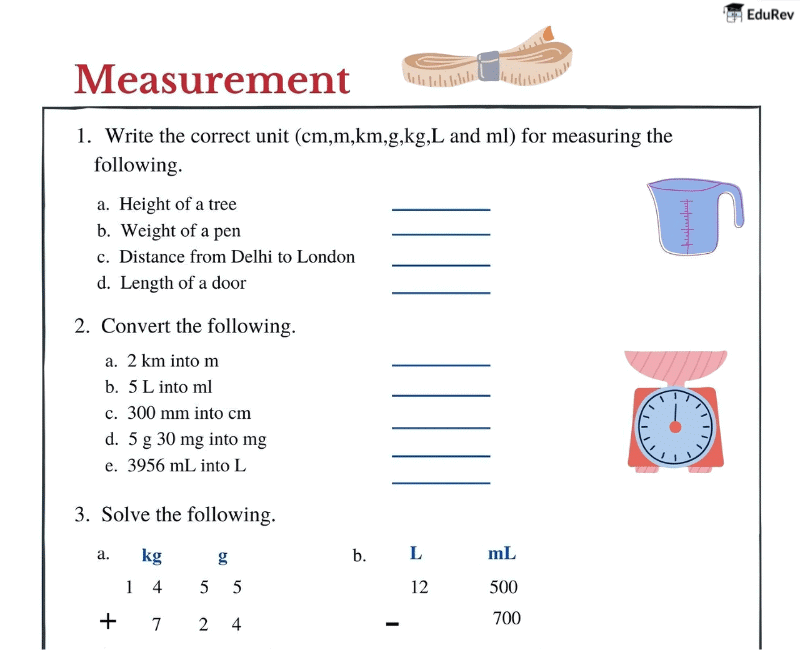
The document Printable Worksheet: Measurement is a part of the Class 4 Course Mathematics for Class 4.
All you need of Class 4 at this link: Class 4
FAQs on Printable Worksheet: Measurement
| 1. How do I convert between different units of measurement like metres and centimetres? |  |
Ans. To convert between metres and centimetres, multiply metres by 100 to get centimetres, or divide centimetres by 100 to get metres. For example, 5 metres equals 500 centimetres. Similarly, 1 kilometre equals 1,000 metres. Understanding these conversion factors helps solve measurement problems quickly. Practice with worksheets that focus on unit conversion to build confidence with larger and smaller measurements.
| 2. What's the difference between perimeter and area, and when do I use each one? | |
Ans. Perimeter measures the total distance around a shape's outer edge, while area measures the space inside the shape. Use perimeter when calculating fencing or borders; use area for floor space or painted surfaces. For a rectangle, perimeter equals 2(length + width), and area equals length × width. Both are essential measurement concepts taught in Class 4 mathematics that appear frequently in problem-solving questions.
| 3. How do I measure length and width accurately using a ruler or scale? | |
Ans. Place the ruler's zero mark at one end of the object and read the number where the object ends. Always measure from the starting point to the endpoint without gaps. For length, measure the longest side; for width, measure the shorter side. Ensure the ruler is straight and aligned properly with the edge being measured to avoid errors in your measurement worksheet tasks.
| 4. Why do my answers come out wrong when I'm calculating the area of rectangles and squares? | |
Ans. Common mistakes include forgetting to multiply both dimensions or mixing up length and width. Ensure you're using the correct formula: area equals length × width for rectangles and side × side for squares. Check that both measurements use the same unit before multiplying. Sketch the shape and label all sides clearly before calculating to prevent confusion when working through measurement problems.
| 5. What are all the different units of measurement I need to know for Class 4 maths? | |
Ans. Essential units include millimetres, centimetres, metres, and kilometres for length; millilitres and litres for capacity; and grams and kilograms for weight or mass. Each unit relates to others through fixed conversion factors, such as 1,000 grams equalling 1 kilogram. Refer to flashcards and mind maps available on EduRev to memorise these measurement units and their relationships quickly.
About this Document

3.3K Views

4.96/5 Rating

Apr 18, 2026 Last updated
Document Description: Printable Worksheet: Measurement for Class 4 2026 is part of Mathematics for Class 4 preparation. The notes and questions for Printable Worksheet: Measurement have been prepared according to the Class 4 exam syllabus. Information about Printable Worksheet: Measurement covers topics like and Printable Worksheet: Measurement Example, for Class 4 2026 Exam. Find important definitions, questions, notes, meanings, examples, exercises and tests below for Printable Worksheet: Measurement.
Introduction of Printable Worksheet: Measurement in English is available as part of our Mathematics for Class 4 for Class 4 & Printable Worksheet: Measurement in Hindi for Mathematics for Class 4 course. Download more important topics related with notes, lectures and mock test series for Class 4 Exam by signing up for free. Class 4: Printable Worksheet: Measurement
Description
Printable Worksheet: Measurement of Mathematics - variety of important questions with solutions, helping you prepare for exam. Download free PDF from EduRev.
Information about Printable Worksheet: Measurement
In this doc you can find the meaning of Printable Worksheet: Measurement defined & explained in the simplest way possible. Besides explaining types of Printable Worksheet: Measurement theory, EduRev gives you an ample number of questions to practice Printable Worksheet: Measurement tests, examples and also practice Class 4 tests



Related Searches
Free, Exam, video lectures, Extra Questions, mock tests for examination, Printable Worksheet: Measurement, practice quizzes, past year papers, MCQs, Summary, Objective type Questions, Previous Year Questions with Solutions, ppt, Semester Notes, Printable Worksheet: Measurement, study material, Printable Worksheet: Measurement, Important questions, Sample Paper, shortcuts and tricks, Viva Questions, pdf ;