Mnemonics: Alcohols, Phenols and Ethers


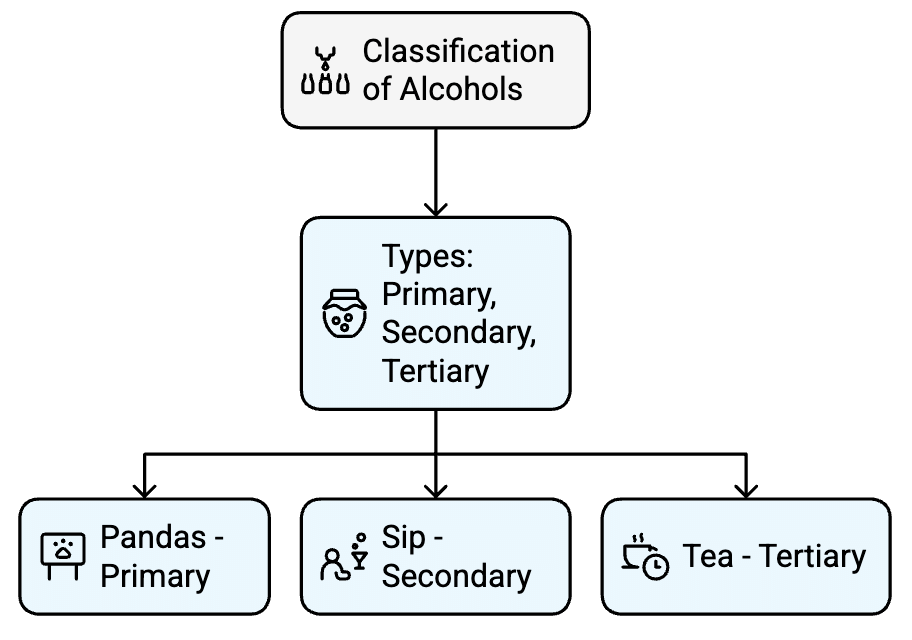
Classification of Alcohols
An alcohol is an organic compound in which one or more hydrogen atoms of a hydrocarbon have been replaced by the hydroxyl group -OH. The simplest mono-hydric alcohols have the general formula R-OH, where R is an alkyl group. Alcohol molecules exhibit hydrogen bonding, which raises their boiling points and affects their solubility in water and their chemical behaviour.
Classification by the carbon bearing the -OH group
- Primary (1°) alcohol: The carbon bearing the -OH group is attached to one alkyl group (or none in methanol). Example: ethanol, CH3CH2OH.
- Secondary (2°) alcohol: The carbon bearing the -OH group is attached to two alkyl groups. Example: isopropyl alcohol, (CH3)2CHOH.
- Tertiary (3°) alcohol: The carbon bearing the -OH group is attached to three alkyl groups. Example: tert-butyl alcohol, (CH3)3COH.
Mnemonic
Pandas Sip Tea
- Pandas - Primary
- Sip - Secondary
- Tea - Tertiary
Methods of Preparation of Alcohols
Alcohols can be prepared by a variety of laboratory and industrial methods. The chosen route depends on the starting material and whether the desired product is primary, secondary or tertiary, and on regiochemical and stereochemical requirements.
Common preparative routes
- From alkenes: Acid-catalysed hydration (Markovnikov addition) converts an alkene to the corresponding alcohol (for example, CH2=CH2 + H2O → CH3CH2OH in presence of acid). Hydroboration-oxidation gives anti-Markovnikov alcohols (BH3 then H2O2/OH-), useful when the less substituted alcohol is required.
- From aldehydes and ketones: Reduction of carbonyl compounds with reducing agents such as NaBH4 or LiAlH4 converts aldehydes to primary alcohols and ketones to secondary alcohols (for example, RCHO + [H] → RCH2OH).
- From Grignard reagents: Addition of a Grignard reagent (R-MgX) to a carbonyl compound followed by aqueous work-up yields alcohols: reaction with formaldehyde gives a primary alcohol, with other aldehydes gives secondary alcohols, and with ketones gives tertiary alcohols.
- From alkyl halides: Nucleophilic substitution by hydroxide ion (SN2 for primary halides; SN1 possible for tertiary halides) converts R-X to R-OH. Conditions must be chosen to minimise elimination (E2).
- Fermentation (biological/industrial): Carbohydrates are converted by yeast to ethanol and carbon dioxide (C6H12O6 → 2 C2H5OH + 2 CO2); this is a major industrial and biological route to ethanol.
Mnemonic
Apes Always Grab
- Apes - From Alkenes
- Always - From Aldehydes/Ketones
- Grab - From Grignard Reagents
Reactions of Alcohols
Important reaction types with brief explanations and examples
- Dehydration: Acid-catalysed elimination of water gives alkenes (for example, CH3CH2CH2OH → CH3CH=CH2 + H2O with concentrated H2SO4 and heat). Mechanism: E1 for secondary and tertiary alcohols (carbocation intermediate), and E2-like or concerted for some primary alcohol eliminations under special conditions.
- Oxidation: Primary alcohols are oxidised to aldehydes and further to carboxylic acids; secondary alcohols are oxidised to ketones; tertiary alcohols resist oxidation under mild conditions. Typical reagents: PCC (for oxidation of primary alcohols to aldehydes), KMnO4 or CrO3 (strong oxidants to acids). Example: CH3CH2OH → CH3CHO → CH3COOH.
- Esterification: Alcohols react with carboxylic acids (or acid derivatives) in presence of acid catalyst to form esters (Fischer esterification): R-OH + R'COOH ⇌ R'COOR + H2O (conc. H2SO4, heat).
- Conversion to alkyl halides: Alcohols can be converted to alkyl halides using reagents such as PCl5, SOCl2, or concentrated HBr/HCl (with tertiary alcohols often converted via SN1 mechanism under acidic conditions).
- Preparation of ethers: Symmetrical ethers may be prepared by acid-catalysed condensation of two primary alcohol molecules; unsymmetrical ethers are best prepared by Williamson synthesis (see ether section).
Mnemonic
Dogs Often Eat
- Dogs - Dehydration
- Often - Oxidation
- Eat - Esterification
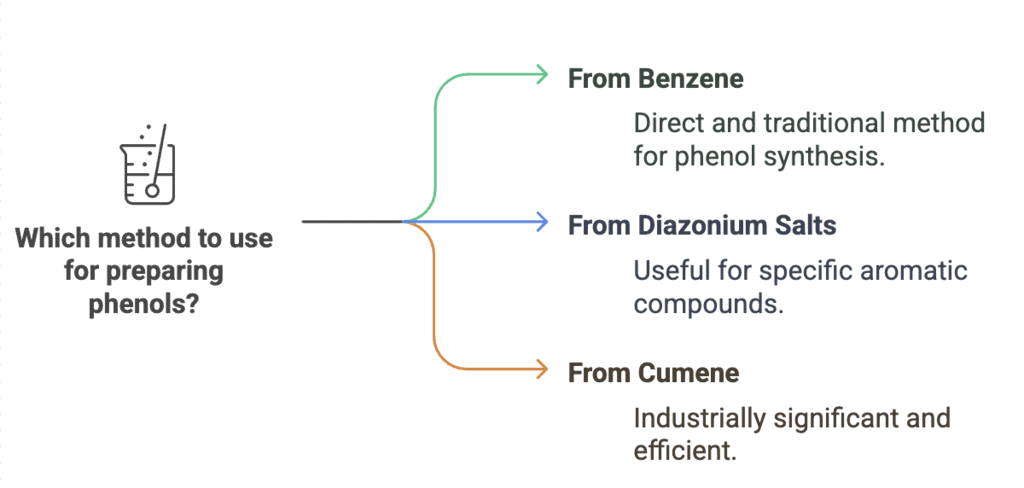
Methods of Preparation of Phenols
A phenol is an aromatic compound in which a hydroxyl group is directly bonded to an aromatic ring (Ar-OH). Phenols are significantly more acidic than aliphatic alcohols because the phenoxide ion is stabilised by resonance with the aromatic ring. Typical pKa values: phenol ≈ 10, while simple aliphatic alcohols have pKa ≈ 16-18, indicating stronger acidity of phenols.
Common preparative routes
- From benzene via multi-step routes: Historically, benzene was nitrated, reduced to aniline, diazotised and then hydrolysed to phenol (Ar-NH2 → Ar-N2+ → Ar-OH on warming). This sequence is classical in the laboratory and historical industry.
- From diazonium salts: Aromatic amines are converted to diazonium salts, which on hydrolysis yield phenols (Ar-NH2 → Ar-N2+ → Ar-OH on heating with water).
- Cumene process (industrial): Cumene (isopropylbenzene) is oxidised to cumene hydroperoxide, which upon acid cleavage yields phenol and acetone. This is the major modern industrial method for phenol production.
Mnemonic
Bears Dig Caves
- Bears - From Benzene
- Dig - From Diazonium Salts
- Caves - From Cumene
Reactions of Phenols
- Electrophilic aromatic substitution: The -OH group is a strong activating substituent due to its resonance donation (+R). Phenol directs electrophiles mainly to the ortho and para positions. Reactions include nitration (mild nitration conditions give mainly o- and p-nitrophenols), halogenation (bromination in aqueous medium can give 2,4,6-tribromophenol), and sulfonation.
- Kolbe-Schmitt reaction: Carboxylation of sodium phenoxide with CO2 under pressure followed by acidification gives salicylic acid (the carboxylation occurs predominantly at the ortho position). This is an important laboratory and industrial method for producing salicylic acid (a precursor of aspirin).
- Reimer-Tiemann reaction: Treatment of phenol with chloroform (CHCl3) in the presence of strong base (NaOH) leads to introduction of a formyl group at the ortho position, producing salicylaldehyde after work-up.
Mnemonic
Elephants Kick Rocks
- Elephants - Electrophilic Substitution
- Kick - Kolbe's Reaction
- Rocks - Reimer-Tiemann Reaction
Methods of Preparation of Ethers
An ether is a compound with the general formula R-O-R′, where R and R′ may be identical or different alkyl or aryl groups. Ethers are relatively unreactive compared with alcohols, have lower boiling points than comparable alcohols (because ethers do not hydrogen-bond to each other), and are widely used as solvents in organic chemistry.
Preparative methods
- Williamson synthesis: An alkoxide ion reacts with a primary (or methyl) alkyl halide via an SN2 mechanism to give an ether. Example: R-O- Na+ + R′-X → R-O-R′ + NaX. This method is the most reliable laboratory route for unsymmetrical ethers when the alkyl halide is primary.
- From alcohols (acid-catalysed dehydration): Two molecules of a primary alcohol can undergo condensation in presence of concentrated acid to give a symmetrical ether (2 R-OH → R-O-R + H2O; conc. H2SO4, ∼140 °C). This method is less useful for unsymmetrical ethers due to competing elimination and possible rearrangements.
- From alkyl halides: Alkyl halides can react with alkoxide ions (Williamson type) or undergo intramolecular substitution to give cyclic ethers (e.g., formation of tetrahydrofuran derivatives by intramolecular SN2).
Mnemonic
Wolves Attack Hares
- Wolves - Williamson Synthesis
- Attack - From Alcohols
- Hares - From Alkyl Halides
Reactions of Ethers
- Cleavage with hydrogen halides (HI, HBr): Ethers are cleaved by strong hydrogen halides. For primary alkyl groups the reaction proceeds by an SN2 pathway; with tertiary alkyl groups cleavage may proceed by SN1 via tertiary carbocations. Example: R-O-R′ + HI → R-I + R′-OH (product distribution depends on relative ease of substitution).
- Electrophilic substitution (aromatic ethers): Aromatic ethers such as anisole are activated towards electrophilic aromatic substitution and direct incoming electrophiles to ortho and para positions.
- Autoxidation: Ethers exposed to air can slowly form peroxides (ROOR), which are potentially explosive; ethers should be stored with antioxidants or tested for peroxides before concentration or distillation.
Mnemonic
Cats Enjoy Apples
- Cats - Cleavage with HI
- Enjoy - Electrophilic Substitution
- Apples - Autoxidation
FAQs on Mnemonics: Alcohols, Phenols and Ethers
| 1. What are the main differences between alcohols, phenols, and ethers? |  |
| 2. How can I memorize the structures of alcohols, phenols, and ethers for the NEET exam? | |
| 3. What are some common uses of alcohols, phenols, and ethers in everyday life? | |
| 4. What are the safety precautions to consider when handling alcohols, phenols, and ethers? | |
| 5. How do the boiling points of alcohols, phenols, and ethers compare, and why? | |




