Mnemonics: Magnetism and Matter


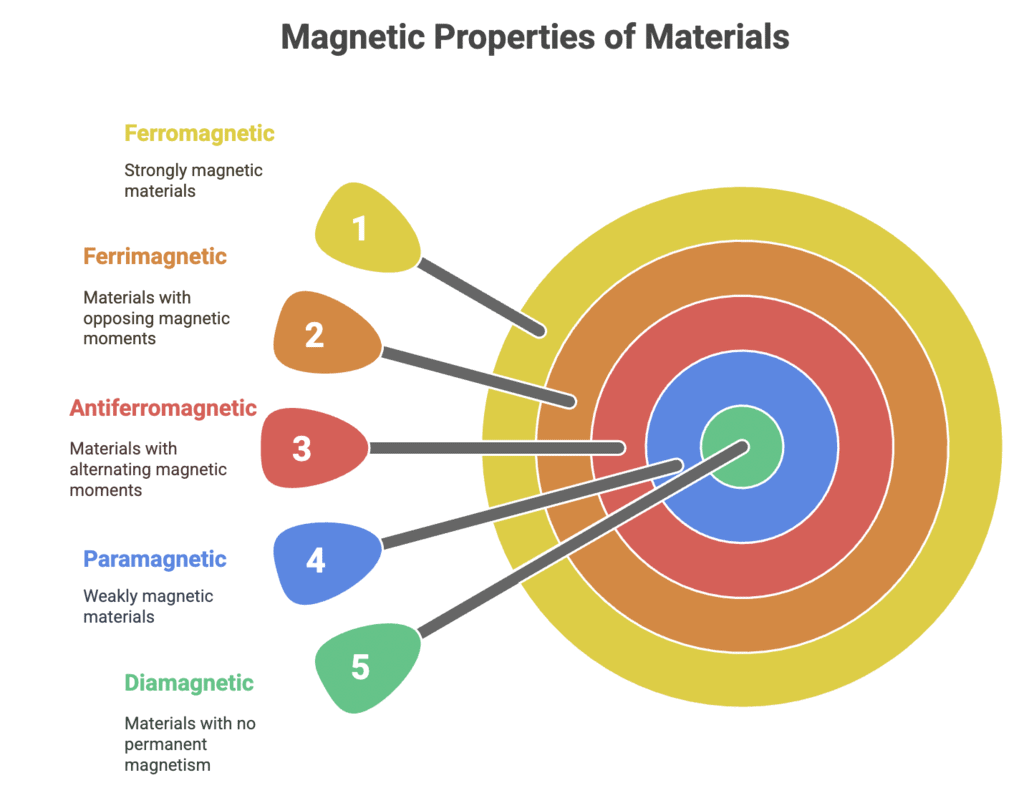
1. Magnetic Properties of Materials
Types: Diamagnetic, Paramagnetic, Ferromagnetic, Antiferromagnetic, Ferrimagnetic
Mnemonic: "Don't Play Football After Fights"
Don't - Diamagnetic
Play - Paramagnetic
Football - Ferromagnetic
After - Antiferromagnetic
Fights - Ferrimagnetic
This mnemonic makes it easier to remember the order of magnetic material types:
Diamagnetic - Weakly repelled by magnetic fields
Paramagnetic - Slightly attracted to magnetic fields
Ferromagnetic - Strongly attracted and retains magnetism
Antiferromagnetic - Opposing magnetic moments cancel out
Ferrimagnetic - Unequal opposing magnetic moments lead to net magnetism
2. Magnetic Elements of Earth
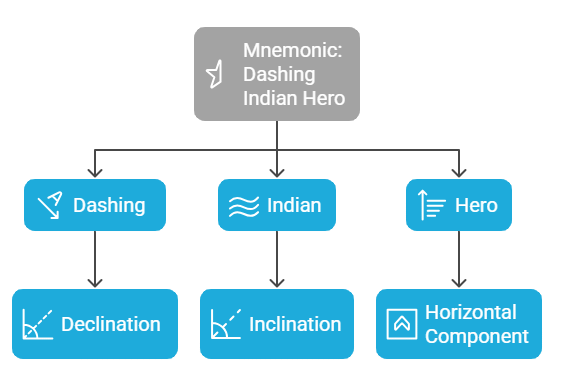
Mnemonic: "Dashing Indian Hero"
Dashing - Declination
Indian - Inclination
Hero - Horizontal Component
This mnemonic helps you recall the three important magnetic elements of the Earth:
Declination - The angle between the magnetic north and true north (difference in direction).
Inclination - The angle between the magnetic field lines and the horizontal plane (also known as dip).
Horizontal Component - The component of the Earth's magnetic field that lies in the horizontal plane.
3. Order of Magnetic Susceptibility
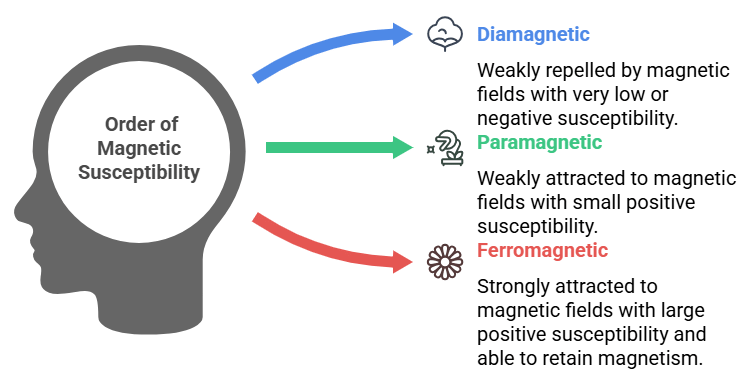
Types: Diamagnetic < Paramagnetic < Ferromagnetic
Mnemonic: "Dull Plants Flourish"
Dull - Diamagnetic (very low or negative susceptibility)
Plants - Paramagnetic (positive but small susceptibility)
Flourish - Ferromagnetic (large and positive susceptibility)
This mnemonic helps you remember the order of magnetic susceptibility for different materials:
Diamagnetic materials are weakly repelled by magnetic fields and have very low or negative susceptibility.
Paramagnetic materials are weakly attracted to magnetic fields with a small positive susceptibility.
Ferromagnetic materials have a large positive susceptibility, making them strongly attracted to magnetic fields and able to retain magnetism.
4. Magnetic Quantities and Their Meaning
Types: Magnetic Moment, Magnetisation, Magnetic Field Intensity, Magnetic Susceptibility, Relative Permeability
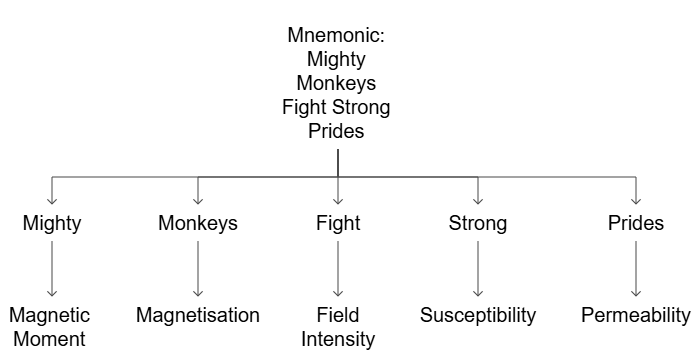
Mnemonic: "Mighty Monkeys Fight Strong Prides"
Mighty - Magnetic Moment
Monkeys - Magnetisation
Fight - Field Intensity
Strong - Susceptibility
Prides - Permeability (Relative)
This mnemonic uses an image of "Mighty Monkeys Fighting Strong Prides" to help you recall the magnetic quantities:
Magnetic Moment - The strength and orientation of a magnet's field.
Magnetisation - The degree of magnetization a material achieves in response to an external magnetic field.
Magnetic Field Intensity - The strength of the magnetic field produced by a current or magnet.
Magnetic Susceptibility - How easily a material becomes magnetized in the presence of a magnetic field.
Relative Permeability - The ratio of a material's permeability to that of free space.
[Question: 0]
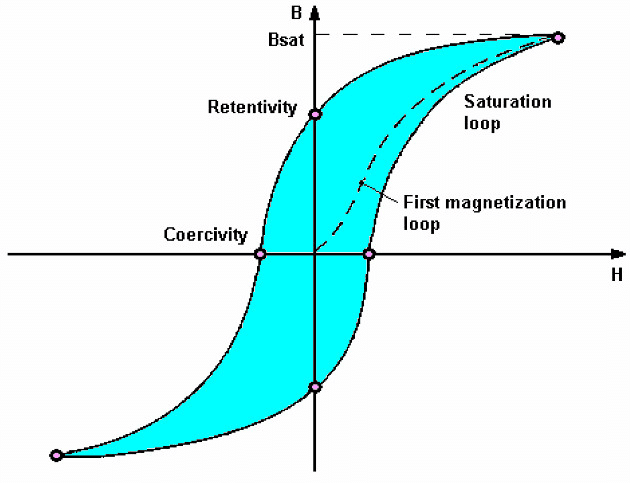
5. Magnetic Behaviour Based on Hysteresis
Types: Retentivity, Coercivity, Hysteresis Loss, Saturation
Mnemonic: "Rita Cooks Hot Soup"
- Rita - Retentivity
- Cooks - Coercivity
- Hot - Hysteresis Loss
- Soup - Saturation
This mnemonic helps you easily remember the key concepts related to hysteresis in magnetic materials:
Retentivity - The ability of a material to retain magnetization after the external magnetic field is removed.
Coercivity - The measure of the resistance of a material to becoming demagnetized.
Hysteresis Loss - Energy lost in the form of heat when a magnetic material is magnetized and demagnetized.
Saturation - The point at which an increase in the magnetic field does not result in any further increase in magnetization.
6. Magnetic Field Lines Characteristics
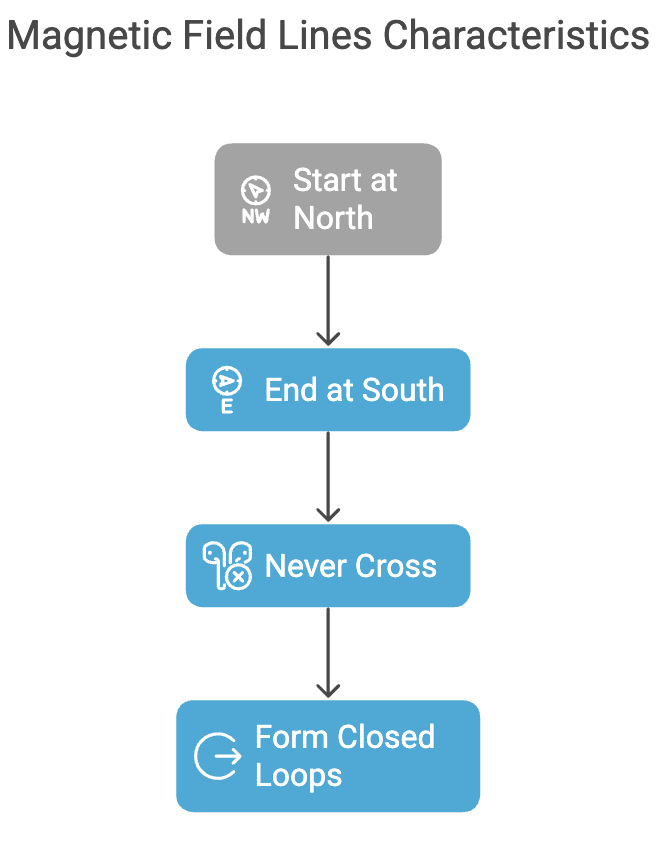
Types: Start from North, End at South, Never Cross, Form Closed Loops
Mnemonic: "Snakes Enter Narrow Caves"
- Snakes - Start at North
- Enter - End at South
- Narrow - Never Cross
- Caves - Closed Loops
This mnemonic helps you remember the important characteristics of magnetic field lines:
Start at North - Magnetic field lines begin at the north pole of a magnet.
End at South - Magnetic field lines end at the south pole of a magnet.
Never Cross - Magnetic field lines never intersect or cross each other.
Closed Loops - Magnetic field lines form closed loops, meaning they travel from the north pole to the south pole outside the magnet and loop back inside.
7. Units Related to Magnetism
Types: Ampere, Tesla, Weber, Henry
Mnemonic: "Ali Took Warm Hats"
- Ali - Ampere
- Took - Tesla
- Warm - Weber
- Hats - Henry
This mnemonic helps you remember the key units used in the study of magnetism:
Ampere - Unit of electric current.
Tesla - Unit of magnetic flux density (magnetic field strength).
Weber - Unit of magnetic flux.
Henry - Unit of inductance.
[Question: 0]
FAQs on Mnemonics: Magnetism and Matter
| 1. What is the difference between magnetism and matter? |  |
| 2. How do magnetic fields interact with magnetic materials? | |
| 3. What are the types of magnetic materials? | |
| 4. What is the significance of the magnetic field lines? | |
| 5. How can the concept of magnetism be applied in everyday life? | |




