CBSE Class 10 > Class 10 Notes > Mathematics (Maths) > Mind Map: Arithmetic Progressions-2
Mind Map: Arithmetic Progressions-2

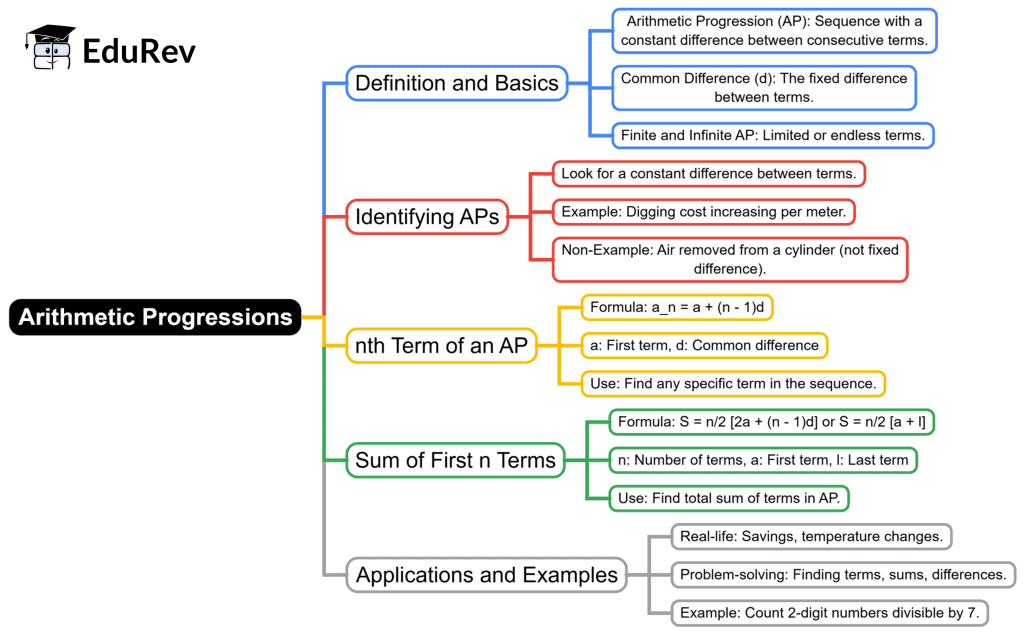
The document Mind Map: Arithmetic Progressions-2 is a part of the Class 10 Course Mathematics (Maths) Class 10.
All you need of Class 10 at this link: Class 10
FAQs on Mind Map: Arithmetic Progressions-2
| 1. What is an arithmetic progression (AP)? |  |
Ans.An arithmetic progression (AP) is a sequence of numbers in which the difference between any two consecutive terms is constant. This difference is known as the common difference. For example, in the sequence 2, 5, 8, 11, the common difference is 3.
| 2. How do you find the nth term of an arithmetic progression? | |
Ans.To find the nth term of an arithmetic progression, you can use the formula: \( a_n = a + (n-1)d \), where \( a \) is the first term, \( d \) is the common difference, and \( n \) is the term number. For example, if the first term is 2 and the common difference is 3, the 5th term would be \( a_5 = 2 + (5-1)3 = 14 \).
| 3. What is the sum of the first n terms of an arithmetic progression? | |
Ans.The sum of the first n terms of an arithmetic progression can be calculated using the formula: \( S_n = \frac{n}{2} (2a + (n-1)d) \) or \( S_n = \frac{n}{2} (a + l) \), where \( l \) is the last term. For example, if the first term is 2, common difference is 3, and you want to find the sum of the first 5 terms, it would be \( S_5 = \frac{5}{2} (2 \times 2 + (5-1) \times 3) = 40 \).
| 4. Can an arithmetic progression have a negative common difference? | |
Ans.Yes, an arithmetic progression can have a negative common difference. This would result in a decreasing sequence. For example, in the sequence 10, 7, 4, 1, the common difference is -3, demonstrating a valid arithmetic progression with a negative common difference.
| 5. How do you determine if a sequence is an arithmetic progression? | |
Ans.To determine if a sequence is an arithmetic progression, you can check if the difference between consecutive terms is constant throughout the sequence. If the difference remains the same for all pairs of consecutive terms, then the sequence is an arithmetic progression. For example, for the sequence 4, 8, 12, 16, the differences (4, 4, 4) are all equal, confirming it is an AP.
About this Document

4.81/5 Rating

Apr 22, 2026 Last updated
Document Description: Mind Map: Arithmetic Progressions-2 for Class 10 2026 is part of Mathematics (Maths) Class 10 preparation. The notes and questions for Mind Map: Arithmetic Progressions-2 have been prepared according to the Class 10 exam syllabus. Information about Mind Map: Arithmetic Progressions-2 covers topics like and Mind Map: Arithmetic Progressions-2 Example, for Class 10 2026 Exam. Find important definitions, questions, notes, meanings, examples, exercises and tests below for Mind Map: Arithmetic Progressions-2.
Introduction of Mind Map: Arithmetic Progressions-2 in English is available as part of our Mathematics (Maths) Class 10 for Class 10 & Mind Map: Arithmetic Progressions-2 in Hindi for Mathematics (Maths) Class 10 course. Download more important topics related with notes, lectures and mock test series for Class 10 Exam by signing up for free. Class 10: Mind Map: Arithmetic Progressions-2
Description
Mind Map: Arithmetic Progressions of Maths Class 10 provides you one-page visual summary of the chapter covering all the important topics. Download the PDF from EduRev.
Information about Mind Map: Arithmetic Progressions-2
In this doc you can find the meaning of Mind Map: Arithmetic Progressions-2 defined & explained in the simplest way possible. Besides explaining types of Mind Map: Arithmetic Progressions-2 theory, EduRev gives you an ample number of questions to practice Mind Map: Arithmetic Progressions-2 tests, examples and also practice Class 10 tests



Related Searches
Semester Notes, mock tests for examination, MCQs, Mind Map: Arithmetic Progressions-2, Previous Year Questions with Solutions, Mind Map: Arithmetic Progressions-2, practice quizzes, pdf , Mind Map: Arithmetic Progressions-2, past year papers, Extra Questions, Free, Important questions, shortcuts and tricks, Exam, Sample Paper, Summary, video lectures, Viva Questions, ppt, Objective type Questions, study material;