Chapter Notes: Food Chains and Food Webs

Food Chains, Food Webs, and Energy Transfers
Food chains
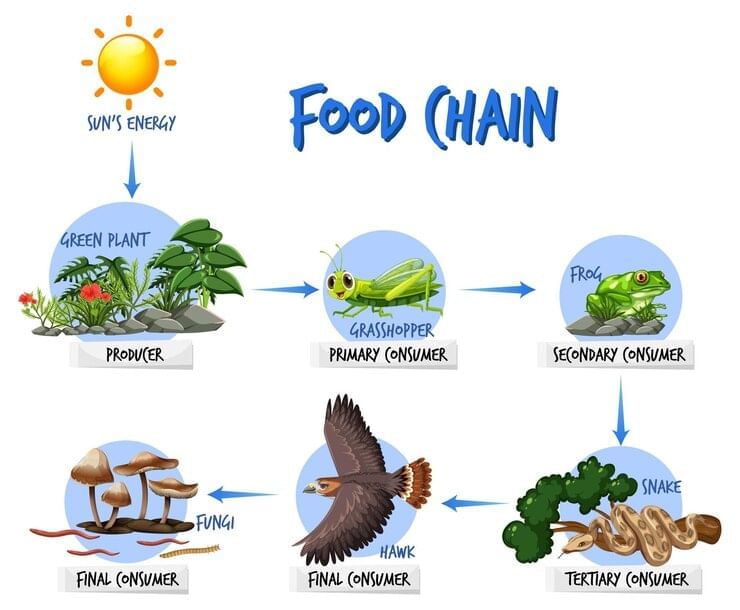
A food chain shows a simple sequence of organisms through which energy and nutrients pass when one organism eats another. Each step in a food chain is called a trophic level. The arrows in a food chain point in the direction of energy flow (from the organism that is eaten to the organism that eats it).
- A typical sequence in a food chain is: producer → consumer.
- Producers are usually green plants or algae that make their own food using sunlight by the process of photosynthesis. Producers form the base of every food chain.
- Consumersare organisms that obtain energy by eating other organisms. Consumers can be classified by what they eat:
- Herbivores eat plants (for example, a rabbit that eats grass).
- Carnivores eat other animals (for example, a snake that eats a frog).
- Omnivores eat both plants and animals (for example, some birds and humans).
- Decomposers (such as bacteria and fungi) break down dead plants and animals and return nutrients to the soil; they complete the cycle of matter in an ecosystem.
- Simple example of a food chain: grass → grasshopper → frog → snake. Each arrow shows the flow of energy from one organism to the next.
Food webs
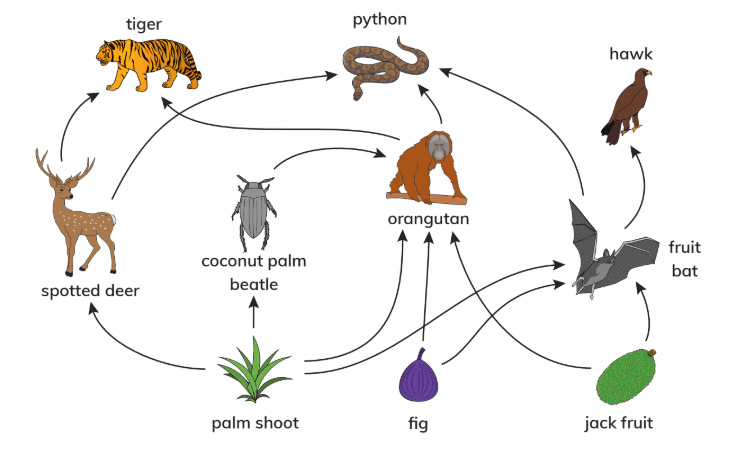
A food web is a network of many interconnected food chains in an ecosystem. Food webs give a more realistic picture of how energy moves through a habitat because most organisms eat more than one kind of food and are eaten by more than one kind of predator.
- Individual food chains link together to form a food web. This shows all the feeding relationships among the organisms in an area.
- For example, a frog might eat worms, flies, beetles and other insects, and larger frogs may also eat small snakes, mice or baby turtles. The frog therefore appears in several linked food chains and so is part of a food web.
- Food webs help us see how a change affecting one species (such as its removal or a decline in its numbers) can affect many other species in the same habitat.
Energy transfers in food chains and food webs
Energy in most ecosystems originates from the Sun. Producers (plants and algae) capture this sunlight energy and convert it into chemical energy in the form of food.
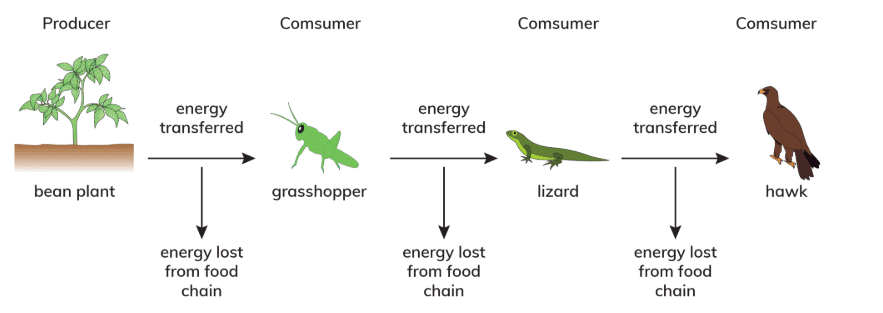
- Energy moves through a food chain when consumers eat producers or other consumers. Each time energy passes from one trophic level to the next, much of it is lost.
- Energy losses occur because:
- some energy is used by the organism for life processes such as movement, growth and reproduction;
- some energy is stored in the body as chemical energy (this is the energy available to the next consumer);
- some energy is lost to the environment as heat.
- Because energy is lost at each step, the quantity of energy available to higher trophic levels becomes smaller and smaller.
- So, when a carnivore eats the herbivore, it only gets the energy that is stored in the herbivore's body. The rest of the energy is lost from the food chain.
- This is why there are usually fewer animals at the top of a food chain than at the bottom.
- In many ecosystems a fairly small fraction of the energy stored at one trophic level is transferred to the next; a useful rule of thumb in ecology is that, on average, only about 10% of the energy stored in one trophic level becomes available to the next. This is called an energy pyramid concept and explains why food chains usually have only a few trophic levels.
- Example food chain to show energy flow: phytoplankton → zooplankton → small fish → larger fish → shark. Each step represents transfer and loss of energy.
Harm to food chains and food webs
The environment includes air, water, soil and all living things. Harmful substances introduced into the environment can damage organisms and disrupt food chains and food webs.
Harmful substances
- Certain heavy metals such as mercury and cadmium are toxic to living organisms and can cause serious health problems if they enter food chains.
- Microplastics are tiny particles of plastic (less than 5 mm across) formed when larger plastic items break down. Microplastics are widespread in oceans and other environments and can be eaten by small animals, entering food chains.
- People sometimes add harmful chemicals to the environment deliberately or accidentally. Pesticides used on crops can kill pests but also harm other organisms in the food web.
Impact of pesticides and toxic substances
- When farmers spray pesticides on crops, the chemicals can kill not only the target pests but also non-target organisms such as bees and butterflies. For example, butterflies may die after drinking nectar from flowers that have been sprayed with pesticide.
- Some toxic substances do not break down easily. These persistent substances can build up in the bodies of organisms and move up the food chain to higher predators. This process of increasing concentration of a chemical in organisms at higher trophic levels is known as biomagnification or bioaccumulation. Predators at the top of a food chain are especially at risk because they may accumulate large amounts of the toxin over time.
Microplastics and the oceans
- Large amounts of discarded plastic end up in rivers and oceans, where sunlight and waves break the plastic into smaller pieces. Sea animals such as turtles, penguins and fish can mistake plastic for food and may swallow it. Swallowed plastics can block the digestive system, causing injury or death.
- Microplastics affect every part of ocean ecosystems and become part of marine food chains. There are estimated to be more than 51 trillion pieces of microplastic in the oceans, a huge number that can affect organisms from tiny plankton to large mammals.
Reducing plastics in food chains: the Ecobrick project
- Some plastic waste can be recycled into new products, but many small and dirty plastic items cannot be easily recycled.
- An example of a practical solution is the creation of ecobricks - plastic bottles tightly packed with unrecyclable plastic waste such as straws and wrappers. Ecobricks can be used as building materials for low-cost structures.
- A project in South Africa uses ecobricks made from non-recyclable plastic waste to build day-care centres and pre-primary schools in poor communities. Making and using ecobricks reduces the amount of plastic that reaches rivers and oceans, and so helps reduce the entry of plastics into food chains.
Protecting food chains and food webs
- Reduce the use of harmful chemicals and pesticides; use safer alternatives and follow recommended application methods to reduce harm to non-target organisms.
- Reduce, reuse and recycle plastics; prevent plastic litter from reaching waterways and the sea.
- Protect habitats and maintain biodiversity so food webs remain balanced. Removing a species or reducing its numbers can have far-reaching effects on the whole web.
- Support and learn about local conservation projects (for example, community clean-ups or ecobrick initiatives) that reduce pollution and protect ecosystems.
Summary
Food chains and food webs show how energy moves between organisms in an ecosystem. Producers capture solar energy and pass it on to consumers; at each step much energy is lost, so fewer organisms can be supported at higher levels. Harmful substances such as heavy metals, pesticides and microplastics can enter and damage food chains, sometimes accumulating to dangerous levels in top predators. Simple actions - reducing pollution, protecting habitats and using safer materials - help keep food chains and food webs healthy.
FAQs on Chapter Notes: Food Chains and Food Webs
| $1. What is a food chain and how does it work? |  |
| $2. How do food webs differ from food chains? | |
| $3. What are the effects of environmental changes on food chains and food webs? | |
| $4. Why are producers essential to food chains? | |
| $5. How can human activities harm food chains and food webs? | |