Overview: Indian Penal Code


Introduction to the Indian Penal Code (IPC), 1860
The Indian Penal Code (IPC), 1860 is the primary statute in India that defines criminal offences and prescribes penalties for them. It was drafted by the First Law Commission under the chairmanship of Lord Macaulay and enacted in 1860. The IPC applies throughout India (subject to statutory exceptions) and sets out substantive criminal law - that is, it describes which acts constitute crimes and the punishments for them. The Code is divided into chapters and sections and serves as the backbone of criminal liability in India. For CLAT PG candidates, a clear grasp of the IPC's basic rules and major provisions is essential because many examination questions test criminal liability principles and landmark decisions.
Key features
- Divided into 23 chapters and 511 sections.
- Territorial and personal application largely governed by Sections 1-5; applies to all persons within India, including foreigners, subject to statutory exceptions.
- It provides substantive criminal law (specifies offences and punishments); procedural aspects are dealt with by other statutes (for example, the Criminal Procedure Code).
General Principles of Criminal Liability
Actus Reus and Mens Rea
Criminal liability ordinarily requires two elements: the actus reus (the guilty act) and the mens rea (the guilty mind). Both elements are necessary in most offences under the IPC though there are exceptions (strict liability offences).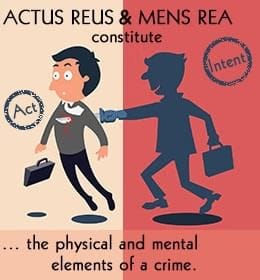
Actus Reus (the guilty act)
Actus reus is the physical element of crime - the conduct, act, omission, or situation the law declares wrongful. It must normally be a voluntary act.
- Includes positive acts, omissions where there is a legal duty to act, and illegal situations (for example, possessing prohibited items).
- The act must be voluntary and not the product of coercion or inadvertence.
Example: If Ram hits Shyam with a stick, the hitting is the actus reus.
Mens Rea (the guilty mind)
Mens rea denotes the mental element - intention, knowledge, recklessness, or negligence - required by the offence. Different offences require different mental states.
- May be expressed as intention, knowledge that an act will probably cause a result, recklessness, or criminal negligence.
- Certain regulatory or public welfare offences may not require mens rea (strict liability).
Example: If Ram hits Shyam intending to hurt him, that intention constitutes mens rea.
Leading authority: R. v. Cunningham (1957) - mens rea signifies a guilty mind and is distinct from mere carelessness.
Stages of Crime
A criminal course of conduct may be analysed in stages: intention, preparation, attempt, and commission. Not all stages attract the same legal consequences.
Intention
A mental resolve to commit a crime; as mere thought or intention alone it is not punishable.
Example: Priya thinks of stealing a watch but does nothing - no punishable offence.
Preparation
Acts or steps taken to plan or prepare for a crime. Preparation is generally not punishable unless a specific statute criminalises preparatory acts (for example, certain offences against the State).
Example: Buying tools to break into a shop is preparatory; not punishable unless a statute provides otherwise.
Attempt
Attempt occurs when a person moves beyond preparation and takes a direct step towards committing the offence but fails to complete it. Attempts are punishable under Section 511 IPC and in specific offences where distinct attempt provisions exist.
- Requires an act proximate to the commission of the offence (more than mere intention or planning).
- Punishment under Section 511 is generally up to half the maximum term provided for the completed offence, or fine, or both.
Example: Priya tries to steal a watch but is apprehended before she takes it - an attempt under Section 511.
Case: Abhayanand Mishra v. State of Bihar (1961) - an attempt requires a direct act towards the commission of the offence.
Commission
Completion of the criminal act - the offence is fully committed and the accused is liable to the full punishment prescribed by the relevant IPC section.
Example: Priya successfully steals the watch - commission of theft (Section 378).
Joint and Group Liability
Section 34 - Liability for acts done by several persons in furtherance of common intention
If two or more persons act in furtherance of a single intention common to them all, each is liable for the act as if done by him alone.
- Requires a common intention or shared plan.
- Each participant is responsible for the whole offence.
Example: Anil and Sunil plan and execute a bank robbery; both are guilty under Section 34.
Case: Barendra Kumar Ghosh v. King Emperor (1925) - common intention entails shared responsibility.
Section 149 - Unlawful assembly and common object
If an offence is committed by any member of an unlawful assembly with a common object, every member of that assembly is guilty of the offence.
- An unlawful assembly is ordinarily a group of five or more persons with a common illegal purpose.
- Liability attaches even if a particular member did not personally commit the act that produced the offence, provided the act was in pursuit of the common object.
Example: A group of six intends to attack a market; one member breaks a shop - all members may be liable under Section 149.
Case: Mizaji v. State of UP (1959) - all members of an unlawful assembly are liable for acts in pursuit of the common object.
Abetment and Criminal Conspiracy
Abetment (Sections 107-120)
Abetment consists of instigating an offence, engaging in a conspiracy to commit it, or intentionally aiding its commission by act or omission. Abetment is punishable under Sections 107-120.
- If the crime abetted is committed, the abettor is punishable as if he had committed the offence (Section 109).
- If the crime is not committed, the abettor may be punished under Section 116 (lesser punishment).
Example: Ria encourages John to set fire to a car and he does so - Ria is guilty of abetment.
Case: Shankarlal Kachrabhai v. State of Gujarat (1965) - encouragement or assistance in commission of crime makes one an abettor.
Criminal Conspiracy (Sections 120A-120B)
Criminal conspiracy is an agreement between two or more persons to commit an offence or to commit a lawful act by unlawful means. It is defined by Section 120A and punished under Section 120B.
- Agreement alone is sufficient for the offence of conspiracy; the crime need not be carried out.
- Punishment under Section 120B varies depending on the gravity of the conspiracy; it may be the punishment of the substantive offence if committed or a prescribed penalty where the substantive offence is not committed.
Example: Tom and Jerry agree to cheat in an exam; the agreement may amount to criminal conspiracy irrespective of whether the cheating occurs.
Case: Kehar Singh v. State (1988) - agreement to commit an unlawful act suffices for conspiracy.
General Exceptions (Defences)
1. Mistake of Fact and Law (Sections 76, 79 IPC)
Mistakes can affect criminal liability depending on their nature.
Mistake of Fact (Sections 76, 79)
A genuine and reasonable mistake of fact that causes a person to act in good faith may excuse criminal liability where the statute contemplates such a defence. Section 76 and Section 79 exemplify such defences for certain persons and circumstances.
- Section 76: Mistake of fact by a person bound by law may excuse liability under specified circumstances.
- Section 79: Acts done in good faith under a mistake of fact may sometimes be justified.
Example: Ram shoots at a moving figure genuinely believed to be a threatening intruder but which is in fact a harmless animal; a genuine mistake of fact may be relevant.
Case: R. v. Tolson (1889) - a genuine mistake of fact in good faith can exculpate.
Mistake of Law
Ignorance of the law is generally no defence; individuals are expected to know the law.
Example: Sita mistakenly believes sale of alcohol is lawful and sells without a licence; she remains liable for the offence.
2. Judicial Acts (Sections 77-78)
Acts done by judicial officers in the course of their duty, done in good faith and within jurisdiction, are not offences.
- Section 77: Protects judicial officers acting in their judicial capacity.
- Section 78: Protects acts done under the authority of a court's judgment or order.
Example: A judge passes sentence based on evidence - even if later the evidence is found unreliable, the judge is not criminally liable if acting within jurisdiction and in good faith.
Accident (Section 80)
Actions that cause harm by accident, without criminal intention and occurring while acting lawfully with proper care, are exculpated under Section 80.
- Requires lawful act, absence of criminal intent, and reasonable care.
Example: A lawful activity causes unforeseen harm despite reasonable care - the actor may not be criminally liable.
Case: State of Orissa v. Khora Ghasi (1978) - accidental acts during lawful activities may be excused.
4. Necessity (Section 81)
An act done in good faith to prevent greater harm may be excused where there is no criminal intent and no reasonable alternative for avoiding serious injury; this is reflected in Section 81.
- The harm caused must be less than the harm sought to be prevented.
Example: Breaking into a house to rescue a child from fire - trespass may be excused by necessity.
Case: R. v. Dudley and Stephens (1884) - extreme examples show the limits of necessity as a defence (particularly regarding killing to survive).
5. Duress and Coercion
Acts committed under threats of immediate and grave harm may sometimes be excused by duress; however, duress is generally not a complete defence for the gravest offences such as murder.
- Threat must be immediate and of serious harm; duress may excuse lesser offences in appropriate circumstances.
Case: DPP v. Lynch (1975) - duress can operate as a defence to certain crimes but not to murder.
6. Consent (Sections 87-91)
Consent can negate criminality where the injured party agreed to the act, provided the act is not intended to cause death or grievous hurt, and consent is given freely and knowledgeably.
- Section 87: Consent to an act not intended to cause death may excuse liability.
- Section 88: Consent to acts done in good faith for a person's benefit (for example, medical treatment).
- Section 89: Consent by guardian of a child or person of unsound mind in certain circumstances.
- Section 90: Consent obtained by force, fraud, or misconception is not valid.
- Section 91: When consent is immaterial (for trivial harms).
Example: Two consenting adults in a regulated sport causing minor injuries - consent may operate as a defence under appropriate provisions.
Case: R. v. Brown (1993) - consent may be ineffective for serious bodily harm in some contexts.
7. Trifles (Section 95)
Section 95 recognises that trivial acts producing negligible harm may not merit criminal punishment; courts exercise discretion in such matters.
Example: Taking a minor item of negligible value in a social context may not attract criminal sanction.
Private Defence (Sections 96-106)
Persons may use reasonable force in private defence of their body, property, or the body and property of another, subject to strict limits on proportionality and necessity.
- Section 96: Acts done in private defence are not offences.
- Section 97: Extends right of private defence to body and property.
- Sections 98-99: Limits on private defence (no excessive force; not against lawful acts by public servants).
- Sections 100-101: Circumstances in which causing death is permitted in private defence (for instance, to prevent murder or grievous hurt).
- Sections 102-106: Rules on commencement, continuation and extent of private defence.
Case: State of UP v. Ram Swarup (1974) - private defence permitted where threat is real and force used is reasonable.
Offences Against the Human Body
1. Culpable Homicide and Murder (Sections 299, 300, 302, 304 IPC)
Unlawful killing offences are divided principally into culpable homicide and murder, distinguished by the mental element and circumstances.
Culpable Homicide (Section 299)
Section 299 defines culpable homicide as causing death with intention to cause death, or with intention to cause such bodily injury as is likely to cause death, or with knowledge that the act is likely to cause death.
- Broader category which may include murder depending on circumstances.
- Punishment under Section 304 varies:
- Part I: Life imprisonment or up to 7 years + fine (if intentional).
- Part II: Up to 7 years + fine (if based on knowledge).
Example: Stabbing someone knowing the wound is likely to cause death - culpable homicide.
Murder (Section 300)
Section 300 elevates certain types of culpable homicide to murder where there is specific intent, or the act is so imminently dangerous that it must in all probability cause death, subject to statutory exceptions (for example, grave and sudden provocation in some cases).
- Conditions include:
- Intention to cause death.
- Intention to cause bodily injury known to be likely to cause death.
- Intention to cause injury sufficient to cause death in ordinary cases.
- Act so dangerous that death is highly likely.
- Exceptions may apply (for instance, sudden fight, grave and sudden provocation, private defence in excess of right may reduce to culpable homicide not amounting to murder).
- Punishment under Section 302: death or life imprisonment plus fine.
Example: Intentionally shooting a person dead - murder under Section 300.
Case: Palaniappa Gounder v. State of Tamil Nadu (1977) - distinctions between murder and culpable homicide depend on intention and severity.
2. Hurt and Grievous Hurt (Sections 319-326)
Offences that cause bodily pain or serious injury are classified as hurt and grievous hurt.
Hurt (Sections 319, 323)
- Section 319 defines hurt as causing bodily pain, disease, or infirmity.
- Section 323 prescribes punishment for causing hurt: imprisonment up to one year, or fine, or both.
Example: Slapping someone causing pain - simple hurt.
Grievous Hurt (Sections 320, 325, 326)
- Section 320 lists specific kinds of grievous hurt (for example, emasculation, permanent privation of sight, loss of limb, fracture, etc.).
- Section 325 prescribes punishment for voluntarily causing grievous hurt: imprisonment up to seven years and fine.
- Section 326 deals with grievous hurt caused by dangerous weapons or means and may attract more severe punishment including life imprisonment.
Example: Breaking a person's arm intentionally - grievous hurt.
Case: Govind v. State of MP (1975) - severity of injury is decisive in classifying grievous hurt.
3. Wrongful Restraint and Confinement (Sections 339-342)
- Section 339 defines restraint as obstructing a person's right to move freely.
- Section 341 prescribes punishment for wrongful restraint: up to one month imprisonment or fine or both.
- Section 340 defines confinement as restraining a person within certain limits so that they cannot move freely in any direction.
- Section 342 prescribes punishment for wrongful confinement: imprisonment up to one year or fine or both.
Example: Locking a person in a room against their will - wrongful confinement.
Case: State of Gujarat v. Keshav Lai (1993) - total restriction of movement is essential for wrongful confinement.
4. Criminal Force and Assault (Sections 349-352)
- Section 349 defines force and Section 350 deals with criminal force; using force without consent to cause injury or insult is criminal force.
- Section 351 defines assault as an act causing another person to apprehend the use of criminal force; physical contact is not necessary.
- Section 352 prescribes punishment for assault or criminal force: imprisonment up to three months or fine or both.
Example: Threatening someone with a raised stick so that they fear being struck - assault.
Case: Bavisetti Kondaiah v. State of AP (1975) - assault requires causing apprehension of immediate harm.
5. Kidnapping and Abduction (Sections 359-363)
These offences involve taking a person away without lawful authority or consent.
- Section 359 distinguishes kidnapping from India and kidnapping from lawful guardianship.
- Section 360: Kidnapping from India (taking a person beyond India) - punishable under Section 363 and related provisions.
- Section 361: Kidnapping from lawful guardianship (minors under certain ages or persons of unsound mind).
- Section 362: Abduction - inducing a person to go from one place to another by force or deceit; often treated in conjunction with other offences.
- Section 363 prescribes punishment for kidnapping or abducting: imprisonment up to seven years and fine.
Example: Taking a 14-year-old away from parents without consent - kidnapping from lawful guardianship.
Case: State of Haryana v. Raja Ram (1973) - abduction requires force or deceit to move the person.
6. Sexual Offences (Sections 375-377 and amendments)
Sexual offences include rape and other sexual crimes. The law on rape and sexual offences has been substantially amended post-2013 following the Nirbhaya case, and further judicial developments followed.
Rape (Section 375; punishment under Section 376)
- Section 375 (as amended) defines rape broadly to include non-consensual sexual intercourse and certain non-penetrative sexual acts; consent must be free and informed.
- Post-2013 amendments expanded the definition and added aggravated offences and specific provisions for custodial or official perpetrators.
- Section 376 prescribes severe punishments: a minimum term in many instances and life imprisonment or even death in aggravated cases where laws have been amended to provide such extremes for child victims or repeat offenders.
Example: Forcing sexual intercourse on a person without consent is rape under Section 375.
Case: Mukesh v. State (2017) - Nirbhaya case jurisprudence resulted in stricter penalties and widened protections.
Other sexual offences and Section 377
- Sections 376A-376E and related provisions address aggravated rape by husband, public servants, custodial persons, and other specified circumstances.
- Section 377 historically criminalised "unnatural offences" (including bestiality and non-consensual sexual acts). Following Navtej Singh Johar v. Union of India (2018), consensual same-sex sexual acts between adults were decriminalised while non-consensual acts remain punishable.
Case: Navtej Singh Johar v. Union of India (2018) - decriminalisation of consensual same-sex acts between adults; non-consensual sexual acts remain offences.
Offences Against Property
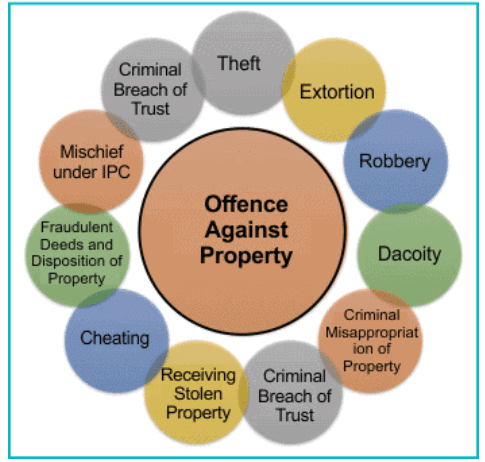
1. Theft (Sections 378-379)
Theft is taking movable property belonging to another without consent and with dishonest intention to permanently deprive the owner.
- Section 378 lists ingredients: movable property, taken out of the owner's possession, without consent, with dishonest intention.
- Section 379 prescribes punishment: imprisonment up to seven years and fine.
Example: Taking someone's mobile phone from their bag intending to sell it - theft.
Case: Pyare Lal v. State of Punjab (1963) - dishonest intent, even for temporary taking, may constitute theft depending on facts.
2. Extortion (Sections 383-384)
Extortion involves intentionally inducing fear of injury (to person, property, reputation) to obtain property or valuable consideration.
- Section 383 defines extortion by inducement of fear and dishonest getting of property.
- Section 384 prescribes punishment: imprisonment up to seven years and fine.
Example: Threatening to publish private photographs unless paid - extortion.
Case: Dhananjay v. State of Bihar (2007) - extortion requires inducing fear to obtain property.
3. Robbery and Dacoity (Sections 390-395)
- Robbery (Section 390 turning theft/extortion into robbery) involves theft or extortion committed with violence or threat of violence; Section 392 prescribes punishment, often up to seven years or more in aggravated situations.
- Dacoity (Section 391) is robbery committed by five or more persons; Section 395 prescribes severe penalties including life imprisonment.
Example: A person threatens with a knife and takes money - robbery. A gang of six carries out the same - dacoity.
Case: Shyam Behari v. State of UP (1957) - dacoity requires five or more persons acting together.
4. Criminal Misappropriation and Breach of Trust (Sections 403, 405-406)
- Criminal misappropriation (Section 403): dishonest appropriation of movable property belonging to another - punishment up to two years and fine.
- Criminal breach of trust (Sections 405-406): dishonestly misusing property that has been entrusted to one's care - punishment under Section 406 up to seven years and fine.
Example: A cashier entrusted with shop money withdraws it for personal use - criminal breach of trust.
Case: R.K. Dalmia v. Delhi Administration (1962) - breach of trust requires proof of entrustment and dishonest misuse.
5. Cheating (Sections 415-420)
Cheating is inducing a person to deliver property or act to their prejudice by deception, with dishonest intent.
- Section 415 defines cheating; Section 420 prescribes a higher penalty for cheating involving property or valuable security (up to seven years and fine).
Example: Selling fake jewellery as genuine to obtain money - cheating.
Case: Shri Bhagwan v. State of Rajasthan (2001) - deception and intent to cause loss are essential ingredients.
Mischief (Sections 425-426)
Mischief is intentionally or knowingly causing wrongful loss or damage to property.
- Section 425: Defines mischief as destruction or damaging property so as to cause wrongful loss.
- Section 426 prescribes punishment: imprisonment up to three months or fine or both (severity varies with degree of mischief).
Case: Nagendranath v. State of West Bengal (1972) - mischief requires intention or knowledge that damage will be caused.
Criminal Trespass (Sections 441-447)
Criminal trespass is entering someone's property illegally with intent to commit a crime.
Key Points (Section 441)
- Needs: Unlawful entry, intent to commit an offense (e.g., theft, harm), or to annoy/intimidate the owner.
- Types: House trespass (Section 442), lurking house trespass (Section 443).
- Punishment (Section 447): Up to 3 months + fine; up to 7 years for house-breaking (Section 446).
Case: Mathri v. State of Punjab (1964) - Trespass requires unlawful entry with criminal intent.
Offences Against Public Tranquillity
Unlawful Assembly (Sections 141-145)
An unlawful assembly is a group (generally five or more persons) with a common object that is illegal or causes public disturbance.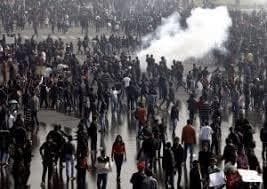
Key Points (Section 141)
- Definition: Five or more persons with a common object to:
- Overawe the government or resist law.
- Commit a crime (e.g., theft, hurt).
- Force or show force to violate someone's rights.
- Disturb public peace.
- Common object: Shared illegal goal of the group.
- Punishments:
- Section 143: Being a member-up to 6 months imprisonment + fine.
- Section 144: Joining with deadly weapons-up to 2 years + fine.
- Section 145: Continuing in an unlawful assembly after ordered to disperse-up to 6 months + fine.
- Example: Five people gather to attack a shop and steal goods. This is an unlawful assembly (Section 141).
Case: Bhim Rao v. State of Maharashtra (1963) - Common object must be illegal for an assembly to be unlawful.
Example: Five persons assemble to attack a shop and steal goods - unlawful assembly.
Case: Bhim Rao v. State of Maharashtra (1963) - an assembly must have an illegal common object to be unlawful.
Rioting (Sections 146-148)
Rioting occurs when members of an unlawful assembly use force or violence in pursuance of their common object; every member may be held liable.
- Section 146 defines rioting; Section 147 prescribes punishment for rioting (up to two years or fine or both).
- Section 148: Rioting with deadly weapons - stiffer punishment (up to three years or more).
- Section 149 links liability for offences committed in pursuit of the common object.
Example: A group of six throw stones at a rival's house in pursuit of a common plan - rioting.
Case: Ram Bilas Singh v. State of Bihar (1964) - rioting requires use of force by an unlawful assembly.
Affray (Sections 159-160)
Affray is fighting in a public place to the disturbance of the public peace. It is less serious than rioting and does not require five or more persons or a common object.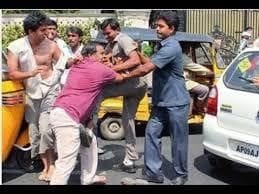
Key Points (Section 159)
- Needs: Two or more persons fighting, in a public place, causing disturbance to others.
- Less serious than rioting; doesn't require a group of five or a common object.
- Punishment (Section 160): Up to 1 month imprisonment + fine, or both.
Case: Jagannath v. State of UP (1974) - Affray must involve public disturbance in a public place.
Offences Against the State
Sedition (Section 124A)
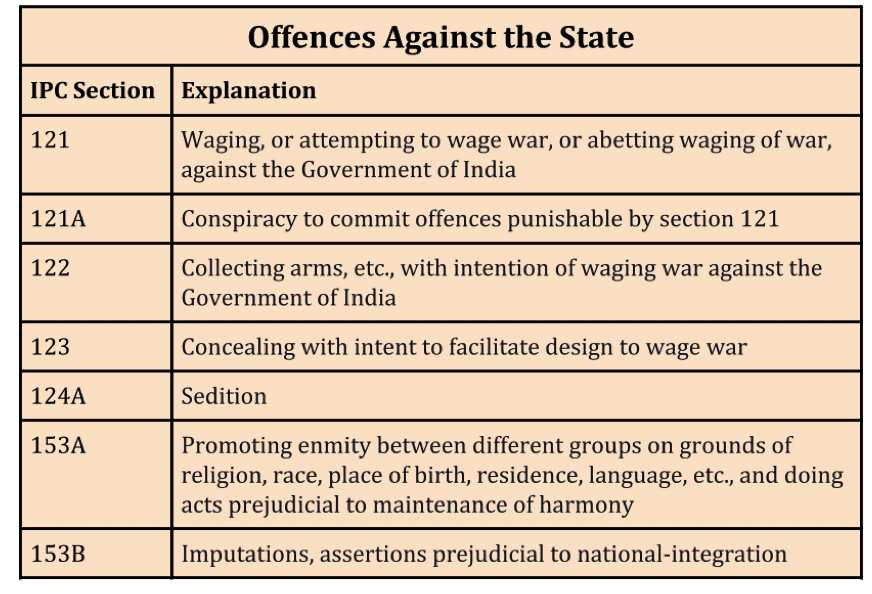
Section 124A criminalises words, signs or actions that bring into hatred or contempt, or excite disaffection towards, the Government established by law. However, mere criticism without intent to incite violence or public disorder does not amount to sedition.
- Sedition requires intent or tendency to cause public disorder, violence or incitement to overthrow the government by force.
- Punishment ranges from fine to imprisonment (including life) depending on circumstances.
- Contemporary note: Section 124A remains part of the IPC; judicial and executive positions, and the mode of its application, have evolved through case law and administrative instructions. (Students should follow current judicial pronouncements and statutory developments for latest position.)
Example: Publishing material that calls for violent overthrow of the government - may amount to sedition if accompanied by intent to incite violence.
Case: Kedar Nath Singh v. State of Bihar (1962) - sedition requires intention or tendency to incite violence or public disorder; mere criticism is not sedition.
Waging War and Related Offences (Sections 121-123)
- Section 121: Waging, attempting or abetting war against the Government of India - punishable with death or life imprisonment.
- Section 121A: Conspiracy to wage war or to overawe the Government by force - grave penalties.
- Section 122: Collecting arms or taking preparatory steps for waging war - severe punishment.
- Section 123: Concealment with intent to assist enemies - punishable.
Example: A group gathers weapons and plans an armed attack on a government building - waging war/conspiracy offences.
Case: State (NCT) v. Navjot Sandhu (2005) - certain acts in support of terrorist attacks may attract charges under waging war provisions depending on intent and effect.
Offences Relating to Documents and Property Marks
Forgery (Sections 463-465)
Forgery is the making of a false document or electronic record or altering a genuine document, with intent to cause damage, injury, deception or to support a false claim.
Section 463: Defines forgery as:
- Making a false document or electronic record.
- With intent to cause damage, injury, or fraud, or to support a false claim.
Section 464: Explains what makes a false document, e.g.:
- Signing or sealing a document as someone else.
- Altering a document without authority.
- Using a document known to be false.
- Needs: Dishonest intent to deceive or cause wrongful loss/gain.
- Punishments:
- Section 465: Forgery-up to 7 years imprisonment + fine (non-cognizable, bailable).
- Examples of false documents: Fake signatures, altered wills, or forged certificates.
- Example: Priya creates a fake degree certificate to get a job, intending to deceive the employer. This is forgery (Section 463).
Case: Ram Narain Poply v. CBI (2003) - Forgery requires a false document made with intent to cause harm or fraud.
Counterfeiting (Sections 231-235)
Counterfeiting covers making or using spurious coins, currency, stamps or material intended to be used as genuine to deceive and harm public trust or the economy.
- Section 231: Counterfeiting Indian coin with intent to use as genuine - punishable up to seven years.
- Section 232: Counterfeiting knowing the coin to be counterfeit with intent to use or pass - may attract life or up to seven years' imprisonment.
- Sections 233-235 deal with manufacturing, selling, and possession of instruments for counterfeiting and possession of counterfeit coins.
Case: State of UP v. Ram Asrey (1970) - knowledge and intent to pass counterfeit currency are elements of the offence.
Offences Against Marriage
Bigamy (Sections 494-495)
 Bigamy is contracting a second marriage during the lifetime of a spouse where the first marriage subsists and there is no legal permission to enter into the second marriage.
- Section 494 defines bigamy; it applies where the first marriage is valid and subsisting and no statutory personal law dispensation permits the second marriage.
- Section 495 deals with bigamy by concealment of the earlier marriage and is treated more severely.
- Punishments include imprisonment and fine, varying by section and facts.
Example: Entering into a new marriage while the first spouse is still alive and not legally divorced - bigamy.
Case: Saroja v. State of Tamil Nadu (2004) - proof of a valid subsisting marriage is essential for liability.
Adultery (Section 497) - Decriminalisation
Adultery as a criminal offence under Section 497 was struck down by the Supreme Court in Joseph Shine v. Union of India (2018). Prior to that decision, Section 497 criminalised certain acts of adultery with gender-discriminatory application. Post-2018, adultery is not a criminal offence but may remain relevant in civil matters such as matrimonial proceedings.
Example: Consensual sexual relations between adults, previously charged under Section 497 in some facts, are no longer a criminal offence after the Supreme Court's ruling.
Case: Joseph Shine v. Union of India (2018) - Section 497 struck down as unconstitutional for violating equality and privacy rights.
Cruelty (Section 498A)
Section 498A penalises cruelty by a husband or his relatives towards a married woman, including physical or mental harassment frequently linked to dowry demands.
- Cruelty includes conduct likely to drive a woman to suicide or cause grave injury to life, limb or health.
- The offence is non-bailable and cognisable; punishment may include imprisonment up to three years and fine.
Case: Girdhar Shankar v. State of Maharashtra (2005) - persistent harassment affecting a woman's mental and physical well-being may constitute cruelty.
Defamation (Sections 499-500)
Defamation involves making or publishing statements that harm a person's reputation. The IPC recognises defamation as both spoken (slander) and written (libel).
- Section 499 defines defamation and lists exceptions (truth for public good, fair criticism, privileged communications, etc.).
- Section 500 prescribes punishment - imprisonment up to two years, or fine, or both.
Case: Subramanian Swamy v. Union of India (2016) - defamation law must be balanced with freedom of speech under Article 19.
Inchoate Offences

Attempt (Section 511)
An attempt is an act done with intent to commit an offence which falls short of completing it. Section 511 punishes attempts to commit offences triable under the IPC where no specific attempt provision exists or as provided by particular sections.
- Requires intent to commit the offence and a substantial step beyond mere preparation.
- Punishment often up to half the term provided for the completed offence, or fine, or both.
Case: Abhayanand Mishra v. State of Bihar (1961) - attempt requires a proximate act towards the commission of the offence.
Abetment (Reprise) and Criminal Conspiracy
Abetment and conspiracy are inchoate offences that penalise instigation, agreement, or facilitation of crimes even where the substantive offence may not have been completed.
- Section 107 defines abetment (instigation, conspiracy plus act, or intentional aid).
- Section 109: Abettor punished as if he committed the offence when the crime is actually committed.
- Section 116: If the crime abetted is not committed, abettor may be punished with a lesser term.
- Section 120A: Defines criminal conspiracy; Section 120B prescribes punishment depending on the gravity of the intended offence.
Example: Conspiring to smuggle drugs - conspiracy punishable even if smuggling is not effected.
Case: Kehar Singh v. State (1988) - an agreement to commit an offence is sufficient for conspiracy.
Conclusion
The Indian Penal Code, 1860, forms the foundational structure of substantive criminal law in India. This overview covered key concepts: general principles of criminal liability (actus reus and mens rea), stages of crime (intention, preparation, attempt, commission), joint and group liability (Sections 34 and 149), inchoate offences (abetment and conspiracy), the main categories of offences against the person and property, offences against public tranquillity and the State, offences relating to documents and property marks, and marriage-related offences. Landmark cases cited (for example, Kedar Nath Singh, Joseph Shine, Navtej Singh Johar) illustrate the interaction between statute and judicial interpretation. For CLAT PG study, focus on the specific sections mentioned, the elements of each offence, the applicable defences, and the leading case law that shapes interpretation. Understanding how to apply statutory ingredients to factual scenarios is the key to answering passage-based and problem questions on the IPC.
FAQs on Overview: Indian Penal Code
| 1. What is the significance of Actus Reus and Mens Rea in the Indian Penal Code? |  |
| 2. What are the different stages of crime as per the Indian Penal Code? | |
| 3. How does the Indian Penal Code define Joint Liability and Group Liability under Sections 34 and 149? | |
| 4. What does the IPC state about Abetment and what are its implications under Sections 107-120? | |
| 5. What are the General Exceptions under the IPC, particularly concerning Mistake of Fact and Law, Judicial Acts, and Accident? | |