Corporate Governance


Concept and Importance of Corporate Governance
Corporate governance refers to the framework of rules, relationships, systems, and processes by which a company is directed and controlled. It ensures accountability, transparency, and ethical behavior in corporate operations, balancing the interests of stakeholders such as shareholders, management, employees, customers, creditors, and the community.
Definition
- Organisation for Economic Co-operation and Development (OECD): Corporate governance involves a set of relationships between a company's management, its board, shareholders, and other stakeholders, providing the structure through which company objectives are set and performance is monitored.
- Cadbury Committee (1992): Defined it as the system by which companies are directed and controlled.
Objectives
- Enhance transparency and disclosure.
- Ensure accountability of management to shareholders.
- Protect stakeholder interests, especially minority shareholders.
- Promote ethical and sustainable business practices.
Importance
- Builds investor confidence and attracts capital.
- Reduces risk of corporate fraud and mismanagement.
- Enhances long-term sustainability and corporate reputation.
- Ensures compliance with legal and regulatory frameworks.
CLAT PG Focus: Understand the theoretical definitions and their practical implications, especially in the context of corporate scandals.
Principles of Corporate Governance
The principles of corporate governance provide a universal framework for effective governance. These are critical for CLAT PG as they form the basis of many questions.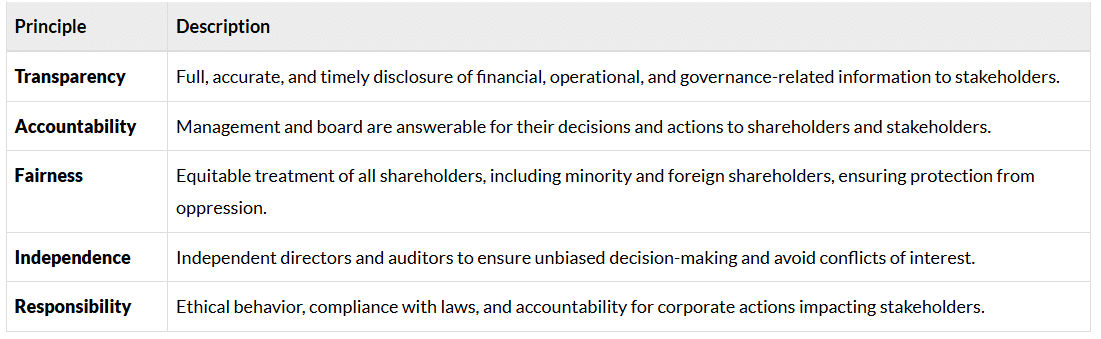
Exam Tip: Questions may ask you to apply these principles to hypothetical scenarios or real-world cases like the Satyam scam.
Legal Framework for Corporate Governance in India
Corporate governance in India is governed by a robust legal and regulatory framework, primarily under the Companies Act, 2013, and SEBI regulations. Below is a detailed breakdown:
Companies Act, 2013
- Section 134: Mandates the board's report to include financial statements, disclosures on related-party transactions, and risk management policies.
- Section 149: Requires listed companies and certain public companies to have at least one-third independent directors and at least one woman director.
- Section 177: Establishes the Audit Committee, which oversees financial reporting, internal controls, and auditor appointments.
- Section 178: Mandates the Nomination and Remuneration Committee to oversee director appointments and remuneration policies.
- Section 135: Governs Corporate Social Responsibility (CSR) obligations.
- Sections 241-244: Provide remedies against oppression and mismanagement, protecting minority shareholders.
SEBI (Listing Obligations and Disclosure Requirements) Regulations, 2015
- Applies to listed companies, mandating disclosures on financial performance, governance practices, and related-party transactions.
- Requires formation of key committees like Audit, Risk Management, and Stakeholders Relationship Committees.
- Enforces timely reporting and compliance with corporate governance norms.

Clause 49 of Listing Agreement
- Originally introduced by SEBI, now integrated into SEBI LODR Regulations.
- Prescribes norms for board composition, independent directors, and audit committee functions.
Other Regulations
- SEBI (Prohibition of Insider Trading) Regulations, 2015: Prevents misuse of unpublished price-sensitive information.
- Ministry of Corporate Affairs (MCA) Guidelines: Issues circulars and notifications to strengthen governance practices.
CLAT PG Tip: Memorize key sections of the Companies Act, 2013, and their practical applications, as they are frequently tested.
Role and Responsibilities of the Board of Directors
The board of directors is the cornerstone of corporate governance, responsible for strategic oversight, policy-making, and ensuring compliance.
Composition
- Executive Directors: Involved in day-to-day management (e.g., CEO, Managing Director).
- Non-Executive Directors: Provide strategic guidance without daily involvement.
- Independent Directors: At least one-third of the board in listed companies (Section 149), ensuring unbiased decision-making.
- Woman Director: Mandatory for certain companies under Section 149.
Duties (Section 166)
- Act in good faith to promote the company's objectives.
- Exercise due care, skill, and diligence.
- Avoid conflicts of interest.
- Not seek undue personal gains.
- Ensure compliance with legal obligations.
Key Committees
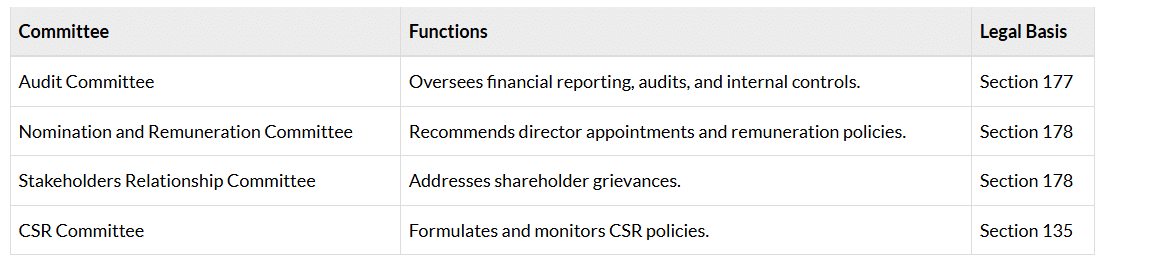
Key Case: Tata Sons v. Cyrus Mistry (2016) - Highlighted the role of independent directors and board accountability in corporate disputes.
Corporate Social Responsibility (CSR)
CSR is a critical aspect of corporate governance, integrating social and environmental responsibilities into business operations.
Legal Provision (Section 135)
- Applicability:Companies with:
- Net worth of ₹500 crore or more.
- Turnover of ₹1000 crore or more.
- Net profit of ₹5 crore or more in any financial year.
- Requirement: Spend at least 2% of average net profits of the last three years on CSR activities.
- CSR Committee: Formed to formulate and monitor CSR policies.
Eligible Activities
- Education and skill development.
- Healthcare and sanitation.
- Environmental sustainability.
- Rural development.
- Disaster relief.
Compliance
- Mandatory disclosure of CSR activities in the board's report.
- Non-compliance may lead to penalties under the Companies Act.
CLAT PG Focus: Questions may test the applicability of CSR provisions or analyze CSR compliance in corporate case studies.
Shareholder Rights and Protection
Protecting shareholder rights, especially those of minority shareholders, is a core objective of corporate governance.
Rights of Shareholders
- Right to vote in general meetings.
- Right to receive dividends.
- Right to inspect financial statements and statutory registers.
- Right to participate in company decisions (e.g., mergers, acquisitions).
Protection Mechanisms
- Oppression and Mismanagement (Sections 241-244): Shareholders can approach the National Company Law Tribunal (NCLT) for relief against oppressive acts or mismanagement.
- Class Action Suits (Section 245): Allows shareholders to file collective lawsuits against the company for mismanagement or fraud.
- SEBI Regulations: Ensure fair treatment through disclosures and grievance redressal mechanisms.
Case Law: Tata Sons v. Cyrus Mistry (2016)
The Supreme Court ruled on the removal of Cyrus Mistry as chairman, emphasizing the protection of minority shareholder rights and the need for transparency in board decisions.
Exam Tip: Be prepared for passage-based questions on shareholder oppression, referencing cases like Tata-Mistry.
Corporate Governance and Ethics
Ethical conduct is integral to corporate governance, ensuring trust and long-term sustainability.
Code of Conduct
- Companies must establish a code of conduct for directors and senior management, outlining ethical standards.
- Enforced under SEBI LODR Regulations and Companies Act.
Whistleblower Policy
- Vigil Mechanism (Section 177): Allows employees and stakeholders to report unethical practices or fraud anonymously.
- Mandatory for listed companies and certain public companies.
Insider Trading
- SEBI (Prohibition of Insider Trading) Regulations, 2015: Prohibits trading based on unpublished price-sensitive information.
- Penalties include fines and imprisonment.
Case Law: Satyam Computer Services Ltd. (2009)
The Satyam scandal involved accounting fraud by Chairman Ramalinga Raju, exposing lapses in ethical governance and leading to stricter regulations.
CLAT PG Focus: Questions may involve analyzing ethical breaches in corporate scandals and their legal consequences.
Emerging Trends in Corporate Governance
Corporate governance is evolving to address global challenges and technological advancements.
Environmental, Social, and Governance (ESG)
- Companies are increasingly integrating ESG factors into governance frameworks.
- Focus on sustainability, diversity, and ethical supply chains.
- SEBI mandates Business Responsibility and Sustainability Reporting (BRSR) mandates ESG disclosures for listed companies.
Technology and Governance
- Use of AI and blockchain for transparent record-keeping and compliance.
- Cybersecurity as a governance priority due to rising data breaches.
SEBI Reforms
- Stricter norms for related-party transactions.
- Enhanced disclosures on board evaluations and risk management.
CLAT PG Tip: Stay updated on ESG and its integration into corporate governance, as it is a trending topic in exams.
Landmark Case Laws
Case laws are critical for CLAT PG, as they illustrate the application of corporate governance principles.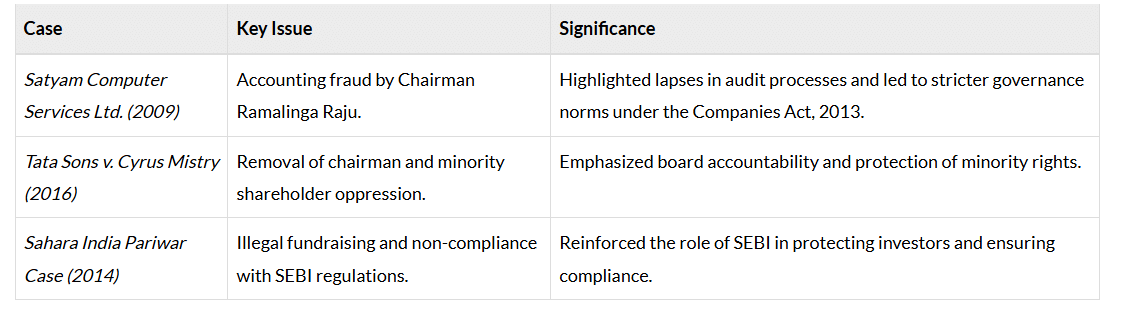
Exam Tip: Focus on the facts, issues, and judgments of these cases, as they are often tested in passage-based or direct questions.
International Perspectives on Corporate Governance
While CLAT PG primarily focuses on Indian laws, understanding global frameworks can enhance answers, especially for comparative questions.
OECD Principles
- Globally accepted guidelines emphasizing transparency, accountability, and shareholder rights.
- Influenced India's corporate governance framework.
UK Corporate Governance Code
- Focuses on board leadership, remuneration, and stakeholder engagement.
- Similar to SEBI LODR in emphasizing independent directors.
Sarbanes-Oxley Act (USA)
- Introduced post-Enron to enhance financial disclosures and auditor independence.
- Comparable to India's audit committee requirements.
FAQs on Corporate Governance
| 1. What is the concept of corporate governance and why is it important? |  |
| 2. What are the key principles of corporate governance? | |
| 3. What is the legal framework for corporate governance in India? | |
| 4. How do corporate social responsibility (CSR) initiatives relate to corporate governance? | |
| 5. What are some emerging trends in corporate governance? | |