CBSE Class 4 > Class 4 Notes > EVS (Our Wondrous World: New NCERT) > Mind Map: Living Together
Mind Map: Living Together

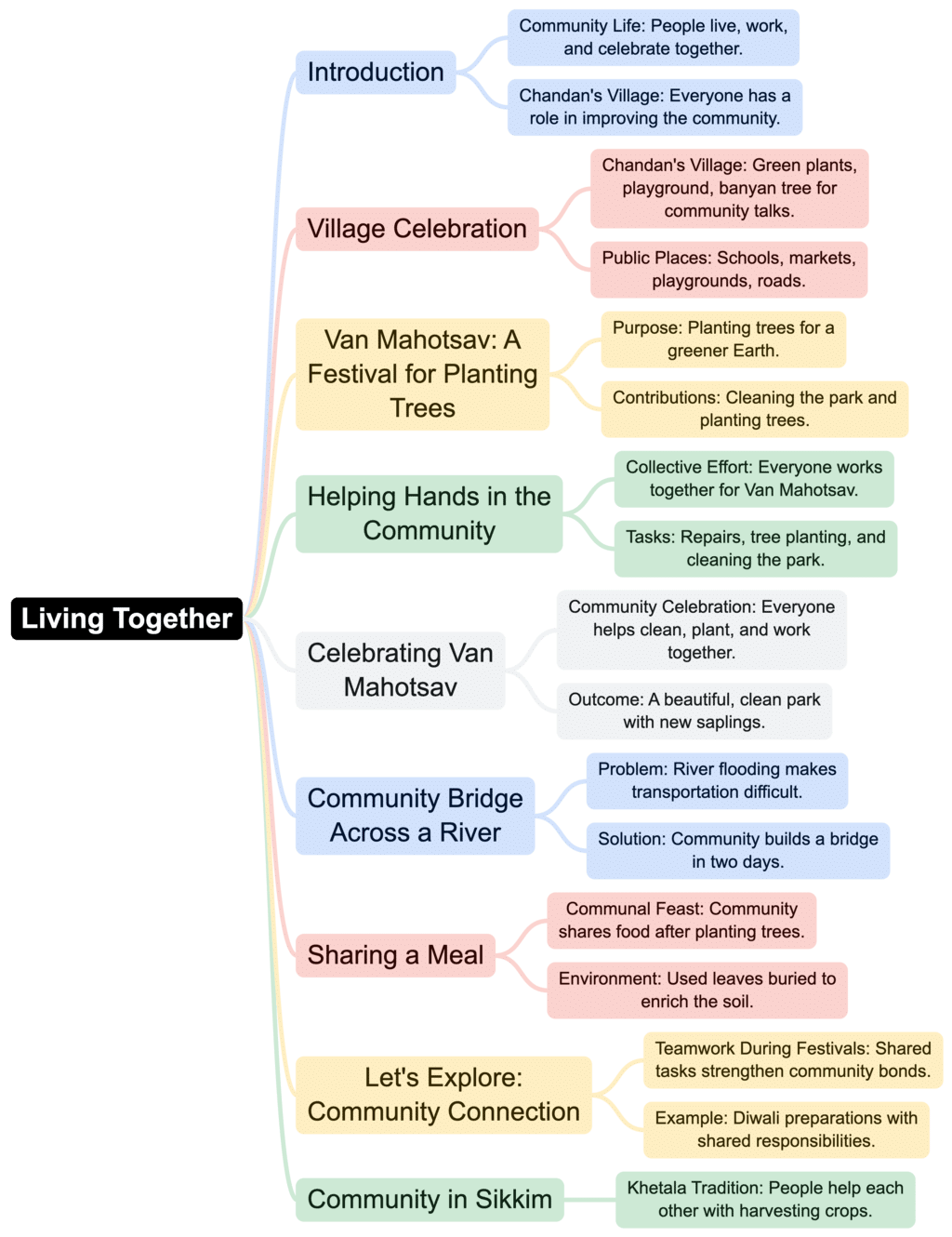
The document Mind Map: Living Together is a part of the Class 4 Course EVS for Class 4 (Our Wondrous World: New NCERT).
All you need of Class 4 at this link: Class 4
FAQs on Mind Map: Living Together
| 1. What does "living together" mean in EVS and why is it important for Class 4 students? |  |
Ans. Living together means sharing spaces and resources with others-like family, classmates, and communities-and cooperating peacefully. It teaches Class 4 students how to respect differences, follow rules, and contribute to group harmony. Understanding interdependence helps children recognise that humans, plants, and animals depend on each other for survival and well-being.
| 2. How do animals and humans live together in the same environment? | |
Ans. Animals and humans coexist by sharing habitats, food sources, and water. Humans depend on animals for food, clothing, and companionship, while animals need safe spaces to survive. This mutual relationship shows that living together requires balance-humans must protect animal habitats and follow conservation practices to maintain ecological harmony and biodiversity in nature.
| 3. What are the rules and responsibilities we need to follow when living with others? | |
Ans. Living together requires following household rules, respecting personal space, helping with chores, and communicating kindly. Children learn responsibility by caring for siblings, pets, and shared spaces. In communities, responsibilities include following traffic rules, keeping environments clean, and participating in local activities. These practices build trust and ensure everyone feels safe and valued in shared spaces.
| 4. How do different types of families live together, and what makes them work? | |
Ans. Families-nuclear, joint, or extended-live together by sharing responsibilities, resources, and affection. Strong family bonds develop through communication, cooperation, and supporting each member. Different cultures have unique family structures; some prioritise individual needs while others emphasise collective well-being. Successful families adapt to challenges together and celebrate differences, creating secure environments where children thrive.
| 5. What does a mind map on living together teach us about social connections? | |
Ans. A mind map visualises how living together connects multiple ideas: family roles, community relationships, environmental interdependence, and personal responsibilities. It shows relationships between concepts-how helping others strengthens communities, how rules protect everyone, and how cooperation benefits all. Mind map structures help Class 4 learners organise their understanding of social harmony and interconnectedness in daily life, making complex ideas clearer and more memorable.
About this Document

2.7K Views

4.97/5 Rating

Apr 18, 2026 Last updated
Document Description: Mind Map: Living Together for Class 4 2026 is part of EVS for Class 4 (Our Wondrous World: New NCERT) preparation. The notes and questions for Mind Map: Living Together have been prepared according to the Class 4 exam syllabus. Information about Mind Map: Living Together covers topics like and Mind Map: Living Together Example, for Class 4 2026 Exam. Find important definitions, questions, notes, meanings, examples, exercises and tests below for Mind Map: Living Together.
Introduction of Mind Map: Living Together in English is available as part of our EVS for Class 4 (Our Wondrous World: New NCERT) for Class 4 & Mind Map: Living Together in Hindi for EVS for Class 4 (Our Wondrous World: New NCERT) course. Download more important topics related with notes, lectures and mock test series for Class 4 Exam by signing up for free. Class 4: Mind Map: Living Together
Description
Mind Map: Living Together of EVS provides you one-page visual summary of the chapter covering all the important topics. Download the PDF from EduRev.
Information about Mind Map: Living Together
In this doc you can find the meaning of Mind Map: Living Together defined & explained in the simplest way possible. Besides explaining types of Mind Map: Living Together theory, EduRev gives you an ample number of questions to practice Mind Map: Living Together tests, examples and also practice Class 4 tests


Related Searches
Important questions, Free, Viva Questions, Previous Year Questions with Solutions, practice quizzes, MCQs, study material, pdf , past year papers, ppt, video lectures, Semester Notes, Objective type Questions, Summary, mock tests for examination, Mind Map: Living Together, shortcuts and tricks, Exam, Extra Questions, Mind Map: Living Together, Mind Map: Living Together, Sample Paper;