NCERT Solutions: Maheshwar

Let us Think
A. Answer the following.
Q1: Who was Ahilya Bai?Ans: Ahilya Bai (Ahilyabai Holkar) was a brave and respected queen who ruled Maheshwar in Madhya Pradesh. She cared for her people, improved the town and its buildings, and is remembered for being kind and wise.
Q2: Where is Maheshwar Fort located? What makes its location special?
Ans: Maheshwar Fort is in Maheshwar, Madhya Pradesh, about 95 kilometres from Indore. It stands on a hill beside the Narmada River. Because it looks down over the river and the town, the fort gives a very beautiful and wide view of the area.
Q3: What materials were used to build Maheshwar Fort, and where did they come from?
Ans: The fort was built mostly from red sandstone brought from Gujarat and Rajasthan. This stone was used for the walls, balconies and steps, giving the fort its red colour and strong structure.
Q4: What does the statue of Queen Ahilya Bai in front of the palace represent?
Ans: The 13-feet tall statue of Queen Ahilya Bai shows her as a guardian and leader who watches over her land and people. It reminds visitors of her courage and care for Maheshwar.
B. Think and discuss.
Q1: Aarav and Ananya get excited about visiting Maheshwar Fort. What do you think makes historical places like this interesting?Ans: Historical places are interesting because they show us old buildings, art and ways of life from long ago. We can learn about brave people like Queen Ahilya Bai, see pretty carvings and designs, and imagine how people lived in the past.
Q2: If you were Aarav or Ananya, what part of the fort would you be most excited to see-the overhanging balconies, the statue, or the temples? Why?
Ans: I would be most excited to see the overhanging balconies. They look as if they are floating, have lovely carvings, and give a clear view of the Narmada River and the town below. Standing there would feel exciting and a little bit grand.
Let us Learn
A. The words "smiling", "grinning", and "laughing" have similar meanings.Example:
- happy, joyful, cheerful
- brave, bold, fearless
Given below are sets of words that have similar meaning, along with a word that does not fit the group. Circle the odd one out.
Q1: sad, unhappy, tearful, thrilled
Ans: The odd one out is thrilled because it means happy, while the others mean sad or unhappy.
Q2: talk, discuss, kind, speak
Ans: The odd one out is kind because it describes a nice person, while the others mean to speak.
Q3: noisy, quiet, silent, calm
Ans: The odd one out is noisy because it means loud, while the others mean soft or still.
Q4: cotton, wooden, silk, woollen
Ans: The odd one out is wooden because it is made of wood, while the others are fabrics used to make clothes.
Find out two such sets of words and write them below.
Ans:
- Set 1: big, large, huge
- Set 2: run, jump, walk
B. Read the word 'design' aloud.
What did you observe?
The letter 'g' is silent.
Now, read the following words. Underline the words that have a silent 'g' letter.

Ans:

(Note: In these words, the 'g' is not pronounced. For example, "sign" sounds like "sine," "night" sounds like "nite," and "high" sounds like "hi.")
C. Match the following.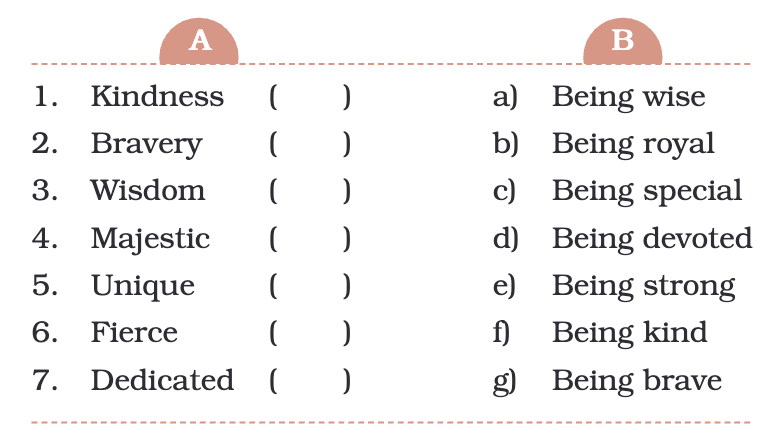 Ans:
Ans: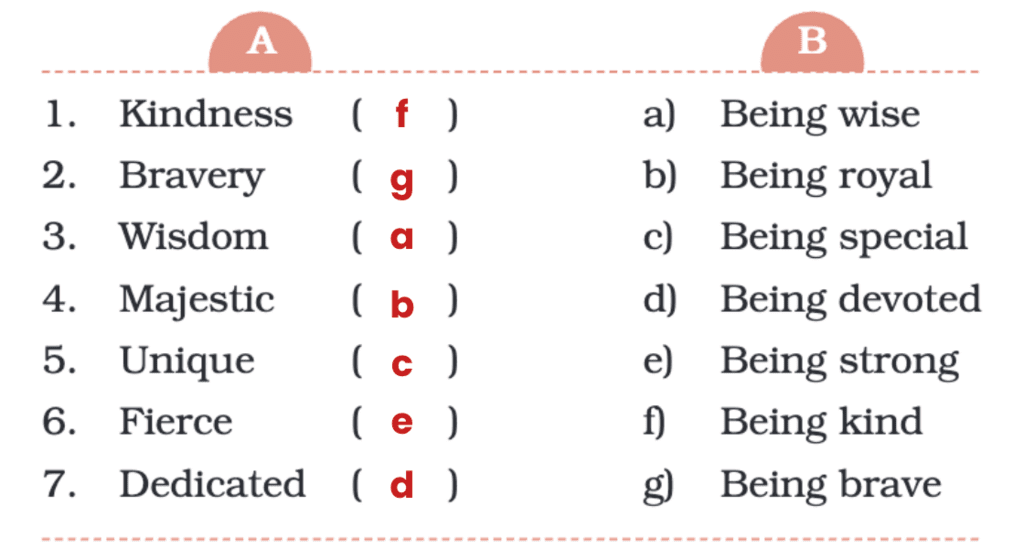
Let us Listen
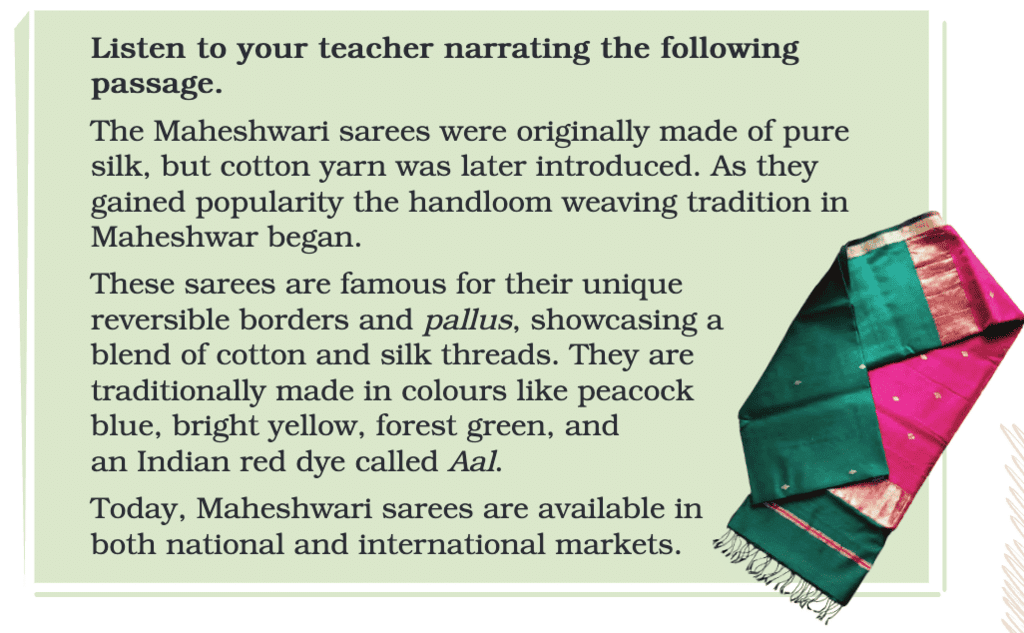
Arrange the following sentences in the order in which they appear in the passage.
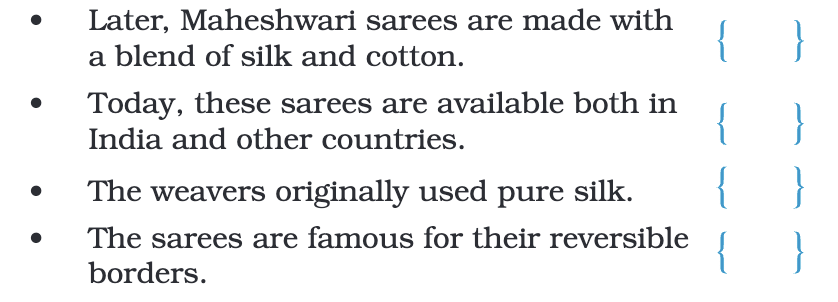
Ans: 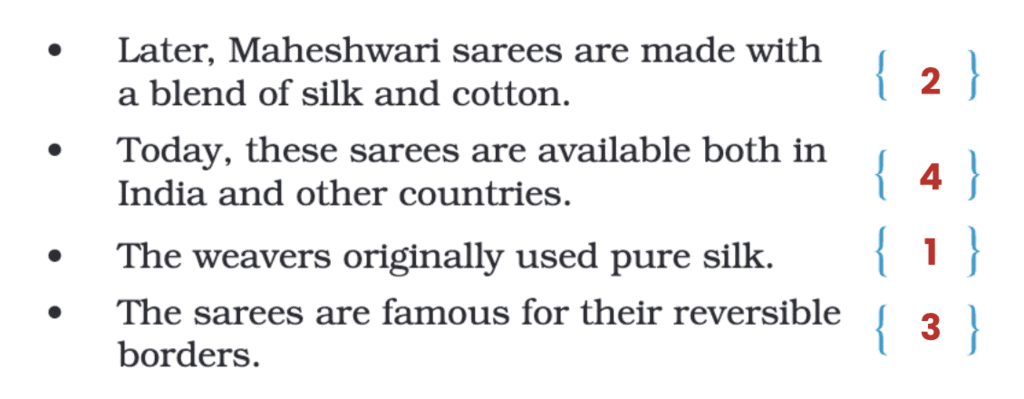
Let us Speak
A. Find out from the elders of your home and your locality about any historical places that are in your town or nearby. You may consider more than one place, too! Collect information and pictures of that place and present them to the class.
Ans:
- Name of the place: Agra
- Name of the monument: Taj Mahal
- Historical people associated with that monument: Emperor Shah Jahan and Mumtaz Mahal
- Special features of that monument: It is a beautiful white marble building with a big dome and four tall minarets.
- How the monument is connected to the people (emotionally): People feel proud of the Taj Mahal because it is a symbol of love and a world-famous wonder.
- Other relevant information: It was built in the 1600s, and many tourists visit it every year.
Presentation: I will show pictures of the Taj Mahal and tell my class, "This is the Taj Mahal in Agra. It was built by Shah Jahan for his wife Mumtaz Mahal. It is made of white marble and looks very beautiful. People love it because it shows true love. It is also a famous place for tourists."
B. Complete the following passage with suitable Articles (a, an, and the)
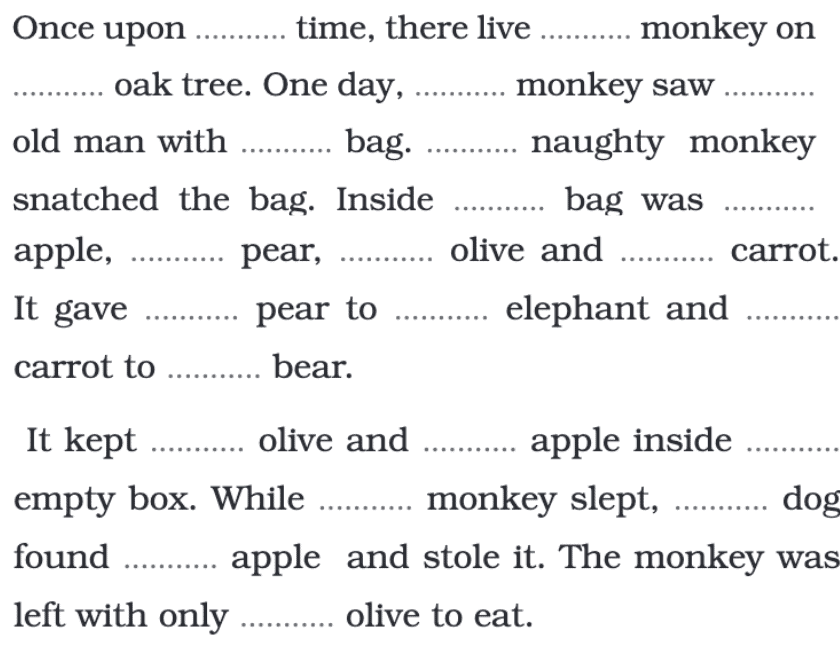 Ans:
Ans: 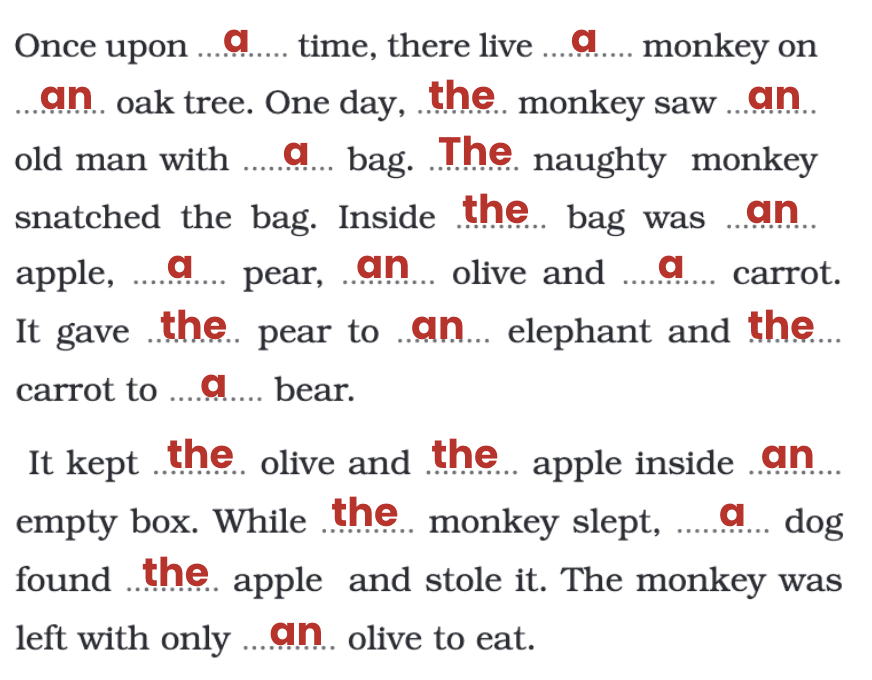
Let us Write
A. Imagine you are visiting Maheshwar Fort with your family. Write a short description of what you see and feel as you explore the fort's balconies and temples.
Ans: I am at Maheshwar Fort with my family. I see the wide red stone walls and the overhanging balconies that look like they are floating. From the balconies, I can see the Narmada River shining below and the small town of Maheshwar. The temples near the fort have pretty designs, and I can hear bells ringing softly. I feel excited and happy to be here and to learn about Queen Ahilya Bai. Walking on the old steps makes me feel close to the past.
B. Based on the facts that you have learnt in the lesson, write a short paragraph on the Maheshwar Fort.
Ans: Maheshwar Fort is a famous fort in Maheshwar, Madhya Pradesh, built and cared for by Queen Ahilya Bai. It sits on a hill beside the Narmada River and is made of red sandstone brought from Gujarat and Rajasthan. The fort has overhanging balconies, wide staircases and old temples nearby. A 13-feet tall statue of Queen Ahilya Bai stands in front of the palace to honour her. Maheshwar is also known for its special Maheshwari sarees, which people weave there even today.
FAQs on NCERT Solutions: Maheshwar
| 1. What are the main topics covered in the Maheshwar Class 4 NCERT solutions? |  |
| 2. How can I access the Maheshwar Class 4 NCERT solutions online? | |
| 3. Are the Maheshwar Class 4 NCERT solutions helpful for exam preparation? | |
| 4. Can I find sample papers for Class 4 in the Maheshwar NCERT solutions? | |
| 5. How do I effectively use the Maheshwar Class 4 NCERT solutions for my studies? | |