Worksheet Solutions: Measuring Length

Q1: Convert to the units shown.
(i) 54 m = ____ cm
Ans: 5400 cm (54 m x 100 = 5400 cm)
(ii) 55 m = ____ cm
Ans: 5500 cm (55 m x 100 = 5500 cm)
(iii) 69 m = ____ cm
Ans: 6900 cm (69 m x 100 = 6900 cm)
(iv) 63 m = ____ mm
Ans: 63000 mm (63 m x 1000 = 63000 mm)
(v) 53 cm = ____ mm
Ans: 530 mm (53 cm x 10 = 530 mm)
Q2: Convert into metres.
(i) 7 km = ____ m
(ii) 2 km 500 = ____ m
(iii) 15 km 305 m = ____ m
(iv) 9 km 50 m = ____ m
Sol: (i) 7000 m (As1 km = 1000 m)
(ii) 2500 m (As 2 km 500 m = 2 x 1000 + 500 m = 2500m)
(iii) 15305 m (As 15km 305m = 15x 1000 + 305 = 15000 + 305 = 15305m
(iv) 9050 m
Q3: Multiple Choice Questions (MCQs).
(i) Circle the longest box.(a)

(b)

(c)

(d)

Sol: (d)
(ii) Which city has the farthest distance point X?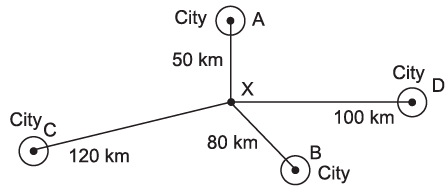 (a) City A
(b) City B
(c) City C
(d) City D
Sol: (c)
Q4: Fill in the blanks.
(a) 10 m = ____ cm
(b) 50 m = ____ cm
Sol: (a) 1000 cm
(b) 5000 cm
Q5: Answer the following Questions.
(i) Complete the table Sol:
Sol:
(ii) A room has 6 m length and 4 m breadth. What is the perimeter of the room?
Sol: Length of room = 6 m
Breadth of room = 4 m
Perimeter of room = Perimeter of rectangle = 2 x (length + breadth) = 2(6+4) = 2 x 10 = 20 m
(iii) How much money does Renu have if she has 5 (₹ 10 notes) + 3 (₹ 50 notes) + 10 (₹ 100 notes) = 
Sol: Total money Renu has = (5x10) + (3x50) + (10x100) = ₹ 1200
(iv) Find the perimeter of the given figure.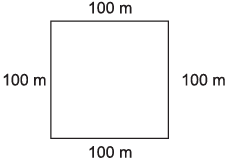 Sol: The given figure is a shape ( all sides are equal with side length = 100 m, and all angles are also equal with each angle = 90o)
Perimeter of a square = 4 x side length = 4 x 100 = 400 m
(v) Ram is 1 m 23 cm tall. Seeta is 12 cm shorter than Ram. What is their total height?
Ans: Height of Ram = 1 m 23 cm = 1x100 + 23 = 123cm (Because 1m = 100cm)
Height of Seeta = Height of Ram - 12cm = (1m 23 cm -12 cm) = 1 m 11 cm = 111cm
Total height of the two = 123 cm + 111 cm = 234 cm =1 m 23 cm + 1 m 11 cm = 2 m 34 cm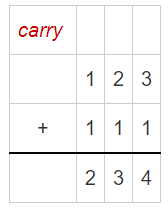
(vi) Find the total distance covered by Mohan from home to school.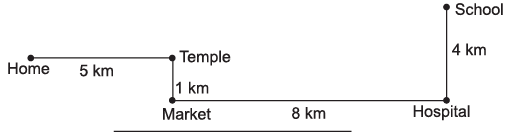
Sol: Total distance covered = (5 + 1 + 8 + 4)km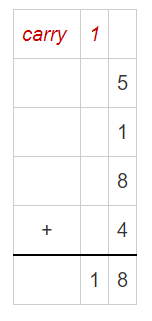
(vii) Ram is 150 cm tall and his sister Teena is 115 cm tall. Who is taller and by how many cms? Sol: Height of Ram = 150 cm
Height of Teena = 115 cm
The difference in their heights = 150 - 115 = 35 cm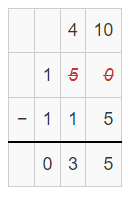 Hence, Ram is taller than Seeta by 35 cm.
(viii) Using a ruler, draw lines of following measurements
(a) 7.7 cm
(b) 6.5 cm
Sol: Students should draw it themselves.
FAQs on Worksheet Solutions: Measuring Length
| 1. How do I measure length accurately using a ruler in Class 4 maths? |  |
| 2. What's the difference between centimetres and metres when measuring objects? | |
| 3. Why do my length measurements keep coming out different each time I measure the same object? | |
| 4. How do I convert between different units of length for maths problems? | |
| 5. What measurement tools other than rulers can I use for measuring length? | |