NCERT Solutions: Measuring Length


Page 80: Let Us Observe
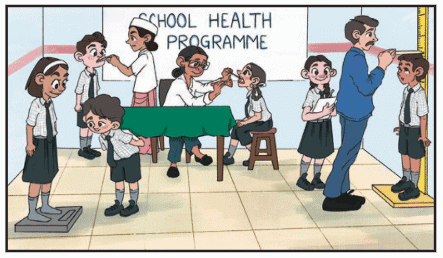
Q1: Look at the picture. What are the students measuring? Put a tick mark (✓) if you find it being measured.
Ans: Length, Weight, and Temperature are measured by the students in the above picture.
Q2: What is being used to measure the height? What other tools can be used to measure height?
Ans: A measuring scale is used to measure height. Other tools include a ruler, height chart, or a meter stick.
Q3: Recall in Grade 3 you studied that lengths are measured in metres. Check and fill in the blanks whether the following are correct/incorrect for your classroom.
(a) The height of most of the students in my grade is more than a metre.
Ans: Correct. Most children in Class 4 are taller than 1 metre.
(b) The length of my arm is less than a metre.
Ans: Correct. The length of an arm is usually less than 1 metre.
(c) The height of the door of the grade is less than a metre.
Ans: Incorrect. A classroom door is usually more than 1 metre tall.
(d) The breadth of the blackboard is more than a metre.
Ans: Correct. A blackboard is typically wider than 1 metre.
Page 81: Let Us Do
1. Walk, Jump, and Crawl on 1, 5 and 10 m line. Draw lines of 1 m, 5 m, and 10 m on the floor of the classroom or outside in the playground. How will you make these lines? Think and share with your friends. Walk, jump, and crawl on the lines.
Ans: Do it Yourself!
(Hint: Try this activity with your classmates. Use a metre rope or measuring tape to mark lines of 1 m, 5 m and 10 m. Walk, jump and crawl along each line and observe the difference in distances.)
Page 82: Let Us Do
2. Long Jump
Each child can participate in a long jump competition. How far have your friends jumped? Measure as accurately as possible using a combination of ropes. Who jumped the longest distance? Who has jumped the shortest?
Fill the following table. 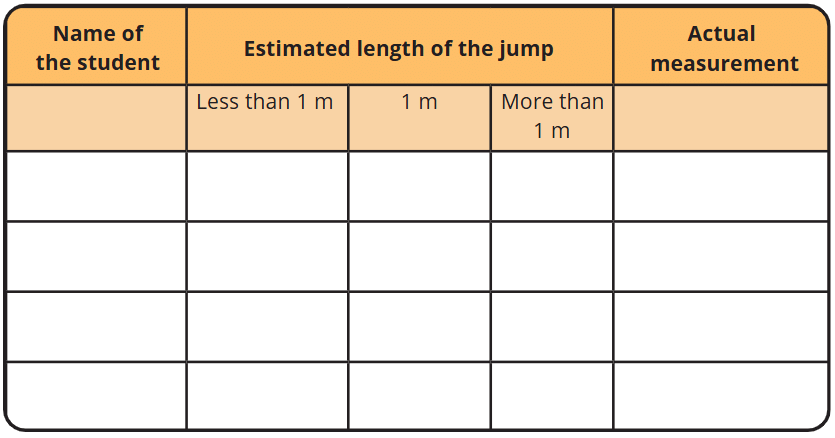
Ans: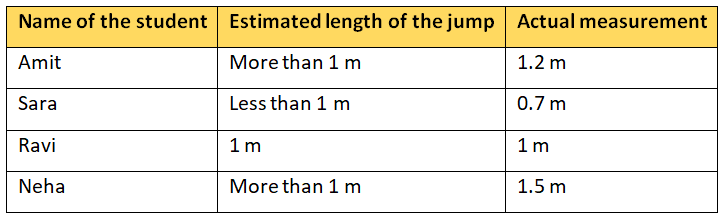
Q3: Estimate how long and broad is your classroom. Measure and check.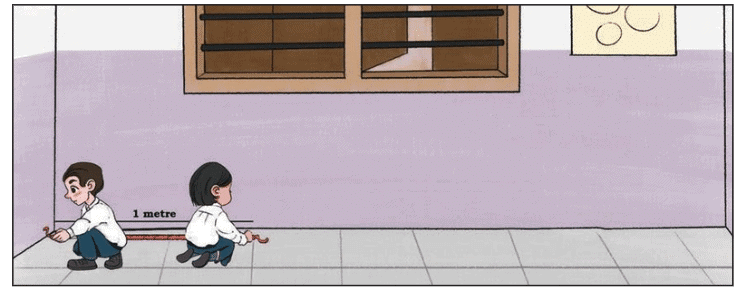 Ans: Estimate the classroom length and breadth (e.g., length is about 8 m, breadth is about 6 m). Use a measuring tape or meter rope to measure accurately. Compare your estimate with the actual measurement.
Page 83: Let Us Think: Guess the Length
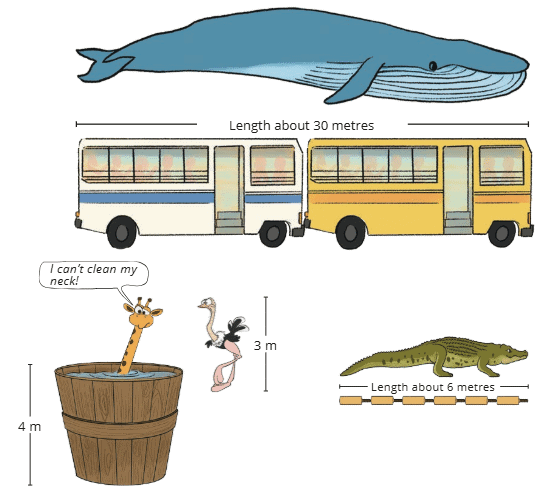
Look at the pictures carefully and answer the questions.
Q1: What is the length of one bus in metres? What is the length of one cricket bat in metres?
Ans: A bus is about 15 meters long. A cricket bat is about 1 meter long.
Q2: How many buses would be equal to the length of two blue whales?
Ans: A blue whale is about 30 meters long. Two blue whales = 2 × 30 = 60 meters. A bus is about 15 meters. So, 60 ÷ 15 = 4 buses.
Q3: How many cricket bats will be needed to measure one whale?
Ans: A blue whale is about 30 meters. A cricket bat is about 1 meter. So, 30 ÷ 1 = 30 cricket bats.
Q4: If two ostriches stand one above another, their height will be equal to the height of
Ans: One ostrich's height is 3 m.
Therefore, the heights of two ostriches are 3m + 3m = 6m
As we can see in the given picture, the crocodile's length is also 6 metres.
Therefore, the two ostriches' height will be equal to the length of one crocodile.
Q5: How many crocodiles will be equal to the length of a blue whale?
Ans: A crocodile is about 6 meters long. A blue whale is 30 meters. So, 30 ÷ 6 = 5 crocodiles.
Page 84: Let Us Observe
Chutki wants to keep track of the increase in height of her plant. Compare the metre rope with the measuring tape used by a tailor. Is the length of both the same or different? 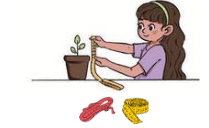
Ans: The metre rope and the tailor's measuring tape are both 1 metre long, so their length is the same.
Observe the measuring tape carefully. What do you notice? 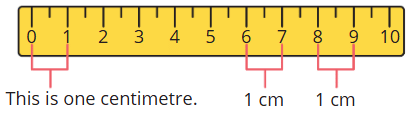
Ans: The measuring tape has marks for centimetres (cm) and smaller marks for millimetres (mm). The numbers usually show every 1 cm and there are special coloured marks or blocks at every 10 cm to make reading easier.
Discuss how these marks help us measure clearly.
Ans: The red bar or coloured block shows 10 cm. This block repeats 10 times to make 1 metre, so the tape helps us count centimetres quickly and measure small lengths accurately.
Q: 1 metre (m) = 100 centimetre (cm), ½ m = ___ cm, ¼ m = ___ cm
Ans:
- ½ m = 50 cm (½ × 100 = 50)
- ¼ m = 25 cm (¼ × 100 = 25)
Page 85: Let Us Do
Q1: Measure each object using a scale. 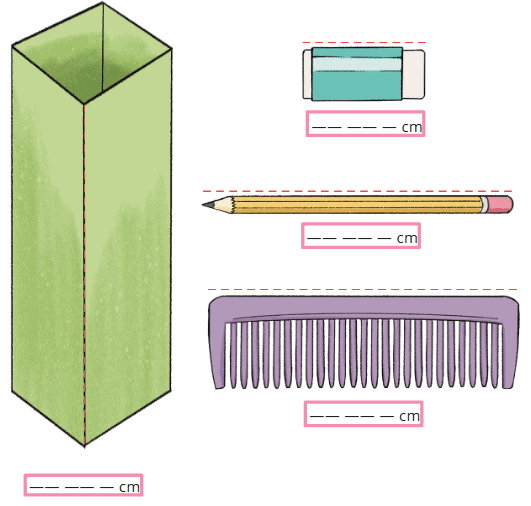
Write the names of the objects in increasing order of length.
Ans: How to do: Measure each object in centimetres using a scale. Then list them from the shortest to the longest.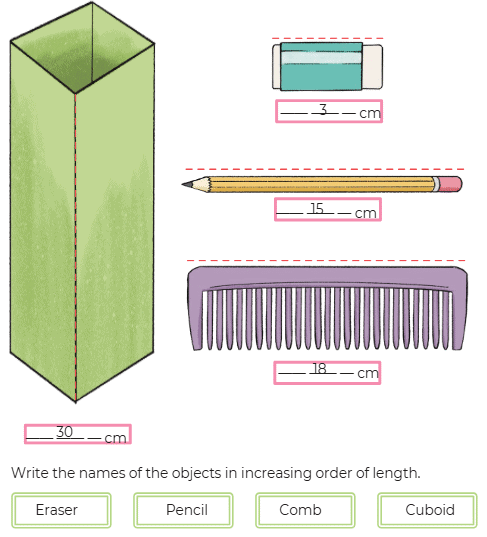
Page 86: Let Us Do
Q2: Estimate the lengths of the following and compare your responses with your friends in the grade. Write some examples of things that can be lesser than or equal to 1 cm in length. Verify by measuring.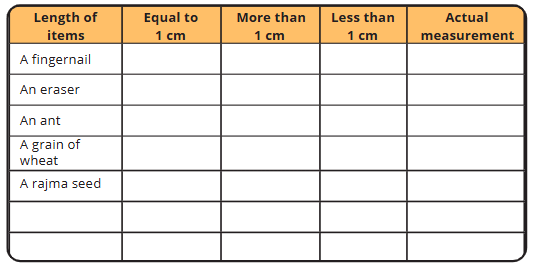 Ans:
Ans: 
Q3: Take three toy cars and find out how far each one can go. You can use a small wooden ramp, or you might like to make a ramp using any material that you have. Measure the distance each of your cars travels using measuring tape and write the answers in cm.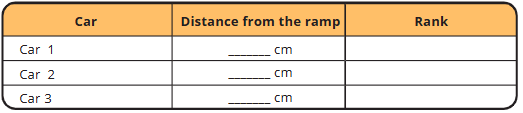
Ans: 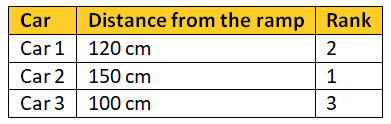
Page 87: Let Us Do
Q4: Find the longest and the shortest route in this treasure hunt. You can go around the obstacles but cannot jump over them. You can only walk on the yellow tiles and not on the grass. Can you find the length of your route in centimetres? Look for the 1 cm clue in the map.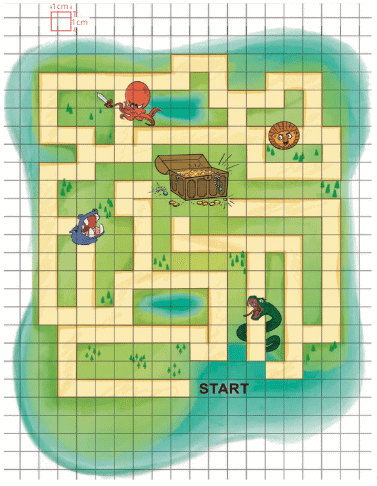
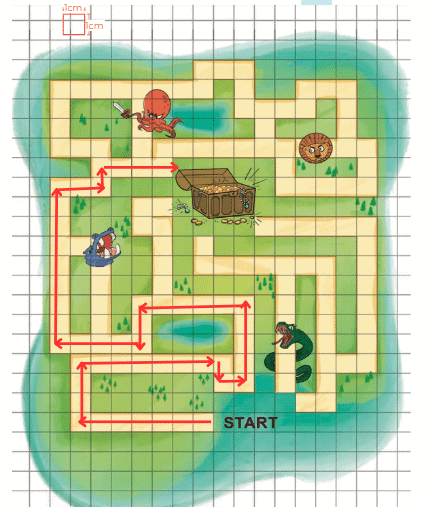
Ans: Trace paths on yellow tiles, avoiding obstacles. Use the 1 cm clue to scale the map. Measure each route with a scale. Compare lengths to find the longest and shortest routes in cm.
Shortest Route: 16 cm.
Longest Route: 48 cm
Page 88: Let Us Do
Q5: Trace your hand on a piece of paper. Measure it using the scale. Length of my hand = ___ cm
Ans: Trace your hand and measure from the wrist to the tip of the middle finger with a scale. Record the measurement in centimetres, for example: 15 cm (your result may vary).
Q6: Use your hand to estimate the measurement of any object. Convert into centimetres. Verify using the scale.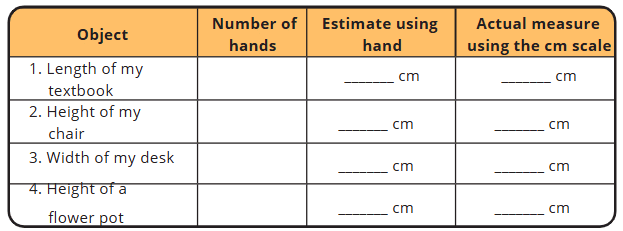 Ans:
Ans: 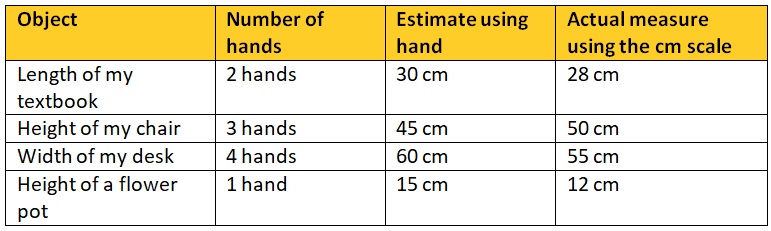
Q7: Ashwin's scale is broken. Can you help him to measure using this scale?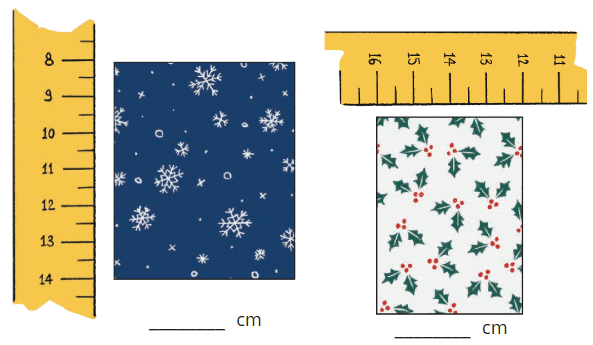
Ans: If the scale is broken (e.g., missing the start), align the object with the first visible mark (e.g., 2 cm) and subtract the starting mark from the end mark to find the length. If an object starts at 8 cm and ends at 14 cm, length = 14 - 8 = 6 cm.
And if an object starts at 12 cm and ends at 16 cm, length = 16 - 12 = 4 cm.
Q8: Fill the blanks on the number line below appropriately.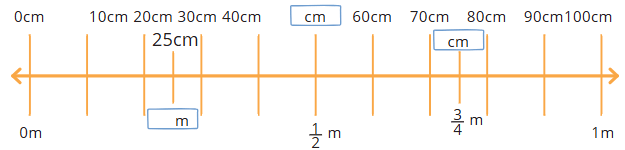 Ans:
Ans: 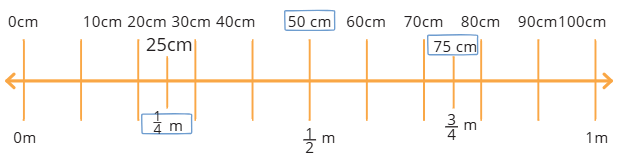
Q9: The length of a board is 2 metres. Sonu has a decorative border sticker which is 20 cm long. How many such stickers are needed to cover the length of the board completely?
Ans: The board is 2 meters long.
1 meter = 100 cm, so 2 meters = 200 cm.
Each sticker is 20 cm long.
To find how many stickers are needed, divide the board's length by the sticker's length:
200 ÷ 20 = 10.
So, 10 stickers are needed to cover the board.
Metre and Centimeters
Ramu and Shamu are using a measuring tape to measure their own height.
Ramu reads his height from the tape as 120 cm and Shamu reads it as 1 m 20 cm.
Who is correct?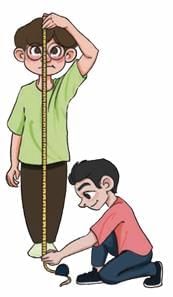
Pinki says both are correct and draws this.
Ans: Ramu's height = 120 cm
Shamu's height = 1 m 20 cm
Since 1 metre = 100 cm,
Now, convert 1 m 20 cm into cm:
1 m 20 cm = 1 × 100 cm + 20 cm = 120 cm
Both measurements are the same.
Pinki is correct because both Ramu and Shamu have given the same height in different units.
Page 90: Let Us Do
Q1: Fill in the blanks: A kilometre is 1000 metres.
i) 2 m = 200 cm
ii) ____ m = 400 cm
Ans: 4 m = 4 × 100 cm = 400 cm
iii) 6 m = _____ cm
Ans: 6 m = 600 cm
iv) _____ m = 800 cm
Ans: 8 m = 800 cm
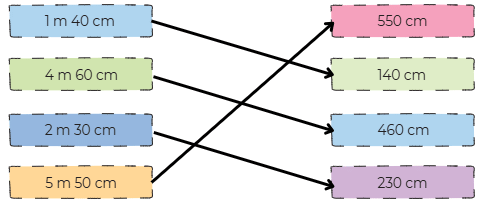
b) Identify the wells with the same depth and match them.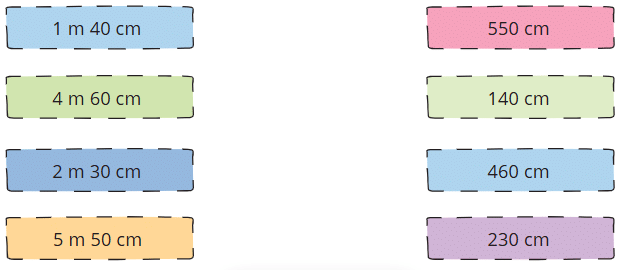
Ans:
Page 90: Let Us Explore
Activity: Students will measure their height using a measuring tape. Make a table in your notebook and complete it.

Answer the following questions.
1. Height of the tallest child is _____.
2. Height of the shortest child is _____.
3. Number of children who are more than 1 m tall _____.
4. Number of children who are shorter than 1 m _____.
Ans: Do it Yourself!
Page 91: Fencing and Lacing
How many bricks will Bhola need to make the boundary?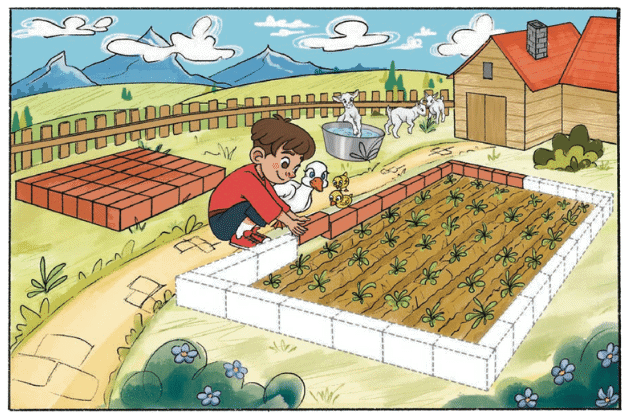
Ans: 21 more bricks are needed to cover the boundary.
Page 92: Let Us Do
Q1: Bhola made the boundary of his gardens in the following ways. Circle the boundary that is longest.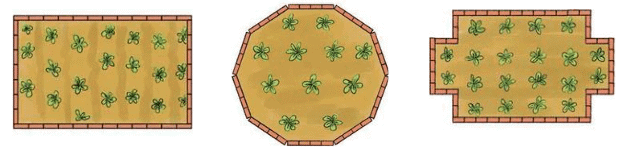
Ans: Compare the boundaries of each garden by counting the sides or measuring with a scale. Circle the garden with the most sides or longest total length.
Image 1: Bricks used - 12 + 12 + 7 + 7 = 38 bricks
Image 2: Bricks used - 4 x sides = 4 x 10 = 40 bricks
Image 3: Bricks used - 12 + 12 + 2 + 2 + 2 + 2 + 2 + 2 + 2 + 2 + 5 + 5 = 50 bricks (longest)
Q2: Let us find the perimeter of some shapes using the dot grid. One is done for you.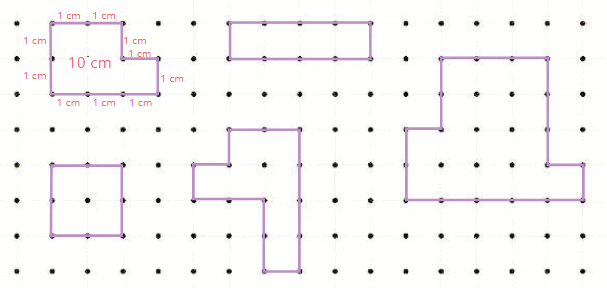
a) Colour the boundary with the longest length in blue.
Ans: Count the dots along each shape's boundary (1 dot = 1 cm). Colour the shape with the highest count in blue.

b) Colour the boundary with the shortest length in green.
Ans: Colour the shape with the lowest count in green.
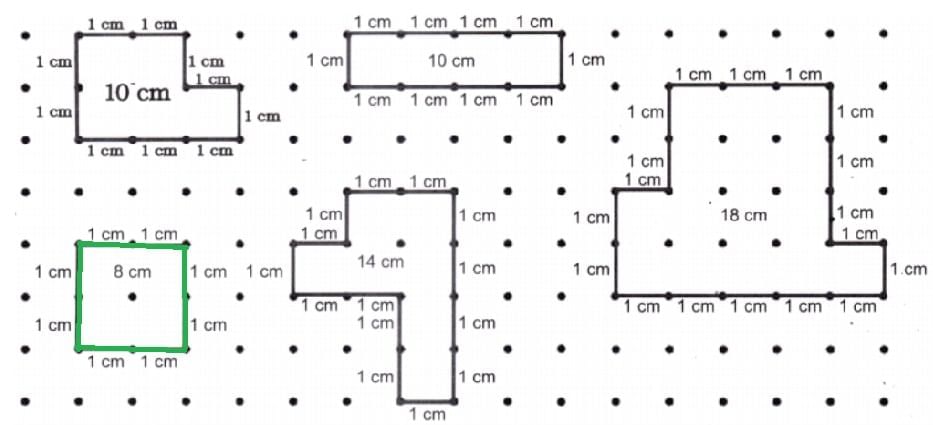
c) Tick the shapes with the same length.
Ans: Tick shapes with the same number of dots along their boundaries.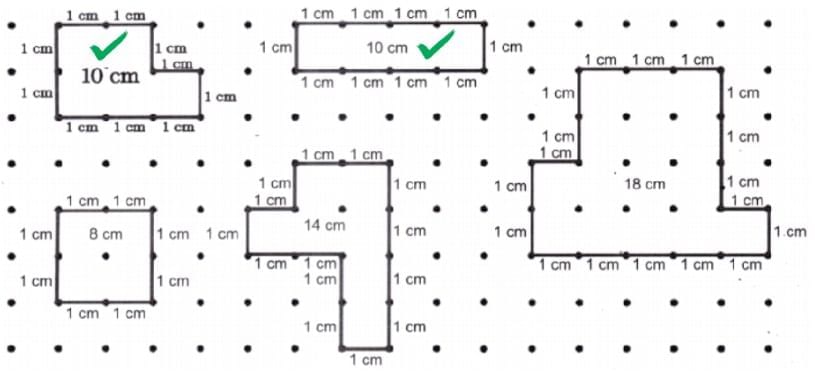
Page 93: Let Us Do
Q3: Do any of the following shapes have the same perimeter? Tick them. Ans: Measure each shape's perimeter using a scale or count sides on a grid.
 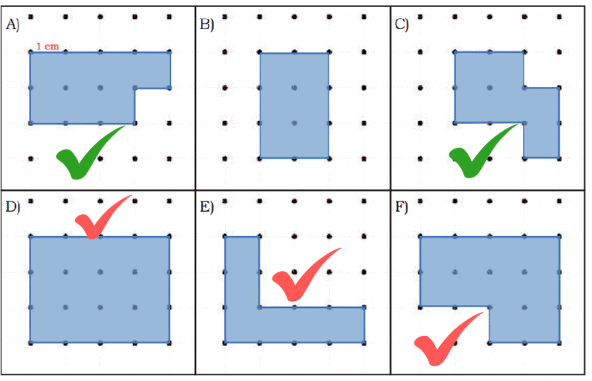 1. Image A and C are same: 12 cm
2. Image D, E and F are same: 14 cm
3. Image B: 10 cm
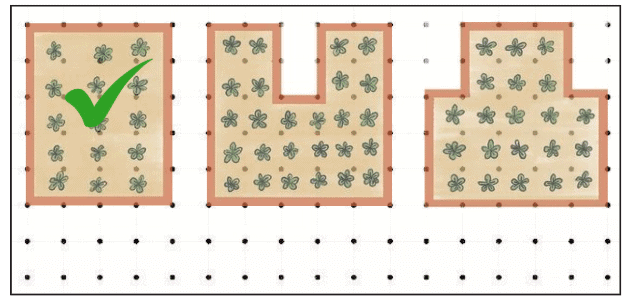
Q4: Tick the garden with the minimum perimeter. Measure the perimeter of each garden. Tick the one with the smallest total length.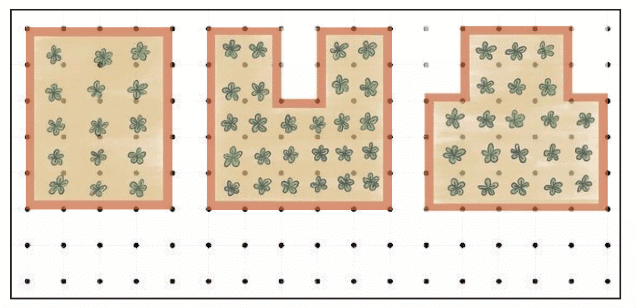 Ans: The perimeters given are: first figure = 18 cm, second = 24 cm, third = 20 cm. The minimum is 18 cm, so tick the first garden.
Page 94: Let Us Do
Q5: Estimate and measure the perimeters of shapes around you using a scale and write them in the space given below.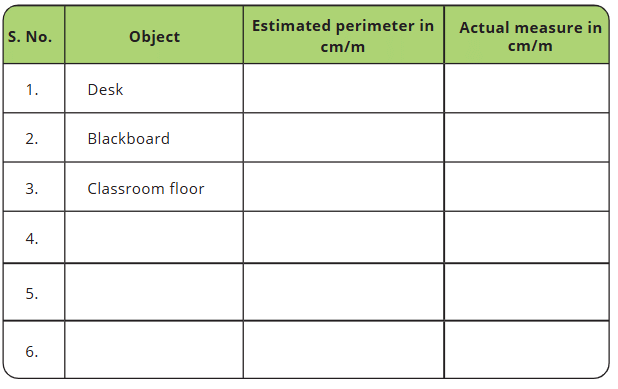 Ans:
Ans: 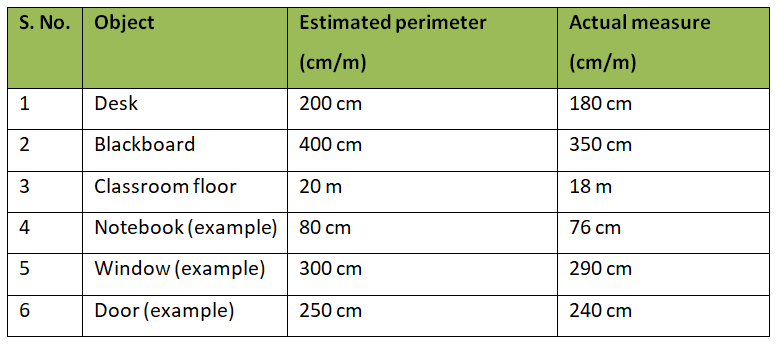
Q6: Draw three different shapes with perimeter of 20 cm.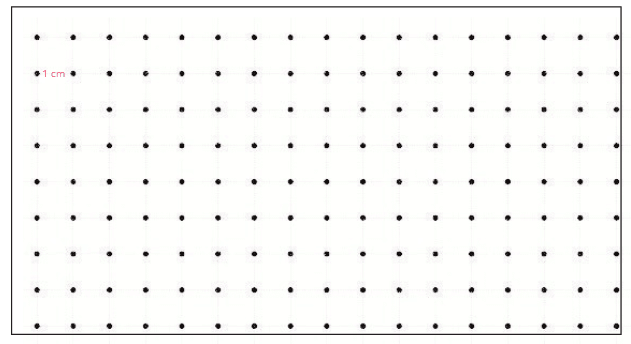 Ans:
Ans:
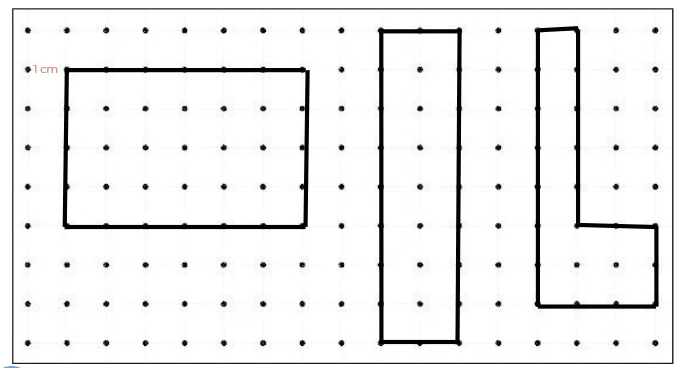
Some other shapes that you can draw whose sides together measure 20 cm in total are:
A square with each side 5 cm (5 + 5 + 5 + 5 = 20 cm)
A triangle with sides 7 cm, 7 cm, and 6 cm (7 + 7 + 6 = 20 cm)
FAQs on NCERT Solutions: Measuring Length
| 1. What are the different units used for measuring length in CBSE Class 4 Mathematics? |  |
| 2. How do I convert centimetres to metres and metres to kilometres? | |
| 3. What's the difference between measuring length with a ruler and measuring with a measuring tape? | |
| 4. Why do we need standard units for measuring length instead of using hands or steps? | |
| 5. How can I check if my measurement of length is correct and accurate? | |