NCERT Solutions: Elephants, Tigers, and Leopards


Page No. 149
NIM Game (2 Player Game)
You have played a version of this game in the chapter 'Vacation with my Nani Maa' in Grade 3. We will add either 1 or 2 each time to reach the target number 10.
Can you win the game if
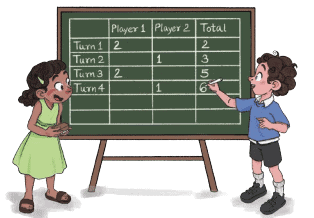
(a) The other player has reached the total of 6, and it is your turn.
Ans: Yes, you can win. Add 1 to bring the total to 7. Now, whatever the opponent does, you will have a reply that reaches 10. If the opponent adds 1, the total becomes 8, and you add 2 to make 10. If the opponent adds 2, the total becomes 9, and you add 1 to make 10. This way, you can force a win.
(b) The other player has reached the total of 7, and it is your turn?
Ans: No, you cannot force a win from here. If you add 1, the total becomes 8, and the other player can add 2 to reach 10. If you add 2, the total becomes 9, and the other player can add 1 to reach 10. Thus, whichever move you make, the opponent will get 10 on their next turn.
(c) The other player has reached the total of 8, and it is your turn?
Ans: Yes, you can win. Add 2 to bring the total to 10, and you win immediately.
Q: Can you find a number in each case when you are sure that you can win?
Ans: Suppose, if the other player has reached the total 9 and its our turn, we can add 1 to reach 10 and win. Similarly, we can find some numbers in each case when we are sure that we can win if the target number is 11 or 12. For example, if the target number is 11 and the other player has reached a total 7, and it's our turn. Then we can add 1 to reach 8. The other player can either add 1 or 2. If they add 1 the total becomes 9 and in our turn we can add 2 to win.
If the player adds 2, the total becomes 10, and in our turn we can add 1 to reach 11 and win. Similarly, if the target number is 12 and the other player has reached the total 8, and it's our turn, then we can be sure to win.
Page No. 150
Addition Chart
Q1: Identify some patterns in the table.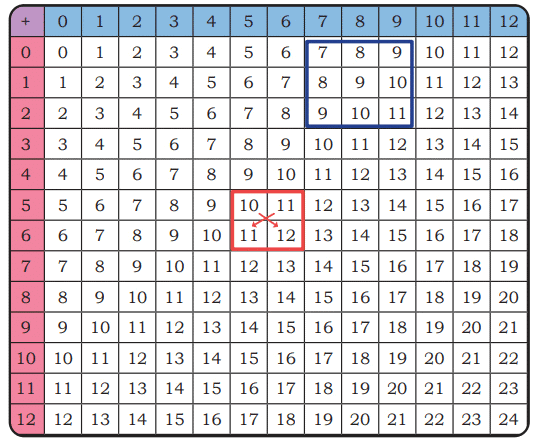
The following are some patterns that can be observed in the table.
- Any number plus 0 remains the same.
- The sum increases by 2 when moving diagonally (down-right) across cells where both addends increase by 1.
- Each row increases by 1 as you move right; each column increases by 1 as you move down.
- The table is symmetric about the main diagonal because a + b = b + a.
Q2: Observe the cells where the number 9 appears in the table. How many times do you see the number 9? What about other numbers?
Ans: There are ten 9's in the table.
A clear pattern appears: the frequency of each sum increases by one for each step up to the middle value, then decreases symmetrically. For example, 0 appears once, 1 appears twice, 2 appears three times, and so on up to 12 (which appears thirteen times). After 12, the counts reduce symmetrically: 13 appears twelve times, 14 eleven times, 15 ten times, ..., 24 appears once.
Q3: Are there any rows or columns that contain only even numbers or only odd numbers? Explain your observation.
Ans: No. Every row and every column contains both even and odd numbers. This is because adding two even numbers or two odd numbers gives an even sum, while adding an even and an odd gives an odd sum. Since the table includes both even and odd addends across rows and columns, the results are mixed.
Q4: Look at the window frame highlighted in red in the table.
(a) Find the sum of the two numbers in each row.
Ans: Sum of 10 and 11 = 10 + 11 = 21.
Sum of 11 and 12 = 11 + 12 = 23.
(b) Find the sum of the two numbers in each column. What do you notice?
Ans: Sum of the top column numbers 10 and 11 = 21.
The sum of the bottom column numbers 11 and 12 = 23.
We get the same pair of sums (21 and 23) in columns as in rows for this window.
(c) Now, find the sum of the numbers in each of the two diagonals marked by arrows. What do you notice?
Ans: Sum of the diagonal 10 and 12 = 10 + 12 = 22.
Sum of the other diagonal 11 and 11 = 11 + 11 = 22.
Both diagonal sums are equal.
(d) Now, put the red window frame in other places and find the sums as above. What do you notice?
Ans: If we move the same 2×2 window elsewhere in the table, the sums of rows and columns will change according to the numbers inside the window. However, the relationship that the two diagonal sums are equal still holds for any 2×2 block taken from an addition table where the entries increase by 1 across rows and down columns.
Q5: Identify some patterns and relationships among the numbers in the blue window frame.
Ans: In the blue 2×2 window, each row and each column contains the same two numbers shifted by one; the sums in rows and columns differ by a fixed amount. In the example shown, the difference between the sum of one row and the sum of the other row (or between the two columns) is 3. This happens because each step to the right or down increases the entry by 1, so the differences remain constant across that small block.
Page No. 151
Reverse and Add
(a) Take a 2-digit number, say, 27. Reverse its digits (72). Add them (99). Repeat for different 2-digit numbers.
- 27 + 72 = 99.
- 45 + 54 = 99.
- 19 + 91 = 110.
Ans: Sums like 99, 110, etc.
(b) What sums can we get when we add a 2-digit number to its reverse?
Ans: When we add a two-digit number and its reverse, we often get a multiple of 11. For example:
10 + 01 = 11 = 1 × 11
11 + 11 = 22 = 2 × 11
12 + 21 = 33 = 3 × 11
13 + 31 = 44 = 4 × 11
...
18 + 81 = 99 = 9 × 11
99 + 99 = 198 = 18 × 11
So the sum is always a multiple of 11, and the multiple depends on the sum of the digits of the original number.
(c) List down all numbers that, when added to their reverse, give
(i) 55
Ans: Find pairs that add to 55: 14 + 41 = 55, 23 + 32 = 55, 32 + 23 = 55, 41 + 14 = 55, and 50 + 05 = 55.
Thus, the two-digit numbers whose reverse gives a sum of 55 are 14, 23, 32, 41 and 50.
(ii) 88
Ans: Pairs that add to 88 are: 17 + 71 = 88, 26 + 62 = 88, 35 + 53 = 88, 44 + 44 = 88, and 80 + 08 = 88.
Thus, the two-digit numbers are 17, 26, 35, 44, 53, 62, 71, and 80.
(d) Can we get a 3-digit sum? What is the smallest 3-digit sum that we can get?
Ans: Yes. The smallest 3-digit sum from adding a two-digit number and its reverse is 110, for example 19 + 91 = 110.
Fill in the blanks with appropriate numbers.
(a)

Ans:

(b)

Ans:

(c)

Ans:
Page 154
How Many Animals? (Continued)
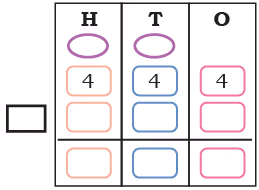
Q3: Maharashtra has 444 tigers. Madhya Pradesh has 341 more tigers than Maharashtra. Uttarakhand has 116 tigers more than Maharashtra.(a) How many tigers does Madhya Pradesh have?
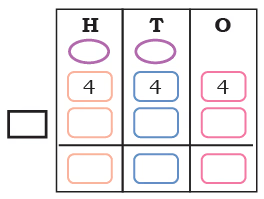
Ans:
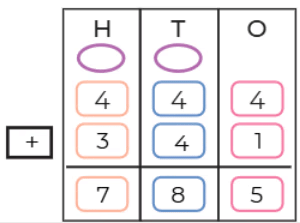
So, Madhya Pradesh has 785 tigers.
(b) How many tigers does Uttarakhand have?
Ans:
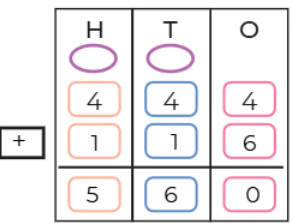
Therefore, there are 560 tigers in Uttarakhand.
(c) How many tigers does Madhya Pradesh and Uttarakhand have?
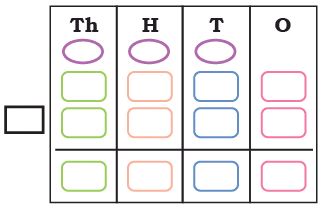
Ans:
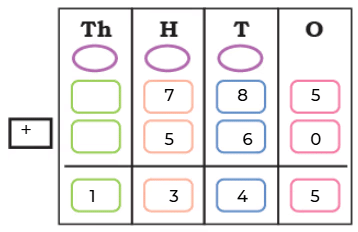
So, there are 1,345 tigers in Madhya Pradesh and Uttarakhand together (785 + 560 = 1,345).
(d) How many tigers are there in total across the three states?
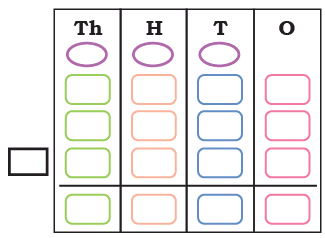
Ans:
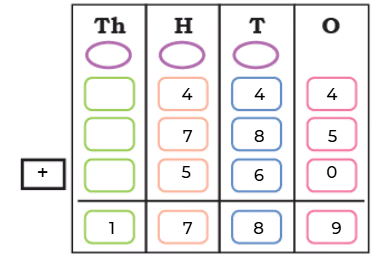
So, there are 1,789 tigers across the three states (444 + 785 + 560 = 1,789).
Page 156
More or Less?
1. Assam has 5719 elephants. It has 3965 more elephants than Meghalaya. How many elephants are there in Meghalaya?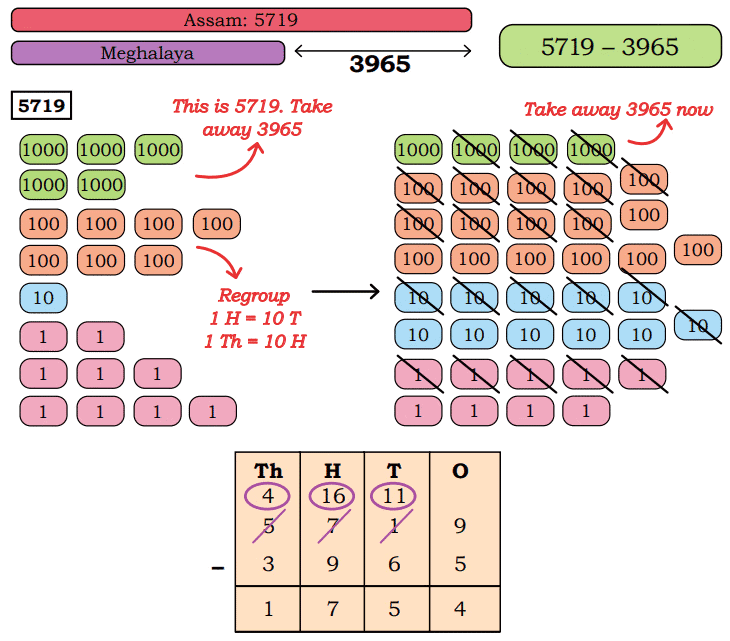
1754 elephants are in Meghalaya.
2. The population of leopards as per the 2022 census was 8820 in Central India and the Eastern Ghats. It had increased by 749 in comparison to the number of leopards in 2018 in the same region. How many leopards were there in 2018?
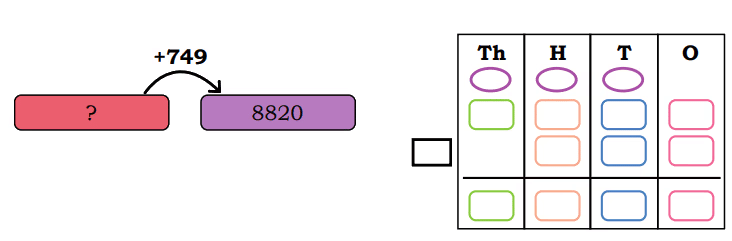
_________ leopards were there in 2018.
Write the number of animals on this map based on the data from the problems in the previous pages.
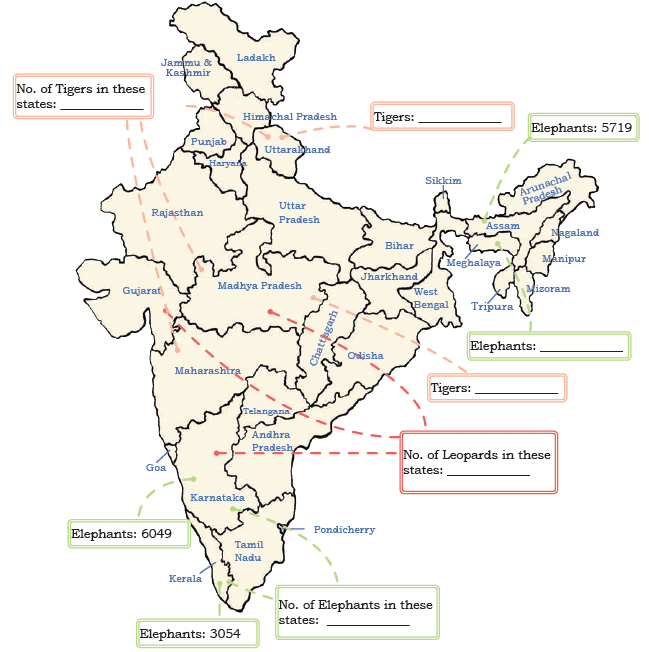
Ans: 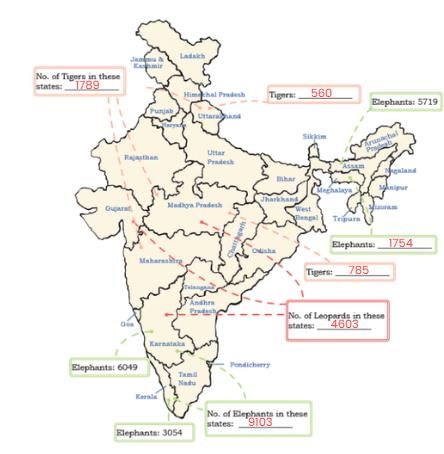
- Elephants: Karnataka (6,049), Kerala (3,054), Assam (5,719), Meghalaya (1,754).
- Leopards: Gujarat (1,355), Karnataka (1,131), Madhya Pradesh (1,817).
- Tigers: Maharashtra (444), Madhya Pradesh (785), Uttarakhand (560).
- Ans: Map data as listed.
Page 157
Let Us Do
Q1: The board in the ticket office in the Kaziranga National Park shows the following: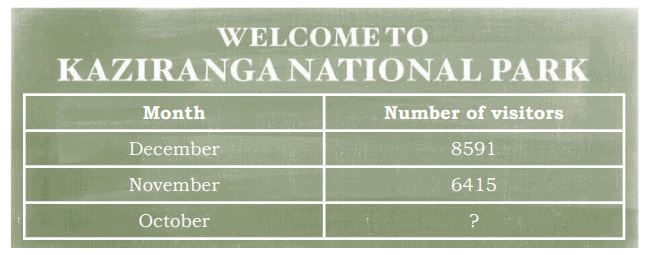
(a) How many more visitors came in December than in November?
Ans: Number of visitors in December = 8,591
Number of visitors in November = 6,415
Difference = 8,591 - 6,415 = 2,176
Therefore, 2,176 more visitors came in December than in November.
(b) The number of visitors in November is 1587 more than in October. How many visitors were there in October?
Ans: Number of visitors in November = 6,415
Since November has 1,587 more than October, October = 6,415 - 1,587 = 4,828.
Thus, there were 4,828 visitors in October.
Q2: In a juice-making factory, women make different types of juices as given below:
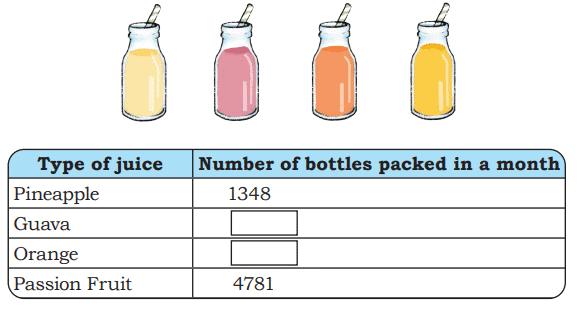
(a) The number of bottles of guava juice is 759 more than the number of bottles of pineapple juice. Find the number of bottles of guava juice.
Ans: Number of bottles of pineapple juice = 1,348.
Number of bottles of guava juice = 1,348 + 759 = 2,107.
Therefore, there are 2,107 bottles of guava juice.
(b) The number of bottles of orange juice is 1257 more than the number of bottles of guava juice and 1417 less than the number of bottles of passion fruit juice. How many bottles of orange juice are made in a month?
Ans: Number of bottles of guava juice = 2,107.
Number of bottles of orange juice = 2,107 + 1,257 = 3,364.
Therefore, 3,364 bottles of orange juice are made in a month.
(c) Is the total number of bottles of guava juice and orange juice more or less than the number of bottles of passion fruit juice? How much more or less?
Ans: Total of guava and orange = 2,107 + 3,364 = 5,471.
Number of passion fruit bottles = orange + 1,417 = 3,364 + 1,417 = 4,781.
Difference = 5,471 - 4,781 = 690.
Thus, guava and orange bottles together are 690 bottles more than passion fruit juice.
Page 158
Let Us Do (Continued)
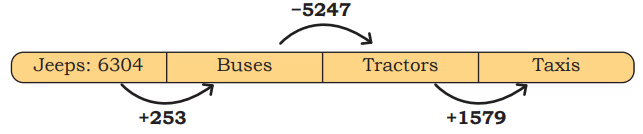
Q3: In a small town, the following vehicles were registered in the year 2022. Find the number of vehicles as per the conditions given below.(a) The number of buses is 253 more than the number of jeeps. How many buses are there in the town?
Ans: Number of jeeps = 6,304
Number of buses = 6,304 + 253 = 6,557
Therefore, there are 6,557 buses in the town.
(b) The number of tractors is 5247 less than the number of buses. How many tractors are in the town?
Ans: Number of buses = 6,557
Number of tractors = 6,557 - 5,247 = 1,310
Therefore, there are 1,310 tractors.
(c) The number of taxis is 1579 more than the number of tractors? How many taxis are there?
Ans: Number of tractors = 1,310
Number of taxis = 1,310 + 1,579 = 2,889
Therefore, there are 2,889 taxis.
(d) Arrange the numbers of each type of vehicle from lowest to highest.
Ans: The numbers are: Tractors 1,310; Taxis 2,889; Jeeps 6,304; Buses 6,557.
So, from lowest to highest: 1,310, 2,889, 6,304, 6,557.
Therefore, Tractors, Taxis, Jeeps, Buses
Q4: Solve
(a) 1459 + 476
Ans: 1459 + 476 = 1,935.
(b) 3863 + 4188
Ans: 3863 + 4188 = 8,051.
(c) 5017 + 899
Ans: 5017 + 899 = 5,916.
(d) 4285 + 2132
Ans: 4285 + 2132 = 6,417.
(e) 3158 + 1052
Ans: 3158 + 1052 = 4,210.
(f) 7293 - 2819
Ans: 7293 - 2819 = 4,474.
(g) 3105 - 1223
Ans: 3105 - 1223 = 1,882.
(h) 8006 - 5567
Ans: 8006 - 5567 = 2,439.
(i) 5000 - 4124
Ans: 5000 - 4124 = 876.
(j) 9018 - 487
Ans: 9018 - 487 = 8,531.
Page 159
Let Us Do (Continued)
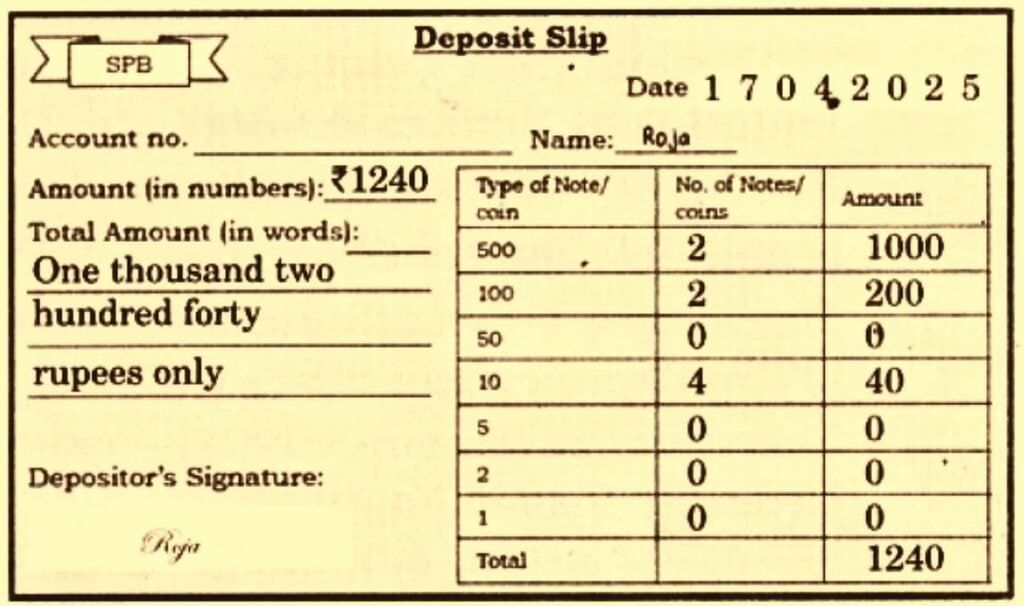
Q5: The children in a school in Chittoor are planning to organise a Baal Mela in their school. Raju, Rani and Roja decided to raise some money to make arrangements for the mela. The money is available in notes of 500, 100, 50, 10 and coins of 5, 2 and 1. They decide to put the money in the School Panchayat Bank.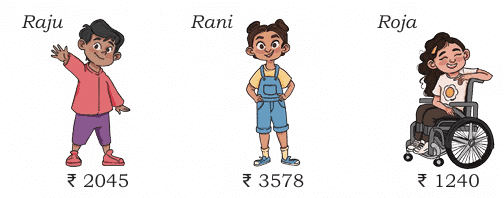
Help each of the children fill out the deposit slip given below.
Different combinations of notes can give the same amount. Can you guess a possible combination of notes they might have? Fill in the amounts appropriately.
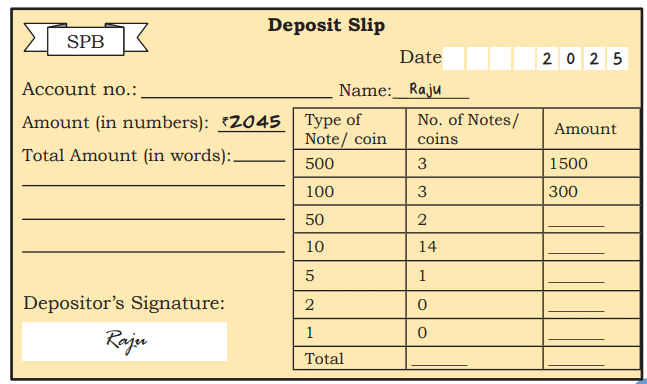
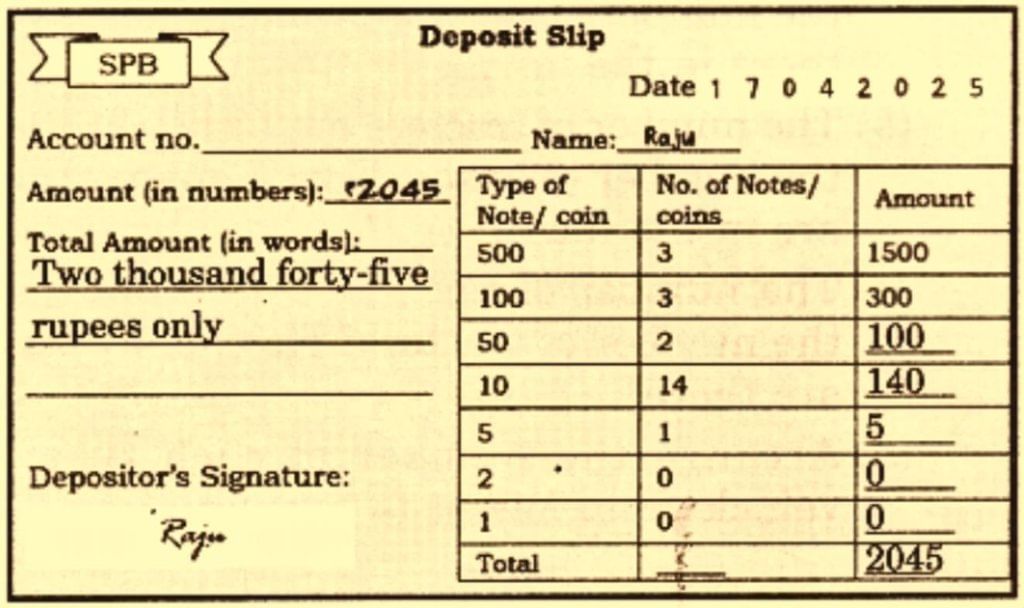
- Total in words: Two thousand forty-five.
Ans: Raju's slip is completed as shown.
Page 160
Let Us Do (Continued)
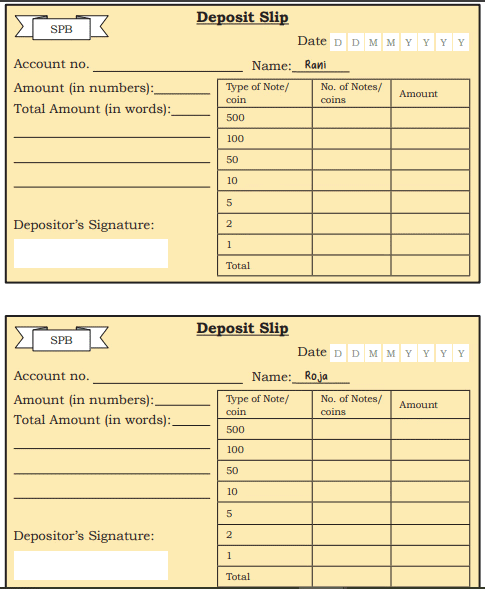
1. Rani
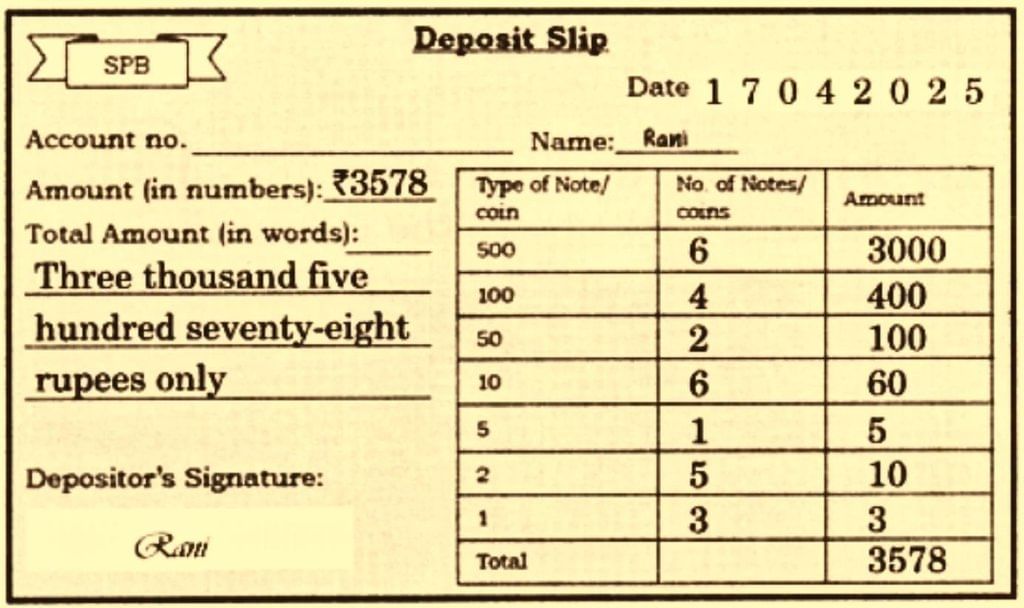
2. Roja
Page 161
Let Us Solve
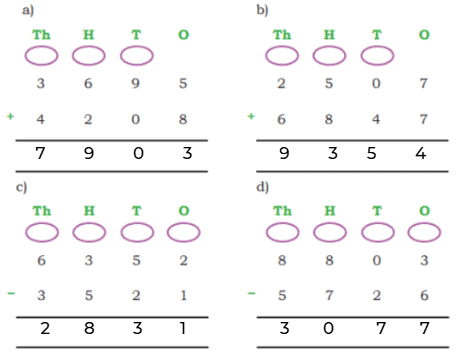
Q1: Solve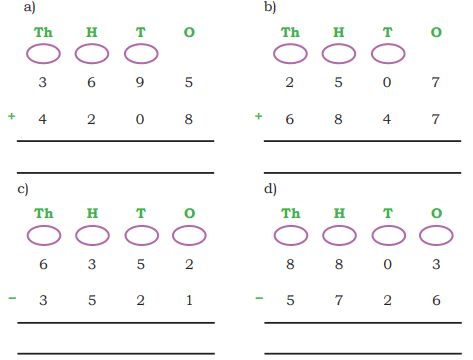
Ans:
Q2: Arrange the following in columns and solve in your notebook.
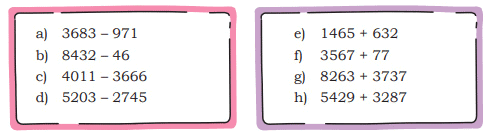
(a) 3683 - 971
Ans: 3683 - 971 = 2,712.
(b) 8432 - 46
Ans: 8432 - 46 = 8,386.
(c) 4011 - 3666
Ans: 4011 - 3666 = 345.
(d) 5203 - 2745
Ans: 5203 - 2745 = 2,458.
(e) 1465 + 632
Ans: 1465 + 632 = 2,097.
(f) 3567 + 77
Ans: 3567 + 77 = 3,644.
(g) 8263 + 3737
Ans: 8263 + 3737 = 12,000.
(h) 5429 + 3287
Ans: 5429 + 3287 = 8,716.
Page 162
Let Us Solve
Q1: Find easy ways to solve the following problems.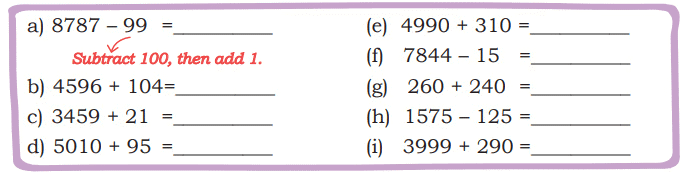
(a) 8787 - 99
Ans: 8787 - 100 + 1 = 8,688.
(b) 4596 + 104
Ans: 4596 + 100 + 4 = 4,700.
(c) 3459 + 21
Ans: 3459 + 20 + 1 = 3,480.
(d) 5010 + 95
Ans: 5010 + 100 - 5 = 5,105.
(e) 4990 + 310
Ans: 4990 + 300 + 10 = 5,300.
(f) 7844 - 15
Ans: 7844 - 20 + 5 = 7,829.
(g) 260 + 240
Ans: 260 + 240 = 500.
(h) 1575 - 125
Ans: 1575 - 100 - 25 = 1,450.
(i) 3999 + 290
Ans: 3999 + 300 - 10 = 4,289.
Q2: Use the signs <, =, > as appropriate to compare the following without actually calculating.
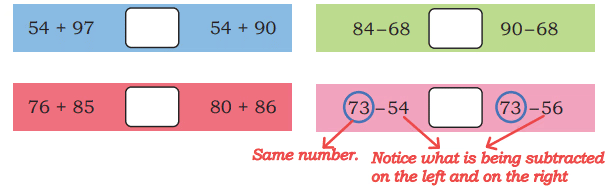
Ans: 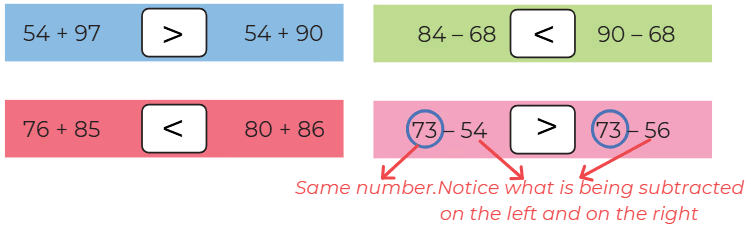
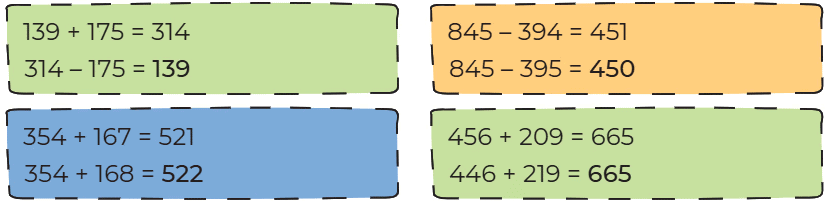
Q3: Use the given information to find the values.
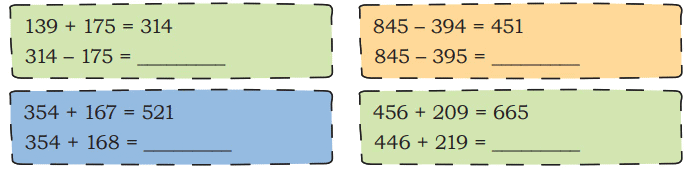
Ans:
Page 163
Let Us Solve
Q1: Add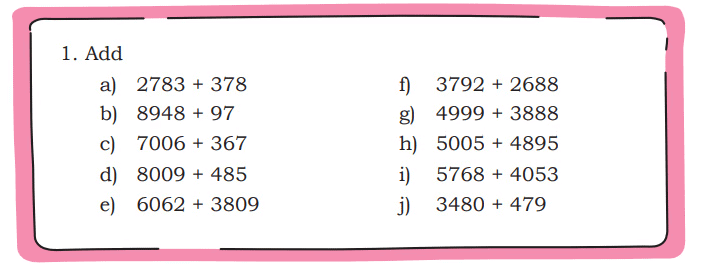 (a) 2783 + 378
Ans: 2783 + 378 = 3,161.
(b) 8948 + 97
Ans: 8948 + 100 - 3 = 9,045.
(c) 7006 + 367
Ans: 7006 + 367 = 7,373.
(d) 8009 + 485
Ans: 8009 + 485 = 8,494.
(e) 6062 + 3809
Ans: 6062 + 3809 = 9,871.
(f) 3792 + 2688
Ans: 3792 + 2688 = 6,480.
(g) 4999 + 3888
Ans: 4999 + 3,900 - 12 = 8,887.
(h) 5005 + 4895
Ans: 5005 + 4895 = 9,900.
(i) 5768 + 4053
Ans: 5768 + 4053 = 9,821.
(j) 3480 + 479
Ans: 3480 + 479 = 3,959.
Q2: Subtract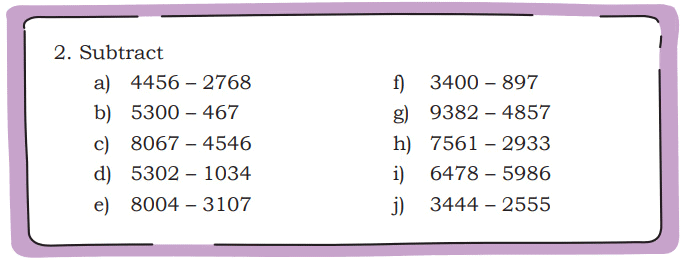
(a) 4456 - 2768
Ans: 4456 - 2768 = 1,688.
(b) 5300 - 467
Ans: 5300 - 467 = 4,833.
(c) 8067 - 4546
Ans: 8067 - 4546 = 3,521.
(d) 5302 - 1034
Ans: 5302 - 1034 = 4,268.
(e) 8004 - 3107
Ans: 8004 - 3107 = 4,897.
(f) 3400 - 897
Ans: 3400 - 897 = 2,503.
(g) 9382 - 4857
Ans: 9382 - 4857 = 4,525.
(h) 7561 - 2933
Ans: 7561 - 2933 = 4,628.
(i) 6478 - 5986
Ans: 6478 - 5986 = 492.
(j) 3444 - 2555
Ans: 3444 - 2555 = 889.
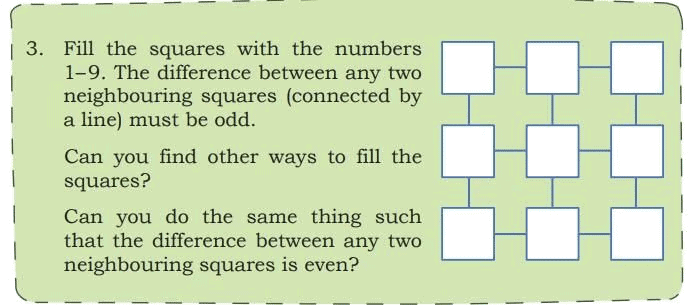
Q3: Fill the squares with the numbers 1-9. The difference between any two neighbouring squares (connected by a line) must be odd.
 Ans:
Ans: 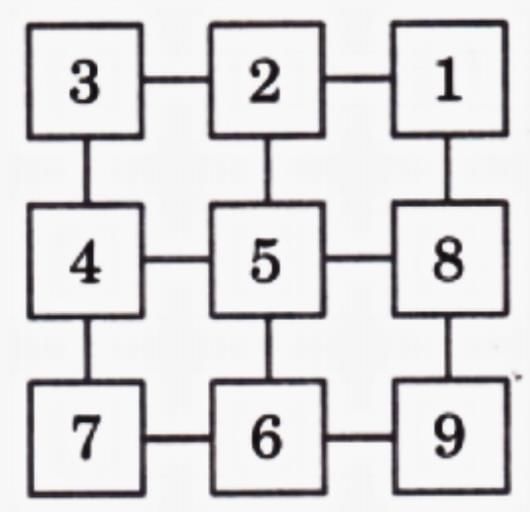
Yes, we can fill the squares in many ways.
No, it is not possible to fill the squares such that the difference between any two neighbouring squares is even. This is because the difference between two odd numbers is even, and the difference between two even numbers is even. In the given connected figure it is not possible to place only evens next to evens and odds next to odds for all connections, so the required arrangement with all even differences cannot be made.
FAQs on NCERT Solutions: Elephants, Tigers, and Leopards
| 1. How many elephants, tigers, and leopards are there in the world right now? |  |
| 2. What's the difference between African elephants and Asian elephants for Class 4? | |
| 3. Why do tigers have stripes and leopards have spots? | |
| 4. Can elephants really remember things better than other animals? | |
| 5. Which is stronger-a tiger, leopard, or elephant, and why? | |