NCERT Solutions: The Gupta Era: An Age of Tireless Creativity

The Big Questions (Page 145)
Q1: Who were the Guptas? Why is the Gupta period sometimes called the 'classical age' in Indian history?
Ans:
- The Guptas were a dominant royal family who ruled large parts of north and north-western India roughly between the 3rd and 6th century CE. Their authority covered important cities, villages and trade routes, giving their rule wide influence.
- Their rule is remembered for long periods of peace and prosperity. With fewer large wars, people could concentrate on farming, craft production, trade and building towns. This stable environment encouraged public works and urban growth.
- Historians call this a Classical Age because of the high level of achievement in learning, literature and the arts. Scholars and artists such as Aryabhata and Kālidāsa produced work of lasting value, and monuments and paintings at places such as Ajanta and Udayagiri show technical skill and refined taste.
- The Guptas also promoted education, trade and a degree of religious tolerance. Royal patronage of scholars, poets and artists helped set standards in administration, culture and learning that influenced Indian civilisation for many centuries.
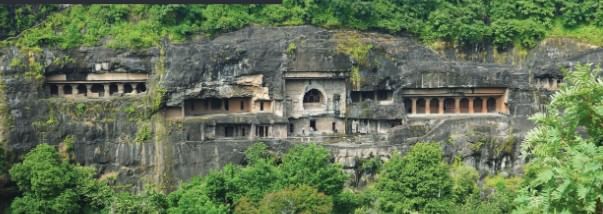 Landscape of Ajanta Caves
Q2: What was happening in the rest of the subcontinent at this time?
Ans:
- In south India, regional dynasties such as the Pallavas became powerful. Their capital, Kanchipuram, grew into an important centre of learning, religion and temple architecture.
- In the northeast, kingdoms like Kamarupa (covering parts of present-day Assam and Bengal) developed distinctive religious and artistic traditions and built monasteries and temples.
- Across the subcontinent, local rulers and regional centres developed their own cultural styles. These regions often traded with one another and exchanged ideas, even when they were politically independent.
- The Gupta emperor Samudragupta campaigned in many directions and secured tribute from several southern and eastern rulers. Often these defeated rulers continued to govern locally as tributary states, keeping trade and diplomatic ties intact.
Q3: Who were some great figures of this period, and why do their stories matter today?
Ans:
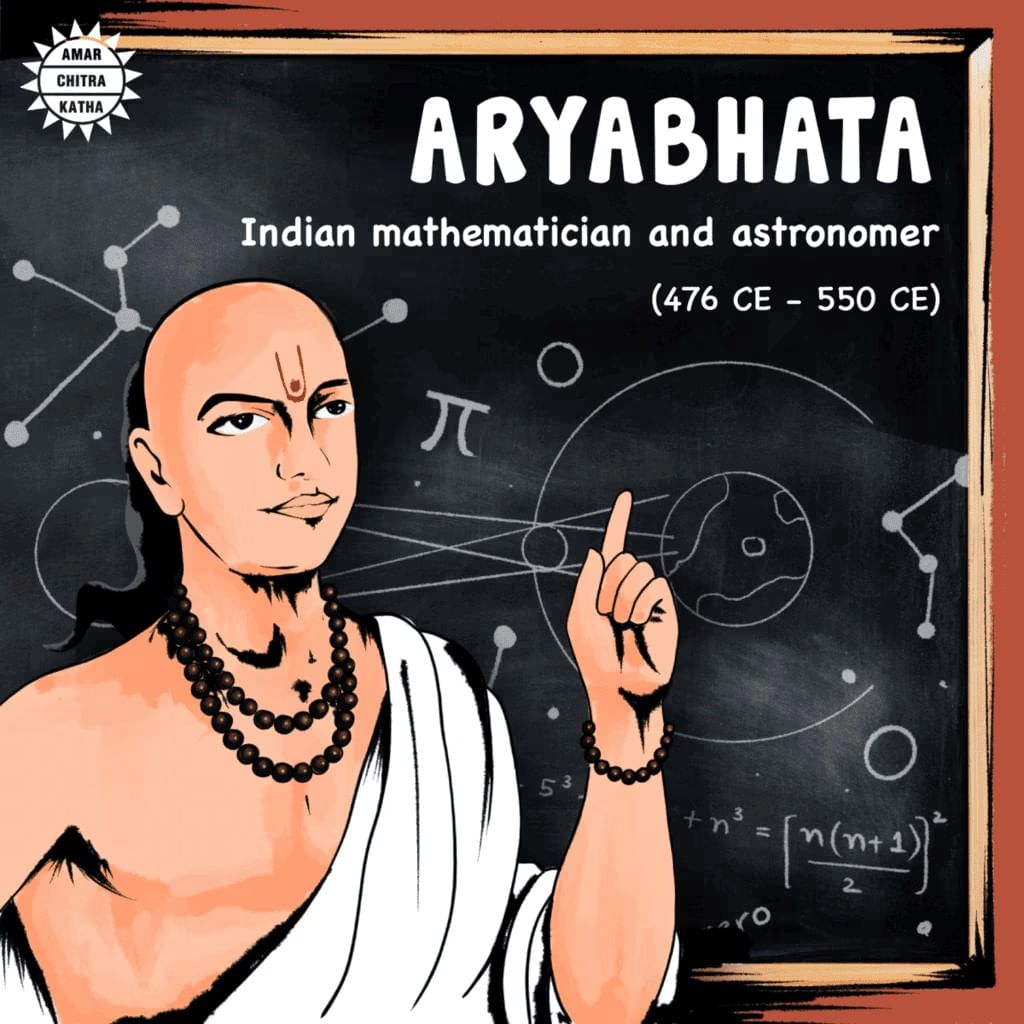
- Āryabhaṭa - A notable mathematician and astronomer. He offered clear explanations for the cause of day and night, described eclipses, and made calculations about the length of the year. His mathematical ideas influenced later scholars in India and beyond.
- Varāhamihira - A scholar who wrote on astronomy, astrology, weather and practical sciences. His works combined careful observation with earlier learning to help with tasks such as agriculture, timekeeping and town planning.
- Chandragupta II (Vikramaditya) - A wise and powerful ruler under whose reign art and literature flourished.
- Kālidāsa - One of the finest Sanskrit poets and dramatists. His poems and plays, including Meghadūta and Śakuntalā, are admired for their language, imagery and emotional depth.
- The achievements of these figures in mathematics, astronomy, literature and the arts laid foundations that later scholars built on. Their works are still read and studied, showing how knowledge from that period continued to shape cultural and intellectual life.
Think About It (Page 150 )
Q1: Why do you think kings chose to proclaim their achievements in the form of inscriptions?
Ans : Kings chose to proclaim their achievements in the form of inscriptions for several important reasons:
Permanent Record: Inscriptions carved on stone or metal were long-lasting and difficult to alter. They served as reliable and permanent records of a king's achievements for future generations.
Public Display of Power: By placing inscriptions on pillars, temples, and other public places, kings could showcase their victories, strength, and generosity, thereby gaining respect and loyalty from their subjects.
Justification of Rule: Inscriptions helped kings justify their authority by presenting themselves as righteous rulers with a divine right to govern.
Communication Across the Empire: Since inscriptions were installed in different regions, they acted as a means to spread royal orders, achievements, and donations even to distant parts of the kingdom.
Promotion of Religious Patronage: Inscriptions often recorded donations to temples, educational institutions, and religious causes. This enhanced the king's image as a patron of religion and culture, earning goodwill among people and priests.
Back Questions (Page 165 & 166)
Q1: Imagine you receive a letter from someone living in the Gupta Empire. The letter starts like this:
"Greetings from Pāṭaliputra! Life here is vibrant and full of excitement. Just yesterday, I witnessed ...\" Complete the letter with a short paragraph (250-300 words) describing life in the Gupta Empire.
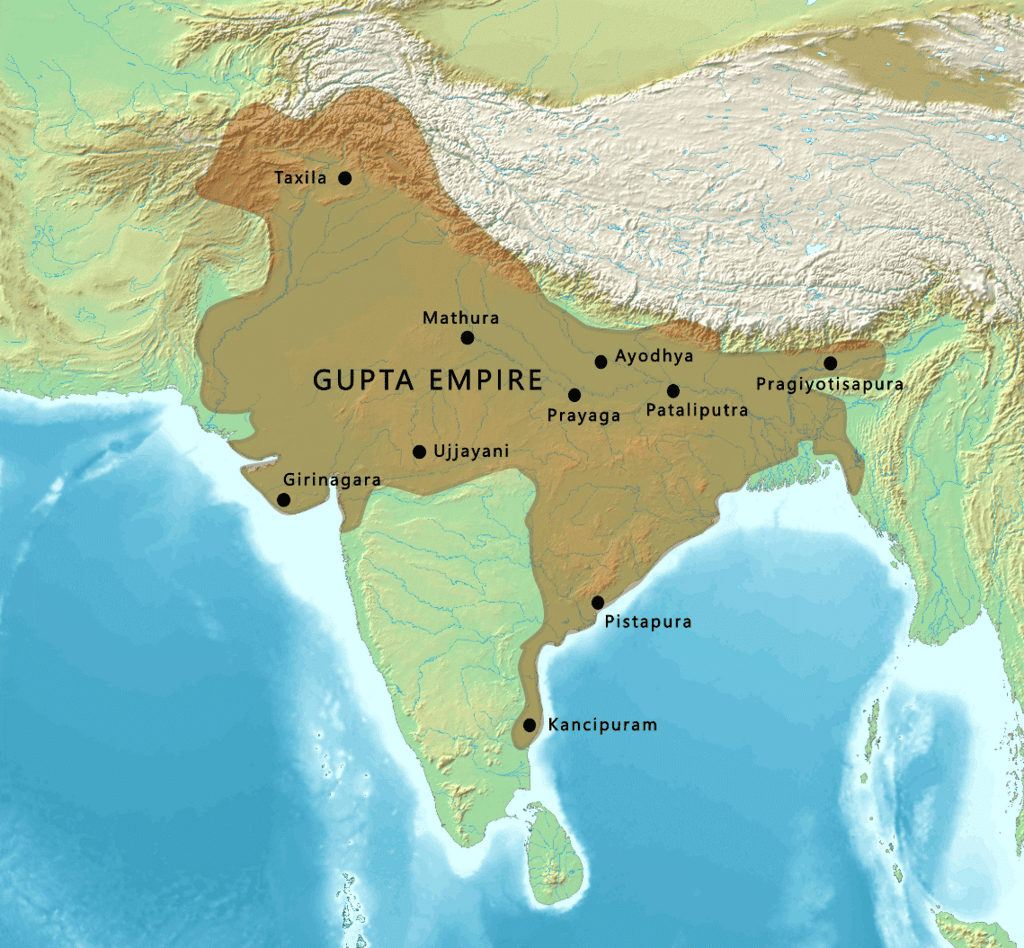 Gupta Empire
Ans:
Dear Friend,
Greetings from Pāṭaliputra! Life here is vibrant and full of excitement. Just yesterday I watched a colourful religious procession pass the market, with dancers, musicians and devotees offering lamps at the temple. The markets are busy: traders sell fine silk, spices and jewellery brought by river and sea routes. Craftsmen work with metal and cloth, and potters and carpenters fill the lanes with steady sound.
Our city benefits from long periods of peace and prosperity. This means children attend schools where teachers read and explain poetry, stories and mathematics. Centres of learning-similar to Nalanda-draw students and scholars who debate astronomy and medicine. The court of King Chandragupta II supports poets and artists; we hear new plays and songs at festivals. The countryside is well cultivated; farmers use good irrigation and produce grain for the towns. Traders bring foreign goods such as glass and gems, and we send out textiles and spices.
Art and architecture are lively here. I saw fine cave paintings and carved panels at nearby sites, and new temples are being built with careful stonework and sculpted figures. People of different faiths live close to one another and often share customs at public events. Life is not without its duties and laws, but overall there is a sense of security and shared pride in our learning and craft. I hope you will visit soon to see these sights and meet our teachers, poets and merchants.
Warm regards,
[Your Name]
Pāṭaliputra
Q2: Which Gupta ruler was also known as the 'Vikramāditya'?
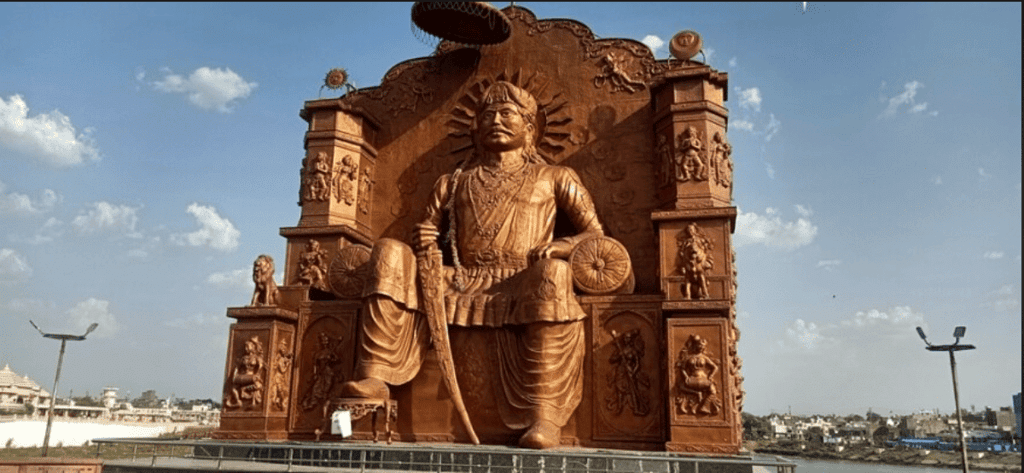 King Vikramaditya
Ans: The Gupta ruler known as 'Vikramāditya' was Chandragupta II. He earned this title for his military successes, his patronage of learning and the arts, and for the reputation of being a brave and cultured king.
Q3: "Periods of peace support the development of various aspects of sociocultural life, literature, and the development of science and technology." Examine this statement in the light of the Gupta empire.
Ans:
- The Gupta Empire shows how prolonged peace allows society to invest time and resources in learning and culture rather than defence. Stable conditions made it easier for towns to grow and for crafts and trade to expand.
- In literature, poets and playwrights such as Kālidāsa produced works of great beauty. Religious texts and Puranic literature were compiled and edited, preserving knowledge and belief systems for the future.
- In science and mathematics, scholars like Āryabhaṭa and Varāhamihira made important observations and calculations in astronomy and practical sciences. Craftsmen developed advanced techniques in metallurgy and sculpture, as seen in monuments like the Iron Pillar of Delhi.
- Thus, peace and prosperity under Gupta rule encouraged intellectual exchange, artistic creation and technological skill, leaving a cultural legacy that lasted for centuries.
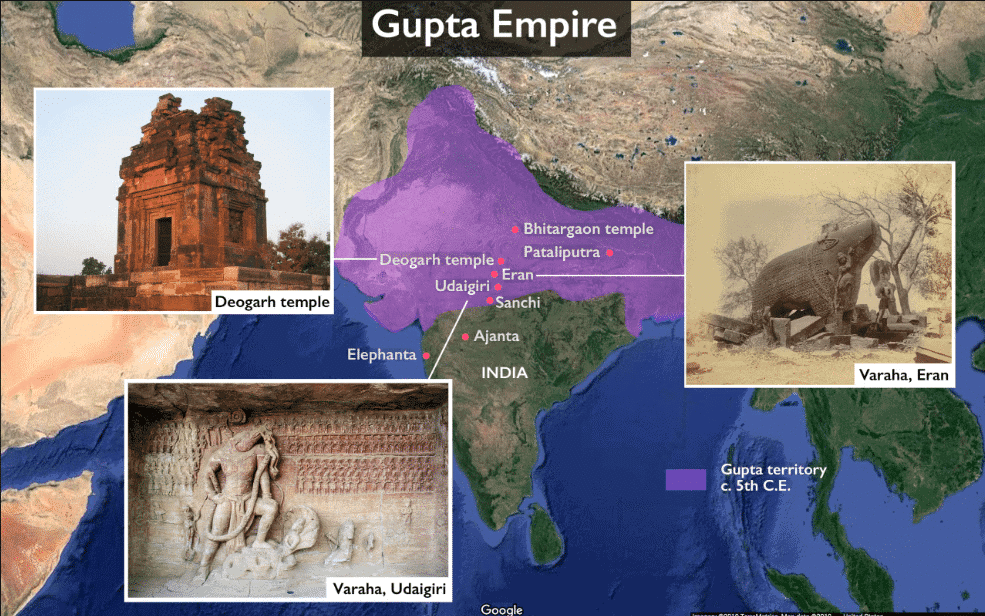 Gupta Empire
Q4: Recreate a scene from a Gupta ruler's court. Write a short script, assign roles like the king, ministers, and scholars, and enact a role play to bring the Gupta era to life!
Ans: Title: A Day at the Gupta King's Court
Scene: The grand court of Chandragupta II (Vikramāditya), decorated with tapestries, sculptures and graceful pillars.
Roles:
Chandragupta II (King)
Prime Minister (Mantri)
Court Poet (Kavi)
Scholar (Vidyapati)
General (Senapati)
Merchant (Vyāpāri)
[The scene opens with the king on his throne, ministers and scholars seated around him.]
Chandragupta II: Welcome, learned friends. Tell me of your work. Kavi, have you composed anything new?
Kavi: O King, I have composed a poem praising the beauty of the Ajanta Caves, the fertility of the Ganga plains and the lively markets. May I present it?
[The poet recites his verses. The court listens attentively.]
Chandragupta II: Well done. Vidyapati, what have you discovered in your studies of the skies?
Vidyapati: Your Majesty, I have recorded movements of the planets and noted patterns that help predict seasons. Our teacher, Āryabhaṭa, has guided much of this work. These observations aid farming and navigation.
Chandragupta II: Excellent. Senapati, how secure are our frontiers?
Senapati: The borders remain calm, Your Majesty. Our alliances and troop patrols keep the region peaceful, so traders and farmers live without fear.
Chandragupta II: Merchant, what news of trade?
Merchant: Trade with Rome, China and regions around the Mediterranean prospers. We export textiles, spices and ivory, and import glass, gems and other luxuries. This trade brings wealth and new ideas to our towns.
Chandragupta II: Continue to support learning, crafts and trade. Their prosperity strengthens the whole realm.
[The court agrees and the scene ends with polite applause.]
Q5: Match the two columns:
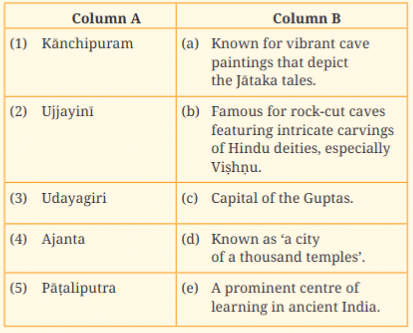
Ans:
(1) Kānchipuram → (d) Known as 'a city of a thousand temples'. It became a major centre of religion, learning and temple architecture.
(2) Ujjayinī → (e) A prominent centre of learning in ancient India, noted for scholars and trade links.
(3) Udayagiri → (b) Famous for rock-cut caves with carved panels of Hindu deities, especially images of Viṣhṇu.
(4) Ajanta → (a) Known for its vivid cave paintings that narrate stories from the Jātaka tales and Buddhist life.
(5) Pāṭaliputra → (c) Capital of the Guptas, an important administrative and cultural centre.
Q6: Who were the Pallavas and where did they rule?
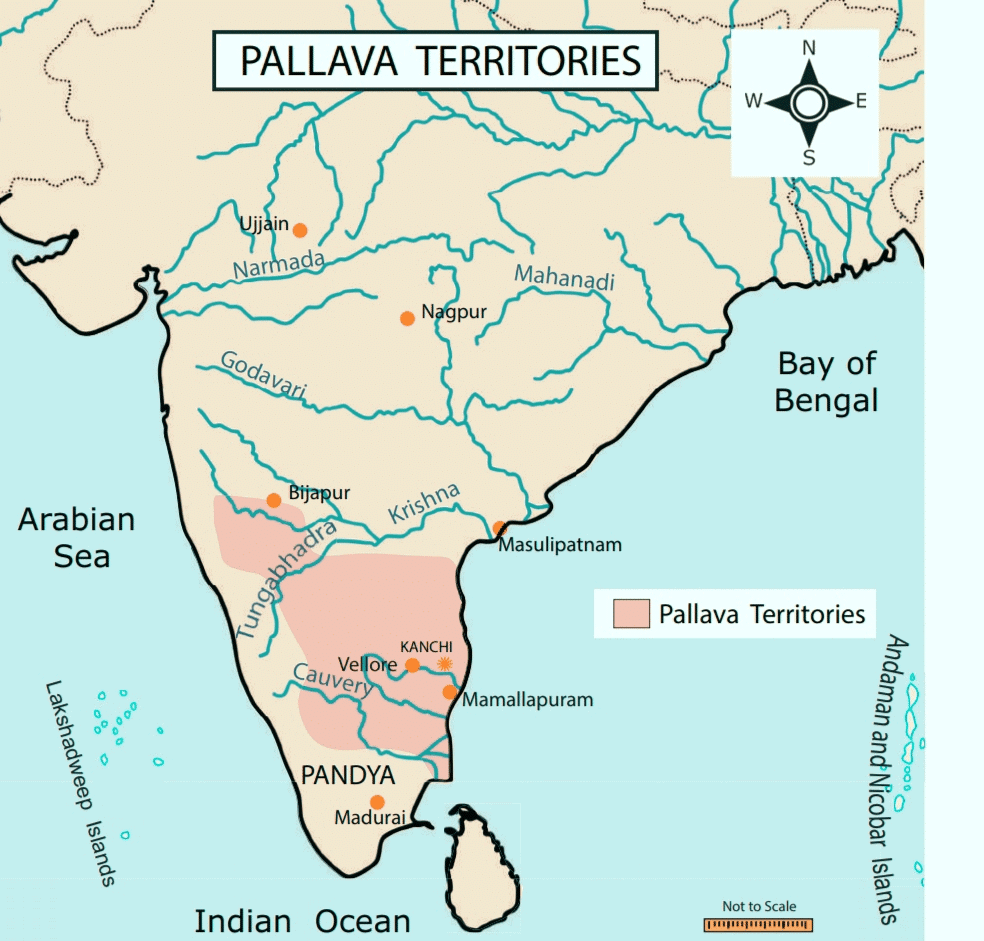 Pallava Empire
- The Pallavas were an important dynasty that ruled parts of southern India, especially areas of present-day Tamil Nadu and parts of Karnataka and Andhra Pradesh.
- They rose to prominence after the decline of the Sātavāhana power and made Kanchipuram their capital. Kanchipuram became a centre of religion, learning and temple building.
- The Pallavas were noted patrons of architecture and sculpture. Many rock-cut temples and cave shrines, and their later structural temples and reliefs (for example at Mahabalipuram), show their artistic skill and influence on south Indian temple architecture.
Q7: Organise an exploration trip with your teachers to a nearby historical site, museum, or heritage building. After the trip, write a detailed report describing your experience. Include key observations about the site's historical significance, the architecture, artefacts, and any interesting facts you learned during the visit. Reflect on how the trip enhanced your understanding of history.
Here is one Sample Report:
Ans: Sample Report: Exploration Trip to the Qutub Minar
- Introduction: On 10 August 2025 our class, accompanied by our teacher, visited the Qutub Minar in Mehrauli, Delhi. The Qutub Minar is a well-known historical monument and a UNESCO World Heritage Site. The visit aimed to study the site's historical significance, observe its architecture and view nearby artefacts, so that we could better understand medieval Indian history.
- Historical Significance: The Qutub Minar was begun by Qutb-ud-Din Aibak in the early 13th century and finished by later rulers. It marks the start of sustained Muslim rule in Delhi and is an early example of Indo-Islamic architecture. At about 72.5 metres in height, it is one of the tallest brick minarets in the world and symbolises political change and cultural exchange.
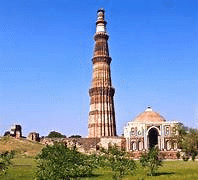 Qutub Minar
- Architecture and Design: The Qutub Minar is built mainly from red sandstone, with detailed carvings and bands of calligraphy on its lower storeys. Its five storeys are separated by projecting balconies. The complex shows a blend of Persian, Central Asian and Indian stone carving techniques.
- Artefacts and Surrounding Structures: We examined important structures such as the Iron Pillar of Delhi, which dates from the Gupta period and is famous for its resistance to rust. We also saw the Quwwat-ul-Islam Mosque, where reused temple pillars show how builders combined older materials with new designs.
- Interesting Facts Learned: We learned that the minar was used as a victory tower and as a minaret for the call to prayer. It was damaged several times by lightning and earthquakes and repaired by later rulers. The inscriptions in Arabic and the early Islamic ornamentation are among the earliest examples of such work in India.
- Reflection: Seeing the monument and nearby artefacts made the historical material from our book more real. The scale of the minar and the detail of the carvings helped me understand the technical skill of builders and how different cultures influenced one another.
- Conclusion: Overall, the trip to the Qutub Minar was an enriching experience. It deepened our understanding of medieval Indian architecture, the role of monuments in marking historical change, and the interaction of different artistic traditions over time.
FAQs on NCERT Solutions: The Gupta Era: An Age of Tireless Creativity
| 1. Why is the Gupta Empire called an age of creativity and what made it so special? |  |
| 2. What were the main achievements in mathematics and science during the Gupta period? | |
| 3. Which famous Sanskrit writers and poets created their best works during Gupta times? | |
| 4. How did Gupta rulers support art, architecture, and culture in their empire? | |
| 5. What was the role of religion in shaping Gupta-era creativity and cultural development? | |