Worksheet Solutions: Patterns Around Us

Section A: Multiple Choice Questions
1. Which of the following is an example of an even number?
a) 13
b) 18
c) 21
d) 25
Answer: b) 18
Explanation: 18 is even because it can be divided by 2 without any leftover.
2. If coins are arranged in a flower pattern with 1 coin in the center and 6 coins around it, how many coins are there in total and is it a odd or an even number?
a) 6, even
b) 7. odd
c) 6. odd
d) 7, even
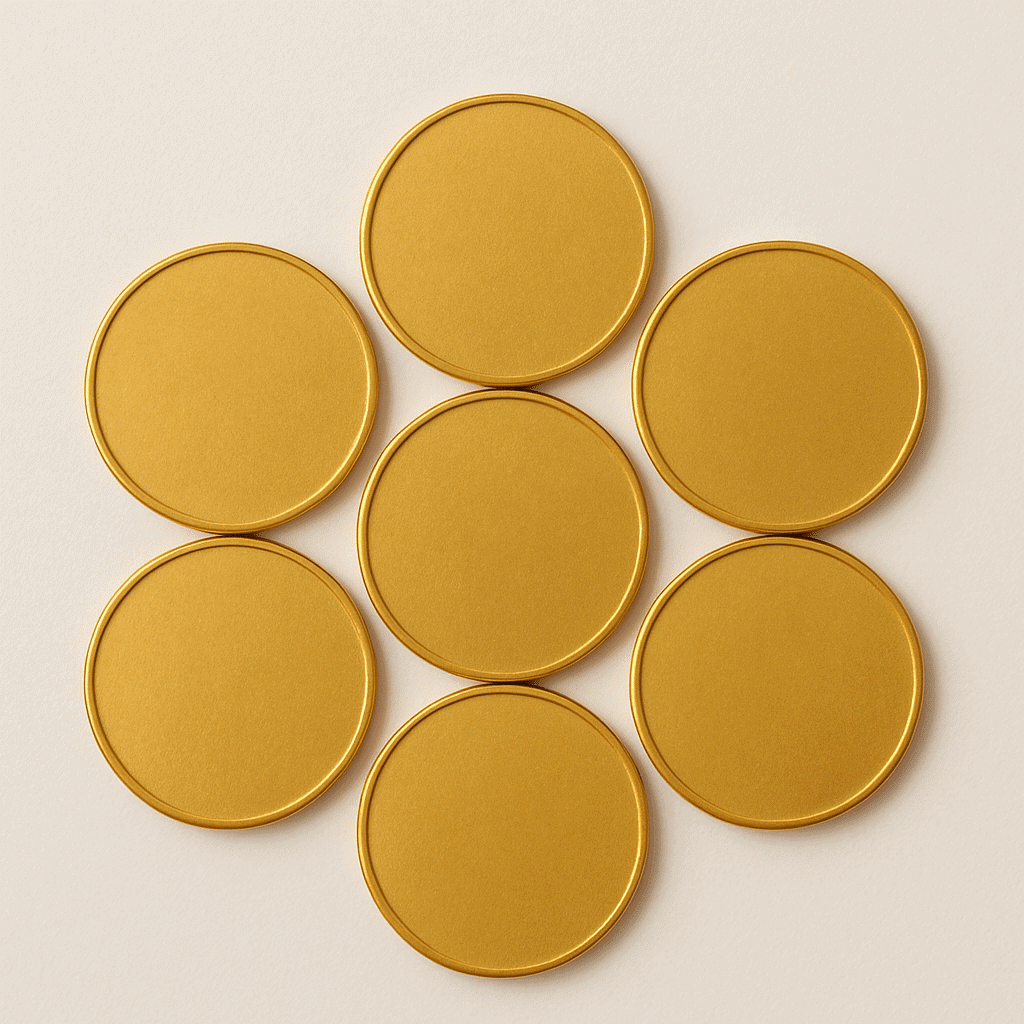
Answer:b) 7, oddExplanation: 1 coin in the center + 6 coins around it = 7 coins.
7 is an odd number because it can't be split into 2 equal groups.
3. Which of the following numbers is odd?
a) 24
b) 30
c) 35
d) 42
Answer: c) 35
Explanation: 35 is odd because it does not divide evenly by 2.
Section B: Answer the Following Questions
4. List the odd numbers between 10 and 20.
Answer: 11, 13, 15, 17, 19
5. Complete the pattern: 4, 8, 12, __, 20.
Answer: 16
6. If you have 4 notes of ₹10 and 5 coins of ₹2, what is the total amount?
Answer: 4 notes of 10 = 4 x ₹10 = ₹40
5 coins of ₹2 = 5 x ₹2 = ₹10
Total amount = ₹40 + ₹10 = ₹50
7. Can 16 balls be divided equally into 2 groups? If yes, how many in each group?
 Answer: Yes, 16 balls can be divided equally into 2 groups.
- We can use division to solve this: 16 ÷ 2.
- 16 divided by 2 equals 8.
8. Make two-digit numbers using digits 2 and 7 and identify a 2-digit even number.
Answer: We can make two numbers 27 and 72, using 2 and 7.
Now out of these two, 72 is an even number.
9. What is the 5th term in the pattern: 3, 6, 9, 12, ___?
Answer: 15
The terms are: 3 (1st), 6 (2nd), 9 (3rd), 12 (4th).
Each term increases by 3:
- 3 + 3 = 6
- 6 + 3 = 9
- 9 + 3 = 12 So, to get the 5th term, we add 3 to the 4th term:
- 12 + 3 = 15
Section C: Word Problems
10. Raju arranges 12 coins in a rectangle with 3 coins in each row. How many rows are there?
Answer: 4 rows
Raju has 12 coins.
Each row has 3 coins.
We divide the total coins by the coins per row: 12 ÷ 3 = 4.

11. Sita has 23 pencils. Can she share them equally between 2 friends?  Answer: No, 23 is odd and leaves 1 pencil unshared.
Hence it cannot be shared.
12. Describe how to arrange 9 coins in a flower pattern (1 center + surrounding coins).
Answer: 1 center coin + 8 outer coins. 13. Find odd and even numbers from the given image.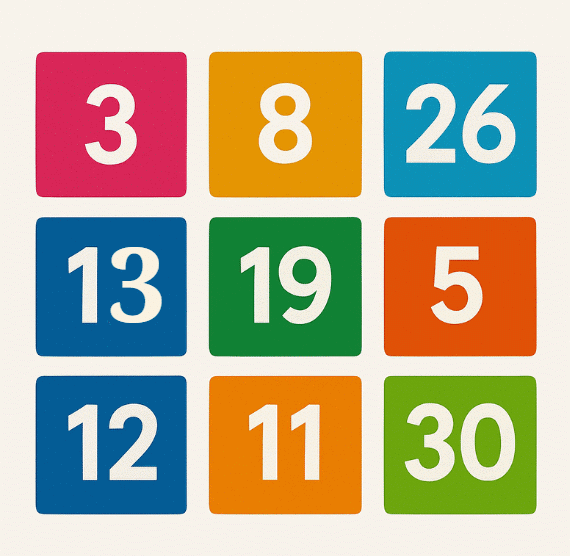
Answer:
Odd Numbers: 3, 13, 19, 5, 11
Even Numbers: 8, 26, 12, 30
14. If 30 students are to be divided into groups of 5, how many groups are formed?
Answer: 6 groups.
- To figure out how many groups we can make, we divide the total number of students by the number of students per group: 30 ÷ 5.
- 30 ÷ 5 = 6.
- So, we can form 6 groups.
FAQs on Worksheet Solutions: Patterns Around Us
| 1. What are the different types of patterns that can be found around us? |  |
| 2. How do patterns affect our daily lives? | |
| 3. Why is it important for children to learn about patterns? | |
| 4. Can you give examples of patterns in nature? | |
| 5. How can I create my own patterns at home? | |