Worksheet Solutions: Thousands Around Us

Q1: Multiple Choice Questions
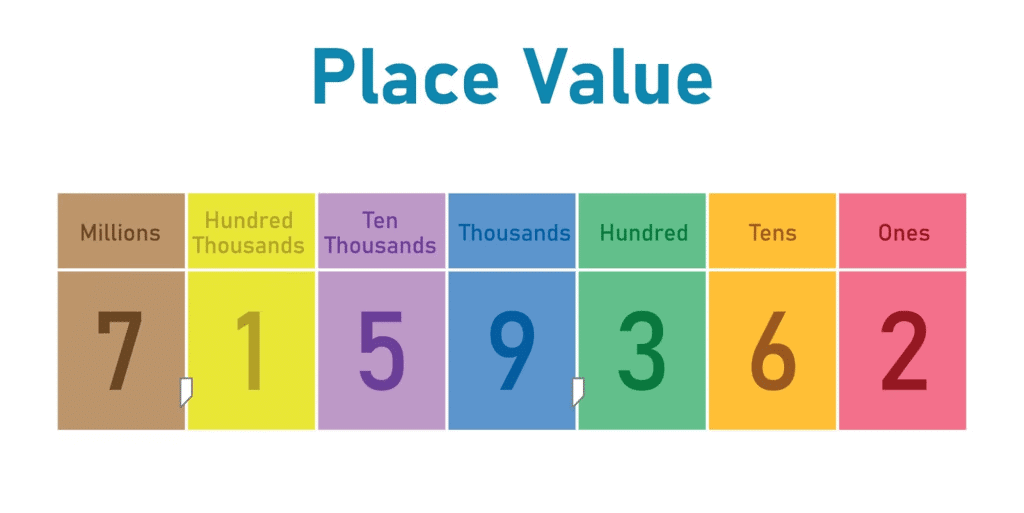
1. Which digit is in the thousands place in the number 5,672?
a) 5
b) 6
c) 7
d) 2
Answer: a) 5
Explanation: The number is 5,672. The first digit from the left is in the thousands place. So, 5 is in the thousands place.
2. What is the correct expanded form of 3,045?
a) 300 + 40 + 5
b) 3,000 + 400 + 5
c) 3,000 + 40 + 5
d) 30,000 + 400 + 5
Answer: c) 3,000 + 40 + 5
Explanation: In 3,045 → 3 is in the thousands, 0 is in the hundreds, 4 is in the tens, and 5 is in the ones.
3. Which of the following numbers is the largest?
a) 2,099
b) 2,909
c) 2,990
d) 2,999
Answer: d) 2,999
Explanation: 2,999 is the biggest because it is just one less than 3,000.
4. How many hundreds are there in 1,500?
a) 5
b) 15
c) 150
d) 1,500
Answer: b) 15
Explanation: 1,500 ÷ 100 = 15. That means there are 15 hundreds in 1,500.
Q2: Answer the Following Questions
5. Write the place value of the digit 3 in 7,832.
Answer: Tens place (30). In 7,832, the 3 is in the tens place, so its value is 3 × 10 = 30.
6. Form the smallest 4-digit number using the digits 4, 0, 9, 2 without repetition.
Answer: 2,049. The smallest digit (other than 0) should be in the thousands place. So, we use 2 first.
7. Regroup 2,563 as thousands + hundreds + tens + ones.
Answer: 2,000 + 500 + 60 + 3.
8. Use >, <, or = to compare: 4,321 ___ 4,231.
Answer: 4,321 > 4,231. Compare the hundreds place - 3 is more than 2.
9. Complete the pattern: 1,250, 1,500, 1,750, ___.
Answer: 2,000 (increasing by 250).
10. Convert 6,208 into expanded form.
Answer: 6,000 + 200 + 8.
Q3: Word Problems
11. A library has 2,345 books. If 1,230 books are fiction, how many are non-fiction?
 Answer: 2,345 - 1,230 = 1,115 non-fiction books.
12. In the number 8,765, the digit 6 represents a value greater than its actual place. How?
Answer: It represents 60 (tens place), not 6 (ones).
13. A school has 1,800 students. If 30 students fit in a bus, how many buses are needed?
Answer: 1,800 ÷ 30 = 60 buses.
14. Represent 2,000 and 2,500 on a number line. What is the difference between them?
Answer: 500 (2,500 - 2,000).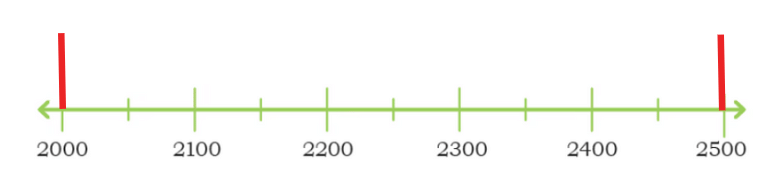
15. Write 5,67,890 in words using the Indian number system.
Answer: Five lakh sixty-seven thousand eight hundred ninety.
16. How many hundreds blocks are needed to represent 3,700?
Answer: 37 (3,700 ÷ 100).
17. A sequence starts at 3,000 and decreases by 150 each time. Write the next two terms.
Answer: 2,850, 2,700.
3,000 - 150 = 2,850 → 2,850 - 150 = 2,700
18. Explain why 4,050 is greater than 4,005 using place value.
Answer: Tens digit (5 > 0).
19. A stadium has 9,999 seats. If 5,678 seats are occupied, how many are empty?
 Answer: 9,999 - 5,678 = 4,321 seats
20. Add 2,000 + 300 + 50 + 4. Write the standard form.
Answer: 2,354.
FAQs on Worksheet Solutions: Thousands Around Us
| 1. How do I read and write numbers in the thousands correctly for Class 4? |  |
| 2. What's the difference between 1,000 and 999 in the thousands concept? | |
| 3. How do I write numbers like 5,247 in expanded form using thousands? | |
| 4. Why do we use commas when writing numbers with thousands in CBSE Class 4? | |
| 5. Can you explain how many thousands are in numbers like 7,500 or 9,999? | |