UPSC Exam > UPSC Notes > Sociology Optional (Notes) > Mind Map: Stratification and Mobility
Mind Map: Stratification and Mobility

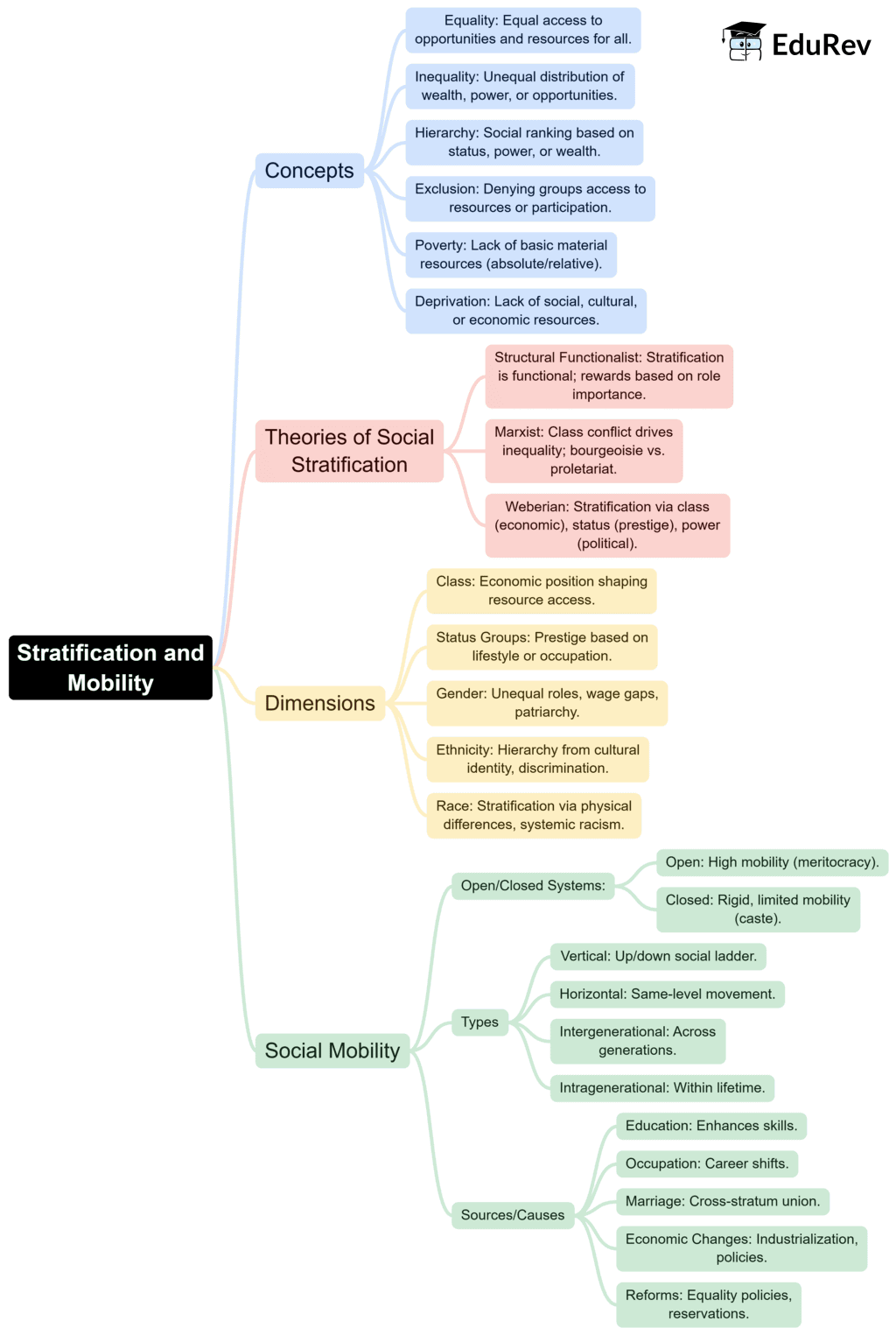
The document Mind Map: Stratification and Mobility is a part of the UPSC Course Sociology Optional for UPSC (Notes).
All you need of UPSC at this link: UPSC
FAQs on Mind Map: Stratification and Mobility
| 1. What is social stratification and how does it impact society? |  |
Ans. Social stratification refers to the hierarchical arrangement of individuals in society based on various factors like wealth, education, power, and prestige. This system creates layers where individuals in higher strata have more access to resources and opportunities, affecting their life chances, social status, and overall quality of life. It can lead to inequality, social tensions, and divisions based on class, caste, race, or gender.
| 2. What are the different forms of social mobility? | |
Ans. Social mobility is the ability of individuals or groups to move within the social hierarchy. It can be classified into vertical mobility (upward or downward movement in status), horizontal mobility (movement within the same social level), and intergenerational mobility (changes in social status between different generations). These forms illustrate how individuals can change their social position over time and the factors influencing these changes.
| 3. How does education influence social mobility? | |
Ans. Education plays a crucial role in promoting social mobility by providing individuals with skills and knowledge that enhance their employability and earning potential. Higher education often opens doors to better job opportunities, which can elevate an individual's social status. However, disparities in access to quality education can perpetuate existing inequalities, affecting the overall mobility of certain groups.
| 4. What is the relationship between caste and social stratification in India? | |
Ans. In India, the caste system is a traditional form of social stratification that divides society into hierarchical groups based on birth. This system influences various aspects of life, including marriage, occupation, and social interactions. Despite legal efforts to abolish caste discrimination, it continues to impact social mobility, as individuals from lower castes often face significant barriers to upward mobility due to socio-economic disadvantages and systemic discrimination.
| 5. What are the implications of social stratification on economic development? | |
Ans. Social stratification can significantly affect economic development by creating barriers to resource allocation, innovation, and productivity. When individuals are unable to access opportunities due to their social status, it can hinder overall economic growth and development. A more equitable society, where individuals can move freely across social strata, tends to foster inclusive growth, harness diverse talents, and enhance social cohesion.
About this Document

4.95/5 Rating

Apr 20, 2026 Last updated
Related Exams
Document Description: Mind Map: Stratification and Mobility for UPSC 2026 is part of Sociology Optional for UPSC (Notes) preparation. The notes and questions for Mind Map: Stratification and Mobility have been prepared according to the UPSC exam syllabus. Information about Mind Map: Stratification and Mobility covers topics like and Mind Map: Stratification and Mobility Example, for UPSC 2026 Exam. Find important definitions, questions, notes, meanings, examples, exercises and tests below for Mind Map: Stratification and Mobility.
Introduction of Mind Map: Stratification and Mobility in English is available as part of our Sociology Optional for UPSC (Notes) for UPSC & Mind Map: Stratification and Mobility in Hindi for Sociology Optional for UPSC (Notes) course. Download more important topics related with notes, lectures and mock test series for UPSC Exam by signing up for free. UPSC: Mind Map: Stratification and Mobility
Description
Mind Map: Stratification & Mobility of Sociology Optional provides you one-page visual summary of the chapter covering all the important topics. Download the PDF from EduRev.
Information about Mind Map: Stratification and Mobility
In this doc you can find the meaning of Mind Map: Stratification and Mobility defined & explained in the simplest way possible. Besides explaining types of Mind Map: Stratification and Mobility theory, EduRev gives you an ample number of questions to practice Mind Map: Stratification and Mobility tests, examples and also practice UPSC tests



Related Searches
Viva Questions, Previous Year Questions with Solutions, Objective type Questions, Free, practice quizzes, pdf , shortcuts and tricks, Exam, Important questions, MCQs, video lectures, Summary, Semester Notes, past year papers, Mind Map: Stratification and Mobility, ppt, mock tests for examination, Extra Questions, Mind Map: Stratification and Mobility, Sample Paper, Mind Map: Stratification and Mobility, study material;