NCERT Solutions: Try Again


Page 16: Let us do these activities before we read
Q1: Who inspires you to do your best?
Ans: This is a personal response question. For example: My parents inspire me to do my best because they encourage me to work hard, support me when I fail and remind me to try again.
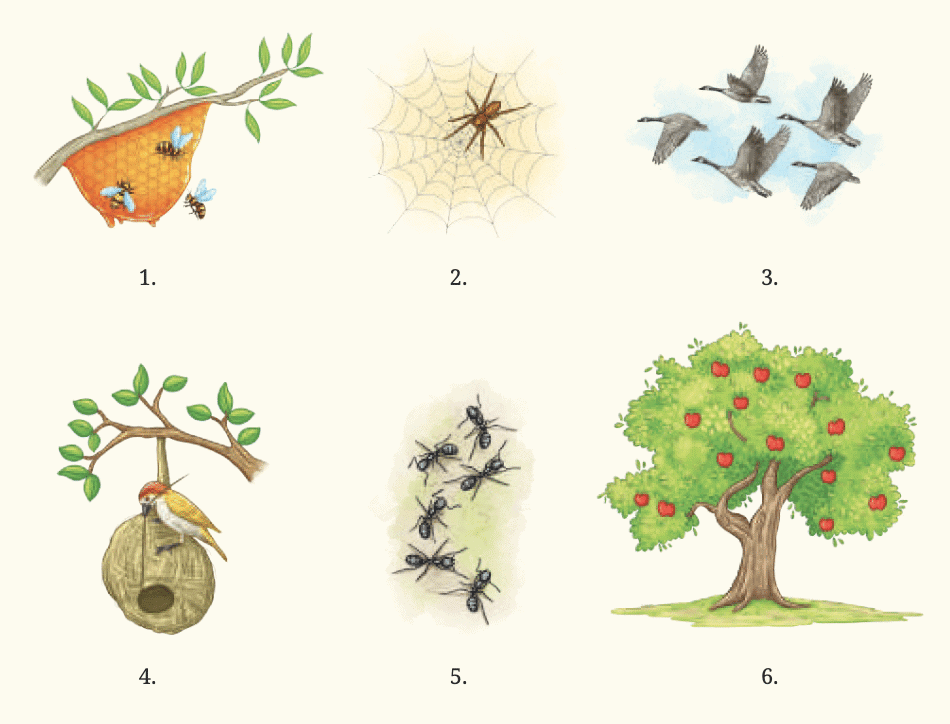
Q2: Work in pairs, identify what you see in the pictures given below. What can we learn from them? Share your answers with your classmates and the teacher.
Ans:
- Honey bees: The picture shows honey bees working together in a hive, collecting nectar. We learn the importance of teamwork and steady effort, because bees cooperate to make honey and support the entire colony.
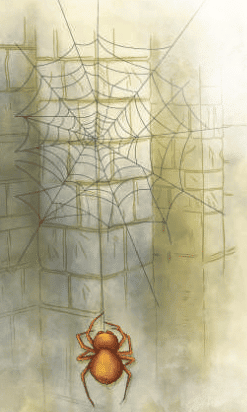
- Spider: The picture shows a spider spinning its web, trying again even if the web breaks. We learn persistence and how to keep trying until we succeed.
- Migratory birds: The picture shows a flock of migratory birds flying long distances. We learn about endurance and determination, since these birds travel thousands of miles to reach their destination.
- Bird: The picture shows a single bird building a nest, which teaches patience and careful work, as it creates a safe place for its young through small, steady efforts.
- Ants: The picture shows a colony of ants working together. We learn the value of cooperation and how many small efforts combine to produce large results.
- Apple tree: The picture shows an apple tree growing strong and bearing fruit after years of growth. We learn patience and perseverance, because the tree succeeds after long, steady care.
Page 19: Let us discuss
QI: Complete the summary of the poem by filling in the blanks with suitable words from the text given in the box below. Share your answers with the teacher.

The poem, written in a narrative style, tells the story of King Bruce of Scotland, who was feeling 1. _____________ after failing multiple times to achieve something 2. _____________ for his people. In a moment of 3. _____________, he observed a spider trying to reach its web high above. The spider 4. _____________ every time it fell after getting close to its goal. It made nine 5. _____________ and finally succeeded. The king said that the spider had 6. _____________ and so would he. Inspired by the spider's determination, King Bruce decided to 7. _____________. When he 8. _____________ this time, he ultimately succeeded.
Ans:
- low
- great
- despair
- mounted
- attempts
- conquered
- strive
- tried
QII. Complete the following sentences suitably
1: We can say that the poet uses the narrative style because _________.
Ans: The poem tells a sequence of events about King Bruce and the spider and presents them as a short tale with a clear beginning, middle and end.

2: The central idea of the poem is ________.
Ans: The central idea of the poem is perseverance and not giving up, even after repeated failures, as shown through the spider's efforts and King Bruce's realisation.
QIII. Pick three examples from the poem for each of the following:
1: lines that describe the spider's efforts.
Ans:
(a) "It soon began to cling and crawl, Straight up with strong endeavour" - This line shows the spider's power and steady effort to climb.
(b) "Again it fell and swung below, But again it quickly mounted" - This highlights that the spider keeps trying even after falling.
(c) "Steadily, steadily, inch by inch, Higher and higher he got" - This describes how the spider advances slowly but persistently.
2: alliteration (the repetition of the same consonant sounds at the beginning of closely connected words).
Ans:
- "cling and crawl" - The repetition of the 'c' sound makes the line lively.
- "Bravo, bravo!" - The repeated 'b' sound adds emphasis to the cheer.
- "Bruce of Scotland braced" - The repeated 'b' sound links the king's name with his growing strength and resolve.
QIV: Why does the poet repeat the following words or phrases in the poem?
tried and tried; steadily, steadily; up, up
Ans: The poet repeats these phrases to stress the spider's persistence and continuous effort. The repetition helps the reader feel how often the spider attempts to climb and how determined it is.
QV. Fill in the blanks by choosing the correct answer from within the brackets
1: The rhyme scheme of the poem is (AABB/ABBA/ABAB)
Ans: AABB
Explanation: The poem pairs lines in couplets so the first two lines rhyme with each other and the next two lines rhyme with each other, producing an AABB pattern.
2: 'Bravo' is an example of (conjunction/interjection/adjective)
Ans: Interjection
Explanation: 'Bravo' is an exclamation used to show approval or praise; it expresses sudden feeling, so it is an interjection.
3: The poet uses ''twas' and ''tis' for the sake of (rhythm/rhyme/contraction)
Ans: Contraction
Explanation: 'Twas and 'tis are shortened forms of words used primarily for contraction and to preserve the poem's rhythm and old-fashioned tone.
QVI. The spider's climbing is compared to King Bruce's own struggles. Just as the spider repeatedly attempts to reach its web, Bruce is trying to achieve a great deed for his people. This poetic device is called a metaphor. It strengthens the poem's message about perseverance-keep trying till we succeed.
A metaphor is a figure of speech that involves an implied comparison between two unlike things without using 'like', 'as', or 'as...as'. It suggests that one thing is another, highlighting similarities between them to add deeper meaning or understanding.
1: Read the following sentences and identify metaphors and similes. Write M for metaphor and S for simile.
Ans:
(i) He ran as fast as a cheetah. - S
(ii) The world is a stage. - M
(iii) The night was as dark as coal. - S
(iv) He sang like an angel. - S
(v) Her voice was music to his ears. - M
(vi) The classroom was a zoo. - M
(vii) The baby slept like a log. - S
(viii) Her smile was as bright as the sun. - S
(ix) The lake was a mirror, reflecting the sky. - M
2: Read the following sentences and transform the similes to metaphors and metaphors to similes.
(i) Knowledge spreads like the branches of a mighty tree.
Ans: Metaphor: Knowledge is a spreading branch of a mighty tree.
(ii) His courage was a beacon, guiding us through the storm.
Ans: Simile: His courage was like a beacon guiding us through the storm.
(iii) The book was a treasure chest, filled with endless adventures.
Ans: Simile: The book was like a treasure chest, filled with endless adventures.
(iv) Her laughter was a melody that brightened the darkest days.
Ans: Simile: Her laughter was like a melody that brightened the darkest days.
(v) The mountain stood as a guard, watching over the valley below.
Ans: Metaphor: The mountain was a guard, watching over the valley below.
(vi) The night was like a velvet cloak, wrapping the world in mystery.
Ans: Metaphor: The night was a velvet cloak, wrapping the world in mystery.
(vii) Her thoughts were like butterflies in a summer meadow.
Ans: Metaphor: Her thoughts were butterflies in a summer meadow.
Page 21: Let us think and reflect
QI.Read the extracts given below and answer the questions that follow.
1. He flung himself down in low despair,
As grieved as man could be;
And after a while he pondered there,
"I'll give it all up," said he.
Now just at that moment a spider dropped,
With its silken, filmy clue;
(i): Select the phrase which shows the physical expression of the King's emotional state.
Ans: "He flung himself down"
(ii): Why does the poet use the word 'low' before despair?
Ans: The word 'low' emphasises the depth of King Bruce's sadness and shows that he felt deeply hopeless and downcast.
(iii): In the line, 'And after a while he pondered there', the word 'pondered' means ___________
A. paused
B. thought
C. noticed
D. rested
Ans: (B)
Explanation: 'Pondered' means to think carefully or consider, so option B is correct.
(iv): The phrase 'silken filmy clue' creates an image of something that is (long and light/very delicate and soft).
Ans: very delicate and soft
2. "...when it toils so hard to reach and cling, And tumbles every time."
But up the insect went once more,
Ah me! 'tis an anxious minute;
He's only a foot from his cobweb door,
Oh say, will he lose or win it?
(i): Choose the correct option to complete the analogy.
toil: hard:: ___________
A. roll: tumble
B. tumble: circle
C. compress: roll
D. jump: tumble
Ans: (A)
Explanation: 'Toil' is closely linked to 'hard' in meaning; similarly 'roll' is paired with 'tumble' in meaning in this list, so option A is the best match.
(ii): List any two characteristics of the spider highlighted in the line, 'But up the insect went once more'.
Ans:
1. Perseverance - The spider does not give up despite falling and continues to climb.
2. Determination - It shows strong will to reach its goal and tries again.
(iii): The expression 'Ah me!' in the extract indicates a sense of
A. happiness
B. stress
C. relief
D. loneliness
Ans: (B)
Explanation: 'Ah me!' expresses worry or anxious feeling, so it conveys stress or concern.
(iv): Complete the sentence with an appropriate reason.
Readers are able to relate to this extract because ______________
Ans: It describes the spider's struggle and repeated effort, which mirrors challenges people face when trying to reach their own goals.
QII. Answer the following questions.
1: How does the first stanza help in setting the mood of the poem?
Ans: The first stanza shows King Bruce feeling deeply sad and ready to give up, which creates a mood of despair and hopelessness that frames the rest of the poem.
2: Describe how King Bruce's attitude changes from the beginning towards the end of the poem.
Ans: At first King Bruce is despondent and ready to quit. After watching the spider persist, he feels inspired, regains determination and decides to try again; eventually he succeeds.
3: The poet describes every action of the spider in great detail. What does this tell us about his attitude towards the spider?
Ans: The careful description shows the poet's admiration for the spider's effort and resolve. The poet respects how even a small creature can display great determination.
4: How does the spider inspire us to overcome despair and not give up?
Ans: The spider keeps trying until it succeeds, despite falling many times. Its persistence encourages us to continue working toward our goals even after failures.
5: The poem teaches us that failures are stepping stones to success. Explain.
Ans: The poem shows that the spider failed nine times but succeeded on the tenth try. Similarly, King Bruce failed but succeeded after trying again, proving that failures help us learn and lead to success.
6: The spider's journey tells us that anyone can be a source of inspiration in our lives. Elaborate.
Ans: A tiny spider's bravery and persistence inspire King Bruce to carry on. This shows that inspiration can come from unexpected places, such as nature, and anyone or anything can motivate us to persevere.
Page 22: Let us learn
QI: Write the opposites of the following words taken from the poem.1. up × _____________
2. fast × _____________
3. glad × _____________
4. win × _____________
5. succeed × _____________
Ans:
1. up × down
2. fast × slow
3. glad × sad
4. win × lose
5. succeed × fail
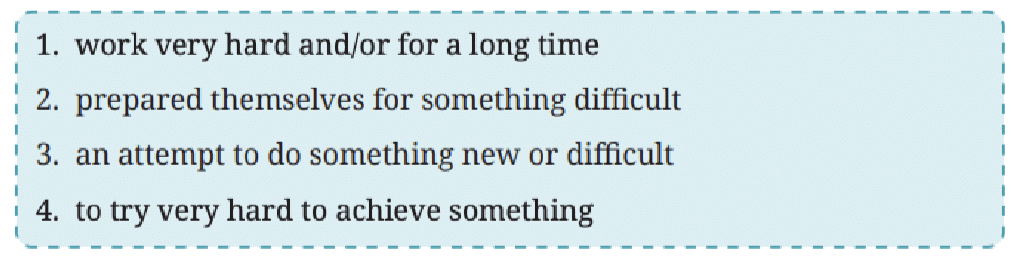
QII: Choose the correct meaning of the underlined words in the following sentences from the box given below. Frame sentences of your own for these words.
Ans:
(i) endeavour - an attempt to do something new or difficult
- Sentence: I will make every endeavour to finish my project on time.
(ii) toil - work very hard and/or for a long time
- Sentence: Farmers toil in the fields to grow crops for us.
(iii) strive - to try very hard to achieve something
- Sentence: Students should strive to improve their skills every day.
(iv) braced - prepared themselves for something difficult
- Sentence: The team braced itself for the tough match ahead.
QIII: The poem uses words that show distance. For example: a long way up, inch by inch, higher and higher, half-yard higher. Classify the words or phrases in the box given below based on the distance (far or near) and write in the space provided. You may take the help of a dictionary.

Ans:
Far: middle of nowhere, remoteness, yonder, afar, light year, farther
Near: proximity, vicinity, adjacent, a stone's throw, hairline
QIV: Read the following line from the poem.
'Twas a delicate thread it had to tread,'
Now repeat the lines five to six times. Are you able to say it clearly? Create more tongue twisters of your own.
Ans:
- Yes, I can say the line clearly after repeating it five to six times.
- Tongue twisters:
- Swift spiders spin strong silk strands.
- Clever crabs crawl cautiously close.
- Tiny turtles tap tough twigs tightly.
Page 24: Let us listen
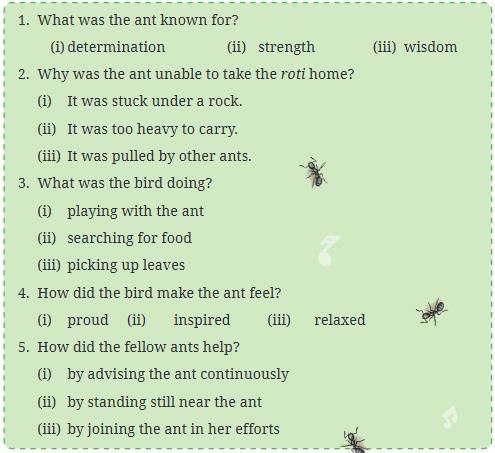
I. You will listen to a narrative about an ant. Read the questions given below and before you listen, guess the answers to these questions.
(Transcript for the teacher)
Hello everyone, I'm sure you have enjoyed learning about King Bruce and the spider. Let me share another account with you.
In a thick green forest, there lived a little ant. She was known for her determination and never-give-up attitude. One sunny day, the ant found a delicious piece of roti that was too big for her to carry alone.
"This crumb is huge, but I must get it back to the anthill. My family will be so happy!" she thought to herself.
She tried to lift the crumb with all her might, but it was too heavy. She tried pushing it, pulling it and even rolling it, but nothing seemed to work. Exhausted and saddened, she sat down and began to cry.
As the ant sat there, feeling beaten, she noticed a small bird nearby. The bird was trying to build a nest. It picked up twigs and leaves, but every time it tried to place them, the wind would blow them away. However, the bird did not give up. It kept trying, over and over again, until finally, it managed to build a strong nest.
"If that bird can keep trying and succeed, then I shouldn't give up either," she thought, feeling inspired.
Determined once more, the ant gathered all her strength and decided to try again. She called her fellow ants for help. Together, they formed a chain and lifted the crumb with their combined strength. Slowly but surely, they carried the crumb back to the anthill.
"We did it! Thank you, everyone! We showed that with teamwork and never giving up, we can achieve anything!" the ant shouted, excited and grateful.
She and her friends celebrated their success.
We too should learn this lesson from the ant's experience-never give up, no matter how difficult the situation may seem.
Hope you all liked the account.
Thank you!
Ans:
1. What was the ant known for?
(i) determination
2. Why was the ant unable to take the roti home?
(ii) It was too heavy to carry.
3. What was the bird doing?
(iii) picking up leaves
4. How did the bird make the ant feel?
(ii) inspired
5. How did the fellow ants help?
(iii) by joining the ant in her efforts
II. Now, listen to the account once again, and as you listen, check whether your answers are correct.
1. What was the ant known for?
Correct answer: (i) determination
It states: "She was known for her determination and never-give-up attitude."
2. Why was the ant unable to take the roti home?
Correct answer: (ii) It was too heavy to carry
It is mentioned that "She tried to lift the crumb with all her might, but it was too heavy."
3. What was the bird doing?
Correct answer: (iii) picking up leaves
The bird was building a nest using twigs and leaves.
4. How did the bird make the ant feel?
Correct answer: (ii) inspired
After watching the bird's repeated attempts, the ant felt inspired to try again.
5. How did the fellow ants help?
Correct answer: (iii) by joining the ant in her efforts
The ants worked together and carried the crumb back to the anthill using teamwork.
Page 25: Let us speak
Q: Narrate a personal experience about a time when you were motivated by someone or something to carry on and never give up. Your perseverance helped you.
Ans:
My Experience of Perseverance
Introduction:
I remember a time when I felt like giving up. It was when I was trying to learn how to ride a bicycle last summer during my school holidays.
Describe the challenge:
The challenge I faced was balancing on the bicycle without falling. I struggled to keep the bike steady, and every time I pedalled, I would wobble and sometimes fall.I scraped my knees several times and felt discouraged, thinking that I might never be able to learn cycling.
Feeling disheartened:
At first, I felt discouraged and thought about giving up because I was tired of falling. I compared myself with friends who could already ride and felt clumsy and upset.
The source of motivation:
Then I remembered the poem about King Bruce and the spider. The spider tried many times and finally reached its web. If a small spider could keep trying, I realised I should not give up either.
Taking action:
I practised every day, even after falling. My elder brother helped by holding the bike while I pedalled. With a new sense of willpower, I kept trying, focusing on balancing and pedaling slowly.
The result:
After a week of steady practice, I could ride the bicycle by myself. I felt proud and happy, and my friends cheered for me.
Reflection:
This taught me to be patient and persistent. Now, when I face difficulty, I remember to keep trying and to learn from each attempt.
Note for Class 7 Students: You can change this account to something that happened to you, such as learning to swim, solving a difficult maths problem, or taking part in a race. Use the prompts to tell your own experience and explain what motivated you-perhaps a person, an incident, or the spider from the poem!
Page 26: Let us write
Q: Think about the steps you can take to overcome a difficult situation and write them down. Now, write a letter to your cousin on how you plan to overcome any difficult situation. Also, advise not to quit and persevere.
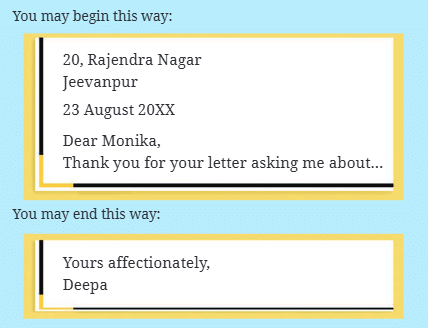
Remember to use transition words like 'To begin with...,' 'Next...,' 'After that...,' 'Then...,' 'Finally...,' to share the steps of your plan. You may begin this way:
Ans:
Steps to overcome a difficult situation:
- Stay calm and think clearly about the problem.
- Make a plan with small, achievable steps.
- Ask for help from family, friends, or teachers when needed.
- Keep trying, even if I fail at first; learn from each attempt.
- Stay positive and believe in my ability to improve.
Letter:
20, Rajendra Nagar
Jeevanpur
23 August 20XX
Dear Monika,
Thank you for your letter asking how I handle difficult situations. To begin with, I stay calm and think about the problem. Next, I make a plan with small steps to solve it. After that, I ask for help from family or teachers if I need it. Then, I keep trying, even if I do not succeed at first. Finally, I stay positive and believe in myself.
My advice to you is never to give up, however hard things seem. Like the spider in "Try Again," keep trying until you succeed. Perseverance usually leads to success.
Yours affectionately,
Deepa
Page 26: Let us Explore
(I) Collect folk songs in your own language that connect us with nature and compile them as a class project.
Ans: Folk songs are traditional songs passed down through generations. They often celebrate nature, daily life and local customs. Collecting them helps us understand how people from our region value nature.
For the class project, we can:
- Ask family members, elders and neighbours to share folk songs about rivers, trees, animals, seasons and farming.
- Write down the lyrics and make audio recordings where possible.
- Find out the meaning of the songs and how they show respect for nature.
- Compile the songs in a booklet or a digital file and present them in class.
This project will help us learn about local culture and how nature has inspired people over time.
(II) Did you know that spiders are not insects? They belong to a group called the arachnids. Observe a spider and an ant from a distance and note down the differences between them. Share your observations with your classmates. Ask your Science teacher for more information to know about spiders better.
Ans:
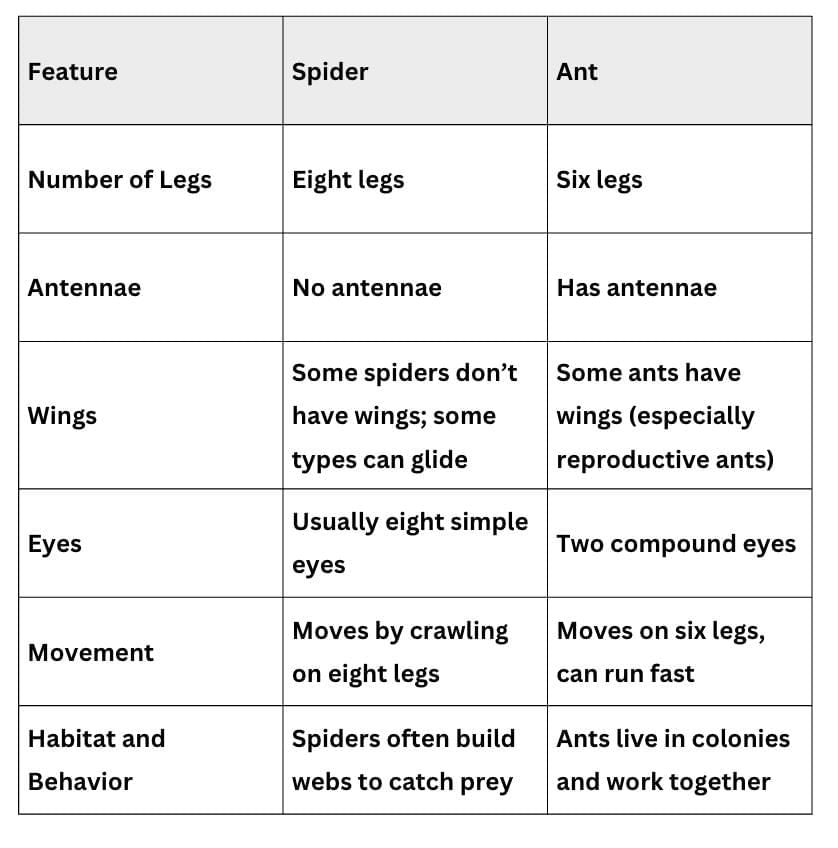
III Let us learn how to weave a spider web.
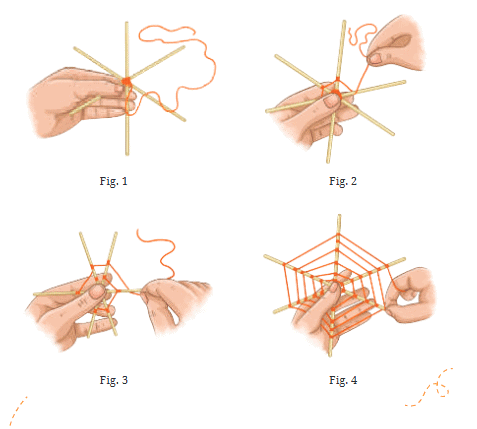
1. Take three sticks (each about eight inches long) and a roll of old wool.
2. Tie the sticks together in the centre with the wool (Fig. 1).
3. Start weaving the web by putting a loop around every stick (Figs. 2 and 3).
4. Complete the web and tie the thread in a knot on the stick where the web is complete (Fig. 4).
Now, decorate it with words and phrases you learnt about the spider in the poem or anything else that you like.
Ans: Now, let's decorate the web with words and phrases from the poem about the spider. We can write these on small pieces of paper and stick them on the web, or use a marker to write on the wool. Here are some words and phrases from the poem:
- Silken thread (the poem says "silken, filmy clue" for the spider's web).
- Cobweb home (the spider is trying to reach its "cobweb home").
- Strong endeavour (it climbs with "strong endeavour").
- Nine attempts (the spider tries many times before success).
- Defied despair (the spider kept going despite difficulty).
You can also add a cheerful phrase such as "Bravo, spider!" because King Bruce cheers for the spider when it succeeds. If you like, draw a small spider on the web or add glitter to make it look shiny like a real web.
FAQs on NCERT Solutions: Try Again
| 1. What is the main message of the poem "Try Again" that I need to understand for Class 7 English? |  |
| 2. How should I answer comprehension questions about "Try Again" to score full marks in exams? | |
| 3. What are the key literary devices used in "Try Again" and why does the poet use them? | |
| 4. Why do students find the moral lesson of "Try Again" difficult to connect with their own lives? | |
| 5. What specific lines from "Try Again" best capture the poem's central idea about never giving up? | |