Worksheet Solutions: Elephants, Tigers, and Leopards

Section A: Multiple Choice Questions
1. What is the sum of 3,459 and 21?
a) 3,480
b) 3,470
c) 3,490
d) 3,500
Ans: (a)
Sol: 3,459 + 21 = 3,480
2. Which of the following is the correct comparison?
a) 54 + 97 > 54 + 90
b) 84 - 68 < 90 - 68
c) 76 + 85 = 80 + 86
d) 73 - 54 > 73 - 56
Ans: (a)
Sol: Calculate both expressions to compare:
54 + 97 = 151
54 + 90 = 144
Since 151 > 144, option (a) is correct.
3. The number of buses in a town is 253 more than the number of jeeps, which are 6,304. How many buses are there?

a) 6,557
b) 6,507
c) 6,447
d) 6,600
Ans: (a)
Sol: Number of buses = Number of jeeps + 253 = 6,304 + 253 = 6,557
4. Which 2-digit number, when added to its reverse, gives 88?
a) 17
b) 26
c) 35
d) 44
Ans: (d)
Sol: Reverse of 44 is 44, so 44 + 44 = 88. Thus (d) is correct.
Section B: Answer the Following Questions
5. Solve: 8,787 - 99.
Ans: 8,688
Sol: 8,787 - 99= 8,688
6. Add: 4,999 + 3,888.
Ans: 8,887
Sol: Add in parts for clarity:
4,999 + 3,000 = 7,999
7,999 + 888 = 8,887
7. Subtract: 5,302 - 1,034.
Ans: 4,268
Sol: Subtract in steps:
5,302 - 1,000 = 4,302
4,302 - 30 = 4,272
4,272 - 4 = 4,268
8.
(a)
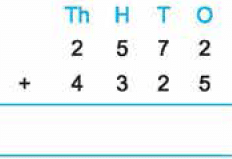
Ans:
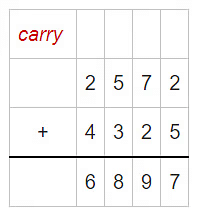
(b)
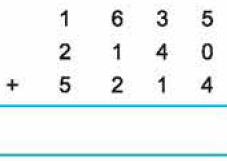
Ans:

Section C: Arrange in Columns and Add
9. 215, 340 and 100
Ans: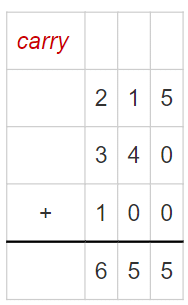
Sol: 215 + 340 + 100 = 650
10. 321, 436 and 157
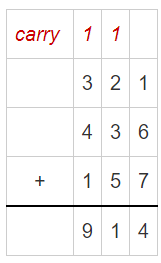
Sol: 321 + 436 + 157 = 914
Section D: Word Problems
11. A factory packed 1,348 bottles of pineapple juice. Guava juice bottles were 759 more than pineapple. How many guava juice bottles were packed?
Ans: 2,107
Sol: Number of guava bottles = Pineapple bottles + 759 = 1,348 + 759 = 2,107
12. In Kaziranga National Park, December had 8,591 visitors, and November had 6,415. How many more visitors came in December?
Ans: 2,176
Sol: More visitors = December visitors - November visitors = 8,591 - 6,415 = 2,176
13. A toy store sold 444 teddy bears last month. This month, they sold 341 more teddy bears than last month. How many teddy bears did they sell this month?

Ans: 785
Sol: Teddy bears this month = Last month + Additional = 444 + 341 = 785
14. The sum of a 2-digit number and its reverse is 55. List all such numbers.
Ans: 14, 23, 32, 41
Sol: For a 2-digit number, the digits must add so that the number plus its reverse equals 55. Try pairs of digits that add to 5:
1 + 4 → numbers 14 and 41; 2 + 3 → numbers 23 and 32.
Check: 14 + 41 = 55; 23 + 32 = 55; 32 + 23 = 55; 41 + 14 = 55.
15. Gujarat has 444 more tigers than Uttarakhand, which has 116 tigers. How many tigers are there in Gujarat?

Ans: 560
Sol: Tigers in Gujarat = Uttarakhand tigers + 444 = 116 + 444 = 560
FAQs on Worksheet Solutions: Elephants, Tigers, and Leopards
| 1. What are the main differences between elephants, tigers, and leopards? |  |
| 2. What do elephants, tigers, and leopards eat? | |
| 3. Where can you typically find elephants, tigers, and leopards in the wild? | |
| 4. How do elephants, tigers, and leopards communicate? | |
| 5. Why are elephants, tigers, and leopards considered important to their ecosystems? | |