Rectilinear Motion

What is Rectilinear Motion?
When we require only one co-ordinate axis and time to describe a particle's motion, it is said to be in linear motion or rectilinear motion. Examples of linear motion are a parade of soldiers, a train moving along a straight line, and many more.
Distance and Displacement
So now that we have learned about linear motion, we will discuss two terms related to change in position. These are called - 'Distance' and 'Displacement'.
Distance is defined as,
The total path length covered during a journey
While displacement is defined as,
The path length from final position of the particle to the origin O.
Consider the following figure:
We have an origin O. Measurements to the right of O are taken as a positive while to the left are taken as negative. Suppose a person who starts from origin O reaches point A,
Distance = OA
Displacement = OA
Now he turns and reaches point B,
Distance = OA + AB
Displacement = -OB
As we can see, displacement is negative since it is measured to the left of the origin. We can infer from the above example that distance is always positive while displacement can either be positive or negative.
Speed and Velocity
These terms are used to describe the rate of change of position. Speed is the rate of change in distance, while velocity is the rate of change in displacement. Comparing from above as distance can never be negative, so the speed is never negative while velocity can be positive and negative. In mathematical terms, these are defined as follows:
Speed = 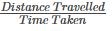
Velocity = 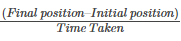
Examples for Rectilinear Motion
Following are the rectilinear motion examples:
- The use of elevators in public places is an example of rectilinear motion.
- Gravitational forces acting on objects resulting in free fall is an example of rectilinear motion.
- Kids sliding down from a slide is a rectilinear motion.
- The motion of planes in the sky is a rectilinear motion.
Types of Rectilinear Motion
There are three types of rectilinear motion and they are:
- Uniform rectilinear motion: When an object travels at a constant speed with zero acceleration it is known as uniform rectilinear motion.
- Uniformly accelerated rectilinear motion: When an object travels with constant acceleration it is known as uniformly accelerated rectilinear motion.
- Rectilinear movement with non-uniform acceleration: When an object travels at an irregular speed and acceleration it is known as a rectilinear movement with non-uniform acceleration.
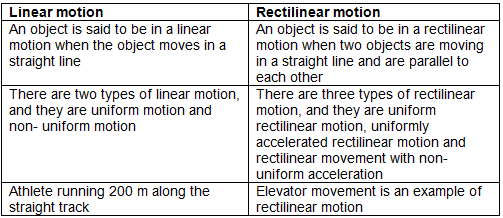
What is the difference between linear and rectilinear motion?
FAQs on Rectilinear Motion
| 1. What is rectilinear motion? |  |
| 2. Can you provide examples of rectilinear motion? | |
| 3. What are the types of rectilinear motion? | |
| 4. What is the difference between linear and rectilinear motion? | |
| 5. How is rectilinear motion relevant for UPSC exams? | |




