Short & Long Answer Questions: Climates of India

Short Answer Questions
Q1: How do seasons influence festivals in India?
Ans: Many Indian festivals are linked to the changing seasons and farming cycles. Seasons determine when crops are sown and harvested, so communities celebrate at harvest time to give thanks and share food. For example, Baisakhi celebrates the spring harvest in Punjab, Onam marks the monsoon harvest in Kerala and Pongal celebrates the harvest in Tamil Nadu. Seasonal festivals also follow religious and cultural calendars that reflect local weather and agricultural life.
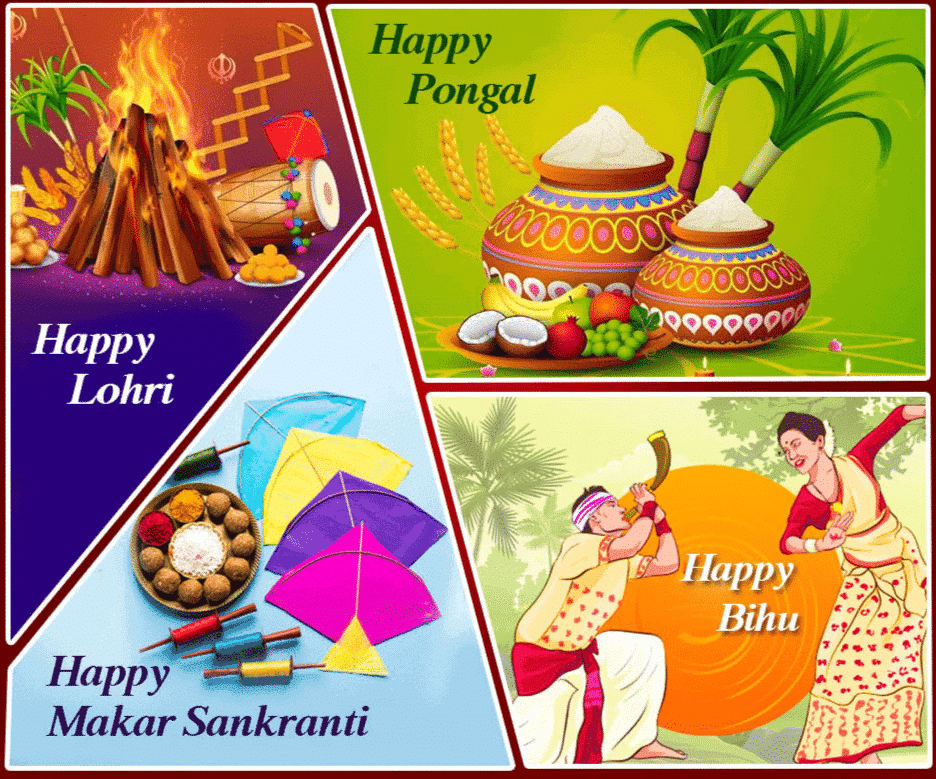 Seasons influencing festivals
Q2: Why does the Deccan Plateau receive less rainfall than the Western Ghats?
Ans: The Western Ghats face the incoming monsoon winds and force moist air to rise. As the air rises it cools and the moisture condenses to give heavy rain on the western slopes. The Deccan Plateau lies on the leeward side of these mountains and falls in the rain-shadow region, so it receives much less rainfall.
Q3: How does altitude affect temperature in cities like Ooty and Coimbatore?
Ans: Even at the same latitude, higher places like Ooty are cooler than lower places like Coimbatore because temperature generally falls with height. The air is thinner and holds less heat at higher altitudes, so hill stations stay cooler, especially at night.
Q4: Why do inland areas like Nagpur experience greater temperature variation than coastal cities like Mumbai?
Ans: Land heats up and cools down faster than the sea. Coastal cities such as Mumbai are moderated by the nearby ocean, which keeps temperatures steadier. Inland places like Nagpur do not get this moderating effect, so they have hotter summers and colder winters with greater daily and seasonal temperature ranges.
Q5: What is the role of sea winds in India's climate?
Ans: Sea winds bring moisture from the Indian Ocean, Arabian Sea and Bay of Bengal. During the monsoon, these moist winds move inland and cause most of India's rainfall. Sea breezes also help to cool coastal areas during the day and reduce extreme temperature changes there.
Q6: How do people in the Thar Desert adapt to the arid climate?
Ans: People living in the Thar Desert adapt to the hot and dry climate mainly by managing water carefully. They collect and store rainwater when it is available and use it sparingly for drinking and farming.Communities have developed traditional methods of saving water because rainfall is very low and rivers are scarce.
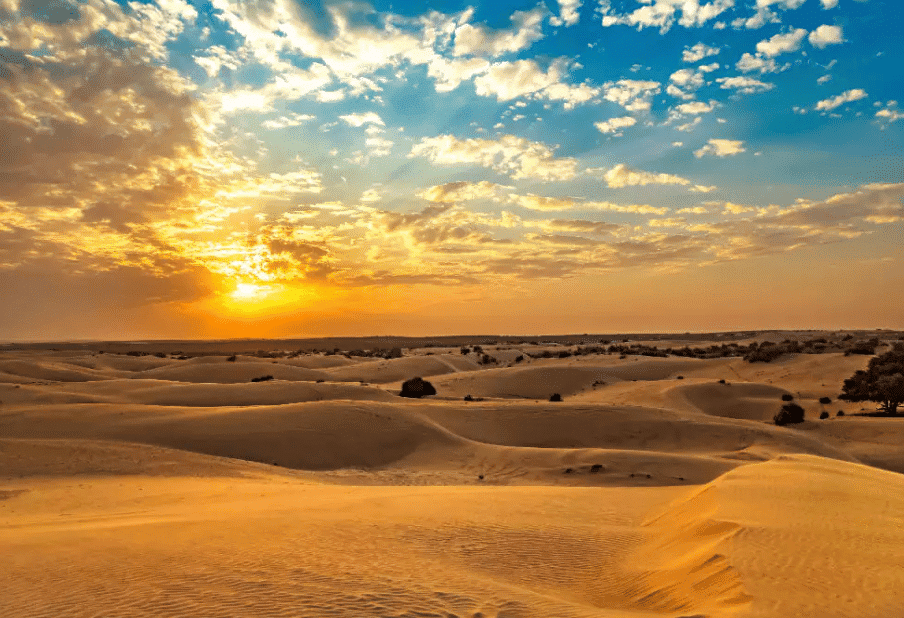 Thar Desert
Q7: What is the difference between weather and climate?
Ans: Weather is the short-term condition of the atmosphere at a place, such as rain, sunshine or a windy day. Climate is the average pattern of weather over many years for a region and tells us what to expect generally, for example whether a place is usually hot, cold, dry or wet.
Q8: How do topographical features affect rainfall in India?
Ans: Mountains, plateaus and coasts change how winds move and whether they rise or fall. The Himalayas block cold northern winds and help form snow, while ranges like the Western Ghats force monsoon winds upward so they drop rain on the windward side and leave a dry rain-shadow on the other side. Coastal plains receive moisture from the sea, whereas plateaus and deserts get less rain.
Q9: How do monsoons affect agriculture in India?
Ans: Most Indian farming depends on monsoon rains for watering crops. A good monsoon helps crops grow well and increases harvests, while a weak or late monsoon can cause drought, poor yields and financial loss for farmers. Excessive rain or floods during the monsoon can also damage crops and soil.
Q10: Why is understanding microclimates important for farmers?
Ans: Microclimates are small local climate variations caused by shade, slope, water bodies or buildings. Farmers use microclimate knowledge to choose the right crops, decide planting times and protect plants from frost or heat. This helps improve yields even within the same village or field.
Q11: What is traditional knowledge used for predicting monsoons?
Ans: Communities have long used signs from nature to guess the coming rains, such as unusual behaviour of birds or fish, early flowering of certain trees, or the arrival of particular winds. These signs are simple indicators that, when combined with local experience, help people prepare. Today, such traditional methods are often used together with scientific forecasts.
Q12: How does climate influence traditional art and culture in India?
Ans: Climate shapes music, dance, costumes and festivals because communities celebrate events tied to seasons and farming. For example, songs and dances mark sowing and harvesting seasons, and local dress adapts to heat or cold. Stories, rituals and crafts often reflect weather patterns and farming life passed down through generations.
Long Answer Questions
Q1: Explain how latitude and the Earth's shape influence climate in different parts of India.
Ans:
- Latitude affects how directly the Sun's rays fall on different places.
- Areas near the Equator receive more direct rays, so they are hotter.
- As we move northwards, the rays become more slanted and spread over a larger area, giving less heat.
- Because of this, southern places like Kanyakumari are warm for most of the year, while northern places such as Srinagar are much cooler.
- The curved shape of the Earth causes this change in temperature from south to north, creating different climate zones across India.
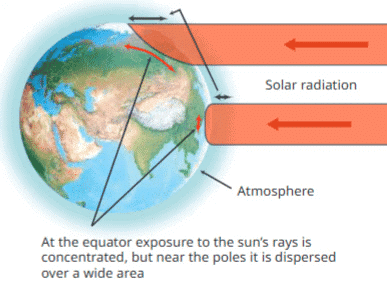 Effect of Latitude
Q2: What are the characteristics of the summer and winter monsoons in India?
Ans:
- The summer monsoon (mainly June to September) brings strong south-west winds from the sea to the land. These winds are laden with moisture and give heavy rainfall, especially on the western coast and northeastern states.
- The summer monsoon usually starts in the south and advances northwards and eastwards, providing most of the yearly rain needed for crops.
- The winter monsoon (mainly October to January) involves dry north-east winds that blow from land to sea. These winds carry less moisture, so most of the country is drier in winter.
- However, parts of east and south India may receive some winter rain from winds that pick up moisture over the Bay of Bengal.
- Both monsoons together shape the agricultural calendar and water availability across India.
Q3: How does India's geography contribute to its climate diversity?
Ans:
- India has a wide range of landforms - high mountains, plateaus, deserts and long coasts - each of which affects temperature and rainfall in different ways.
- The Himalayas block cold northern air and create snow and cold conditions in the mountain regions, protecting peninsular India from extreme cold.
- The Thar Desert is hot and dry because it lies inland with little rainfall and open terrain that heats quickly.
- Coastal regions receive moisture from the seas and therefore get heavier rain and milder temperatures.
- The Deccan Plateau lies inland and gets moderate rainfall and warm temperatures; mountain ranges create rain shadows in some areas.
- These varied features together produce many different climates across India, from tropical to alpine.
Q4: Describe how floods and glacial bursts impact different parts of India.
Ans:
- Floods happen when rivers overflow their banks or drainage fails during heavy rain, causing water to spread over land and damaging crops, homes and roads.
- In the Himalayan regions, melting glaciers or sudden heavy rains known as cloudbursts can cause fast and powerful flash floods that move large amounts of water and debris.
- Glacial lake bursts, such as the disaster in Uttarakhand in 2013, can destroy villages, bridges and roads and lead to loss of life.
- Lowland states like Bihar and Kerala also suffer regular monsoon floods that displace people, ruin crops and damage infrastructure.
- Floods have short-term impacts like loss of life and property and long-term effects such as soil erosion and disruption of livelihoods.
Q5: What are the causes and effects of landslides in India?
Ans:
- Landslides are sudden movements of rock, earth or debris on slopes, common in hilly regions such as Himachal Pradesh, Uttarakhand and Sikkim.
- They are often triggered by heavy rain, earthquakes, steep slopes, deforestation and unstable construction on hillsides.
- Poor land use and cutting of slopes for roads and buildings increase the risk of landslides.
- Effects include destruction of houses and roads, blocking of rivers which can cause floods, loss of life, and long delays in transport and rescue operations.
- Early warning systems, careful land use planning and slope protection can reduce landslide risks.
Q6: How do forest fires affect the environment and people?
Ans:
- Forest fires burn vegetation and destroy wildlife habitats, reducing biodiversity and upsetting ecosystems.
- They release smoke and gases that pollute the air, harm human health and contribute to climate change.
- Fires can spread rapidly in dry, windy weather or when people are careless with campfires and burning waste.
- States such as Uttarakhand and parts of central India often face seasonal forest fires that threaten villages and farmland.
- Preventive measures, quick firefighting response and public awareness help reduce damage from forest fires.
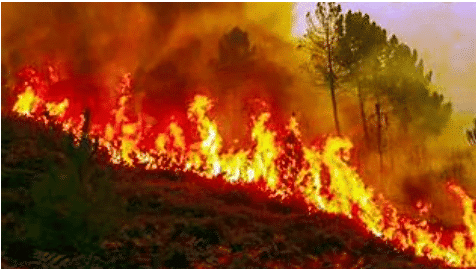 Forest Fires
Q7: Explain how climate change is affecting India's weather and agriculture.
Ans:
- Climate change is making rainfall patterns more irregular and is increasing average temperatures in many places.
- Winters are becoming shorter in some regions and heatwaves are becoming more frequent and intense, harming health and crops.
- Unpredictable rains, too little rain or heavy downpours at the wrong time can cause crop failure and lower yields.
- Farmers face greater uncertainty, which can increase poverty and raise food prices.
- Poor and marginalised communities who depend directly on rain and land are the most vulnerable to these changes.
Q8: What are some solutions to reduce the impact of climate change?
Ans:
- Reduce greenhouse gas emissions by using renewable energy such as solar and wind power instead of fossil fuels.
- Planting trees and protecting forests helps absorb carbon dioxide and supports biodiversity.
- Save energy at home, recycle materials and reduce waste to lower emissions.
- Governments can set policies that encourage clean technology, public transport and efficient farming methods.
- Adapting to changes-such as using drought-tolerant crops, better water management and disaster planning-helps communities cope with climate impacts.
- Combining these steps can reduce future warming and lessen harm to people and nature.
FAQs on Short & Long Answer Questions: Climates of India
| 1. What are the major seasons in India? |  |
| 2. How does the climate vary in different regions of India? | |
| 3. What factors influence the climate of India? | |
| 4. What is the impact of the monsoon season on agriculture in India? | |
| 5. How do climate change and global warming affect India's climate? | |





