Short & Long Answer Questions: The Gupta Era: An Age of Tireless Creativity

Short Answer Questions
Q1: How did Samudragupta expand the Gupta Empire?
Ans: Samudragupta expanded the Gupta Empire mainly through skilful military campaigns. He defeated many neighbouring kings across north and central India and either annexed their territories or made them pay tribute while allowing local rulers to remain in power. He combined force with diplomacy and rewarded loyal allies. His achievements are recorded in inscriptions such as the Prayāga (Allahabad) inscription, which describes his conquests and the wide area under Gupta influence.
Q2: What role did Faxian's travelogue play in understanding Gupta society?
Ans: Faxian's travelogue, A Record of Buddhistic Kingdoms, is an important foreign account that helps us understand Gupta society. Written by a Chinese Buddhist monk who visited India in the early 5th century CE, it describes peaceful and prosperous conditions, the presence of many Buddhist monasteries, the welfare of people, and how merchants and pilgrims lived. His observations give historians useful evidence about religion, social life and the economy during the Gupta period.
Q3: What does the Iron Pillar in Delhi signify?
Ans: The Iron Pillar in Delhi signifies the advanced metallurgy of the Gupta period. Its remarkable resistance to rust shows the high skill of Gupta metalworkers in forging and treating iron. The pillar serves as evidence that artisans of that time had a good knowledge of metal-making techniques and could produce large, durable iron structures.
 Iron Pillar, Mehrauli, Delhi
Q4: How did the Gupta rulers contribute to Sanskrit literature?
Ans: The Gupta rulers patronised Sanskrit literature and encouraged poets and scholars. Their support led to the production of great works, such as Kālidāsa's Meghadūtam and classical dramas like Abhijñānaśākuntalam, as well as the compilation and propagation of the Purāṇas. Royal patronage helped Sanskrit literature flourish and set standards for later classical writing.
Q5: Why was the Gupta period considered the "Classical Age" of India?
Ans: The Gupta period is called the Classical Age because it witnessed outstanding achievements in several fields. Art and architecture reached new heights (for example, at the Ajanta Caves), Sanskrit literature produced masterpieces, and science and mathematics advanced through scholars like Āryabhaṭa. Political stability and economic prosperity during much of this period allowed culture and learning to flourish, leaving a lasting legacy.
Q6: How did the Gupta rulers support Buddhism and other religions?
Ans: Gupta rulers practised religious tolerance and supported a range of faiths. They funded Buddhist vihāras and monasteries, patronised Brahmanical rituals and learned Brahmin scholars, and allowed Jain communities to continue their practices. This policy of support and tolerance encouraged peaceful coexistence and cultural exchange among different religious groups.
Q7: What was the significance of the Gupta Empire's coinage system?
Ans: The Gupta coinage system was important for the economy and for showing royal authority. Coins were issued in gold, silver and copper and often carried images of rulers and deities. These well-made coins helped trade by providing a reliable medium of exchange, displayed the empire's prosperity, and served as a form of political propaganda that spread the image and titles of the rulers.
Q8: How did Gupta art influence Indian architecture?
Ans: Gupta art influenced Indian architecture through refined sculptural work, elegant temple designs and detailed carvings. Artistic developments of the period are visible in rock-cut monuments and temple decorations, with examples such as the Ajanta Caves, where murals and statues show advanced techniques in stone carving and painting. These styles set patterns for later temple architecture across India.
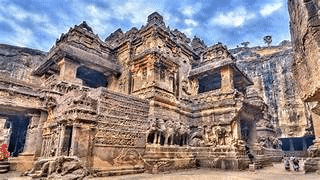 Ajanta Caves
Q9: What role did Varāhamihira play in the development of Indian science?
Ans: Varāhamihira was a leading scholar in astronomy and related sciences during the Gupta period. His book Brihat Samhita compiled observations about planets, weather, eclipses and natural phenomena, and combined practical knowledge with traditional ideas. His work influenced later scientists and shows the period's interest in systematic study of the natural world.
Q10: How did Kālidāsa contribute to Indian literature?
Ans: Kālidāsa made a lasting contribution to Sanskrit literature through his poetry and plays. Works such as Meghadūtam (The Cloud Messenger) and the play Abhijñānaśākuntalam are admired for their lyrical beauty, vivid images of nature and clear expression of human emotions. Kālidāsa's language and style became models for later poets and dramatists.
Q11: How did the Gupta administration support trade and economy?
Ans: The Gupta administration supported trade and the economy through several measures. They maintained a structured taxation system that provided revenue for the state, issued standard coins to ease transactions, and protected trade routes. These steps encouraged internal commerce and long-distance trade with regions beyond India, helping the empire to prosper economically.
Q12: What led to the decline of the Gupta Empire?
Ans: The decline of the Gupta Empire resulted from a mix of external invasions and internal weaknesses. Repeated invasions by groups such as the Hunas weakened the empire's frontier defences. At the same time, later rulers faced political instability and loss of central control, which led to the breakup of the empire into smaller regional kingdoms.
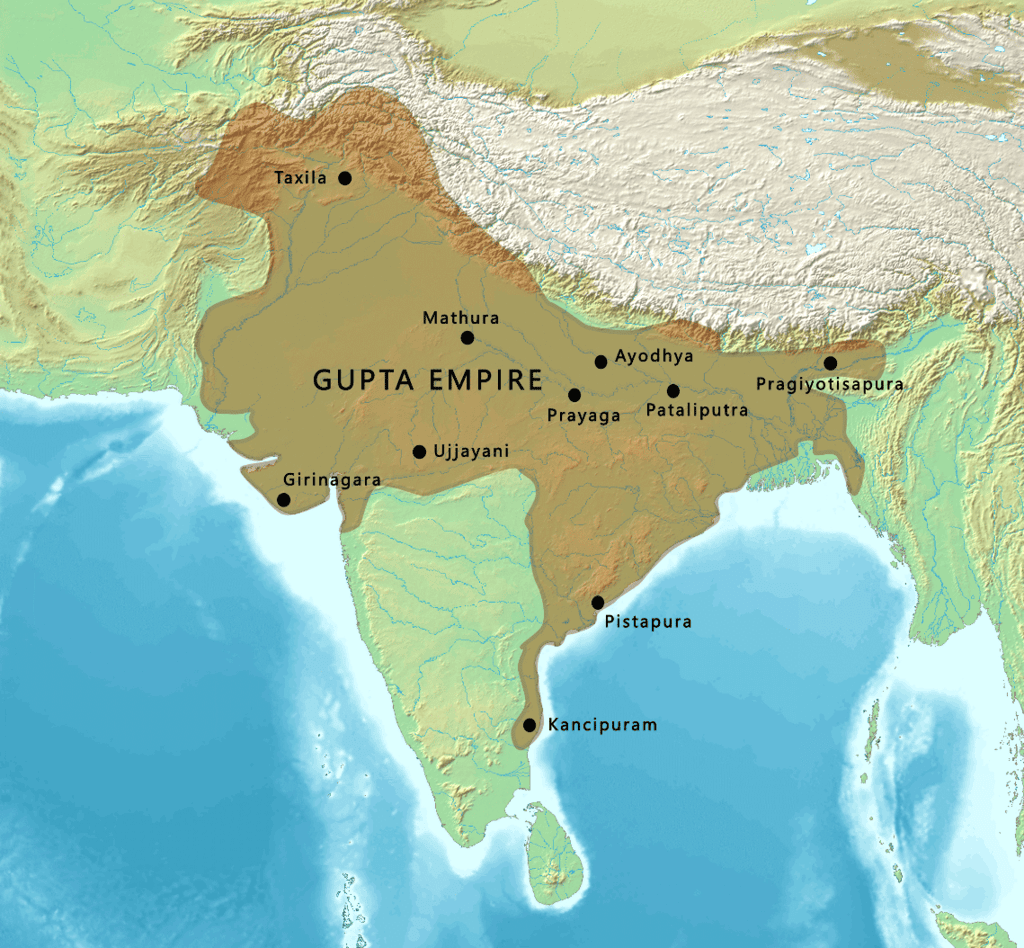 Gupta Empire
Long Answer Questions
Q1: How did Samudragupta contribute to the expansion of the Gupta Empire?
Ans: Samudragupta expanded the Gupta Empire through a combination of military skill, strategic policy and careful governance. He led successful campaigns against many neighbouring kingdoms and brought them under Gupta influence either by annexation or by making them tributary states. After victory, he often restored friendly rulers to power under Gupta suzerainty, which helped maintain stability while extending his authority. Records such as the Prayāga inscription praise his military achievements and show that his conquests created a large and more unified political area that provided a stable base for the cultural and economic prosperity of the Gupta age.
Q2: How did the Gupta period contribute to the development of science and mathematics?
Ans: The Gupta period made important contributions to science and mathematics through the work of scholars and systematic study. Notable contributions include:
• Āryabhaṭa and other scholars advanced astronomy and mathematics. Āryabhaṭa explained the rotation of the Earth on its axis and gave accurate methods to calculate eclipses. He made precise mathematical calculations and worked on algebra and trigonometry.
• Scholars compiled and shared knowledge in texts that combined observation with mathematical rules, helping later scientists to build on their work.
Overall, the Gupta period provided both the intellectual atmosphere and royal patronage that allowed scientific ideas to develop and spread.
Q3: Discuss the role of art and architecture during the Gupta period.
Ans: Art and architecture flourished during the Gupta period and set lasting standards for Indian cultural expression. Key points are:
• Religious monuments: The period saw the building and decoration of temples, monasteries (vihāras) and cave complexes.
• Sculpture and relief: Gupta artists produced delicate and well-proportioned sculptures of deities and human figures, showing calm expressions and graceful postures.
• Painting: Murals such as those in the Ajanta Caves display advanced techniques in composition, colour and storytelling.
• Influence: The architectural styles and sculptural forms developed in this period influenced temple design and artistic traditions in later centuries, making Gupta art a model for the classical style of India.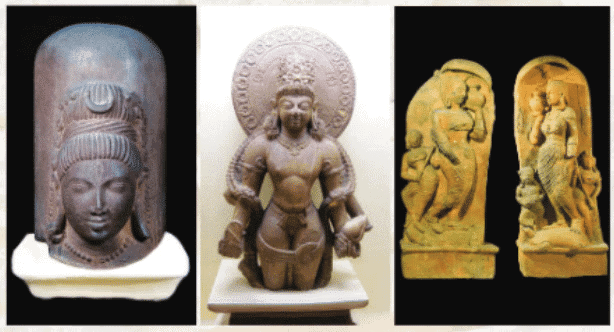 Aspects of Gupta Art
Q4: How did the Gupta rulers encourage religious tolerance?
Ans: Gupta rulers encouraged religious tolerance by supporting different religious communities and allowing them freedom to practise their faiths. They funded Buddhist vihāras and supported Brahmanical learning and ritual; Jain communities also continued their traditions. This patronage of multiple religions, together with a general policy of tolerance, helped create an environment in which learning, art and religious activity could flourish jointly.
Q5: How did trade contribute to the Gupta Empire's prosperity?
Ans: Trade was a major factor in the Gupta Empire's prosperity because:
• The empire occupied strategic positions on inland and maritime trade routes, which connected India with South-East Asia, Central Asia and the Mediterranean world.
• A standard coinage and state protection of routes encouraged merchants to trade widely.
• Taxes and duties on trade provided revenue that supported administration, public works and the military.
Through trade in textiles, spices, gems and other goods, the Gupta economy grew stronger and cities prospered.
Q6: What is the significance of Faxian's travelogue in understanding Gupta society?
Ans: Faxian's travelogue, A Record of Buddhistic Kingdoms, is significant because it provides a first-hand foreign account of life in Gupta India. Faxian, a Chinese Buddhist monk, describes the peaceful and prosperous conditions he observed, the presence and condition of Buddhist monasteries, the welfare of ordinary people, the role of merchants and the treatment of different social groups. His observations offer independent evidence about social and religious life under the Guptas and complement Indian inscriptions and archaeological findings.
Q7: Explain the contributions of Kālidāsa to Sanskrit literature.
Ans: Kālidāsa is one of the greatest poets and dramatists of classical Sanskrit literature. His contributions include:
• Poetry: Works such as Meghadūtam showcase lyrical beauty, vivid natural imagery and deep feeling.
• Drama: Plays like Abhijñānaśākuntalam combine strong characterisation with refined language and were admired for their dramatic art.
• Influence: Kālidāsa's style, use of language and poetic imagery set standards for later Sanskrit poets and helped shape classical Indian literary taste.
 Kalidas
Q8: How did the decline of the Gupta Empire impact India?
Ans: The decline of the Gupta Empire in the 6th century CE had several important effects on India. With the weakening of central authority-caused by foreign invasions such as those by the Hunas and by internal problems-large political unity broke down and regional kingdoms emerged. This led to political fragmentation and the rise of many small states. However, the cultural, scientific and artistic achievements of the Gupta period continued to influence later Indian society and remained an important legacy despite the political changes.
FAQs on Short & Long Answer Questions: The Gupta Era: An Age of Tireless Creativity
| 1. What were the major contributions of the Gupta Empire in the field of science and mathematics? |  |
| 2. How did the Gupta period influence art and culture in India? | |
| 3. What role did trade play in the Gupta Empire's economy? | |
| 4. Who were some prominent rulers of the Gupta Empire, and what were their achievements? | |
| 5. What were the religious developments during the Gupta period? | |