CBSE Class 7 > Class 7 Notes > Mathematics Olympiad > Short & Long Question Answers: Working with Fractions
Short & Long Question Answers: Working with Fractions

Q1: Simplify: 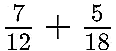
Ans: LCM of 12 and 18 = 36.
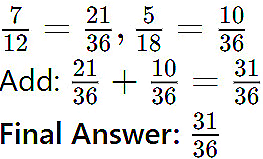
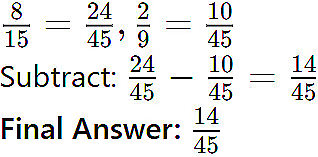
Q2: Simplify and reduce to lowest terms: 
Ans: LCM of 15 and 9 = 45
Q3: Find: 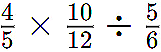
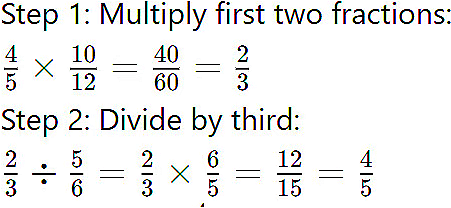
Ans:
Q4: Simplify: 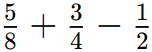
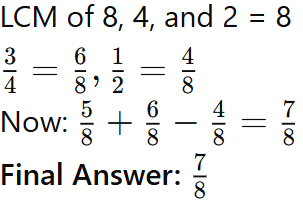
Ans:
Q5: Multiply and reduce: 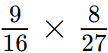
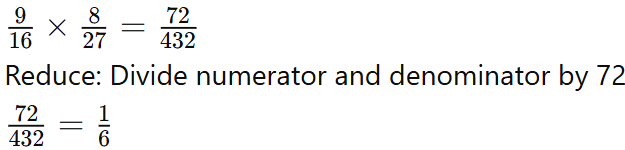
Ans:
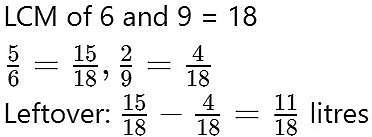
Q6: A container holds  liter of milk. If
 litre is used, how much is left?
Ans:
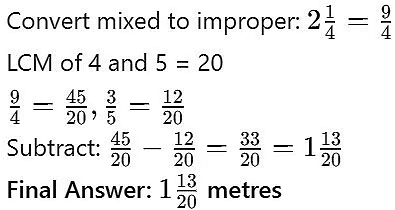
Q7: A ribbon is meters long. If
  metre is cut, how much remains?
Ans:
Q8: A tank is  full. If total capacity is 140 litres, how much water is in it?
Ans:

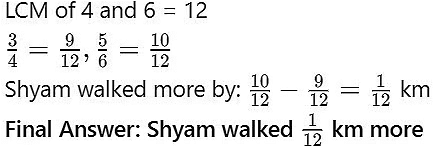
Q9: Ram walked km, Shyam walked
  km. Who walked more and by how much?
Ans:
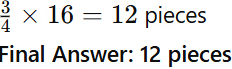
Q10: A chocolate has 16 pieces. Ria ate of it. How many pieces did she eat?
Ans:
Q11: Which is greater:  ?
?
Ans:
Final Answer: 5/6 is greater
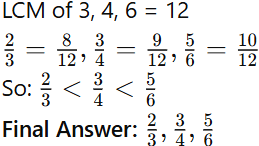
Q12: Arrange in ascending order: 
Ans:
The document Short & Long Question Answers: Working with Fractions is a part of the Class 7 Course Mathematics Olympiad Class 7.
All you need of Class 7 at this link: Class 7
FAQs on Short & Long Question Answers: Working with Fractions
| 1. What are fractions, and how are they used in everyday life? |  |
Ans. Fractions represent a part of a whole and are expressed as a ratio of two numbers, with the top number (numerator) indicating how many parts are taken, and the bottom number (denominator) showing how many equal parts the whole is divided into. In everyday life, fractions are used in cooking (like measuring ingredients), in finance (like calculating discounts), and in various practical situations where parts of a whole are involved.
| 2. How do you add and subtract fractions with different denominators? | |
Ans. To add or subtract fractions with different denominators, first, you need to find a common denominator. This is a number that both denominators can divide into. Once you have the common denominator, convert each fraction to an equivalent fraction with this denominator. Then, you can add or subtract the numerators and keep the common denominator. Finally, simplify the result if possible.
| 3. What is the process for multiplying fractions? | |
Ans. To multiply fractions, simply multiply the numerators together to get the new numerator and multiply the denominators together to get the new denominator. After multiplying, you may need to simplify the fraction by finding the greatest common factor between the numerator and denominator and dividing both by this number.
| 4. How can I convert a mixed number into an improper fraction? | |
Ans. To convert a mixed number (which has a whole number and a fraction) into an improper fraction, multiply the whole number by the denominator of the fraction, then add the numerator. The result becomes the new numerator, while the denominator remains the same. For example, for the mixed number 2 1/3, you multiply 2 (the whole number) by 3 (the denominator) to get 6, then add 1 to get 7. Thus, 2 1/3 = 7/3.
| 5. What are some common mistakes to avoid when working with fractions? | |
Ans. Common mistakes when working with fractions include forgetting to find a common denominator when adding or subtracting, incorrectly multiplying or dividing the numerators and denominators, and failing to simplify the final answer. It's also easy to misread fractions or mix up the numerator and denominator, so careful attention is essential.
About this Document

2.9K Views

4.71/5 Rating

Apr 20, 2026 Last updated
Document Description: Short & Long Question Answers: Working with Fractions for Class 7 2026 is part of Mathematics Olympiad Class 7 preparation. The notes and questions for Short & Long Question Answers: Working with Fractions have been prepared according to the Class 7 exam syllabus. Information about Short & Long Question Answers: Working with Fractions covers topics like and Short & Long Question Answers: Working with Fractions Example, for Class 7 2026 Exam. Find important definitions, questions, notes, meanings, examples, exercises and tests below for Short & Long Question Answers: Working with Fractions.
Introduction of Short & Long Question Answers: Working with Fractions in English is available as part of our Mathematics Olympiad Class 7 for Class 7 & Short & Long Question Answers: Working with Fractions in Hindi for Mathematics Olympiad Class 7 course. Download more important topics related with notes, lectures and mock test series for Class 7 Exam by signing up for free. Class 7: Short & Long Question Answers: Working with Fractions
Description
Short & Long Question Answers: Working with Fractions of Mathematics Olympiad Class 7 - variety of important questions with solutions, helping you prepare for exam. Download free PDF from EduRev.
Information about Short & Long Question Answers: Working with Fractions
In this doc you can find the meaning of Short & Long Question Answers: Working with Fractions defined & explained in the simplest way possible. Besides explaining types of Short & Long Question Answers: Working with Fractions theory, EduRev gives you an ample number of questions to practice Short & Long Question Answers: Working with Fractions tests, examples and also practice Class 7 tests



Related Searches
Free, past year papers, practice quizzes, pdf , Short & Long Question Answers: Working with Fractions, video lectures, Sample Paper, Summary, Previous Year Questions with Solutions, Short & Long Question Answers: Working with Fractions, shortcuts and tricks, study material, Exam, Semester Notes, Viva Questions, Objective type Questions, ppt, MCQs, Short & Long Question Answers: Working with Fractions, Important questions, mock tests for examination, Extra Questions;