Chapter Notes: Properties of Two-Dimensional Shapes (Term 1)


Naming Figures by the Number of Sides
This section teaches students how to identify and name closed 2D shapes based on the number of straight sides they have.Polygons
A polygon is a closed 2D shape with straight sides.
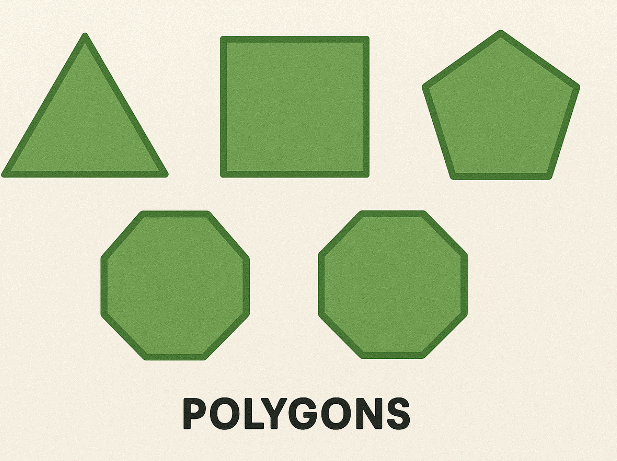 Polygons are named according to the number of sides, using Greek prefixes:
- Triangle: 3 sides.
- Quadrilateral: 4 sides.
- Pentagon: 5 sides ("penta" means five).
- Hexagon: 6 sides ("hexa" means six).
- Heptagon: 7 sides ("hepta" means seven).
- Octagon: 8 sides ("octa" means eight).
Example: A stop sign is an octagon because it has 8 straight sides.
Identifying Shapes
- Shapes are classified by counting their sides.
- Example: A shape with 5 straight sides is a pentagon, regardless of the length of the sides or the size of the angles.
Angles
This section explores angles, how they are formed, and how to compare their sizes using tools like rulers and cardboard strips.What is an Angle?
- An angle is formed when two lines meet at a point or have different directions.
- If two lines have the same direction, they are parallel and remain the same distance apart (no angle is formed).
Example: Two lines drawn from two dots that meet on the right side of a page form an angle at the meeting point.
Extending Lines
- Extending two lines can show if they meet (forming an angle) or stay parallel (no angle).
- Example: On a long wall, two lines with different directions will eventually meet, creating an angle, while parallel lines stay equidistant.
Comparing Angles with Cardboard
A folded cardboard strip can model an angle, with the two arms representing lines.
Moving the arms changes the angle size:
- Wider arms = larger angle.
- Narrower arms = smaller angle.
Example: In photos of a cardboard strip, the angle in Photo C (widest arms) is larger than in Photo B, which is larger than in Photo A (narrowest arms).
Angles in Quadrilaterals
- In a quadrilateral (4-sided shape) with vertices A, B, C, and D, angles are formed at each vertex where two sides meet.
- A folded cardboard strip can help compare which vertex has the largest or smallest angle by aligning the arms with the sides.
Comparing Shapes to Paper
- An A4 sheet of paper is a rectangle (4 sides, opposite sides equal, all angles right angles).
- Comparing the paper to other shapes helps identify differences in sides or angles.
Example: A shape with unequal opposite sides differs from a rectangle.
Rotating Shapes
- Rotating a traced shape (e.g., Figure A) can show if angles at different vertices are equal.
- Example: In a rectangle, rotating the tracing shows that opposite angles (e.g., top left and bottom right) are equal.
Angles of Different Sizes
This section introduces types of angles (right, acute, obtuse, straight, reflex, revolution) and how to measure them using a right-angle template.Right Angles
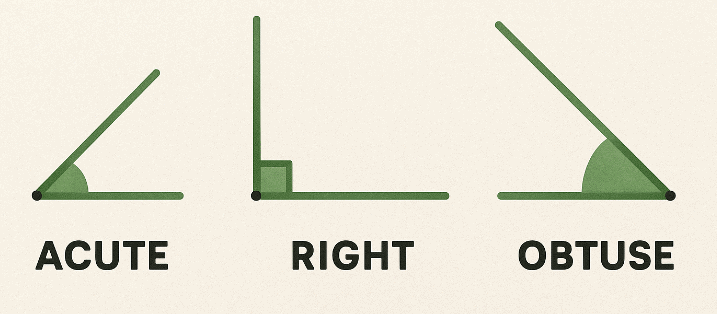
- A right angle is the angle at the corner of a rectangle, like an A4 sheet of paper.
- A right-angle template (a torn corner of an A4 sheet) can check if an angle is a right angle.
Example: All four corners of an A4 sheet have right angles, so the template matches each corner.
Creating and Comparing Angles
Drawing two lines can form angles of different sizes:
- One angle may be larger than a right angle, another smaller.
- Two equal angles can be drawn and checked with a right-angle template to see if they are right angles.
Example: Two lines forming equal angles may not be right angles unless they match the template.
Using Strips to Model Angles
Two narrow strips of paper or cardboard can demonstrate angles:
- Place strips on top of each other and pivot one to form an angle.
- Adjust the angle to be smaller or larger than a right angle.
Types of Angles
- Acute angle: Smaller than a right angle (e.g., less than the corner of an A4 sheet).
- Obtuse angle: Larger than a right angle but smaller than a straight angle.
- Straight angle: Formed when two lines create a straight line (e.g., strips aligned end-to-end).
- Reflex angle: Larger than a straight angle but smaller than a full turn (e.g., turning a strip beyond a straight line).
- Revolution: A complete turn, where the strip returns to its starting position (full circle).
Identifying Angles in Shapes
- In a polygon, angles at vertices can be acute, right, obtuse, or reflex, depending on the shape.
- Example: A quadrilateral may have right angles at some vertices and acute or obtuse at others.
Parallelograms
This section defines parallelograms and compares them to rectangles, focusing on their properties.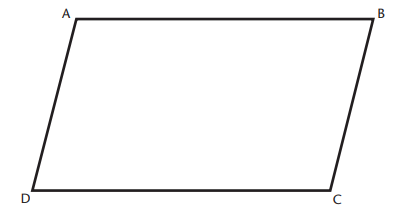
What is a Parallelogram?
A parallelogram is a quadrilateral with:
- Equal opposite angles: Angles at opposite vertices (e.g., A and C, B and D) are equal.
- Equal opposite sides: Sides opposite each other (e.g., AB = DC, AD = BC) are equal in length.
Example: Tracing a parallelogram and aligning vertex A with vertex C shows that angles A and C are equal, as are angles B and D.
Rectangles as Parallelograms
A rectangle is a special type of parallelogram with:
- Equal opposite sides (like all parallelograms).
- Equal opposite angles (all right angles).
- Difference: A rectangle has all right angles, while a general parallelogram may have acute or obtuse angles.
Example: A drawn rectangle has opposite sides AB = CD and AD = BC, and all angles = 90° (right angles).
Comparing Properties
- In a parallelogram, opposite sides and angles are equal, but angles are not necessarily right angles.
- In a rectangle, the right angles make it a specific type of parallelogram.
Points to Remember
- Polygon Names: Shapes are named by sides: triangle (3), quadrilateral (4), pentagon (5), hexagon (6), heptagon (7), octagon (8).
- Angles: Formed by two lines with different directions; parallel lines (same direction) form no angle.
- Right Angle: Matches the corner of a rectangle; used as a reference to classify other angles.
- Angle Types: Acute (< right angle), obtuse (> right angle, < straight angle), straight (straight line), reflex (> straight angle, < revolution), revolution (full turn).
- Parallelogram: Quadrilateral with equal opposite sides and angles; a rectangle is a parallelogram with right angles.
- Comparing Angles: Use tools like cardboard strips or right-angle templates to compare angle sizes in shapes.
- Shape Properties: Opposite sides and angles in parallelograms and rectangles are equal; rectangles have right angles.
Difficult Words
- Polygon: A closed 2D shape with straight sides (e.g., triangle, pentagon).
- Angle: The space between two lines that meet or have different directions.
- Right Angle: An angle equal to the corner of a rectangle (90°).
- Acute Angle: An angle smaller than a right angle.
- Obtuse Angle: An angle larger than a right angle but smaller than a straight angle.
- Straight Angle: An angle formed by two lines in a straight line.
- Reflex Angle: An angle larger than a straight angle but smaller than a full turn.
- Revolution: A complete turn, returning to the starting position.
- Parallelogram: A 4-sided shape with equal opposite sides and angles.
- Rectangle: A parallelogram with all right angles.
Summary
This chapter equips Grade 6 students with the skills to understand and analyze two-dimensional shapes. It begins by naming polygons based on their sides, such as pentagons (5 sides) and octagons (8 sides). Students learn about angles, formed when lines meet, and how to compare them using tools like cardboard strips. The chapter introduces angle types-right, acute, obtuse, straight, reflex, and revolution-using a right-angle template for reference. Finally, it explores parallelograms, highlighting their equal opposite sides and angles, and distinguishes rectangles as parallelograms with right angles. These concepts help students recognize and compare shapes and angles in everyday and mathematical contexts.