Chapter Notes: Numeric Patterns (Term 1)


Revising Sequences of Multiples
This section reviews sequences where numbers are multiples of a constant, such as 3, 4, or 5, and explores their patterns.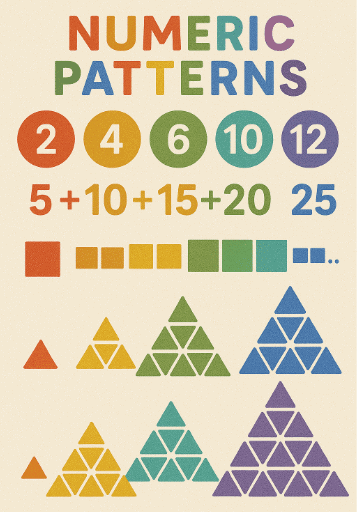
Sequences of Multiples
- A sequence of multiples is a list of numbers where each term is a multiple of a fixed number.
Example: Sequence 3, 6, 9, 12, 15, 18, ... (multiples of 3). - Horizontal pattern: Each term increases by a constant difference (e.g., +3 for 3, 6, 9, ...).
- Vertical pattern: Each term = position number × constant.
Example: For 3, 6, 9, ..., term = position × 3 (1st term = 1 × 3 = 3, 2nd = 2 × 3 = 6).
Working with Sequences
- To find the next terms, add the constant difference.
Example: For 4, 8, 12, 16, ... (+4), next term after 16 is 16 + 4 = 20. - To find the 100th term, multiply the position (100) by the constant.
Example: For 5, 10, 15, ..., 100th term = 100 × 5 = 500. - To check if a number is in the sequence, it must be divisible by the constant.
Example: For 9, 18, 27, ..., 360 ÷ 9 = 40 (integer), so 360 is in the sequence. - To find the position of a number, divide by the constant.
Example: For 360 in 9, 18, 27, ..., 360 ÷ 9 = 40, so it's the 40th term.
Flow Diagrams and Tables
- A flow diagram shows the rule: Input (position) → × constant → Output (term).
Example: For multiples of 6, input 1 → × 6 → 6, input 2 → × 6 → 12. - A table lists position numbers and terms, showing the pattern.
Example: For 6, 12, 18, ..., position 10 → 10 × 6 = 60.
Non-Multiple Sequences
This section explores sequences that are not simple multiples but have a constant difference, introducing a general rule for finding terms.Understanding Non-Multiple Sequences
- Non-multiple sequences have a constant difference but are offset from multiples.
Example: 6, 11, 16, 21, 26, ... (+5, but not multiples of 5). - Horizontal pattern: Constant difference between terms (e.g., +5 for 6, 11, 16, ...).
- Vertical pattern: Each term follows a rule: (position × constant difference) + offset.
Example: For 6, 11, 16, ..., rule is (position × 5) + 1 (1st term = (1 × 5) + 1 = 6).
Family of Sequences
Each sequence of multiples has related non-multiple sequences with the same constant difference.
Example (constant difference 4):
- Multiples of 4: 4, 8, 12, 16, ... (rule: position × 4).
- 1 more: 5, 9, 13, 17, ... (rule: (position × 4) + 1).
- 2 more: 6, 10, 14, 18, ... (rule: (position × 4) + 2).
- 1 less: 3, 7, 11, 15, ... (rule: (position × 4) - 1).
Calculating Terms
To find the 100th term, use the rule: (position × constant difference) + offset.
Example: For 10, 14, 18, 22, ... (+4, 6 more than multiples of 4):
- 100th term in multiples of 4 = 100 × 4 = 400.
- Add offset: 400 + 6 = 406.
To check if a number is in the sequence, solve: number = (position × constant) + offset.
Example: For 2, 5, 8, 11, ... (+3), is 623 in the sequence?
Rule: (position × 3) - 1 = 623 → 3 × position = 624 → position = 208 (integer), so 623 is the 208th term.
Flow Diagrams for Non-Multiples
Flow diagrams show: Input (position) → × constant → + or - offset → Output (term).
Example: For 5, 9, 13, ..., input 1 → × 4 → 4 → + 1 → 5.
Flow Diagrams and Rules
This section focuses on expressing sequence rules as flow diagrams and using them to find terms or positions.Writing Rules as Flow Diagrams
A flow diagram represents the calculation plan:
- For multiples: Input → × constant → Output.
Example: 4, 8, 12, ... → Input → × 4 → Output. - For non-multiples: Input → × constant → + or - offset → Output.
Example: 5, 9, 13, ... → Input → × 4 → + 1 → Output.
Differences: Non-multiple sequences include an offset (+ or -); multiples do not.
Using Flow Diagrams
- To find terms, apply the rule to the input (position).
Example: For 6, 10, 14, ..., rule (position × 4) + 2, 100th term = (100 × 4) + 2 = 402. - To find the position of a known term, reverse the rule.
Example: For 3, 7, 11, ..., rule (position × 4) - 1, find position of 27:
27 = (position × 4) - 1 → 28 = position × 4 → position = 7.
Comparing Sequences
Sequences with the same constant difference (e.g., +4) share a similar structure but differ in their offset.
Example: 4, 8, 12, ... (× 4), 5, 9, 13, ... (× 4 + 1), 6, 10, 14, ... (× 4 + 2).
Tables and Rules
This section uses tables to identify and apply rules for sequences, including matching input-output pairs to calculation plans.Identifying Rules from Tables
A table shows input (position) and output (term) numbers, revealing the rule.
Example: Input 0, 1, 2, 3, 5, 20 → Output 2, 7, 12, 17, 27, 102.
Test rules:
- Rule 1: Input + 6 → 1 + 6 = 7 (matches), but 0 + 6 ≠ 2 (fails).
- Rule 3: (Input × 5) + 2 → 1 × 5 + 2 = 7, 0 × 5 + 2 = 2, 20 × 5 + 2 = 102 (matches all).
- Correct rule: (Input × 5) + 2.
Applying Rules
- Use the rule to find outputs for new inputs.
Example: For (Input × 5) + 2, input 4 → (4 × 5) + 2 = 22. - Match tables to rules by testing input-output pairs.
Example: Table with outputs 10, 15, 20, ... for inputs 0, 1, 2 matches (Input × 5) + 10.
Comparing Tables
Tables may share a constant difference but differ in offsets.
Example: Table 4 (outputs 12, 24, 36, ...) → Input × 12.
- Table 5 (outputs 14, 26, 38, ...) → (Input × 12) + 2.
- Connection: Both have a constant difference of 12, but Table 5 adds 2.
Patterns in Tables
A table with multiple sequences (e.g., Position × 4, Position × 4 + 1, Position × 4 + 2) shows:
- Horizontal pattern: Each sequence increases by 4.
- Vertical pattern: Each sequence's rule is (Position × 4) + offset (0, 1, 2, ...).
Example: For Position 30, Position × 4 = 30 × 4 = 120, Position × 4 + 1 = 121.
Points to Remember
- Sequences: Lists of numbers with a pattern (e.g., 6, 12, 18, ..., +6).
- Horizontal Pattern: Constant difference between terms (e.g., +3 for 3, 6, 9, ...).
- Vertical Pattern: Rule relating position to term (e.g., position × 3 for multiples of 3).
- Multiples: Sequences like 4, 8, 12, ... (rule: position × 4); 100th term = 100 × constant.
- Non-Multiples: Sequences like 5, 9, 13, ... (rule: (position × 4) + 1); 100th term = (100 × constant) + offset.
- Flow Diagrams: Show rules (e.g., Input → × 4 → + 1 → Output) to find terms or positions.
- Tables: Display input-output pairs to identify rules (e.g., (Input × 5) + 2 for 2, 7, 12, ...).
- Checking Numbers: A number is in a sequence if it fits the rule (e.g., for (position × 3) - 1, 623 → position = 208, integer).
Difficult Words
- Sequence: A list of numbers following a specific pattern (e.g., 3, 6, 9, ...).
- Horizontal Pattern: The constant difference between consecutive terms (e.g., +4).
- Vertical Pattern: The rule linking position to term (e.g., position × 5).
- Multiples: Numbers that are products of a constant (e.g., 5, 10, 15, ... for 5).
- Non-Multiples: Sequences with a constant difference but not multiples (e.g., 6, 11, 16, ...).
- Flow Diagram: A visual representation of a rule (e.g., Input → × 4 → Output).
- Rule: A calculation plan to generate terms (e.g., (position × 4) + 2).
- Offset: A number added or subtracted in a rule (e.g., +1 in (position × 4) + 1).
Summary
This chapter equips Grade 6 students with skills to understand and work with numeric patterns in sequences. It begins with sequences of multiples (e.g., 3, 6, 9, ...), teaching how to extend them, find specific terms, and check number positions using rules like position × constant. Non-multiple sequences (e.g., 6, 11, 16, ...) are explored, introducing rules like (position × constant) + offset to calculate terms or verify numbers. Flow diagrams and tables are used to visualize and apply these rules, helping students identify patterns and match input-output pairs. By mastering horizontal (constant difference) and vertical (rule-based) patterns, students can solve problems involving sequence terms, positions, and membership, building a strong foundation in mathematical pattern recognition.
FAQs on Chapter Notes: Numeric Patterns (Term 1)
| 1. What are multiples and how do they form a sequence? |  |
| 2. How can non-multiple sequences be identified? | |
| 3. What are flow diagrams and how are they useful in understanding numeric patterns? | |
| 4. How can tables be used to represent numeric patterns? | |
| 5. What are some key points to remember when studying numeric patterns? | |