Chapter Notes: Whole numbers: Multiplication (Term 2)


 Whole numbers: Multiplication
Extending Multiplication Facts
This section helps students build on known multiplication facts to calculate with larger numbers efficiently.Basic Multiplication Facts
Knowing basic facts (e.g., 2 × 7 = 14, 6 × 8 = 48) is essential for multiplying larger numbers like 56 × 73 or 357 × 472.
Facts can be extended by scaling numbers:
Example: If 2 × 7 = 14, then:
2 × 70 = 140, 2 × 700 = 1400, 2 × 7000 = 14000.
20 × 7 = 140, 200 × 7 = 1400, 20 × 70 = 1400, 200 × 70 = 14000.
Building New Facts
Use known facts to derive others:
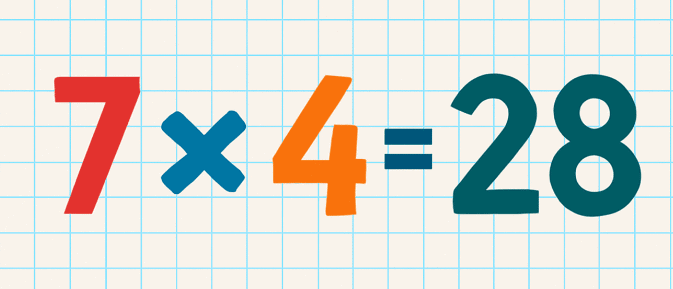
- Doubling: If 2 × 7 = 14, double to get 4 × 7 = 28.
- Adding: If 4 × 7 = 28, add 7 to get 5 × 7 = 35; if 6 × 8 = 48, add 8 to get 7 × 8 = 56.
Record extended facts in tables:
Example: From 2 × 7 = 14:
2 × 70 = 140, 20 × 7 = 140, 20 × 70 = 1400, 4 × 7 = 28, 40 × 7 = 280.
Applying Extended Facts
Extended facts help calculate products like 41 × 7 or 94 × 50 by breaking them into known parts.
Example: 41 × 7 = (40 × 7) + (1 × 7) = 280 + 7 = 287.
Summarise and Practise Multiplication Facts
This section consolidates multiplication facts through tables and applies them to larger calculations.Multiplication Tables
- Tables summarize facts for numbers like 2 to 10 and larger multiples (e.g., 40, 90, 600).
Example: For 7 × 6 = 42, extend to 70 × 6 = 420, 7 × 60 = 420, 70 × 60 = 4200. - Tables include:
Small numbers: 3 × 4 = 12, 5 × 9 = 45.
Larger numbers: 50 × 4 = 200, 70 × 90 = 6300, 600 × 300 = 180000.
Using Tables for Calculations
Tables help calculate products like 900 × 40 or 320 × 800 by finding or deriving facts.
- Example: 900 × 40 = 36000 (from table or 9 × 4 = 36, scaled to 900 × 40 = 36000).
- Break down numbers: 940 × 70 = (900 × 70) + (40 × 70) = 63000 + 2800 = 65800.
Products and Factors
This section explores the concepts of products and factors, including prime numbers and factorizing.Understanding Products and Factors
- A product is the result of multiplication; factors are the numbers multiplied.
Example: 900 = 10 × 6 × 15; 900 is the product, 10, 6, 15 are factors. - When a number is divided by its factor, the remainder is 0.
Example: 900 ÷ 15 = 60 (no remainder).
Factorizing Numbers
- Break a number into factors, then further into smaller factors until reaching prime factors (numbers with only 1 and themselves as factors).
Example: 900 = 10 × 6 × 15 = (2 × 5) × (2 × 3) × (3 × 5) = 2 × 2 × 3 × 3 × 5 × 5. - Numbers like 59 are prime (factors: 1, 59 only).
Non-prime numbers have multiple factors:
Example: 70's factors are 1, 2, 5, 7, 10, 14, 35, 70; prime factors are 2, 5, 7.
Rearranging Factors
- Multiplication is flexible; rearrange factors to simplify:
Example: 2 × 17 × 5 = (2 × 5) × 17 = 10 × 17 = 170. - Apply to real-world problems:
Example: 5 bags × 4 bunches × 3 bananas = (5 × 4 × 3) = 60 bananas.
Multiplying with Factors
This section teaches a method to multiply large numbers by breaking one number into factors.Factor Method
Break one number into factors to simplify multiplication.
Example: 687 × 42 = 687 × (6 × 7) = (687 × 2 × 3) × 7:
- 687 × 2 = 1374.
- 1374 × 3 = 4122.
- 4122 × 7 = 28854.
Works best when factors are small (e.g., 2, 3, 7).
Not effective for prime numbers (e.g., 59 × 13, since 13 is prime).
Applications
- Use for calculations like 24 × 135 or 36 × 4552 by factoring one number (e.g., 24 = 4 × 6).
- Simplifies large multiplications by breaking them into manageable steps.
Different Ways of Recording Multiplication
This section introduces expanded column notation for multiplying two numbers.Sarah's Method
Break one number into tens and units, multiply, then add:
Example: 34 × 63 = (34 × 60) + (34 × 3):
34 × 60 = (30 × 60) + (4 × 60) = 1800 + 240 = 2040.
34 × 3 = (30 × 3) + (4 × 3) = 90 + 12 = 102.
Total: 2040 + 102 = 2142.
Indumiso's Expanded Column Notation
Same method as Sarah's but formatted vertically:
Example: 34 × 63:
34 × 60 = 2040.
34 × 3 = 102.
Add: 2040 + 102 = 2142.
For larger numbers (e.g., 473 × 587):
Break 587 into 500 + 80 + 7, multiply 473 by each, then add.
Applying Expanded Notation
Break the second number into hundreds, tens, units (e.g., 765 = 700 + 60 + 5).
Multiply each part, then sum:
Example: 4385 × 765 requires multiplying 4385 by 700, 60, and 5, then adding results.
Apply Your Multiplication Skills
This section uses multiplication to solve real-world problems, such as calculating costs.Real-World Calculations
Calculate total costs for bulk orders:
Example: 7286 shirts × R46, 5836 trousers × R74, 9557 jackets × R89.
Unit prices:
- Example: 6373 items × R84, 36 items × R9223.
- Petrol costs: 1051 cents/litre × 45 litres or 93 litres.
- Earnings: R8877/month × (3 years + 8 months = 44 months).
- Brick costs: 288 cents/brick × 1000, 10000, 4330, or 5637 bricks.
Steps for Problem-Solving
- Identify quantities and unit costs.
- Multiply using appropriate methods (e.g., expanded notation for large numbers).
Mental Calculation versus the Calculator
This section compares mental, written, and calculator methods for multiplication.
Choosing the Right Method
- Mental: For quick facts (e.g., 5 × 6 = 30, 500 × 6 = 3000) or simple calculations (e.g., 25 × 4 = 100).
- Written: To show understanding (e.g., 349 × 56 using expanded notation).
- Calculator: For large numbers or repeated calculations (e.g., 678 × 234).
Example: 50 × 12 = 600 (mental), but 345 × 45 needs written or calculator methods.
Balancing Speed and Understanding
- Mental methods are faster for known facts; calculators save time for complex problems.
- Written methods clarify the process and build skills.
Use Estimation to Check the Calculator
This section teaches estimating to verify calculator results.Estimation Technique
Round numbers to the nearest hundred or ten to estimate:
Example: 723 × 489:
Lower: 700 × 400 = 280000.
Upper: 800 × 500 = 400000.
Actual answer (353547) should be between 280000 and 400000.
If the calculator gives an incorrect result (e.g., 1212), estimation shows the error.
Applying Estimation
Estimate before calculating to set expected range:
Example: 3456 × 2345 ≈ 3000 × 2000 = 6000000, so actual answer should be near this.
Recalculate if the result is outside the estimated range.
Use Equivalence to Check the Calculator
This section uses rearrangement to verify calculator results.Rearrangement Principle
- Multiplication is commutative; changing the order of factors doesn't change the product.
Example: 1716 × 159 ÷ 286 = 1716 ÷ 286 × 159 (same result). - For multiple operations, reorder calculations to check:
Example: 276 × 288 × 959 = 288 × 959 × 276.
Equivalent Calculation Plans
Two plans giving the same result are equivalent.
Check by recalculating in a different order:
Example: 543 × 178 × 86 → Check with 178 × 86 × 543.
Use Inverses to Check the Calculator
This section uses inverse operations (multiplication and division) to verify results.
Inverse Operations
- Multiplication and division are inverses; one undoes the other:
Example: 432 × 878 ÷ 878 = 432 (returns to original number).
Example: 432 ÷ 878 × 878 = 432. - For complex calculations:
Example: 234 ÷ 325 × 225 = 162.
Check: 162 ÷ 225 × 325 = 234 (original input).
Inverse-in-Reverse-Order Method
Reverse the operations to check:
Example: 234 ÷ 325 × 225:
Result 162 → 162 ÷ 225 × 325 = 234 confirms correctness.
Works because: (a ÷ b × c) ÷ c × b = a.
Points to Remember
- Multiplication Facts: Extend facts (e.g., 2 × 7 = 14 → 20 × 70 = 1400) using scaling, doubling, or adding.
- Products and Factors: Product is the result (e.g., 900); factors are numbers multiplied (e.g., 10, 6, 15). Prime factors are prime (e.g., 2, 3, 5).
- Prime Numbers: Have only 1 and themselves as factors (e.g., 59, 43, 101).
- Factor Method: Break one number into factors (e.g., 42 = 6 × 7) to simplify (e.g., 687 × 42 = 687 × 6 × 7).
- Expanded Column Notation: Break one number into tens/units (e.g., 34 × 63 = (34 × 60) + (34 × 3)) and sum.
- Calculation Methods: Use mental (e.g., 50 × 12), written (e.g., 349 × 56), or calculator (e.g., 8374 × 849) based on complexity.
- Checking Results: Estimate (e.g., 723 × 489 ≈ 700 × 400), rearrange (e.g., 543 × 178 × 86 = 178 × 86 × 543), or use inverses (e.g., 432 × 878 ÷ 878 = 432).
Difficult Words
- Product: The result of multiplication (e.g., 900 in 10 × 6 × 15).
- Factor: A number multiplied to get a product (e.g., 10, 6, 15 for 900).
- Prime Number: A number with only two factors: 1 and itself (e.g., 59).
- Prime Factor: A factor that is a prime number (e.g., 2, 5 for 70).
- Expanded Column Notation: A method breaking one number into parts (e.g., tens, units) for multiplication and summing results.
- Inverse Operations: Operations that undo each other (e.g., multiplication and division).
- Estimation: Rounding numbers to predict an approximate result (e.g., 700 × 400).
Summary
This chapter equips Grade 6 students with comprehensive multiplication skills for whole numbers. It begins with extending basic facts (e.g., 2 × 7 = 14 to 20 × 70 = 1400) and practicing them through tables for calculations like 900 × 40. Students explore products and factors, learning to factorize numbers (e.g., 900 = 2 × 2 × 3 × 3 × 5 × 5) and identify prime numbers. The factor method simplifies large multiplications (e.g., 687 × 42), while expanded column notation breaks numbers into parts for clarity. Real-world applications include calculating costs (e.g., 7286 shirts × R46). Students learn to choose mental, written, or calculator methods and verify results using estimation, rearrangement, and inverse operations, ensuring accuracy and confidence in multiplication.