NCERT Solutions: The Tunnel

Let us discuss (Page 144)
Q1: Suraj compares the train to a magical creature. Pick the phrases that convey the meaning.
Ans: 1. Green, black, and gold dragon
2. Beautiful monster
3. Showering sparks
4. Roared a challenge
Q2: Suraj knew that the train was close by because
Ans: He heard the shrill whistle of the engine and a sound like distant thunder from the tunnel.
Q3: What did Suraj see inside the tunnel?
Ans: Suraj saw damp and sticky walls, a bat flying past, and a lizard scuttling between the lines.
Q4: Select the correct option.
What does Sunder Singh convey about the tunnel?
He says that _______________ (it is damp and sticky inside/he has lent it to the Government).
Ans: He has lent it to the Government.
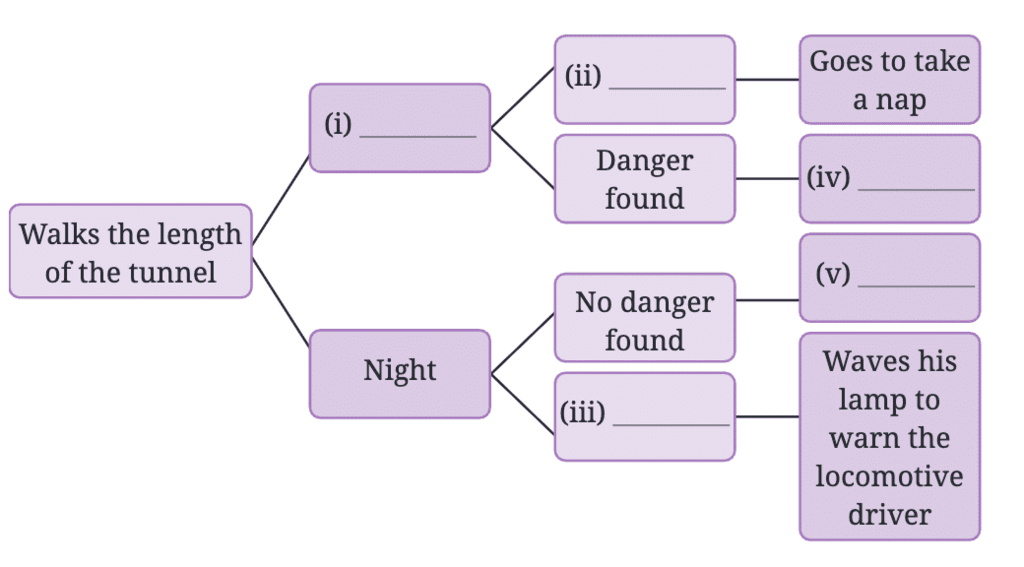
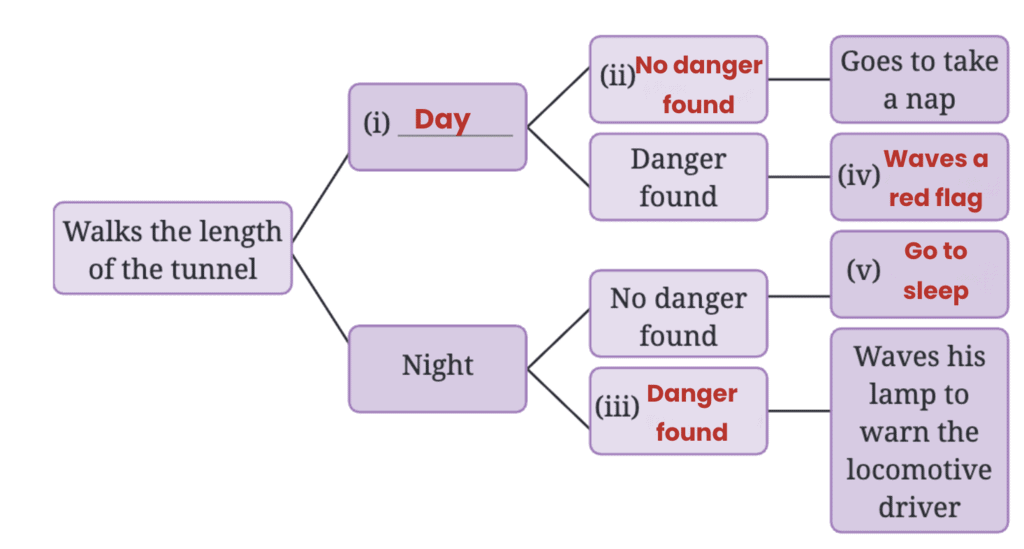
Q5: The watchman has created a system through which he informs the locomotive driver about any danger in the tunnel. The following flow chart shows this system. Refer to the text and complete the flow chart.
Ans:
Let us discuss (Page 149)
Q1: Sunder Singh knew that the leopard was in the tunnel because ___________.
Ans: He heard a rhythmic sawing sound, like someone cutting a branch, which was the leopard's sound.
Q2: Why do you think Suraj was unable to do any shouting in the tunnel in the beginning?
(i) He was afraid of the leopard.
(ii) He didn't want to disturb the leopard.
(iii) He was trying to listen for the leopard.
(iv) He didn't really believe Sunder Singh.
Ans: (i) He was afraid of the leopard.
Q3: What made the leopard disappear into the darkness?
Ans: The leopard disappeared because Suraj and Sunder Singh shouted together, and their voices rang through the tunnel, scaring the leopard.
Q4: How did Suraj know Sunder Singh was at the tunnel?
Ans: Suraj saw the lamp lit by Sunder Singh near the tunnel, even though he couldn't see Sunder Singh himself.
Q5: Why did Suraj's father take him along to Delhi?
Ans: Suraj's father took him along to Delhi because he was going on a business trip and did not want to leave Suraj alone behind.
Let us think and reflect (Page 149)
QI. Read the following lines and answer the questions that follow.
1. Suraj had to turn and look back at the opening to reassure himself that there was still daylight outside. Ahead of him, the tunnel's other opening was just a small round circle of light.
The tunnel was still full of smoke from the train, but it would be several hours before another train came through. Till then, the cutting belonged to the jungle again.
Suraj didn't stop, because there was nothing to do in the tunnel and nothing to see. He had simply wanted to walk through, so that he would know what the inside of a tunnel was really like.
(i): Write whether the following statement is true or false.
Suraj looked back at the opening of the tunnel to check if the train was coming.
Ans: False
Suraj looked back to reassure himself that there was still daylight outside, not to check for a train.
(ii): Choose the correct option to complete the sentence given below.
Suraj did not stop anywhere in the tunnel because
A. there was nothing to see in the tunnel
B. the tunnel was damp and sticky
C. he was in a hurry to get out of the tunnel
D. it was time for another train to come
Ans: A. There was nothing to see in the tunnel
The text directly states that "there was nothing to do in the tunnel and nothing to see," which explains why he didn't stop.
(iii): What does the sentence 'Till then, the cutting belonged to the jungle again' mean?
Ans: It means that after the train passed, the area around the tunnel became quiet and returned to being part of the jungle, with nature taking over again until the next train came.
(iv): Suraj wanted to know the inside of the tunnel. What character trait of Suraj is highlighted here?
Ans: Curiosity
Q2. "The train will soon be here," said Suraj.
"Yes, my friend. And if we don't drive the leopard out of the tunnel, it will be run over and killed. I can't let that happen."
"But won't it attack us if we try to drive it out?" asked Suraj, beginning to share the watchman's concern.
"Not this leopard. It knows me well. We have seen each other many times. It has a weakness for goats and stray dogs, but it will not harm us. Even so, I'll take my axe with me. You stay here, Suraj."
(i): What was the watchman's concern?
Ans: The watchman was concerned that the leopard in the tunnel would be run over and killed by the train.
(ii): Complete the sentence with a suitable reason.
Sunder Singh was sure that the leopard in the tunnel would not attack him and Suraj because
Ans: he knew the leopard well, as they had seen each other many times, and it only attacked goats and stray dogs.
(iii): Select the sentences that are true from those given below.
A. Suraj wants to see the leopards in the jungle.
B. Suraj is concerned about Sunder Singh's safety.
C. The leopard in the tunnel attacks goats and stray dogs.
D. Sunder Singh wants to protect Suraj.
E. Sunder Singh knows all about the animals in the jungle.
Ans: C. The leopard in the tunnel attacks goats and stray dogs.
D. Sunder Singh wants to protect Suraj.
(iv): Choose the correct option to complete the sentence.
Sunder Singh decides to take his axe with him. This tells us that he was
A. violent
B. cautious
C. bold
D. afraid
Ans: B. cautious
QII. Answer the following questions.
1: What does Sunder Singh convey by saying that he has lent his tunnel to the Government?
Ans: Sunder Singh means he takes care of the tunnel like it's his own, but he allows the Government to use it for trains.
2: According to Sunder Singh, "It is safer in the forest than in the town". What example does Sunder Singh give to support his opinion? What does this tell us about him?
Ans: He says he was almost run over by a bus in town. This shows he feels more comfortable and safe in the jungle than in busy towns.
3: Sunder Singh has become part of the jungle life. Support the view with a suitable reason.
Ans: He lives in a hut near the tunnel, knows the jungle sounds and animals like the leopard, and feels safe there, showing he is part of jungle life.
4: Sunder Singh and Suraj form an unlikely friendship. What draws them together?
Ans: Their shared interest in the tunnel and trains, and Suraj's curiosity and Sunder Singh's welcoming nature, bring them together.
5: Why is Sunder Singh referred to as a 'firefly'?
Ans: Sunder Singh is called a firefly because his lamp lights up the darkness near the tunnel, just like a firefly's light in the night.
6: Do you think Suraj is an adventure-loving boy? Give reasons.
Ans: Yes, Suraj loves adventure because he cycles to the jungle, walks through a dark tunnel, and joins Sunder Singh to scare a leopard, showing his curiosity and bravery.
Let us learn (Page 151)
QI: Complete the following sentences using the suitable phrases from the text given in the box below.

1. We could hear the ______________________ of the train long before it came into view at the station.
2. The street was completely dark but the little boy walked to his house guided by the ______________________ from the houses.
3. The ______________________ from the carpenter's workshop grew louder every hour.
4. From the balcony, she watched the ______________________ from her neighbour's chimney float across the backyard.
Ans: 1. We could hear the approaching engine of the train long before it came into view at the station.
2. The street was completely dark but the little boy walked to his house guided by the flickering lights from the houses.
3. The sawing sound from the carpenter's workshop grew louder every hour.
4. From the balcony, she watched the drifting smoke from her neighbour's chimney float across the backyard.
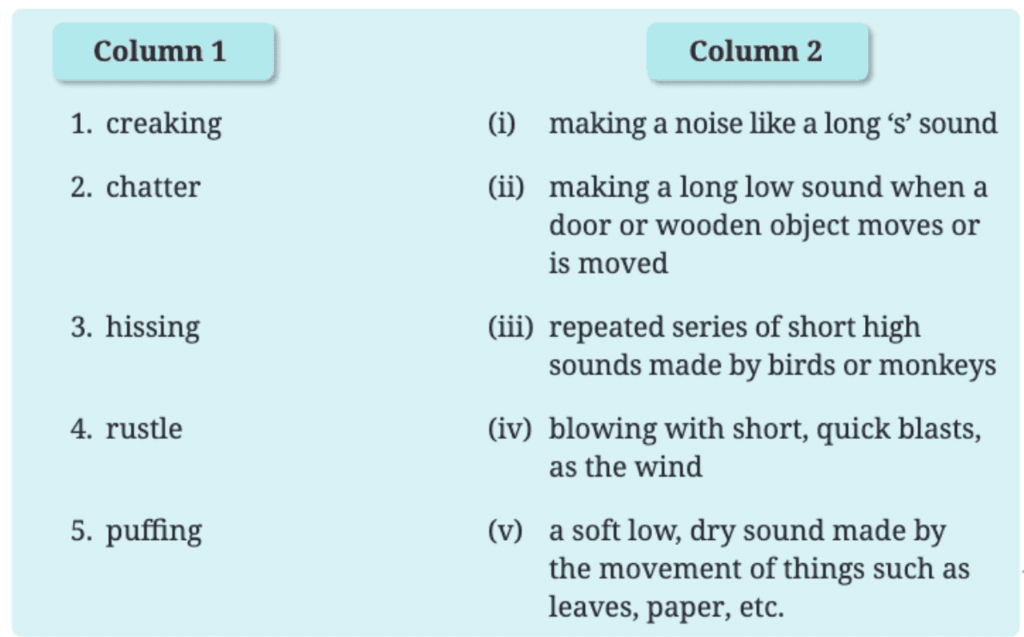
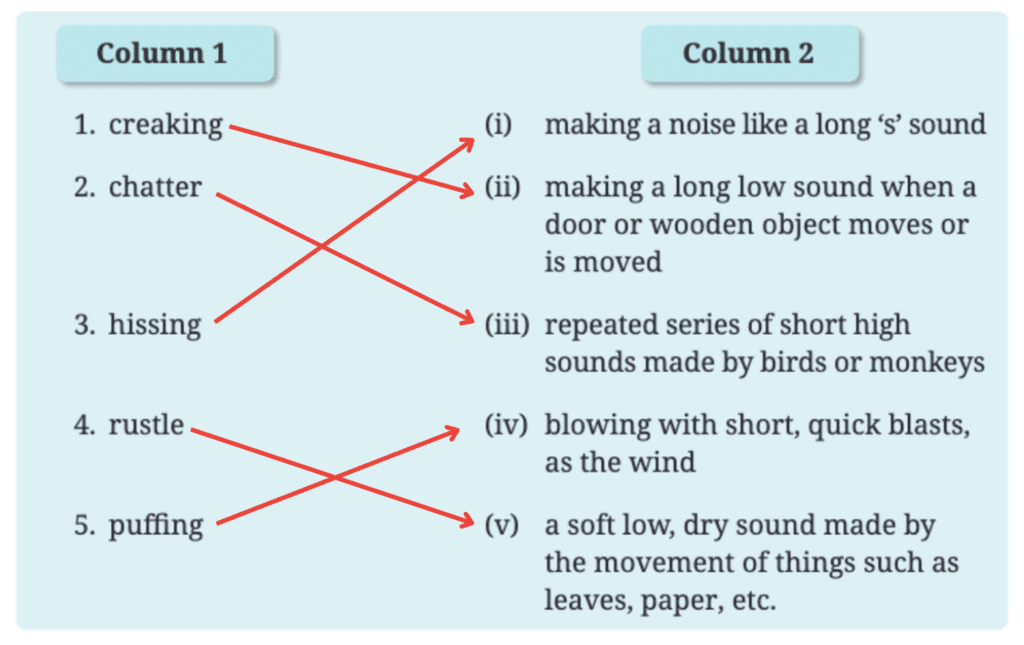
QII: The text has many 'sound words'. Some of these words are given in Column 1 and their meanings are given in Column 2. Match the words with their meanings. You can use a dictionary.
Ans:
Now, complete the sentences given below by filling in the blanks with the correct form of the sound words given in Column 1.
1. The steam engine reached the station __________________ black smoke into the sky.
2. Suddenly, the snake raised its hood and made a __________________ noise.
3. When the wind blew, I heard the __________________ of the wooden roof.
4. He heard a __________________ of leaves behind him when he was walking in the woods.
5. I get disturbed by the continuous __________________ of the monkeys in the neighbourhood.
Ans: 1. The steam engine reached the station puffing black smoke into the sky.
2. Suddenly, the snake raised its hood and made a hissing noise.
3. When the wind blew, I heard the creaking of the wooden roof.
4. He heard a rustle of leaves behind him when he was walking in the woods.
5. I get disturbed by the continuous chatter of the monkeys in the neighbourhood.
QIII. Read what the watchman Sunder Singh did regularly at the tunnel as part of his duty. Notice the use of 'would'.
Every day, before the train came through, he would walk the length of the tunnel. If all was well, he would return to his hut and take a nap. If something was wrong, he would walk back up the line and wave a red flagand the engine driver would slow down. At night, the watchman lit an oil lamp and made a similar inspection of the tunnel.
1: Why is the word 'would' used here?
(i) to make a polite request
(ii) to express a desire
(iii) to talk about a habit in the past
Ans: (iii) to talk about a habit in the past
In these sentences, the word 'would' is used to speak about a past habit.

Would and used to both describe something that happened regularly in the past. However, 'used to' indicates a past action that doesn't happen any longer.
- I used to paint when I was in Grade 4.
- Riya used to eat a lot of junk food, but she stopped last year.
2: Complete the sentences using the verb in brackets with the correct form of 'used to' or 'would'.
When I was a child we used to live in a village near a forest. Back then, we (i) _____________ (grow) vegetables in our back garden. Every day we (ii) _____________ (get up) early and go for a walk. The weather in summer (iii) _____________ (be) really nice. There was a lake near the house and we (iv) _____________ (go) there every Sunday for a picnic. Winters (v) _____________ (be) rather cold. In the evenings, my father(vi) _____________ (tell) us incredible stories and we (vii) _____________(listen) with admiration.
Ans: When I was a child we used to live in a village near a forest. Back then, we (i) would grow vegetables in our back garden. Every day we (ii) would get up early and go for a walk. The weather in summer (iii) used to be really nice. There was a lake near the house and we (iv) would go there every Sunday for a picnic. Winters (v) used to be rather cold. In the evenings, my father (vi) would tell us incredible stories and we (vii) would listen with admiration.
QIV: We use punctuation marks to make our writing clear. You already know how to use full stops and commas. Let us look at three more punctuation marks-brackets, semicolon, and colon.
Colon (:) is used to introduce a list or an explanation.
- You need the following ingredients to make Ela Ada: ghee, coconut, jaggery, and rice flour.
- He has one goal: to win the championship.
Semicolon (;) is used to connect two clauses which are closely related without a conjunction.
- She loves reading; he prefers watching movies.
- Suraj followed close behind; but he found he was unable to do any shouting.
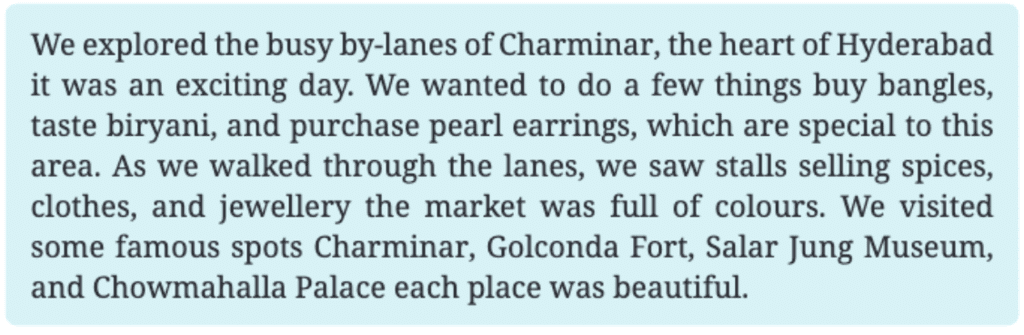
Now, use semicolons and colons to punctuate the following paragraph.
 Ans:
Ans:
We explored the busy by-lanes of Charminar, the heart of Hyderabad; it was an exciting day. We wanted to do a few things: buy bangles, taste biryani, and purchase pearl earrings, which are special to this area. As we walked through the lanes, we saw stalls selling spices, clothes, and jewellery; the market was full of colours. We visited some famous spots: Charminar, Golconda Fort, Salar Jung Museum, and Chowmahalla Palace; each place was beautiful.
Let us write (Page 155)
Write a descriptive paragraph about your experience of a train journey. Describe the sights, sounds, and feelings you experienced during the journey. Include details about the people around you, the scenery outside, and the atmosphere inside the train to make your paragraph vivid and engaging.
You may use the following guidelines to help you create the paragraph.
- Start with how the journey began: boarding the train, finding your seat, and the initial impressions.
- Describe the sounds: the whistle of the train, the chatter of passengers, and the rhythmic clatter of wheels on the tracks.
- Mention the sights: the changing scenery outside the window, the hustle and bustle inside the train, and any interesting moments.
- Reflect on your feelings: Were you excited, relaxed, or curious? How did the journey make you feel overall?
Ans:
1. Beginning of the Journey:
Last winter, I travelled by train from Delhi to Jaipur with my parents. The platform was crowded and lively with vendors, coolies, and passengers. After boarding and finding our seats, I felt thrilled as the whistle blew and the train slowly moved out of the station.
2. Sounds during the Journey:
The rhythmic clatter of the wheels and the cheerful chatter of passengers created a lively atmosphere. Vendors passed by calling out their items, adding to the sounds of travel.
3. Sights outside the Window:
Through the window, I saw changing scenes - busy towns, green fields, and small villages. Children waved as the train passed, and farmers worked in the fields.
4. Feelings and Reflection:
I felt both excited and peaceful as the cool breeze touched my face and the sunset coloured the sky. By the end, I realised a train journey is not just about reaching a destination but enjoying the experience along the way.
FAQs on NCERT Solutions: The Tunnel
| 1. What is the main theme of "The Tunnel" story in NCERT Class 7 English? |  |
| 2. Who are the main characters in "The Tunnel" and what drives their actions? | |
| 3. Why does the tunnel setting matter so much in this NCERT story? | |
| 4. What are the key turning points in "The Tunnel" that show character growth? | |
| 5. How can I prepare better for "The Tunnel" exam questions and comprehension tests? | |