NCERT Solutions: North, South, East, West

Let us do these activities before we read (Page 118)
QI: Work in pairs. Discuss the place that you have enjoyed travelling to. Talk about who you went with, how you travelled, and what you learnt from the experience.
Ans: I enjoyed travelling to Manali with my family. We travelled by car, stopping at small towns on the way. I learnt about mountain life, the cooler climate, and the local culture. Seeing the snow-capped peaks and simple hill villages helped me appreciate how people live in the mountains.
QII: Which State or Union Territory of India do you live in? Write the following details about it.
1. Part of the country-North, East, Northeast, West, South or Centre
2. Its capital
3. Language
4. River(s)
5. Tourist attraction
6. Food
Ans: I live in Uttar Pradesh.
- Part of the country: North
- Capital: Lucknow
- Language: Hindi
- River(s): Ganga, Yamuna
- Tourist attraction: Taj Mahal
- Food: Kebabs, Biryani
QIII: Work in pairs. Recall the names of the states of our country which have 'Pradesh' in their names. Mention if it is in the North, East, Northeast, West, South or Centre of our country. Recall any special feature about each 'Pradesh'. Share your answers with your classmates and the teacher.
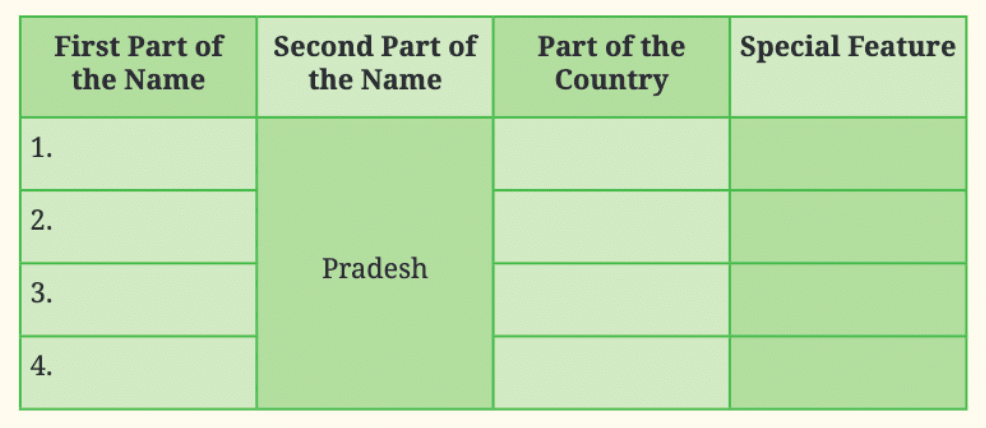
Ans:
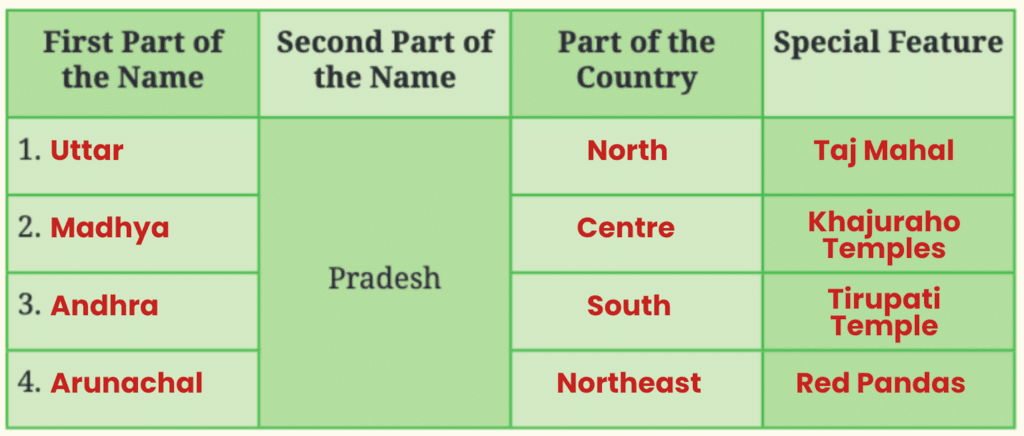
Let us discuss (Page 125)
Q: Complete the table given below based on Shaana's postcards. An example has been done for you. Share your answers with your classmates and the teacher.
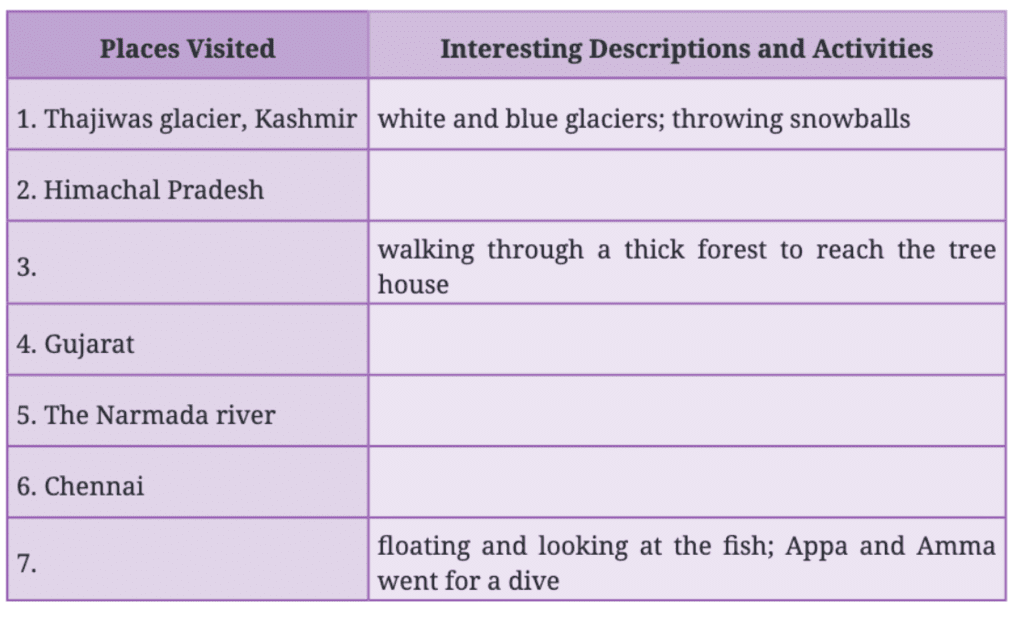
Ans:
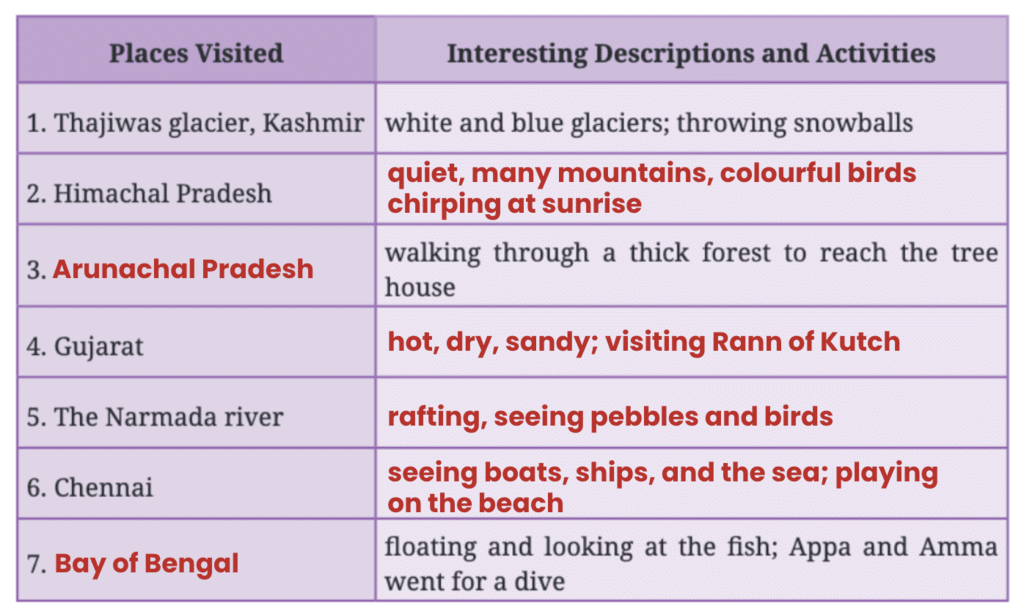
Let us think and reflect (Page 126)
QI. Read the extracts given below and answer the questions that follow.
1. Amma tells me that places like the Sundarbans are called wetlands. I never knew such a place existed, and that it was possible for trees called mangroves to grow in seawater! But Amma is sad about how much this place floods today.
We also saw crocodiles and a lonely snake while boating. I hope they don't follow us home.
How is everyone? Are you missing me yet?
(i): What feeling does Shaana most likely experience when she says, "I never knew such a place existed..."?
A. pride
B. hope
C. relief
D. wonder
Ans: D. wonder
(ii): Complete the following sentence with a suitable reason.
Amma is sad about the frequent flooding in Sundarbans because ________
Ans: it harms the environment and the wildlife that live there, such as mangroves, crocodiles and other animals.
(iii): Select the evidence from the text that reflects a feeling of the speaker's slight nervousness.
Ans: "I hope they don't follow us home."
(iv): Select the option that applies to both the Assertion and the Reason.
Assertion: The speaker is missing her friends.
Reason: The speaker wishes to know the well-being of her friends.
A. Both the assertion and the reason are true, and the reason correctly explains the assertion.
B. Both the assertion and the reason are true, but the reason does not correctly explain the assertion.
C. The assertion is true, but the reason is false.
D. Both the assertion and the reason are false.
Ans: A. Both the assertion and the reason are true, and the reason correctly explains the assertion.
Explanation: In the postcards, Shaana often expresses that she misses her friends. For example, she asks, "How is everyone? Are you missing me yet?" (24 May entry). This clearly indicates she is thinking about her friends and missing them.
At the same time, she expresses curiosity about their well-being, which shows she cares and wants to know how they are doing. This supports the reason.
Since her desire to know how her friends are doing arises because she misses them, the reason correctly explains the assertion.
2. Amma and Appa are fast asleep, and I should be sleeping too, but I just love looking out of the window. I think we're in the southwest part of the country, in Goa, and you won't believe how nice the plateaus look.
There are so many hills here, and beaches too. There are also a lot of tunnels that the train goes through. I used to be afraid of tunnels, but I'm not any more. Someday, I wish we could all go on a tour of the plateaus.
(i): Complete the sentence with a suitable reason.
The speaker chooses to stay awake because ___________
Ans: she loves looking at the beautiful plateaus and the changing scenes outside the train window.
(ii): What does the speaker mean by saying, 'You won't believe how nice the plateaus look'?
Ans: She means the plateaus are surprisingly beautiful and different from what she expected.
(iii): What has been the change in the speaker's attitude towards tunnels?
A. from fear to comfort
B. from courage to confidence
C. from doubt to clarity
D. from fascination to delight
Ans: A. from fear to comfort
(iv): Fill in the blanks with the correct option from those given in the brackets.
The speaker's wish to share the experience of touring the plateaus with others indicates her ________ (ability to communicate/sense of connection) as well as the value she places on ________ (shared experiences/updating information) with her peers.
Ans: The speaker's wish to share the experience of touring the plateaus with others indicates her sense of connection as well as the value she places on shared experiences with her peers.
II. Answer the following questions.
Q1: Shaana mentions that she used to be afraid of tunnels. What could have been the most likely reason for her to be scared of tunnels?
Ans: Shaana was likely afraid of tunnels because they are dark and unknown, and young children often feel frightened in dark, enclosed places.
Q2: Do you think Shaana's Appa and Amma enjoyed themselves, just like children do? Support your answer with evidence from the text.
Ans: Yes. Shaana's Appa and Amma enjoyed themselves; they played with snow, splashed water at each other, and were excited about activities such as scuba diving, which shows they had fun like children.
Q3: Shaana mentions less snow in the glaciers and more flooding in the Sundarbans. Explain what these observations indicate.
Ans: These observations indicate changing weather patterns and environmental problems, such as global warming and its effects on glaciers and low-lying coastal areas.
Q4: Shaana's visits to different parts of the country highlight the diversity of India's geography. Support this statement with evidence from the text.
Ans: Shaana's visit to various destinations throughout the country exhibits the richness of India's geography as she describes the ice-capped glaciers of Kashmir and Himachal Pradesh to the dense forest areas of Arunachal Pradesh. Shaana describes the wetlands of Sundarbans to the desert of Gujarat, followed by the coastal areas and beaches.
Q5: How does Shaana use language to convey her excitement, curiosity, and sometimes her fears about the places she visits?
Ans: Shaana uses lively words to depict her excitement, asks questions to express curiosity, and uses short, tense sentences to share her fears. She describes sights, sounds, and feelings to bring places to life. When excited, she uses energetic words. When curious, she wonders about things. When scared, she uses dark descriptions to show her fear.
Q6: What might Shaana have learned from her travels across India? How would it impact her understanding of the country?
Ans: Shaana likely learned about India's different landscapes, cultures and environmental issues. This would give her a broader understanding of the country's richness and the importance of caring for nature and communities.
Q7: What could be the author's purpose of presenting the text in the form of postcards?
Ans: Presenting the material as postcards makes Shaana's experiences personal and immediate. The postcard form allows short, lively entries that show her feelings and observations, making the journey easy to relate to and enjoyable to read.
Let us learn (Page 128)
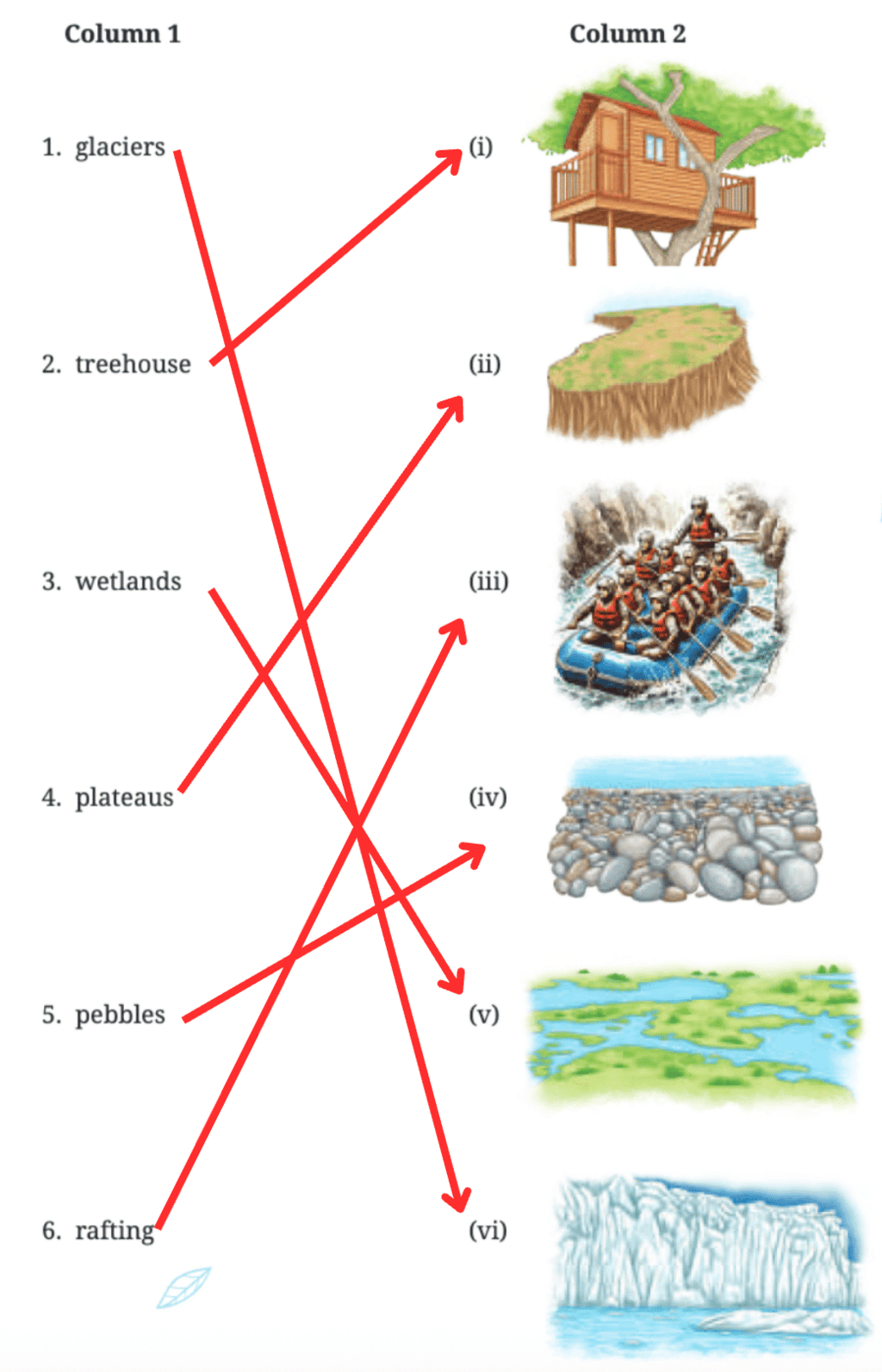
QI: Read the words from the text given in Column 1 and match them with suitable pictures in Column 2.
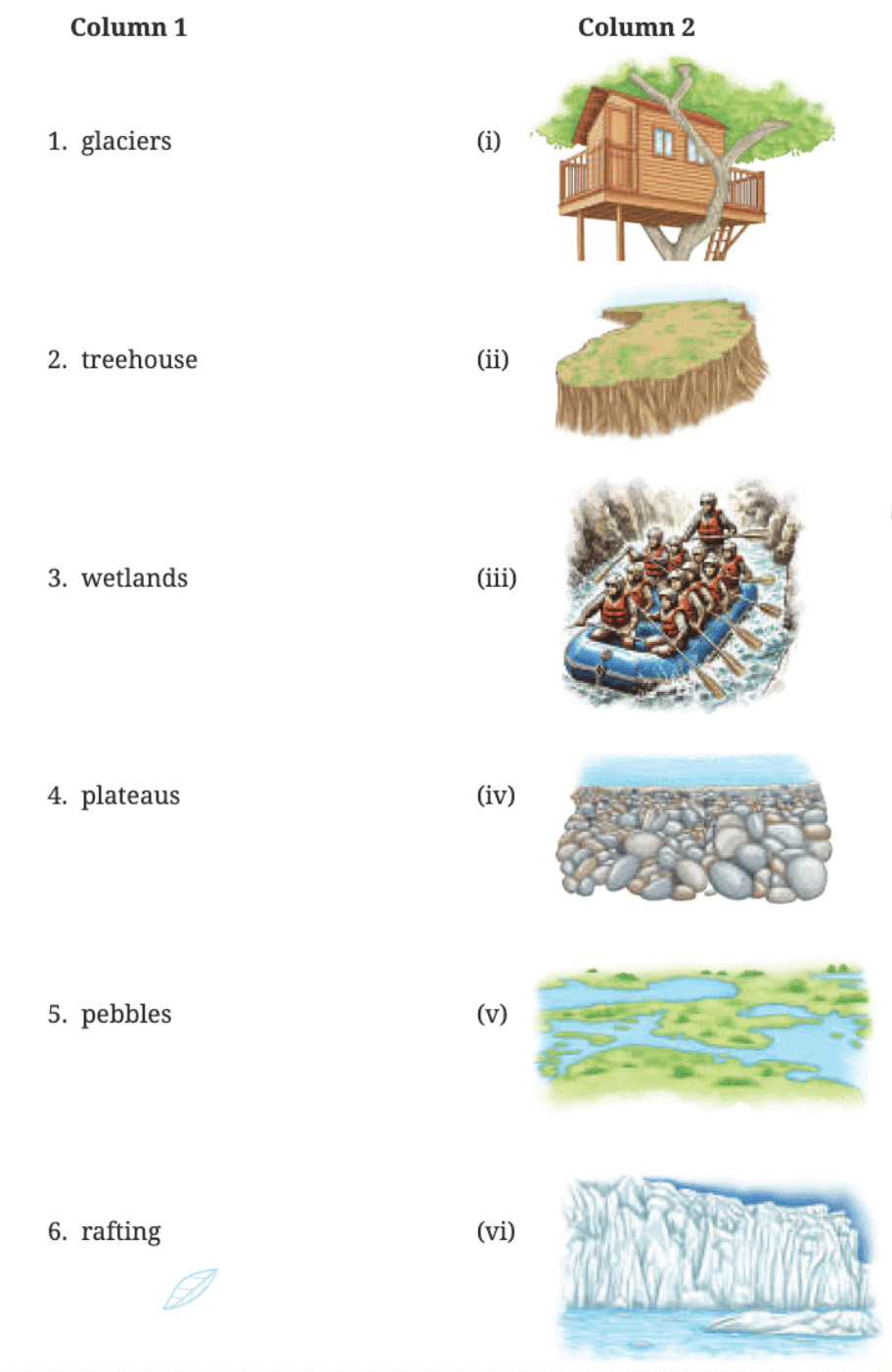
Ans:
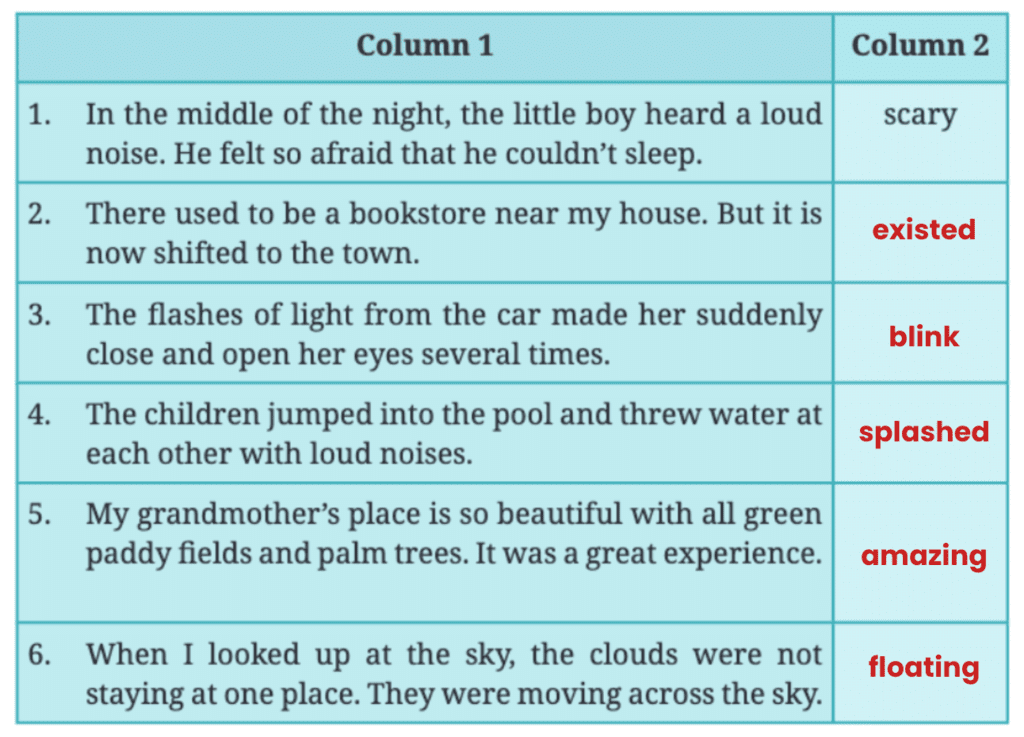
QII: Read the situations given in Column 1. Choose the associated words from the text given in the box below and write them in Column 2.

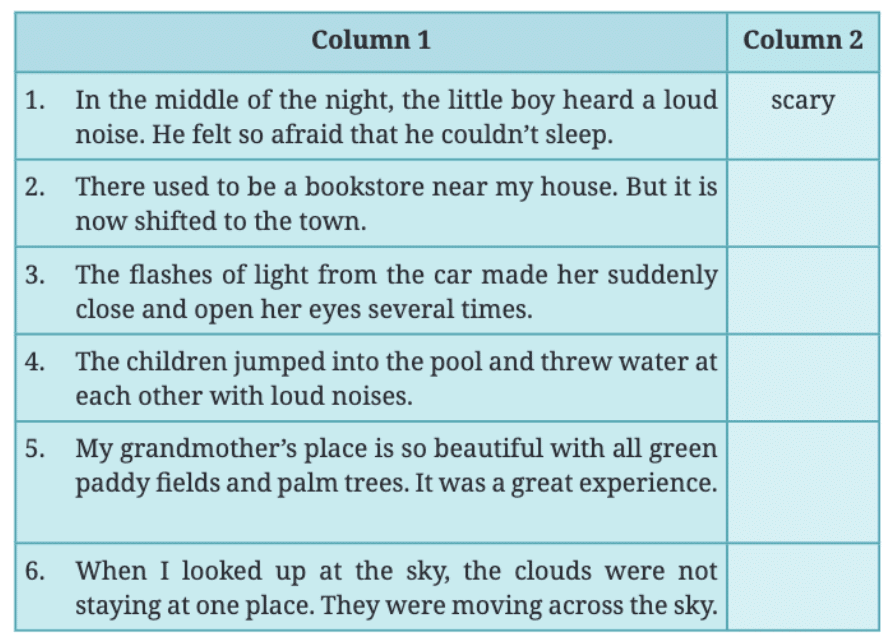
Ans:
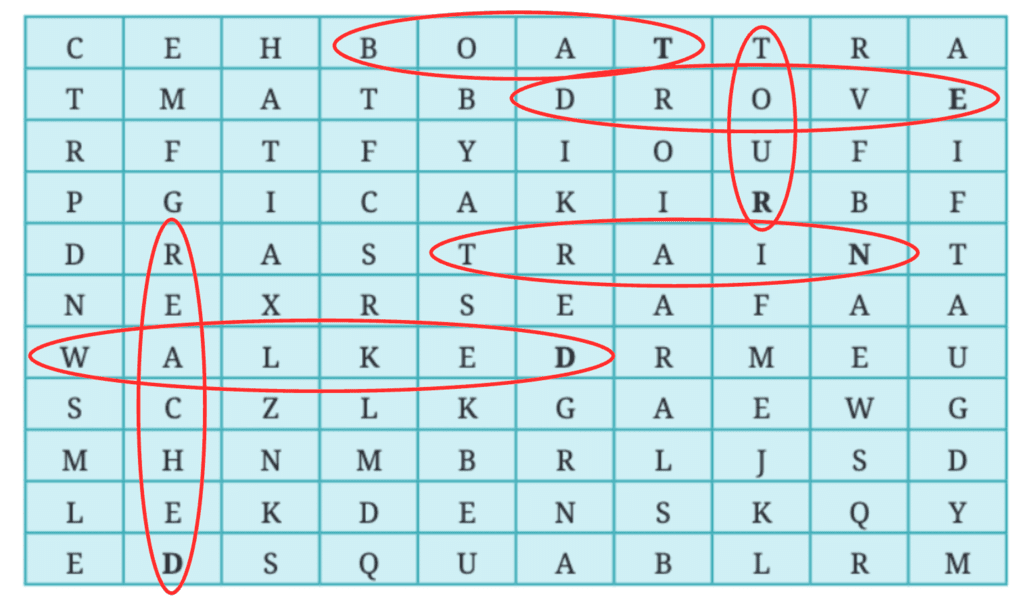
QIII: The following word grid has six words related to 'travel' used in the lesson. Circle the words in the grid. You can search horizontally and vertically. The last letter of each word has been highlighted.
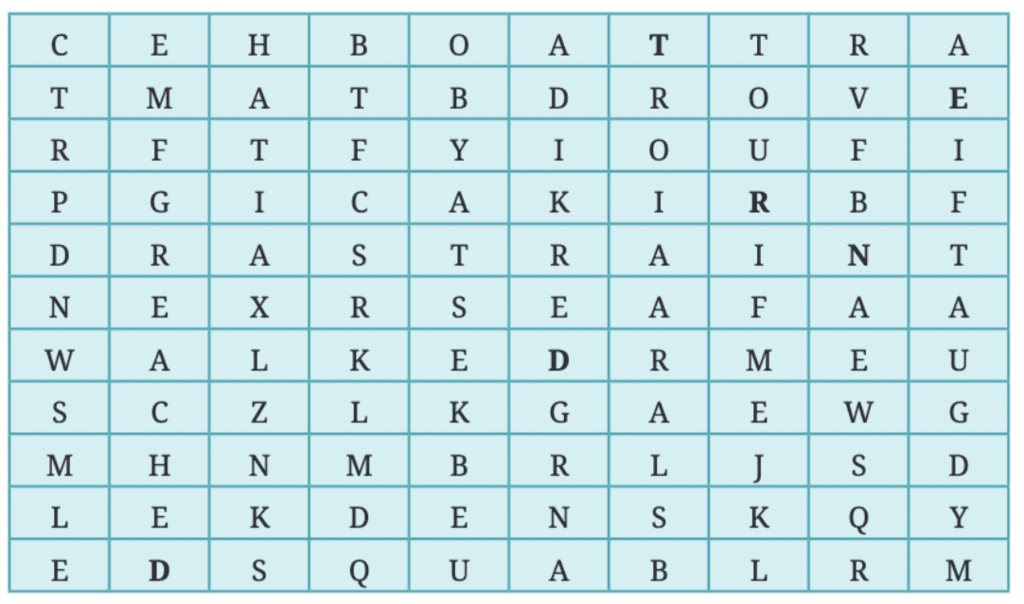
Ans:
QIV: Read the following sentences from the text and underline the subject and the verb.
1. Amma and Appa are fast asleep.
(When the subject of a sentence has two or more nouns or pronouns that are connected by 'and', we use a plural verb).
Ans: Amma and Appa (subject) are (verb) fast asleep.
2. It's hot, dry, and there is sand everywhere.
(In case the subject is 'it', the verb that follows is either 'is' or 'was' depending on the tense of the sentence).
Ans: It (subject) is (verb) hot, dry, and there is sand everywhere.
3. There are so many hills here, and beaches too.
(When we begin a sentence with 'there', the subject comes after the verb).
Ans: There are (verb) so many hills (subject) here, and beaches too.
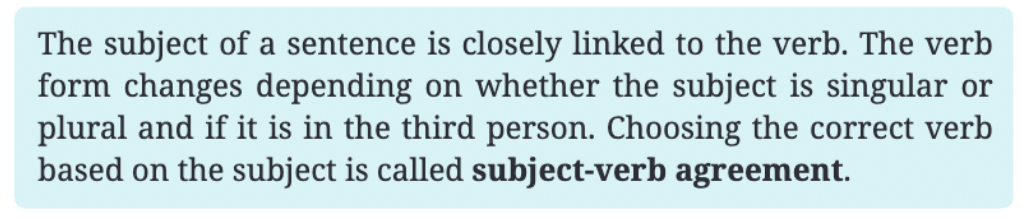
Let us understand subject-verb agreement better.
- A subject and its verb must agree, even if other words or phrases come between them.
Example: The formation of paragraphs is important in writing. - When the subjects are considered individually, we use a singular verb.
Example: Every man and woman has the right to vote. - Collective nouns such as 'class', 'committee', 'audience', and 'team' can be singular or plural, based on the context of the sentence. If the sentence implies the group is acting as one unit, the noun is singular and takes a singular verb.
Example: The committee decides on the new policy tomorrow. - The indefinite pronouns 'each', 'either', 'every', 'much', and 'neither' always require singular verbs.
Example: Each of the children was given a gift. - Subjects that look plural because they end in 's' but refer to one thing are singular.
Example: Mathematics is an interesting subject. - Some nouns (like glasses, scissors, pants, and tongs) are plural but take a singular verb when the phrase 'pair of' is placed before it. Here, 'pair' is the subject.
This pair of scissors is sharp. - When subjects are joined by 'or' or 'nor', the verb should match the subject that is closer to it.
- Neither the students nor the teacher wants to cancel the trip.
- Either the manager or the employees are responsible for the mistake.
QV: Choose the correct option from the words given in the brackets.
1. A pair of sunglasses is (is/are) essential when travelling to sunny destinations.
2. Either the tour guide or the tourists have (has/have) to arrive first at the meeting point.
3. The information on travel expenses is (is/are) useful for first-time travellers.
4. Neither the flight crew nor the pilot was (was/were)aware of the delay.
5. The news about the heavy rains makes (makes/make)many people reconsider their vacation plans.
6. A pair of binoculars is (is/are) useful for spotting wildlife on a safari.
7. The hill stations in India remain (remains/remain) a popular travel destination during winter.
8. Keeping accounts is important for spending money wisely during travel.
9. Either the ticket or the bus passes need to be used for travelling in the tourist bus.
10. Neither the passengers nor the taxi driver was aware of the best route to the hotel.
Let us write (Page 133)
Q: Imagine that you have to travel to your hometown to attend a family event. Write an application to the Principal of your school, requesting leave of absence. Remember to include the duration of the leave, the reason for the leave and mention how you will complete your school work. Use the format of the application and the verbal cues given below.
Leave Application
123, Green Street
Lucknow
Uttar Pradesh
10 May 2025The Principal
St. Mary's School
Lucknow
Uttar PradeshSubject: Request for leave for 5 days
Dear Sir,
I am writing to request five days of leave from 15 May 2025 to 19 May 2025 to attend a family event in my hometown.
I would like to assure you that I will complete all my school work by taking notes from my classmates and submitting assignments on time.
I would be grateful if you could grant me the leave.
Yours sincerely,
Riya Sharma
Class 7, Section A,
Roll Number 12
FAQs on NCERT Solutions: North, South, East, West
| 1. What do the four cardinal directions mean and how do I remember them for my Class 7 exam? |  |
| 2. How can I use North, South, East, West to read maps correctly in geography class? | |
| 3. What's the difference between cardinal directions and intermediate directions like Northeast and Southwest? | |
| 4. Why do we need to know directions if we have GPS and Google Maps now? | |
| 5. How do I answer questions about whether a place lies North or South of another location? | |





