Chapter Notes: Transformations (Term 3)


Rotations, Reflections, and Translations
This section defines the three primary transformations and how they are applied to shapes.Translations
- A translation moves a shape from one position to another without turning or flipping it.
- The shape slides in a straight line, keeping the same orientation (facing the same direction).
Example: On a bead mat, a red figure is a translation of a purple figure if it is shifted left, right, up, or down without rotating or flipping.
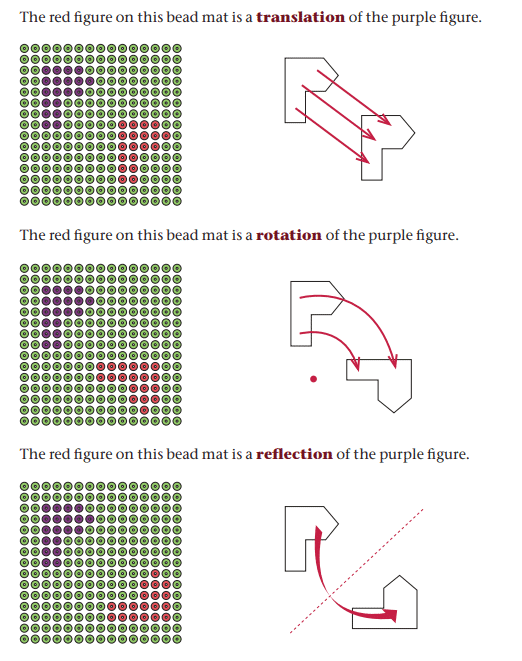
To translate a shape:
- Move every point of the shape the same distance and direction.
Example: A template traced in black is translated to a red position by sliding it horizontally or vertically.
Rotations
- A rotation turns a shape around a fixed point called the center of rotation, usually by a specific angle (e.g., 90°, 180°).
- The shape's orientation changes, but its size and shape remain the same.
Example: On a bead mat, a red figure is a rotation of a purple figure if it is turned around a point (e.g., clockwise or counterclockwise).
To rotate a shape:
- Choose a center point.
- Turn the shape around that point, keeping all distances from the center constant.
Example: A template in a black position is rotated to a red position by turning it 90° around a central point.
Reflections
- A reflection flips a shape over a line called the line of reflection (or mirror line), creating a mirror image.
- The shape's orientation reverses, but its size and shape stay the same.
Example: On a bead mat, a red figure is a reflection of a purple figure if it is flipped over a line, like flipping a page.
To reflect a shape:
- Imagine a mirror along the line of reflection.
- Each point on the shape is moved to the opposite side of the line, at the same distance from it.
Example: A template traced in black is reflected to a red position by flipping it over a vertical or horizontal line.
Note: A shape cannot be moved to a reflected position by translation alone, as flipping changes orientation.
Applying Transformations
- Transformations are identified by comparing two positions of a shape (e.g., black and red positions of a template).
- Example: If a template in a black position matches a red position by sliding, it's a translation; if it requires turning, it's a rotation; if it needs flipping, it's a reflection.
- Patterns often combine multiple transformations (e.g., a sequence of translations or rotations).
Describing Patterns
This section explores how transformations create repeating patterns, with a focus on cultural designs like Ndebele art.

Transformations in Patterns
Patterns are created by repeating a shape (e.g., a triangle) using translations, rotations, or reflections.
Example: In Ndebele wall art, a design with triangles may include:
- Translations: Triangles shifted to new positions without changing orientation.
- Rotations: Triangles turned around a point (e.g., 90° or 180°).
- Reflections: Triangles flipped over a line to create mirror images.
To identify transformations in a pattern:
- Compare two shapes (e.g., a black triangle and a grey triangle).
- Determine if one is slid (translation), turned (rotation), or flipped (reflection).
Example: In a pattern, a grey triangle may be a reflection of a black triangle if it appears as a mirror image.
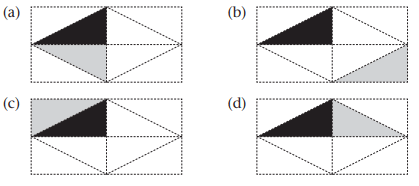
Analyzing Ndebele Designs
- Ndebele art uses geometric shapes (e.g., triangles) arranged in complex patterns.
- Some arrangements fit the Ndebele design, while others do not, based on the transformations used.
Example: A design with repeated triangles may use translations to shift triangles or rotations to turn them, matching the Ndebele style.
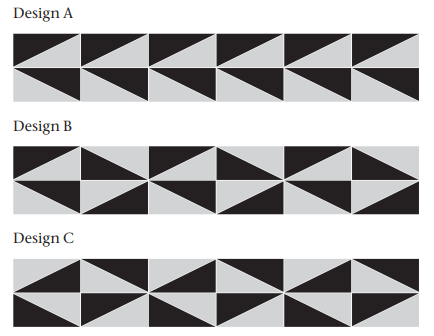
Comparing designs (e.g., Design A, B, C):
- Identify which design matches the Ndebele wall painting by checking the transformations.
- Note differences (e.g., Design B may use more rotations, while Design C uses reflections).
Repeating a figure:
- A single shape (e.g., a triangle) is repeated using specific transformations to form a larger design.
Example: In Design A, a figure may be translated horizontally; in Design B, it may be rotated 90° repeatedly.
Complex Patterns
- Patterns may involve multiple transformations in sequence.
- Example: In Pattern 1, all red triangles are translations of each other (shifted without rotation or reflection).
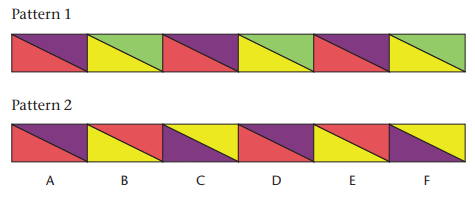
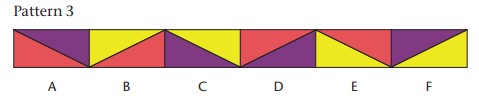
In Pattern 2, parts (A, B, C, D, E, F) each contain two triangles:
- A red triangle in part A may be a rotation or reflection of a red triangle in part E.
- Yellow triangles in different parts may be rotations of a reference triangle.
Pattern 3 differs from Pattern 2 by a specific transformation (e.g., reflection), affecting the arrangement of triangles.
Symmetry in Patterns
This section introduces symmetry, where patterns look the same after certain transformations, and explores lines of symmetry.Understanding Symmetry
A pattern has symmetry if it looks unchanged after a transformation (e.g., reflection, rotation).
- Line of symmetry: A line where a shape or pattern can be folded so that one half matches the other (mirror image).
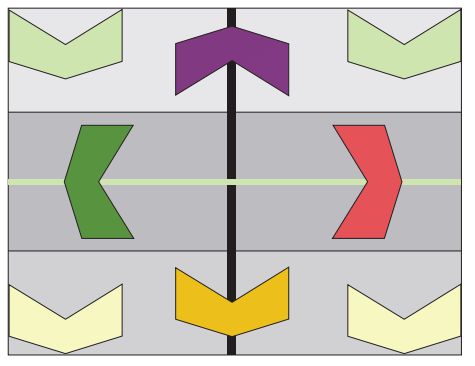
Example: A diagram with hexagons may have a line of symmetry if folding along a thick line (e.g., light green or black) makes both sides identical, ignoring color. - Rotational symmetry: A pattern looks the same after rotating around a center point by a certain angle.
Example: A hexagon may be a rotation of another hexagon if turned 60° around its center.
Analyzing Symmetry in Diagrams
A diagram with colored hexagons, a white cross, and a quadrilateral may include:
- Translations: Light green and cream hexagons are shifted versions of a golden-yellow hexagon.
- Rotations: A golden-yellow hexagon may be a rotated version of a purple hexagon.
- Reflections: A golden-yellow hexagon may not be a reflection of a purple hexagon if their orientations don't match a mirror image.
Lines of symmetry depend on shape, not color:
- A thick light green line may be a line of symmetry if the pattern is identical on both sides when folded.
- A thick black line may not be a line of symmetry if the pattern differs across it.
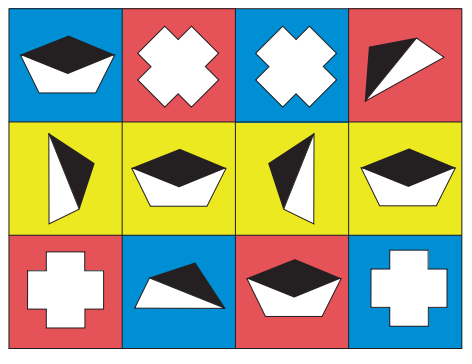
Example: A white cross can be rotated to move between red squares, indicating rotational symmetry.
Reflections and Rotations in Patterns
Reflections create mirror images:Example: In a diagram, two shapes may be reflections if one is flipped over a line (e.g., a quadrilateral moved from a yellow square to a red square).
Rotations reposition shapes:
Example: Arrows in a design may be rotations of a yellow arrow if turned around a central point.
A pattern may have multiple lines of symmetry (e.g., a design with arrows may have several mirror lines, ignoring colors).
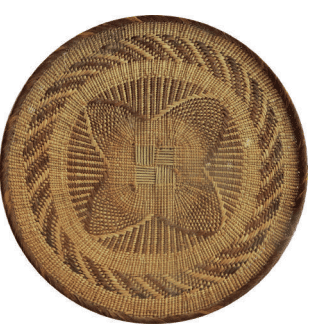
Example: In a placemat design, lines of symmetry are shown with broken lines, and rotations or reflections create the pattern's repeating elements.
Points to Remember
- Translation: Slides a shape without turning or flipping (e.g., a red figure shifted on a bead mat).
- Rotation: Turns a shape around a fixed point (e.g., a red figure turned 90° from a purple figure).
- Reflection: Flips a shape over a line to create a mirror image (e.g., a red figure flipped over a line).
- Patterns: Created by repeating shapes using translations, rotations, or reflections (e.g., Ndebele triangle designs).
- Ndebele art: Uses transformations to arrange geometric shapes in complex, repeating patterns.
- Symmetry: A pattern looks the same after a transformation (e.g., folding along a line of symmetry).
- Line of symmetry: A line where a pattern can be folded to match both sides (e.g., a thick green line in a hexagon pattern).
- Rotational symmetry: A pattern looks the same after turning around a point (e.g., rotating a hexagon 60°).
Difficult Words
- Transformation: A way to move or change a shape's position (e.g., translation, rotation, reflection).
- Translation: Sliding a shape to a new position without turning or flipping.
- Rotation: Turning a shape around a fixed point, like a pivot.
- Reflection: Flipping a shape over a line to create a mirror image.
- Line of symmetry: A line where a shape or pattern can be folded to match both halves.
- Symmetry: When a shape or pattern looks the same after a transformation (e.g., reflection or rotation).
- Template: A cut-out shape used to trace consistent figures in different positions.
- Ndebele art: A cultural art form using geometric patterns with transformations.
Summary
This chapter equips Grade 6 students with a comprehensive understanding of transformations-translations (slides), rotations (turns), and reflections (flips)-and their role in creating patterns and symmetry. Students learn to identify how shapes move between positions (e.g., sliding a template or flipping it) and analyze patterns, such as those in Ndebele art, where triangles are repeated using transformations. The chapter also introduces symmetry, including lines of symmetry and rotational symmetry, in designs like hexagons or placemats. These skills enhance spatial reasoning, preparing students for advanced geometric concepts and real-world applications in art and design.FAQs on Chapter Notes: Transformations (Term 3)
| 1. What are the differences between rotations, reflections, and translations in transformations? |  |
| 2. How can I identify symmetry in a pattern? | |
| 3. What are some real-life examples of transformations like reflections and rotations? | |
| 4. Why are transformations important in geometry and art? | |
| 5. How do you determine the angle of rotation for a shape? | |