NCERT Solutions: Travel

Let us do these activities before we read (Page 157)
QI: Complete the following word web on travel.
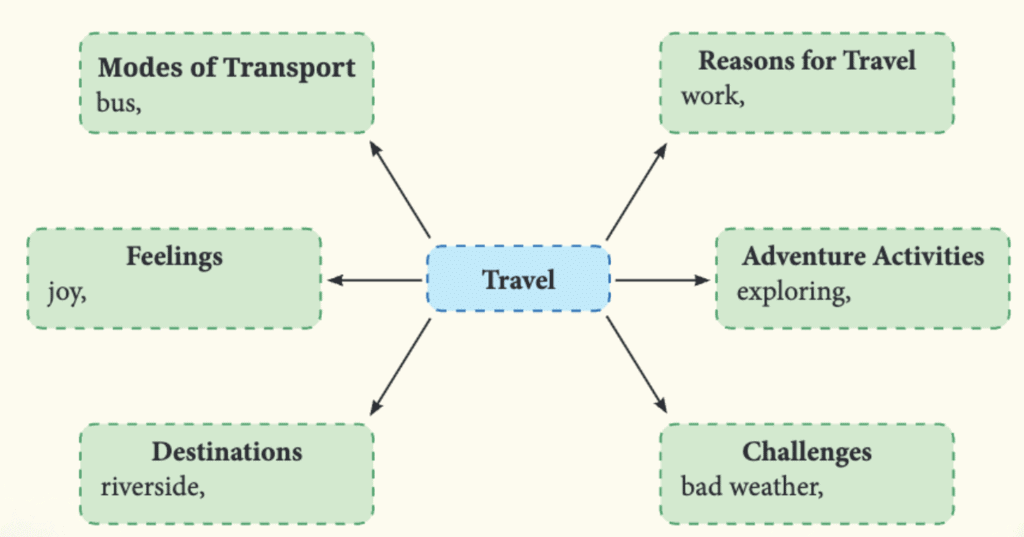
Ans:
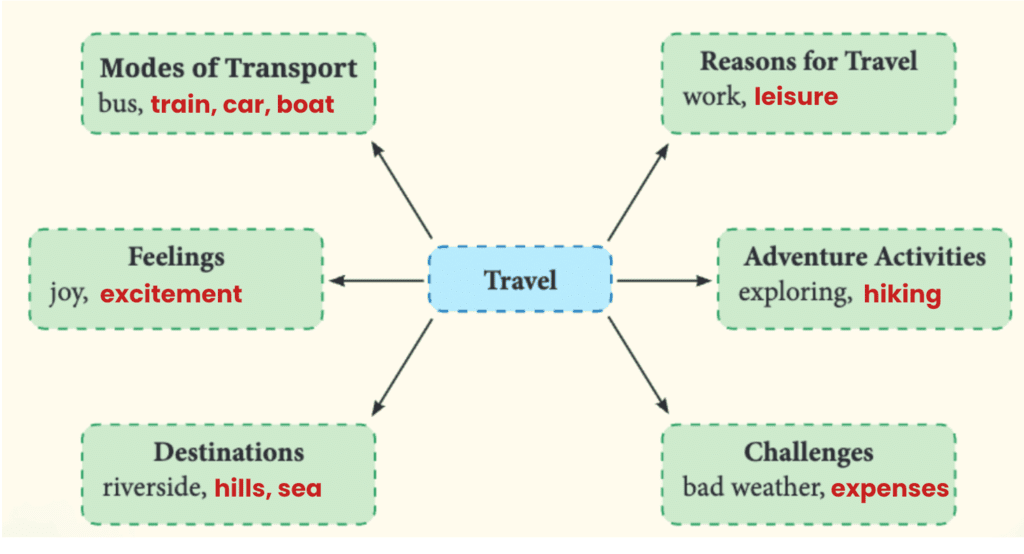
QII: You are going on a trip to an adventure camp with your classmates and teacher.
1: How will you travel to the adventure camp?
Ans: I will travel to the adventure camp by bus with my classmates and our teacher because it is safe, economical and comfortable for a group.
2: What things will you take along?
Ans: I will take a water bottle, healthy snacks, a backpack, comfortable clothes and shoes, a raincoat, a small first-aid kit and a camera to record memories.
3: Why would you like to go there?
Ans: I would like to go to the adventure camp to have fun, try new activities, learn team skills, enjoy nature and spend time with my friends.
4: What are the activities you would like to do with your friends?
Ans: I would like to do trekking, rope climbing, obstacle courses, kayaking (if available) and campfire storytelling with my friends.
5: How much time will it take to complete your adventure trip?
Ans: It will take about three to five days to complete the adventure trip, depending on the programme schedule and the location of the camp.
QIII: Discuss in pairs. What might be the reasons that people enjoy train journeys?
Ans:
- They can see beautiful views such as mountains, rivers and fields passing by.
- It is relaxing to sit back and watch the scenery change without needing to drive.
- Travelling by train gives time to talk, play games and share food with friends or family.
- Trains are usually comfortable and allow people to move about, making long journeys easier.
Let us discuss (Page 161)
QI: The main ideas of each stanza of the poem are given below. Write the number of the stanza against the matching main idea.
1. At night, the speaker imagines the train and hears its engine in the quiet
Ans: Stanza 2
2. The speaker feels a strong desire to take any train, no matter where it goes
Ans: Stanza 3
3. The speaker hears the train whistle during the day, even though the train is far away
Ans: Stanza 1
QII: Read the poem and underline the rhyming words in each stanza. Write the rhyming words from each stanza. An example has been done for you.
1. Stanza (i)
Ans: away-day; speaking-shrieking
2. Stanza (ii)
Ans: by-sky; dreaming-streaming
3. Stanza (iii)
Ans: make-take; knowing-going
QIII: Identify the rhyme scheme of the poem from the options given below.
1. AABB
2. ABCA
3. ABAB
4. ABBC
Ans: (3)
Explanation: The lines in each stanza rhyme in the pattern ABAB, where the first and third lines follow one rhyme and the second and fourth lines follow another.
QIV: Identify the word in the poem that personifies the whistle of the train.
Ans: shrieking
QV: Tone refers to the attitude the poet has about the poem. Which of these words can be used to describe the poet's tone in this poem?

Ans: excited; curious; enthusiastic; joyful
QVI: Select the words that tell us what the train symbolises for the poet.
1. education
2. adventure
3. comfort
4. opportunities
Ans: 2 and 4
Explanation: The train represents a sense of adventure - the desire to travel and explore - and opportunities - new experiences and chances to grow, rather than comfort or formal education.
QVII: Complete the following by choosing the correct option from those given in brackets.
The poet repeats the line, '...there isn't a train goes by,' in all three stanzas to _______. (highlight the speaker's fascination with the train/suggest that the area has many trains passing through)
Ans: highlight the speaker's fascination with the train
Explanation: Repeating the line shows how often the speaker thinks about the train and how fascinated she is with its sound and idea, not that many trains are actually passing by.
QVIII: The poem contrasts the busy day with the stillness of the night. What is the common factor in these?
Ans: In both the busy day and the still night the speaker's thoughts are filled with the train; the train's sound and sight remain important to her at all times.
QIX: Imagery is a literary device that uses descriptive language to create mental pictures and appeal to the reader's senses (sight, sound, smell, taste and touch). It makes the descriptions more relatable. Select the phrases from the poem that are examples of imagery.
Ans:
day is loud
whistle shrieking
cinders red on the sky
engine steaming
Explanation: All these phrases appeal to the senses: the whistle and shrieking suggest sound, "night is still" creates atmosphere, "cinders red on the sky" gives a visual image, and "engine steaming" suggests sight and motion.
Let us think and reflect (Page 162)
QI. Read the extract given below and answer the questions that follow.
1. My heart is warm with the friends I make,
And better friends I'll not be knowing...
(i): Choose the suitable option to complete the following.
The line 'My heart is warm' refers to a heart that is _____
A. filled with worries
B. full of love
C. feeling upset
D. experiencing anger
Ans: (B)
Explanation: 'My heart is warm' means the speaker feels affection and happiness because of the friends she has, so it means a heart full of love.
(ii): What does the speaker say about her current friends?
Ans: The speaker says that her friends make her heart feel warm and that she values them very highly.
(iii): What does the line 'better friends I'll not be knowing' suggest about the speaker's feelings toward their current friends?
Ans: The line suggests that the speaker believes these are the best friends she could have; she feels grateful and thinks she will not meet friends who are better than them.
(iv): Complete the following suitably.
The tone of the speaker in these lines is ______ (grateful/content)
Ans: The tone of the speaker in these lines is grateful.
QII. Answer the following questions.
1: What does the phrase 'cinders red on the sky' tell us about the train at night?
Ans: The phrase suggests that sparks or glowing bits from the train's fire or engine flare up and look red against the dark night sky, so the train is visible even at night.
2: What is the significance of the repeated references to the train's whistle?
Ans: The repeated references show how strongly the train's sound stays in the speaker's mind. The whistle becomes a symbol of longing and the wish to travel, and it shows the speaker's deep emotional connection with the idea of the train.
3: What does the line 'no matter where it's going' reveal about the speaker's attitude towards travel?
Ans: It reveals that the speaker loves the idea of travel itself and the adventure of going somewhere; she is not concerned about the specific destination.
4: Do you think the poet actually sees and hears the train? Why or why not?
Ans: The poet does not see the train nearby, but she can still hear and imagine it vividly even from a distance, showing her deep fascination.
Let us learn (Page 163)
QI: Read the expressions from the poem given in Column 1 and match them with what they indicate in Column 2.
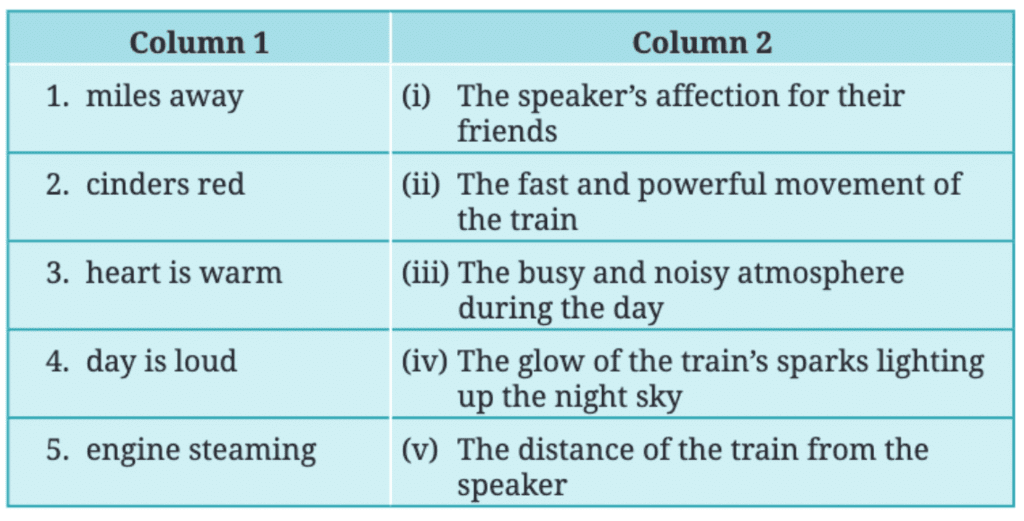
Ans:
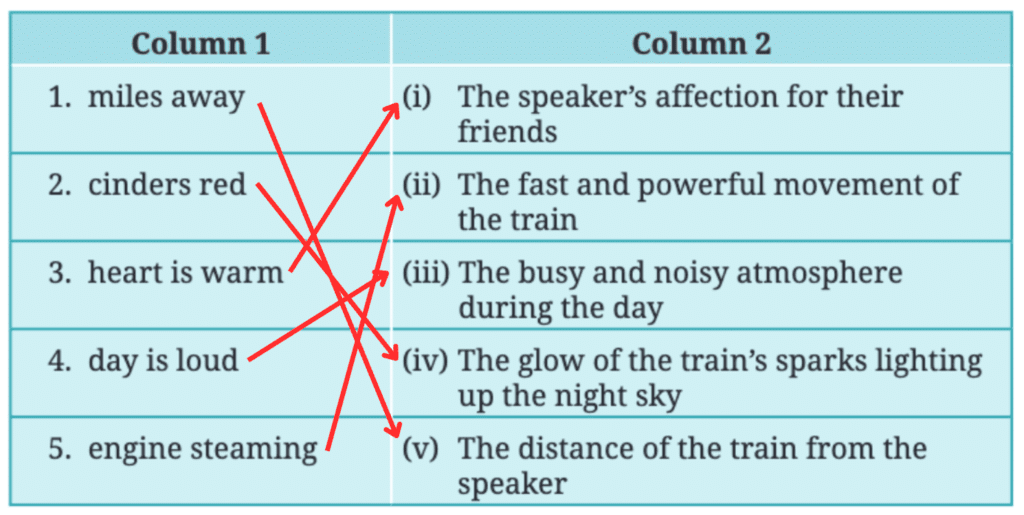
Now, use the expressions in Column 1 to fill in the following blanks correctly.
1. After meeting her old friend, her heart is warm with the joy of rekindled memories.
2. As I arrived at the railway station I could hear the engine steaming.
3. The marketplace is bustling, and the day is loud with the chatter of shoppers and vendors.
4. The bonfire glowed brightly, throwing cinders red into the dark night sky.
5. The sound of a train could still be heard miles away as the evening grew quiet.
QII: The poet uses the word 'shrieking' to tell us about the sound of the train's whistle. There are other words that tell us about different types of related sounds.
Read the meanings of such words in Column 1 and match them with the words in Column 2.
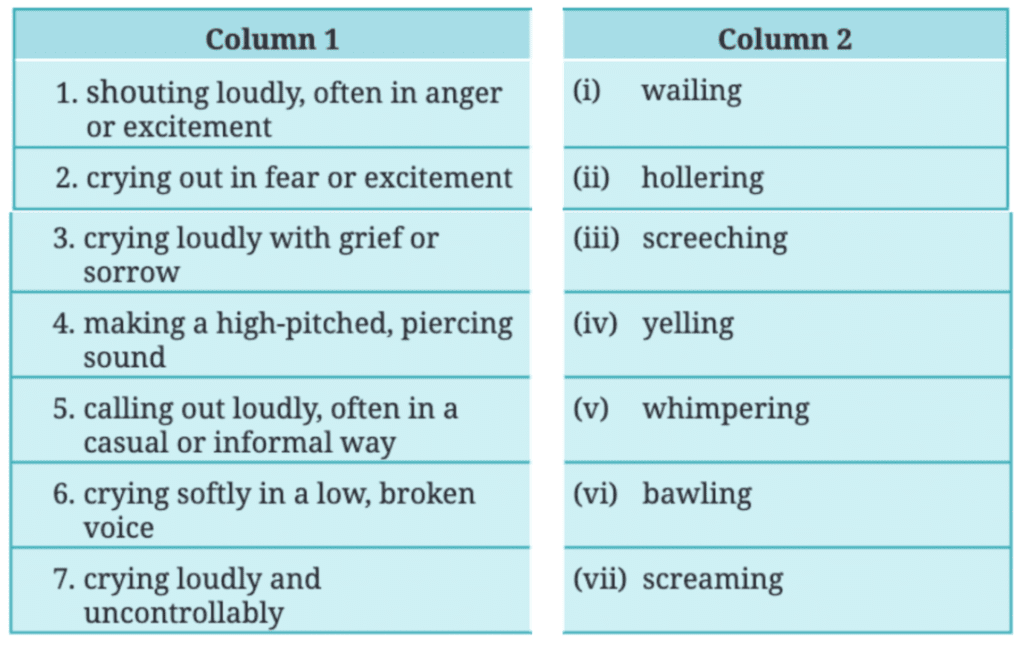
Ans:
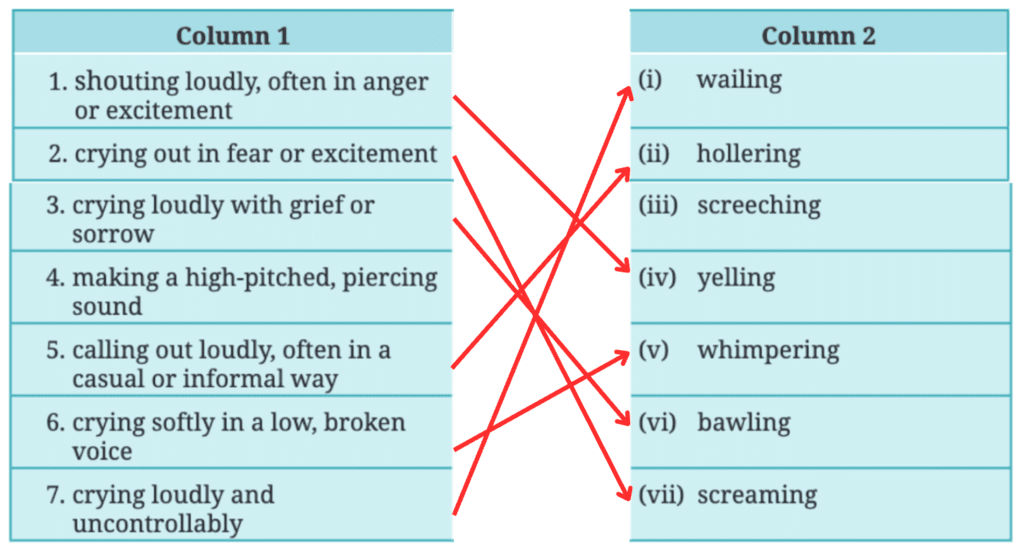
Now, complete the following paragraph by using suitable words from Column 2.
The street was filled with a variety of sounds. A shopkeeper was yelling to attract customers, while a child nearby was hollering at his friend to wait for him. From the other side of the road, a toddler was bawling uncontrollably after dropping his ice cream, and his mother tried to calm him as he began whimpering softly. In the background, someone's loud screaming voice added to the bustling noise of the busy evening.
Let us write (Page 165)
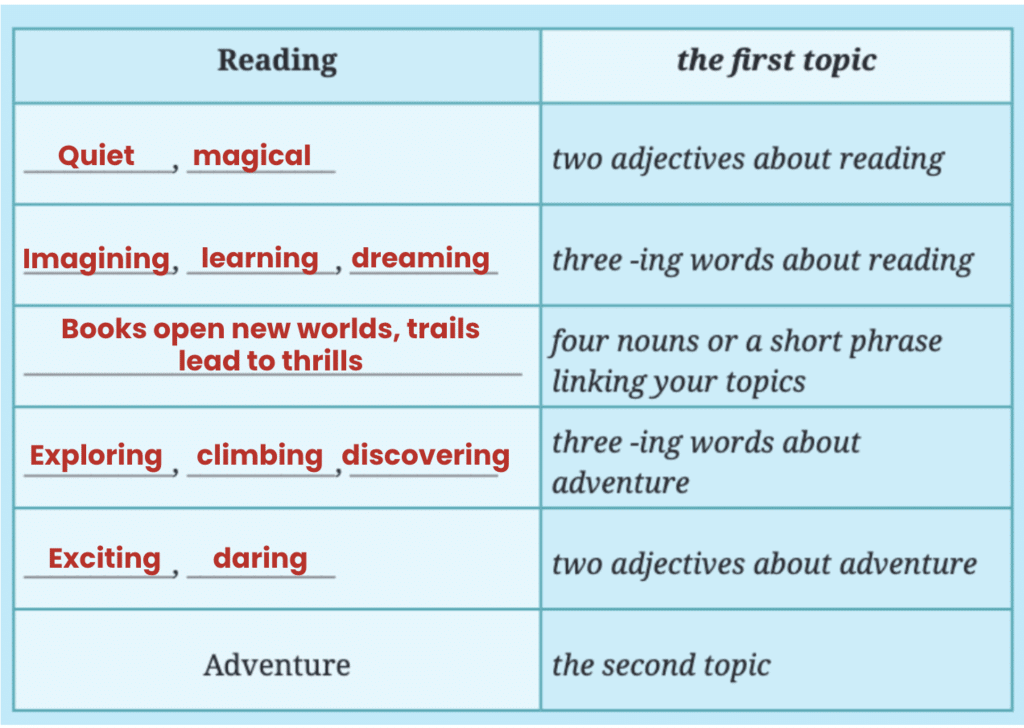
QI: A diamante poem is a poem that is shaped like a diamond, which uses specific types of words like adjectives and -ing words.
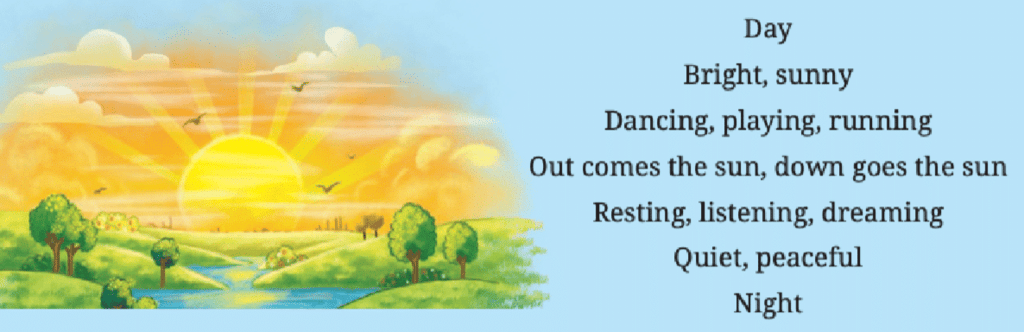
Let us now write a diamante poem that connects 'reading' and 'adventure'.
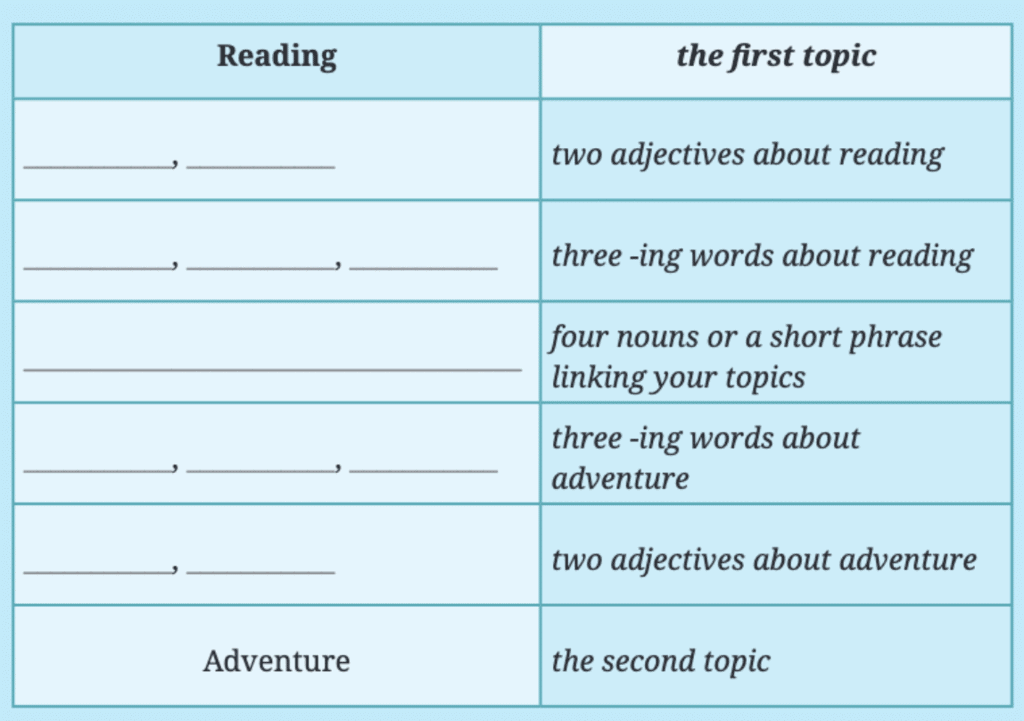
Ans:
QII: We come across many interesting characters while travelling. They become interesting because of their actions, their behaviour, and manner of speaking. Describe one such character that you met.
1. Choose the character.
Ans: During my trip to the hills, I met an interesting man named Sunny.
2. Create a first draft of your description including the following details.
(i) What is the name of the character?
(ii) What does the character look like?
(iii) What does the character do?
(iv) what kind of person is she or he?
(v) Include any line or incident from your experience that you like the most.
Ans: (i) His name was Sunny. He was quiet at first, but once he began to speak, he talked with warmth and humour. (ii) Sunny had a kindly face marked with gentle lines, neat grey hair and round glasses that made his eyes shine. (iii) He was a retired teacher who loved gardening and often spoke to his plants as if they were students. He also told small stories from his life that were full of simple wisdom. (iv) Sunny was thoughtful, gentle and witty; he made ordinary moments feel special by the way he noticed small details. (v) My favourite incident was when I asked him how he stayed happy; he leaned forward with a twinkle in his eye and said, "It's simple: if you cannot find joy in the little things around you, you will not find it anywhere else."
3. Check your description for any spelling mistakes or errors.
Ans: Students should do it themselves.
4. Show your classmates your work and ask for suggestions.
Ans: Students should do it themselves.
5. Rewrite your description including all the changes and suggestions for improvement.
Ans: Students should do it themselves.
FAQs on NCERT Solutions: Travel
| 1. What are the main themes and lessons about travel in the NCERT Class 7 English chapter? |  |
| 2. How should I answer travel-related comprehension questions to score full marks in Class 7 English exams? | |
| 3. What vocabulary words about travel and journeys does NCERT Class 7 English expect students to know? | |
| 4. Why do travel stories teach important life lessons in the NCERT Class 7 curriculum? | |
| 5. What's the difference between descriptive travel writing and narrative travel stories in Class 7 English texts? | |





