Chapter Notes: Common Fractions (Term 4)


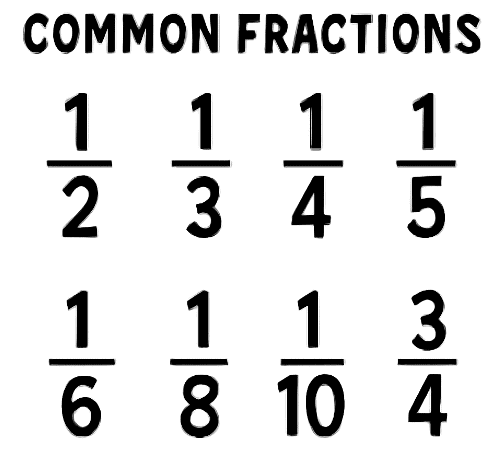 Common Fractions
Fractions of Collections
This section teaches students to calculate fractions of whole numbers and understand division in the context of fractions.Calculating Fractions of Quantities
A fraction represents a part of a whole (e.g., 1/10 of 250 means dividing 250 into 10 equal parts and taking 1 part).Examples:
- 1/10 of 250 = 250 ÷ 10 = 25.
- 2 1/2 hundreds = 2.5 × 100 = 250.
- 1/100 of 250 = 250 ÷ 100 = 2.5.
- 10/100 of 250 = (10 ÷ 100) × 250 = 0.1 × 250 = 25.
- 4/100 of 250 = (4 ÷ 100) × 250 = 0.04 × 250 = 10.
- 1/25 of 250 = 250 ÷ 25 = 10.
Division and Fractions
Dividing a number by a denominator gives the value of one fractional part:
- Example: 200 ÷ 10 = 20 (1/10 of 200).
- Example: 200 ÷ 5 = 40 (1/5 of 200).
- Example: 200 ÷ 20 = 10 (1/20 of 200).
- Example: 200 ÷ 40 = 5 (1/40 of 200).
Real-World Application
Example: 200 chairs divided equally among 10 people:
- 1/10 of 200 = 200 ÷ 10 = 20 chairs per person.
- 1/20 of 200 = 200 ÷ 20 = 10 chairs.
- 4/10 of 200 = (4 ÷ 10) × 200 = 0.4 × 200 = 80 chairs.
- 2/5 of 200 = (2 ÷ 5) × 200 = 0.4 × 200 = 80 chairs.
Writing the Same Number in Different Forms
This section explores expressing fractions as tenths, hundredths, decimals, percentages, and other forms using colored circles.Fractions of a Circle
Example: 2/10 of a circle colored red = 20/100 = 1/5.
Express fractions in multiple ways:
- As tenths and hundredths (e.g., 3/10 + 4/100).
- As hundredths (e.g., 34/100).
- As a decimal (e.g., 0.34).
- As a percentage (e.g., 34%).
- In another form (e.g., 17/50).
Equivalent Representations
Example: 34/100 of a circle colored red:
Correct forms:
- 30/100 + 4/100 = 34/100.
- 34/100.
- 34%.
- 0.34.
- 17/50.
Incorrect forms:
- 3.4 (not a fraction or percentage).
- 2.14 (unrelated decimal).
- 0.17 (half of 0.34).
Some fractions require approximation if the circle's divisions are not exact.
Equivalent Fractions
This section teaches students to find equivalent fractions using fraction strips and understand their role in addition.Understanding Equivalent Fractions
Equivalent fractions have the same value but different numerators and denominators (e.g., 2/5 = 8/20).
Use fraction strips to visualize:
Example: To find fractions equivalent to 3/5:
- Draw a strip divided into 5 equal parts (fifths).
- Divide each fifth into 3 parts (fifteenths).
- Each small part = 1/15.
- 3 fifths = 9 fifteenths (3/5 = 9/15).
Other equivalents: 6/10, 12/20, 24/40 (divide each fifth into 2, 4, or 8 parts).
Creating Equivalent Fractions
Example: For a strip divided into eighths:
- To get fortieths, divide each eighth into 5 parts (1/8 = 5/40).
- To get twenty-fourths, divide each eighth into 3 parts (1/8 = 3/24).
Example: For a strip divided into sixths:
- To get eighteenths, divide each sixth into 3 parts (1/6 = 3/18).
- To get thirtieths, divide each sixth into 5 parts (1/6 = 5/30).
Adding Fractions
Use equivalent fractions to add with common denominators:
Example: 2/5 + 7/20 = 8/20 + 7/20 = 15/20.
Practice
This section reinforces fraction skills through sequences, ordering, calculations, and conversions.Decimal Sequences
Identify patterns in decimal sequences:
- Example: 0.4, 0.8, 1.2, ... increases by 0.4 (next: 1.6, 2.0, 2.4).
- Example: 0.92, 0.94, 0.96, ... increases by 0.02 (next: 0.98, 1.00, 1.02).
- Example: 1.13, 1.12, 1.11, ... decreases by 0.01 (next: 1.10, 1.09, 1.08).
- Example: 22.27, 22.28, 22.29, ... increases by 0.01 (next: 22.30, 22.31, 22.32).
- Example: 1.6, 0.8, 0.4, ... decreases by half (next: 0.2, 0.1, 0.05).
Ordering Numbers
Arrange fractions, decimals, and percentages in ascending order:
Example: 1/4, 7/10, 0.5, 40%, 3/5, 72%, (9 × 7)/100, 0.07.
- Convert to decimals: 0.25, 0.7, 0.5, 0.4, 0.6, 0.72, 0.63, 0.07.
- Order: 0.07, 0.25, 0.4, 0.5, 0.6, 0.63, 0.7, 0.72.
Calculations with Fractions and Decimals
Fraction calculations:
- Example: 1 - 1/100 = 99/100.
- Example: 99/100 + 3/100 = 102/100 = 1 2/100.
- Example: 2 3/5 + 1 4/5 = (2 + 1) + (3/5 + 4/5) = 3 + 7/5 = 4 2/5.
- Example: 2 3/5 - 1 4/5 = (2 - 1) + (3/5 - 4/5) = 1 - 1/5 = 4/5.
Decimal calculations:
- Example: 0.99 + 0.02 = 1.01.
- Example: 1.06 - 0.1 = 0.96.
- Example: 4.25 + 0.1 = 4.35.
Conversion Table
Express fractions in multiple forms:
Example: 3/10 + 2/100:
- Hundredths: 32/100.
- Equivalent fractions: 32/100, 16/50.
- Decimal: 0.32.
- Percentage: 32%.
Example: 75% = 0.75 = 75/100 = 3/4.
Using Fractions to Compare Quantities
This section applies fractions to compare quantities in real-world scenarios like recipes and steps.
Comparing Syrup Recipes
Mrs. Daku's jam syrup recipes:
- Type A: 2 cups water, 2 cups sugar (1:1 ratio, 2/4 sugar).
- Type B: 3 cups water, 2 cups sugar (2:3 ratio, 2/5 sugar).
- Type C: 4 cups water, 2 cups sugar (2:4 ratio, 2/6 sugar).
Sweetest: Type A (highest sugar proportion, 2/4 > 2/5 > 2/6).
Scaling: For Type B, 9 cups water → (2/3) × 9 = 6 cups sugar.
Analyzing Ratios
Mrs. Bester's syrup: 2 cups sugar for 3 cups water.
- True: There is 2/3 as much sugar as water (2 sugar ÷ 3 water = 2/3).
- False: 2/3 of syrup is not sugar (sugar is 2/5 of total 5 cups).
- False: 2/5 of syrup is not sugar (sugar is 2/5, but not stated).
- True: 1 1/2 times as much water as sugar (3 water ÷ 2 sugar = 3/2 = 1 1/2).
Comparing Steps
Jody's steps: 3 steps for 1 of his father's.
- Jody's step = 1/3 of father's step.
- Father's step = 3 times Jody's step.
- Fractions of Time
1 hour = 60 minutes: - 1/3 hour = 60 ÷ 3 = 20 minutes.
- 2/3 hour = 2 × 20 = 40 minutes.
- 1/5 hour = 60 ÷ 5 = 12 minutes.
- 1/6 hour = 60 ÷ 6 = 10 minutes.
- 1/10 hour = 60 ÷ 10 = 6 minutes.
- 1/5 + 1/2 = 12 + 30 = 42 minutes.
- 7/10 = 7 × 6 = 42 minutes.
- 8/10 = 8 × 6 = 48 minutes.
- 1/3 + 1/2 = 20 + 30 = 50 minutes.
- 4/5 = 4 × 12 = 48 minutes.
Equivalent times: 1/5 + 1/2 = 7/10 (both 42 minutes); 8/10 = 4/5 (both 48 minutes).
Points to Remember
- Common fraction: A number like 3/4 (numerator/denominator).
- Fraction of a quantity: Divide by denominator, multiply by numerator (e.g., 1/10 of 250 = 25).
- Equivalent fraction: Same value, different form (e.g., 3/5 = 9/15).
- Decimal notation: Fraction as a decimal (e.g., 34/100 = 0.34).
- Percentage: Fraction of 100 (e.g., 34/100 = 34%).
- Fraction strip: Visual tool to show equivalent fractions.
- Ratio: Compares quantities (e.g., 2 sugar : 3 water).
- Scaling: Adjust quantities proportionally (e.g., 9 water → 6 sugar).
Difficult Words
- Common fraction: A fraction with numerator and denominator (e.g., 2/5).
- Numerator: Top number in a fraction (e.g., 2 in 2/5).
- Denominator: Bottom number in a fraction (e.g., 5 in 2/5).
- Equivalent fraction: Fractions with equal value (e.g., 2/5 = 8/20).
- Decimal notation: Writing fractions as decimals (e.g., 0.34).
- Percentage: Part per 100 (e.g., 34%).
- Fraction strip: A diagram showing equal parts of a whole.
- Ratio: A comparison of two quantities (e.g., 2:3).
Summary
This chapter equips Grade 6 students with skills to work with common fractions by calculating fractions of quantities (e.g., 1/10 of 250 = 25), expressing fractions in multiple forms (e.g., 34/100 = 0.34 = 34%), finding equivalent fractions (e.g., 3/5 = 9/15), performing operations (e.g., 2 3/5 + 1 4/5 = 4 2/5), and comparing quantities (e.g., 2/3 sugar to water). These skills connect fractions to real-world applications like recipes, time, and measurements.FAQs on Chapter Notes: Common Fractions (Term 4)
| 1. What are equivalent fractions and how can I find them? |  |
| 2. How do I compare two fractions to determine which is larger? | |
| 3. What is the process for writing a fraction in different forms? | |
| 4. Can you explain how to use fractions to compare quantities in real-life scenarios? | |
| 5. What are some common mistakes to avoid when working with fractions? | |