NCERT Solutions: Life Processes in Animals

Let Us Enhance Our Learning
Q1: Complete the journey of food through the alimentary canal by filling up the boxes with appropriate parts.

Ans:
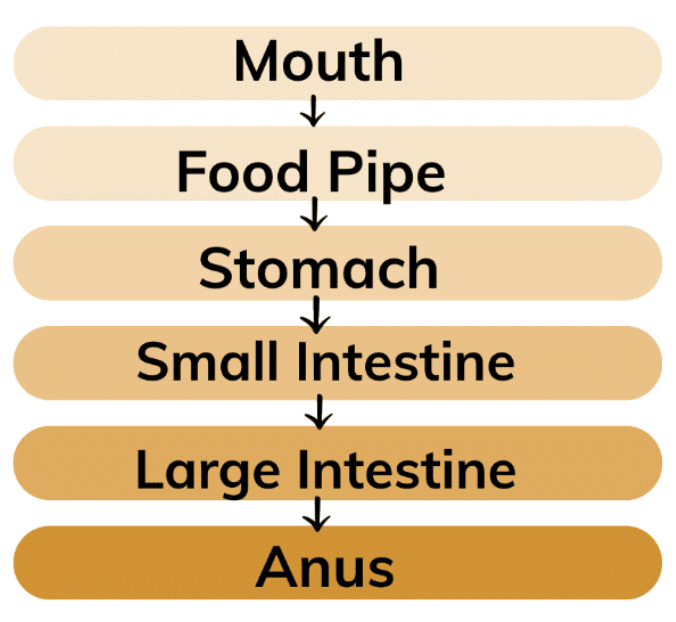
Food passes through the alimentary canal in the following order: Mouth → Oesophagus → Stomach → Small intestine → Large intestine → Rectum → Anus. Digestion begins in the mouth and is completed mainly in the small intestine, where most absorption of digested food into the blood occurs. Each part has a role: the mouth chews food, the oesophagus moves it to the stomach, the stomach mixes and breaks it down further, the small intestine completes digestion and absorbs nutrients, and the large intestine absorbs water and forms faeces which are stored in the rectum.
Q2: Sahil placed some pieces of chapati in test tube A. Neha placed chewed chapati in test tube B, and Santushti took boiled and mashed potato in test tube C. All of them added a few drops of iodine solution to their test tubes-A, B, and C, respectively. What would be their observations? Give reasons.
Ans:
Test tube A (Pieces of chapati): After adding iodine solution, the mixture will turn blue-black. Iodine gives a blue-black colour in the presence of starch, and uncooked or unchewed chapati contains starch.
Test tube B (Chewed chapati): The mixture will show no colour change or only a very faint blue-black shade. Chewing mixes food with saliva; saliva contains an enzyme called amylase that begins to break down starch into simpler sugars, which do not react with iodine.
Test tube C (Boiled and mashed potato): The mixture will turn blue-black, because potato contains a large amount of starch, which reacts with iodine to give the blue-black colour.
Reasoning: Iodine reacts with starch to give a blue-black colour. In test tubes A and C, starch is present so the colour change is clear. In test tube B, chewing and saliva begin starch breakdown, so little or no starch remains to give the colour.
Q3: What is the role of the diaphragm in breathing?
(i) To filter the air
(ii) To produce sound
(iii) To help in inhalation and exhalation
(iv) To absorb oxygen
Ans:
Ans: (iii)
Explanation: The diaphragm is a sheet of muscle below the lungs. During inhalation it moves downward, increasing the volume of the chest cavity so air is drawn into the lungs. During exhalation it relaxes and moves upward, decreasing the chest volume and pushing air out. The diaphragm itself does not filter air, produce sound or absorb oxygen; its main role is to help in inhalation and exhalation.
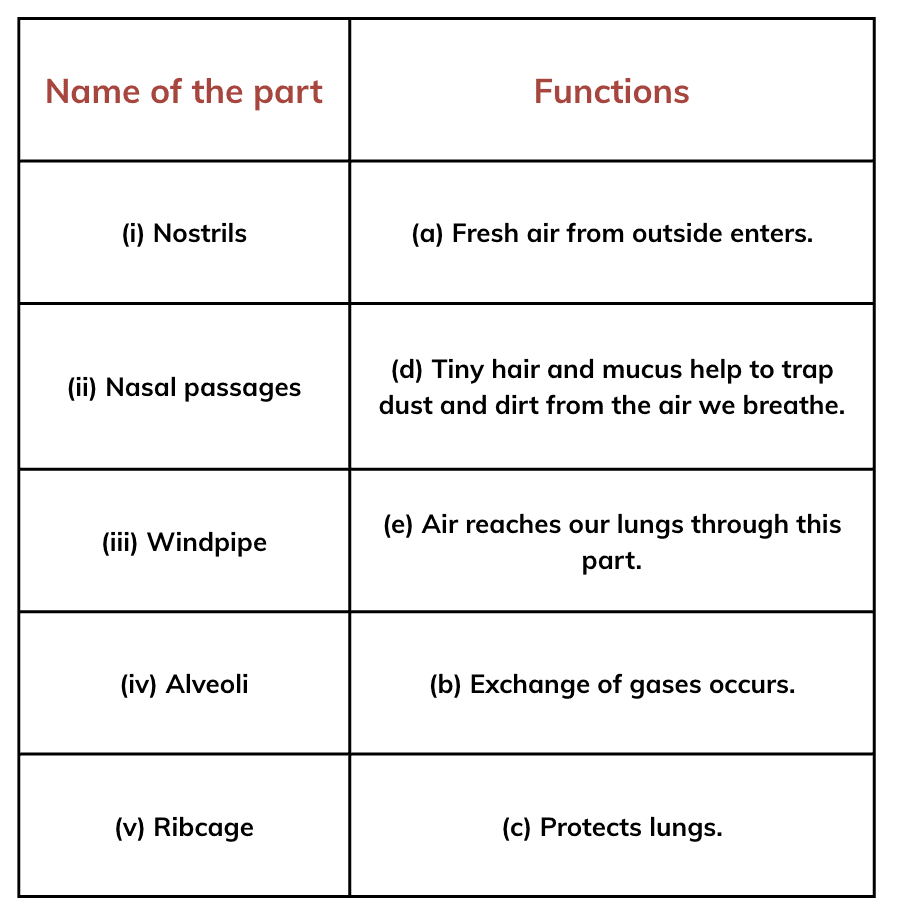
Q4: Match the following.
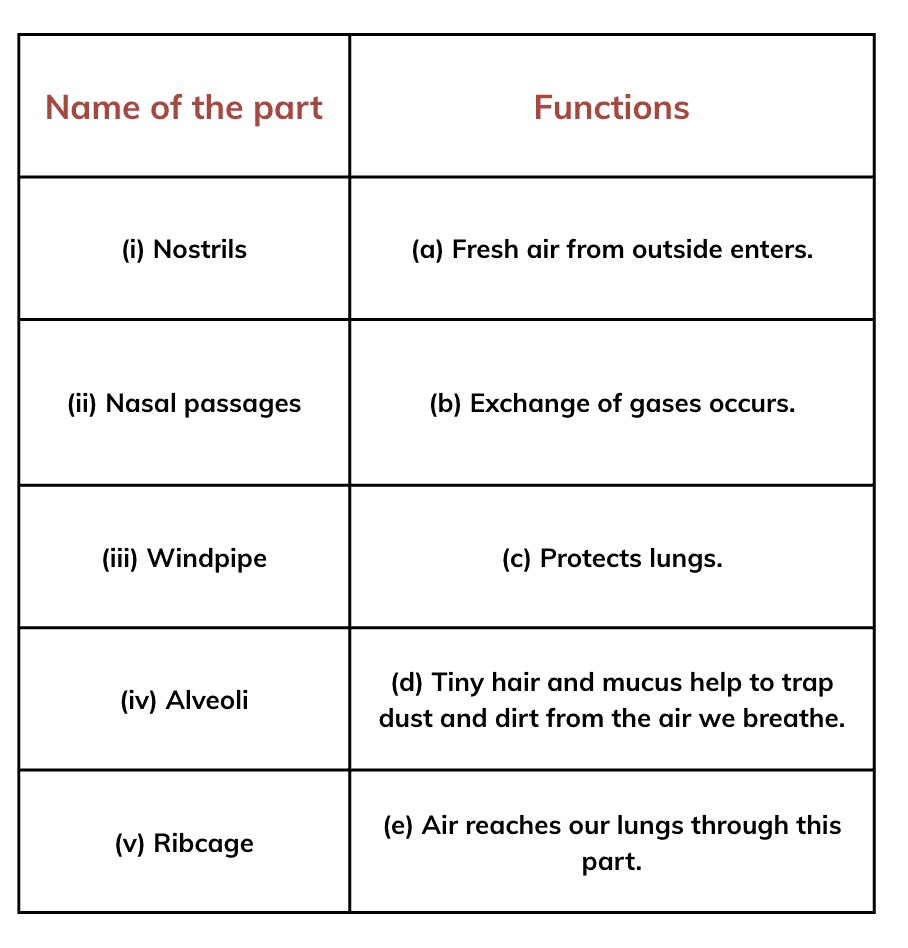
Ans:
Q5: Anil claims to his friend Sanvi that respiration and breathing are the same process. What question(s) can Sanvi ask him to make him understand that he is not correct?
"What is the difference between breathing and respiration?"
"Does respiration continue inside your cells even when you are not breathing?"
"How is the food we eat used to give us energy during respiration?"
These questions will show that breathing is a physical process of taking air in and out of the lungs, while respiration is a chemical process inside cells where oxygen is used to break down food to release energy. Respiration happens continuously in cells whether or not we are actively breathing.
Q6: Which of the following statements is correct and why?
Anu: We inhale air.
Shanu: We inhale oxygen.
Tanu: We inhale air rich in oxygen.
Ans: (iii) Tanu: We inhale air rich in oxygen.
Explanation: The air we breathe is a mixture of gases and contains about 21% oxygen, which is enough for our bodies' needs; so it is correct and more precise to say we inhale air rich in oxygen (meaning air that contains oxygen). Saying simply "We inhale oxygen" is incomplete because we inhale the whole air mixture, not pure oxygen. Saying "We inhale air" is true but less specific.
Q7: We often sneeze when we inhale a lot of dust-laden air. What can be possible explanations for this?
Ans: When we inhale dust-laden air, sneezing happens for these reasons:
1. Nose irritation: Dust particles irritate the lining of the nose, triggering a reflex that causes a sneeze to expel the irritants.
2. Body's defence: Sneezing helps remove foreign particles and protects the lungs from harmful dust.
3. Clearing airways: A strong burst of air during a sneeze clears the nasal passages and throat so breathing becomes easier and cleaner.
Q8: Paridhi and Anusha of Grade 7 started running for their morning workout. After they completed their running, they counted their breaths per minute. Anusha was breathing faster than Paridhi. Provide at least two possible explanations for why Anusha was breathing faster than Paridhi.
Ans: Here are two simple reasons why Anusha was breathing faster than Paridhi after their run:

Running faster: Anusha may have been running faster or putting in more effort, so her muscles needed more oxygen and produced more carbon dioxide. This increases breathing rate to meet the demand.
Fitness levels: If Anusha is less fit than Paridhi, her heart and lungs work harder during exercise, causing a higher breathing rate for the same activity.
In short, differences in effort and fitness explain why Anusha breathed faster than Paridhi.
Q9: Yadu conducted an experiment to test his idea. He took two test tubes, A and B, and added a pinch of rice flour to the test tubes, half-filled with water, and stirred them properly. To test tube B, he added a few drops of saliva. He left the two test tubes for 35-45 minutes. After that, he added iodine solution into both the test tubes. What do you think he wants to test?
Ans: Observation:
Test Tube A (without saliva): After adding iodine, the water in test tube A will turn blue-black, showing that starch is still present in the rice flour.
Test Tube B (with saliva): After adding iodine, the water in test tube B will show little to no colour change (or a much lighter blue-black), indicating that the starch has been broken down by the enzyme amylase present in saliva.
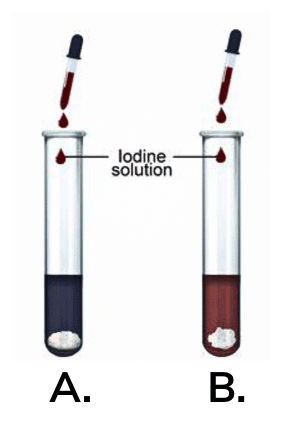
By performing this experiment, Yadu is testing the effect of saliva on the breakdown of starch in rice flour. If starch is broken down by saliva, the iodine test will not produce the blue-black colour in test tube B, confirming that saliva starts digestion of starch into simpler sugars.
Q10: Rakshita designed an experiment taking two clean test tubes, A and B, and filled them with lime water as shown in the figure. In test tube A, the surrounding air that we inhale was passed on by sucking air from the pipe, and in test tube B, the exhaled air was blown through the pipe. What do you think she is trying to investigate? How can she confirm her findings?
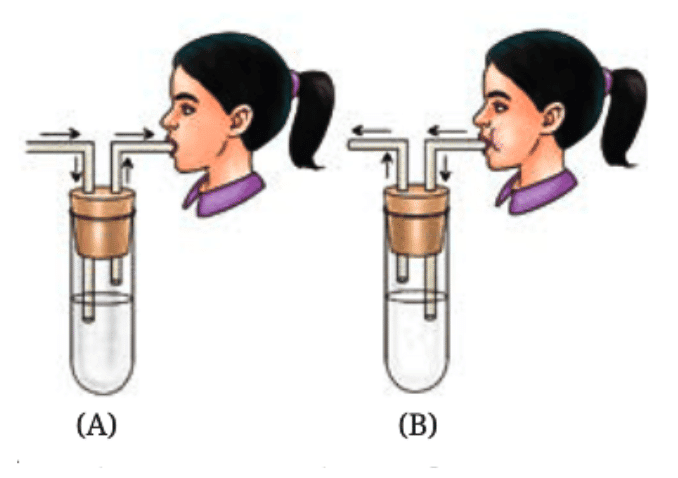
Ans: Rakshita is investigating the difference in the amount of carbon dioxide (CO₂) in inhaled air compared with exhaled air. She can confirm her findings by observing the lime water in the two test tubes:
Test Tube A (Inhaled air): When the air we inhale is passed through lime water, there will usually be no visible change because the inhaled air contains only a small amount of carbon dioxide.
Test Tube B (Exhaled air): When exhaled air is bubbled through lime water, the lime water will turn milky. This happens because exhaled air contains more carbon dioxide, which reacts with the lime water to form a white solid (calcium carbonate), making the solution look milky.
Conclusion: If the lime water in test tube B becomes milky while test tube A does not, Rakshita's observation confirms that exhaled air contains more carbon dioxide than inhaled air.
FAQs on NCERT Solutions: Life Processes in Animals
| 1. What are the main life processes that happen in animal bodies? |  |
| 2. How does the digestive system in animals break down food step by step? | |
| 3. Why do animals need both aerobic and anaerobic respiration for survival? | |
| 4. What's the difference between circulation in fish versus land animals in Class 7 CBSE science? | |
| 5. How does excretion help keep animals healthy and why is it a vital life process? | |