NCERT Solutions: My Dear Soldiers


Let us do these activities before we read (Page 199)
QI: Look around and identify the people who contribute to your life selflessly with a risk to their own lives. Share your answers with your classmates and the teacher.
Ans: Soldiers, firefighters, and doctors contribute to our lives selflessly by risking their lives to protect and help us.
QII: Work in pairs. Discuss at least three questions that you would like to ask the people identified in I.
Ans: 1. How do you stay brave when you face danger?
2. What made you choose this job?
3. How do you feel when you save someone's life?

Let us discuss (Page 201)
QI: Complete the summary with an exact word from the poem. An example has been done for you. Share your answers with your classmates and the teacher.
Ans: The poem is a tribute to the soldiers of the 1. land who defend the 2. borders of their country. It highlights their untiring commitment and sacrifices as they guard the nation. The soldiers remain vigilant and dedicated, whether it's windy, snowy, or 3. scorching hot. They walk on 4. lonely stretches of land like the yogis. Their duty takes them to different terrains, including mountains, valleys, 5. deserts, and marshes. The poet acknowledges that they have given a major part of their 6. youth to protect the nation. The poet says the wind chimes show their respect to the soldiers' 7. feat. The poet concludes with prayers for their well-being and blessings.
QII: Select the correct option for the following questions.
1: The theme of the poem is _______
(i) patriotism and sacrifice
(ii) heroism and awareness
(iii) nature and hardship
(iv) seasons and terrain
Ans: (i)
Explanation: The poem honours those who protect the nation and emphasises their sacrifices and devotion. Words and lines that speak of giving the "prime of your youth" and guarding borders show that the main focus is on patriotism and sacrifice rather than only nature or seasons.
2: The tone of the poem is ______
(i) admiring (ii) sad (iii) respectful(iv) grateful (v) prayerful
A. Only (v)
B. (i) and (iii)
C. (ii), (iii) and (v)
D. (i), (iii), (iv) and (v)
Ans: D
Explanation: The poem is clearly admiring and respectful of the soldiers' bravery; it is also grateful for their sacrifice and ends with a prayerful tone asking for their well-being. These combined tones match option D.
QIII: Complete the following sentences by explaining why the poet has used the following poetic devices.
1: Imagery because _________________________________________________
Ans: Imagery because it helps the reader picture the soldiers guarding in harsh weather and lonely places.
2: Simile because the soldiers are likened to _________________________________________________
Ans: Simile because the soldiers are likened to yogis walking in lonely places.
3: Metaphor because the poet uses wind chimes _________________________________________________
Ans: Metaphor because the poet uses wind chimes to show the respect and honour for soldiers' brave actions.
4: Repetition of the words 'you' and 'we' because _________________________________________________
Ans: Repetition of the words 'you' and 'we' because it shows the connection between the soldiers and the people they protect.
5: Alliteration such as 'season or snowy' and to create _________________________________________________
Ans: Alliteration such as 'season or snowy' and to create a rhythm and make the poem sound more powerful.
Let us think and reflect (Page 202)
QI. Read the extract given below and answer the questions that follow.
When we are all asleep
You still hold on to your deed
Windy season or snowy days
Or scorching sun's sweltering rays
You are there guarding all the time awake
Treading the lonely expanses as yogis
1: Identify a set of opposite words from the extract.
Ans: The opposite words are asleep and awake.
2: Complete the sentence appropriately. The phrase 'still hold on to your deed' refers to the soldier's attitude of
Ans: The phrase 'still hold on to your deed' refers to the soldier's attitude of staying steadfastly committed to their duty despite difficulties.
3: Identify whether the following statement is true or false. The soldiers walk across the deserted stretches of land.
Ans: True
Explanation: The poem mentions "treading the lonely expanses," which indicates that the soldiers walk across deserted or lonely stretches of land while performing their duty.
4: Give evidence from the extract to show that soldiers face harsh weather conditions.
Ans: "Windy season or snowy days / Or scorching sun's sweltering rays" shows that soldiers face harsh and varying weather conditions while on guard.
5: Which quality of the soldiers is highlighted in this extract?
(i) modesty
(ii) optimism
(iii) simplicity
(iv) dedication
Ans: (iv) dedication
QII. Answer the following questions.
1: Who is the speaker of this poem? How can you say so?
Ans: The speaker is A.P.J. Abdul Kalam, the poet. We can say so because his name is given as the author, and the poem uses a direct first-person address that reflects the poet's voice and feelings towards the soldiers.
2: How is the theme of the poem conveyed through imagery? Support your answer with examples from the poem.
Ans: The theme of patriotism and sacrifice is conveyed through vivid imagery that shows the soldiers' hardships. For example, phrases like "windy season or snowy days" and "scorching sun's sweltering rays" create strong pictures of difficult weather, while "treading the lonely expanses" shows their lonely, tireless duty. These images make the soldiers' sacrifice and commitment visible to the reader.
3: How does the poet highlight the commitment of the soldiers? Provide examples from the poem to support your answer.
Ans: The poet highlights soldiers' commitment by saying they guard "all the time awake" and work in "windy season or snowy days," showing they never stop protecting the nation.
4: What is the significance of the line 'Prime of your youth given to the nation!!' with reference to sacrifice and service?
Ans: This line means that soldiers offer their best and most energetic years to serve the nation. It points to a major personal sacrifice: they often postpone personal plans, give up family life and comfort, and risk their future well-being to protect the country.
5: The poem ends with a prayer for the soldiers' well-being and blessings. Why is it important for each one of us to pray for the well-being of soldiers?
Ans: It is important to pray for soldiers because they put themselves in harm's way to ensure our safety. Praying for them expresses gratitude, offers moral support and respect, and acknowledges the sacrifices they make for the country's peace and security.
Let us learn (Page 202)
QI: The poem mentions a few terrains (physical features of land)-valleys, deserts, and marshes. Identify the terrains from the box given below. There are two that you do not need.

Ans:valleys, deserts, marshes
QII: Study the following phrases from the poem.
- treading the lonely expanses
- climbing the heights
- scorching sun
Such phrases are word pairs that come together in combinations and are called collocations.

Fill in the blanks by choosing the words given in the brackets that collocate appropriately.
Ans:
- The hikers reached the peak (summit/peak) of the mountain after several days of trekking through challenging conditions.
- The barren (empty/barren) landscape of the desert made it nearly impossible to find any water sources.
- In the rainforest, the dense (heavy/dense) forest provides a habitat for a diverse range of wildlife.
- Chitra is a very adventurous (heroic/adventurous) person and enjoys mountain climbing.
- I'll try to get back in time, but I'm not making (doing/making) any promises.
Let us listen (Page 203-204)
I. Think and complete the poem titled 'A Soldier's Pride', given below. (Transcript for the teacher on NCERT Page 224)
In fields so vast, our soldiers stand,
With hearts so brave, and firm 1. ______________,
They guard our land both night and 2. ______________,
To keep our fears and foes at bay.
With every dawn and setting 3. ______________,
Their duty calls, it must be done,
Through 4. ______________ skies and blazing heat,
They 5. ______________ along with steady feet.
For love of land, they 6. ______________ and strive,
To keep our hopes and 7. ______________ alive,
With pride and honour, they defend,
Our beloved India, till the very 8. ______________.
Ans:
In fields so vast, our soldiers stand,
With hearts so brave, and firm 1. command.
They guard our land both night and 2. day,
To keep our fears and foes at bay.
With every dawn and setting 3. sun.
Their duty calls, it must be done,
Through 4. stormy skies and blazing heat,
They 5. march along with steady feet.
For love of land, they 6. fight and strive,
To keep our hopes and 7. dreams alive,
With pride and honour, they defend,
Our beloved India, till the very 8. end.
Let us speak ( Page 204)
I. Work in pairs and practise reciting the poem 'My Dear Soldiers'. Pause briefly at (/) and emphasise the highlighted words.My/Dear/Soldiers/by A.P.J. Abdul Kalam
(pause and count 1-2-3 silently before reciting the poem)
Oh! Defenders / of borders /
You are great sons / of my land /
When we are all / asleep /
You still hold on / to your deed /
Windy season / or snowy days /
Or scorching sun's / sweltering rays /
You are there / guarding all the time / awake /
Treading the lonely expanses / as yogis /
Climbing the heights / or striding the valleys /
Defending the deserts / or guarding the marshes /
Surveillance in seas / and by securing the air /
Prime of your youth / given to the nation!! /
Wind chimes of my land / vibrate your feat /
We pray for you / brave men!! /
May the Lord bless you all!! /
Ans:
Students to read the text from page no. 204 from NCERT textbook.
Let us write (Page 205)
QI: An acrostic poem is the one in which the first letter of each line spells out a word, name or phrase when read vertically. Read the example given below and compose your own acrostic poem.

Ans:
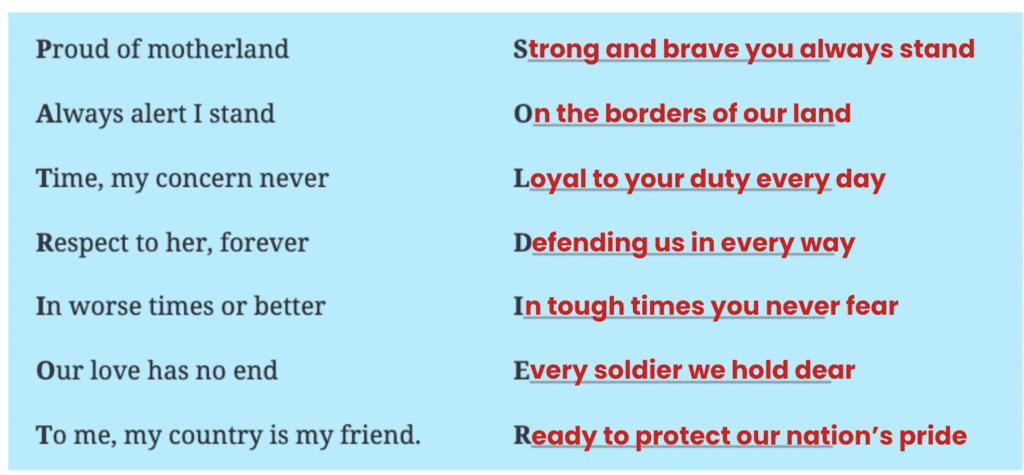
II. We cannot thank'our soldiers enough. To express your admiration, draft a note of gratitude for their selfless service to the nation. (Word limit: 50 words)
You may begin this way:
Dear Bravehearts,
I would like to...
Answer:
Dear Bravehearts,
I would like to express my deepest gratitude for your unwavering dedication to protecting our nation. Your courage and sacrifices keep us safe day and night. We sleep peacefully knowing that you stand guard. Thank you for your selfless service - you are our true heroes. May you always stay safe and strong.
Let us explore ( Page 205)
I. Design a badge of honour for the soldiers. You may make it by hand, with cardboard, paper, and colours, or alternately, design it digitally and take a printout. Remember to include a self-designed logo and a slogan in the badge.
Answer: Do it yourself.
Suggestion : Title: Badge of Honour for Soldiers
Shape: Circular badge with a star in the centre.
Logo (self-designed): A rising sun behind crossed swords, symbolising courage and protection.
Colours:
• Saffron for bravery
• White for peace
• Green for harmony
Slogan:
Guardians of the Nation
or
Courage Beyond Fear
or
For Those Who Stand So We May Live FreeSuggested components to include in the badge:
• Outer ring with the slogan
• Central emblem (sun + swords, or a shield, or a pair of hands saluting)
• A ribbon at the bottom that says Honour and DutyStudents can draw it on cardboard, add colouring, cut the badge shape, and attach a safety pin to present it as a wearable honour badge.
II. Find out any poem or story in your mother tongue or regional language about the sacrifices and bravery of soldiers. Make a presentation in the class.
Ans: Students to do it on their own.
Below are sample suggestions in commonly spoken Indian languages. Students may pick any poem or story from their regional language.
Hindi
Poem suggestion:
Veer Tumhi Ho (anonymous patriotic poem)
Theme summary: It describes the bravery of soldiers who protect the nation even in harsh conditions and sacrifice their lives without hesitation.Kannada
Poem suggestion:
Jaya Bharata Jananiya Tanujate (Kuvempu)
Theme summary: Though not directly about soldiers, it honours the defenders of the land and praises courage and sacrifice.Tamil
Poem suggestion:
A poem from Bharathiyar such as Achamillai Achamillai
Theme summary: It celebrates fearlessness and the fighting spirit, suitable for presenting bravery.Bengali
Poem suggestion:
Bidrohi by Kazi Nazrul Islam
Theme summary: It symbolises the spirit of rebellion and courage and can be connected to the bravery of soldiers.Punjabi
Story suggestion:
Tales of Hari Singh Nalwa
Theme summary: Stories of courage, loyalty, and heroic battles.Marathi
Poem suggestion:
Zenda (Vishnu Vaman Shirwadkar - Kusumagraj)
Theme summary: Speaks of valour and the spirit of protecting the nation.How to present in class
• Begin by introducing the author or source of the poem/story.
• Recite or narrate a short portion.
• Explain the main message about bravery and sacrifice.
• Connect the theme to the role of soldiers today.
FAQs on NCERT Solutions: My Dear Soldiers
| 1. What is the main message of "My Dear Soldiers" poem in Class 7 English? |  |
| 2. Who is the poet of "My Dear Soldiers" and what inspired them to write this poem? | |
| 3. What are the main themes and literary devices used in "My Dear Soldiers"? | |
| 4. How should I answer long questions about soldiers' sacrifice in "My Dear Soldiers" for my exams? | |
| 5. What important quotes from "My Dear Soldiers" should I memorise for CBSE Class 7 examinations? | |