Q1: Calculate the speed of a car that travels 150 meters in 10 seconds. Express your answer in km/h.
Ans:
Speed = Distance / Time
Given:
- Distance = 150 metres
- Time = 10 seconds
- 150 metres = 0.15 km
- 10 seconds = 10 / 3600 hours = 1 / 360 hours
Now calculate speed:
Speed = 0.15 km ÷ (1/360 hour) = 0.15 × 360 = 54 km/h
Final answer: 54 km/h
Q2: A runner completes 400 meters in 50 seconds. Another runner completes the same distance in 45 seconds. Who has a greater speed and by how much?
Ans:
Speed = Distance / Time
Runner 1:
- Distance = 400 metres
- Time = 50 seconds
- Speed = 400 ÷ 50 = 8 m/s
Runner 2:
- Distance = 400 metres
- Time = 45 seconds
- Speed = 400 ÷ 45 ≈ 8.89 m/s
Explanation:
Both runners cover the same distance; the one who takes less time has the greater speed. Runner 2 takes less time (45 s) than Runner 1 (50 s), so Runner 2 is faster.
Difference in speed = 8.89 m/s - 8 m/s = 0.89 m/s (approximately).
Final answer: Runner 2 is faster by about 0.89 m/s.
Q3: A train travels at a speed of 25 m/s and covers a distance of 360 km. How much time does it take?
Ans:
Time = Distance / Speed
Convert 360 km to metres:
360 km = 360,000 metres
Now calculate the time:
Time = 360,000 metres ÷ 25 m/s = 14,400 seconds
Convert seconds to hours:
14,400 ÷ 3600 = 4 hours
Final answer: 4 hours
Q4: A train travels 180 km in 3 hours. Find its speed in:
(i) km/h
(ii) m/s
(iii) What distance will it travel in 4 hours if it maintains the same speed throughout the journey?
Ans:
(i) Speed in km/h:
Speed = Distance ÷ Time = 180 km ÷ 3 hours = 60 km/h
(ii) Speed in m/s:
Convert 60 km/h to m/s:
60 km/h = (60 × 1000) ÷ 3600 m/s = 60 × 5/18 m/s = 16.67 m/s (approx)
(iii) Distance in 4 hours:
Distance = Speed × Time = 60 km/h × 4 hours = 240 km
Final answers: (i) 60 km/h, (ii) 16.67 m/s (approx), (iii) 240 km
Q5: The fastest galloping horse can reach the speed of approximately 18 m/s. How does this compare to the speed of a train moving at 72 km/h?
Ans:
Convert the speed of the train to m/s:
72 km/h = (72 × 1000) ÷ 3600 m/s = 72 × 5/18 m/s = 20 m/s
Comparison:
The horse moves at 18 m/s and the train moves at 20 m/s.
Difference = 20 m/s - 18 m/s = 2 m/s
Final answer: The train is faster by 2 m/s.
Q6: Distinguish between uniform and non-uniform motion using the example of a car moving on a straight highway with no traffic and a car moving in city traffic.
Ans:
Uniform motion
When a car moves on a straight highway with no traffic and keeps the same speed, it covers equal distances in equal intervals of time. This steady motion is called uniform motion. For example, if a car travels 60 km in each hour for several hours, its motion is uniform.
Non-uniform motion
In city traffic, the car frequently slows down, stops at signals, and speeds up again. The distance covered in equal time intervals is not the same. This changing-speed movement is called non-uniform motion. For example, a car may cover 1 km in one minute, then wait at a signal, and cover less distance in the next minute.
Q7: Data for an object covering distances in different intervals of time are given in the following table. If the object is in uniform motion, fill in the gaps in the table.

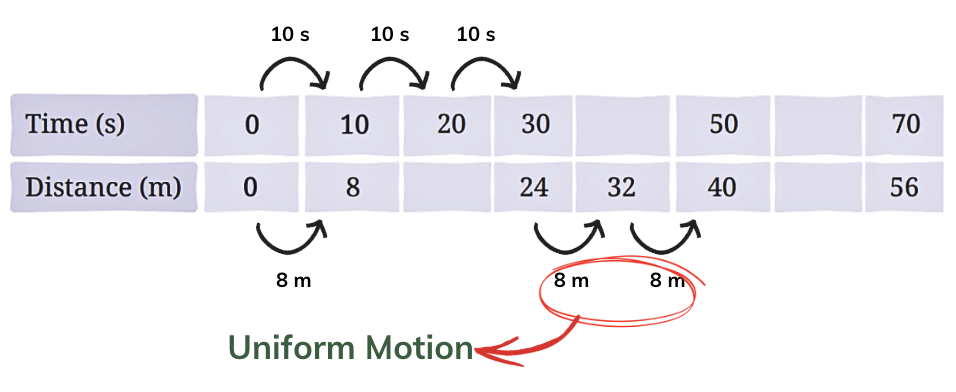
For uniform motion, the object must cover equal distances in equal time intervals. To fill the gaps:
- Find the distance covered in a single known interval by subtracting the distances at its start and end.
- Use that distance per interval to fill any missing distance entries by adding the same amount for each equal time step.
- If times are missing, calculate them from the distance per interval and known speeds (if given), or keep the time steps consistent with the table's pattern.

(The table entries should be completed so that each equal time interval shows the same distance covered.)
Q8: A car covers 60 km in the first hour, 70 km in the second hour, and 50 km in the third hour. Is the motion uniform? Justify your answer. Find the average speed of the car.
Ans:
Since the car covers different distances in each hour (60 km, 70 km and 50 km), the motion is non-uniform because equal time intervals do not have equal distances.
To find the average speed:
Total distance = 60 km + 70 km + 50 km = 180 km
Total time = 3 hours
Average speed = Total distance ÷ Total time = 180 km ÷ 3 hours = 60 km/h
Final answer: Motion is non-uniform; average speed = 60 km/h.
Q9: Which type of motion is more common in daily life-uniform or non-uniform? Provide three examples from your experience to support your answer.
Ans:
Non-uniform motion is more common in daily life. Examples:
A car in city traffic: Speed changes because of traffic lights, junctions and other vehicles.
A bicycle in a park: The rider slows while turning or to avoid obstacles, then speeds up again.
People walking: Walking speed varies because of obstacles, crowding or tiredness.
Q10: Data for the motion of an object are given in the following table. State whether the speed of the object is uniform or non-uniform. Find the average speed.

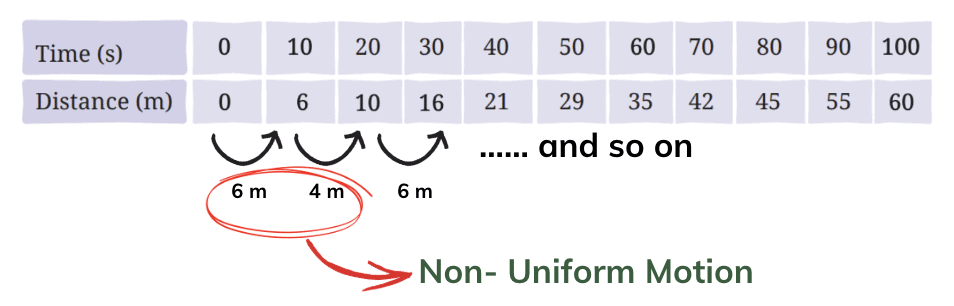
Since the distances covered in each equal time interval are not equal, the motion is non-uniform.
Average Speed = Total Distance ÷ Total Time
Total distance = 60 m (final distance)
Total time = 100 s (final time)
Average speed = 60 m ÷ 100 s = 0.6 m/s
Final answer: Motion is non-uniform; average speed = 0.6 m/s.
Q11: A vehicle moves along a straight line and covers a distance of 2 km. In the first 500 m, it moves with a speed of 10 m/s and in the next 500 m, it moves with a speed of 5 m/s. With what speed should it move the remaining distance so that the journey is complete in 200 s? What is the average speed of the vehicle for the entire journey
Ans:
Total distance = 2 km = 2000 metres
First part: Distance = 500 metres, Speed = 10 m/s
Second part: Distance = 500 metres, Speed = 5 m/s
Total allowed time for the journey = 200 seconds
Time for the first two parts
1. For the first 500 metres at 10 m/s:
Time = Distance ÷ Speed = 500 m ÷ 10 m/s = 50 s
2. For the next 500 metres at 5 m/s:
Time = 500 m ÷ 5 m/s = 100 s
Remaining time and distance
Time spent so far = 50 s + 100 s = 150 s
Remaining time = 200 s - 150 s = 50 s
Remaining distance = 2000 m - 500 m - 500 m = 1000 m
Required speed for the remaining 1000 metres
Required speed = Distance ÷ Time = 1000 m ÷ 50 s = 20 m/s
Thus, the vehicle must travel the remaining distance at 20 m/s.
Average speed for the entire journey
Average speed = Total distance ÷ Total time = 2000 m ÷ 200 s = 10 m/s
Final answers: Required speed for last 1000 m = 20 m/s; average speed for the whole journey = 10 m/s.