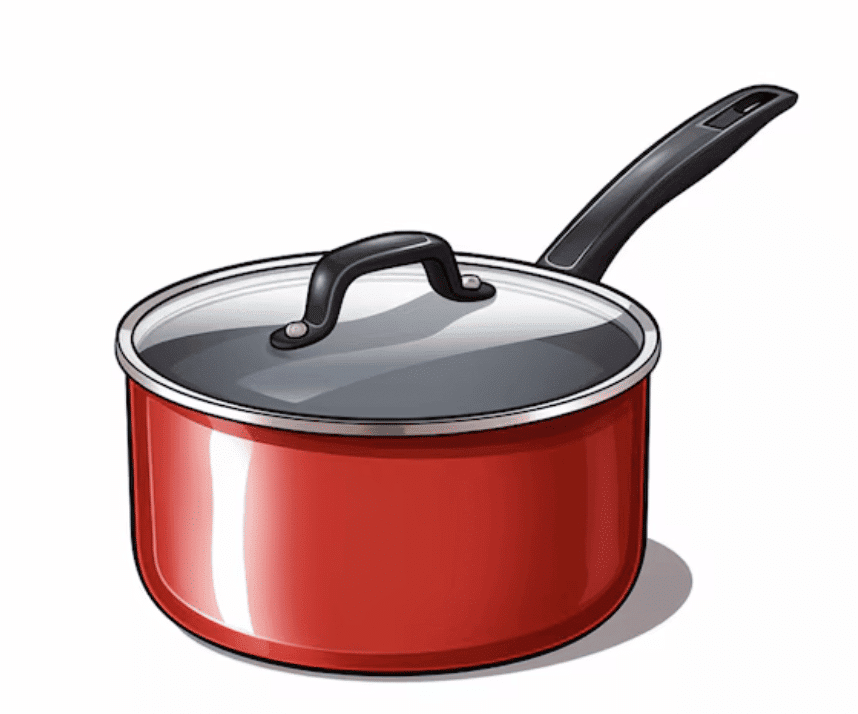
Q1 (i): Your father bought a saucepan made of two different materials, A and B. The materials A and B have the following properties -
(a) Both A and B are good conductors of heat
(b) Both A and B are poor conductors of heat
(c) A is a good conductor and B is a poor conductor of heat
(d) A is a poor conductor and B is a good conductor of heat
Ans: (c) A is a good conductor and B is a poor conductor of heat
Explanation: The base of a saucepan is made of metal, which is a good conductor of heat and allows fast cooking. The handle is made of wood or plastic, which is a poor conductor, so it remains cool to hold safely.
(ii): Pins are stuck to a metal strip with wax and a burning candle is kept below the strip. Which of the following will happen?
(a) All the pins will fall almost at the same time
(b) Pins I and II will fall earlier than pins III and IV
(c) Pins I and II will fall later than pins III and IV
(d) Pins II and III will fall almost at the same time
Ans: (b) Pins I and II will fall earlier than pins III and IV
Explanation: When the flame heats one end of the metal strip, heat moves along the strip by conduction. The metal near the flame becomes hot first, so the wax holding the pins near the flame melts earlier. As a result, the pins closest to the flame (pins I and II) will fall before the pins farther away (pins III and IV). The melting happens in order from the hot end towards the cooler end because conduction transfers heat through the metal progressively.
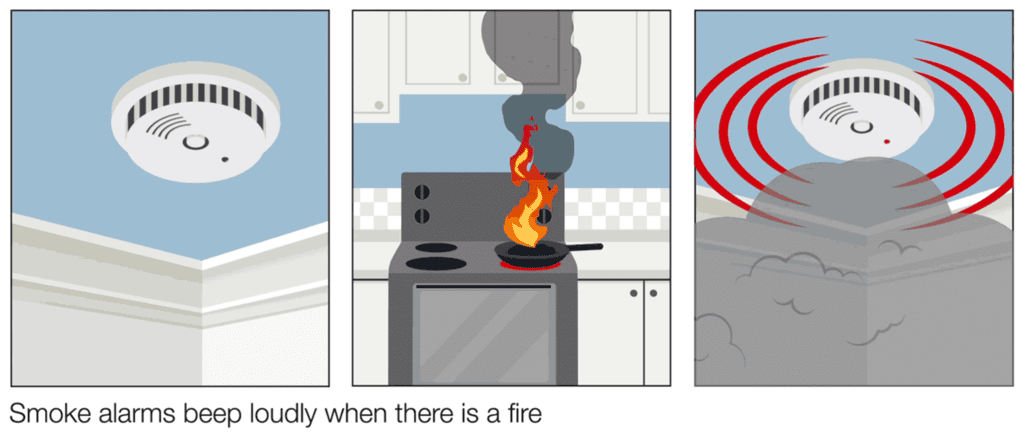
(iii): A smoke detector is a device that detects smoke and sounds an alarm. Where should it be placed in a room?
(a) Near the floor
(b) In the middle of a wall
(c) On the ceiling
(d) Anywhere in the room
Ans: (c) On the ceiling
Explanation: Smoke rises due to convection because hot air is lighter. Therefore, a smoke detector should be placed on the ceiling to detect smoke quickly.
Q2: A shopkeeper serves you cold lassi in a tumbler that has a leak. You are given another tumbler to place it in. Will this help keep the lassi cold for longer? Explain.
Ans: Yes, it will help.
Explanation: When you put the leaking tumbler inside another tumbler, a layer of air gets trapped between the two tumblers. Air is a poor conductor of heat, so this layer slows down the transfer of heat from the warm outside air into the cold lassi. As a result, the lassi stays colder for a longer time. This is the same basic idea used in insulated containers: trapping air (or creating a vacuum) reduces heat flow by conduction.
Q3 (i): Heat transfer takes place in solids through convection.
Ans: False
Reason: In solids, heat transfer happens through conduction, not convection.
(ii): Heat transfer through convection takes place by the actual movement of particles.
Ans: True
Reason: In convection, particles of liquids and gases move to transfer heat.
(iii): Areas with clay materials allow more seepage of water than those with sandy materials.
Ans: False
Reason: Clay has smaller pores than sand, so it allows less seepage.
(iv): The movement of cooler air from land to sea is called land breeze.
Ans: True
Reason: At night, land cools faster, and cooler air moves towards the sea.
Q4: Some ice cubes placed in a dish melt into water after some time. Where do they get heat for this transformation?
Ans: When ice cubes are placed in a dish, they start to melt and turn into water. For this transformation to happen, the ice needs to absorb heat energy.
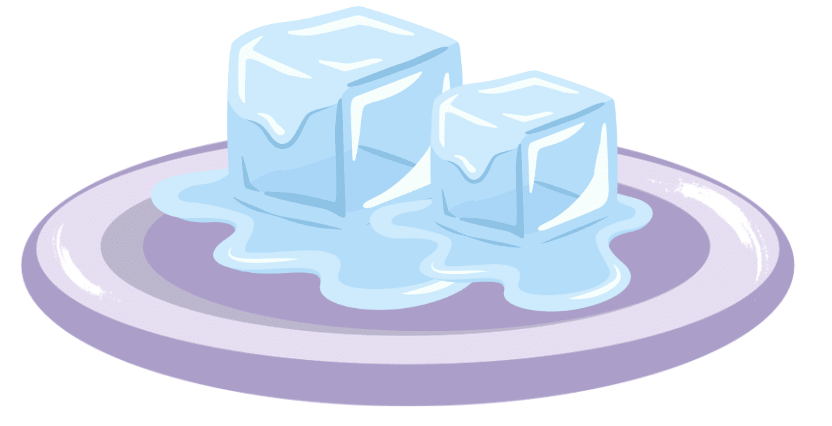
- The ice cubes get heat from the surrounding air.
- They also absorb heat from the surface of the dish and from the table on which the dish is placed.
- This incoming heat increases the energy of the ice particles and causes the solid ice to change into liquid water.
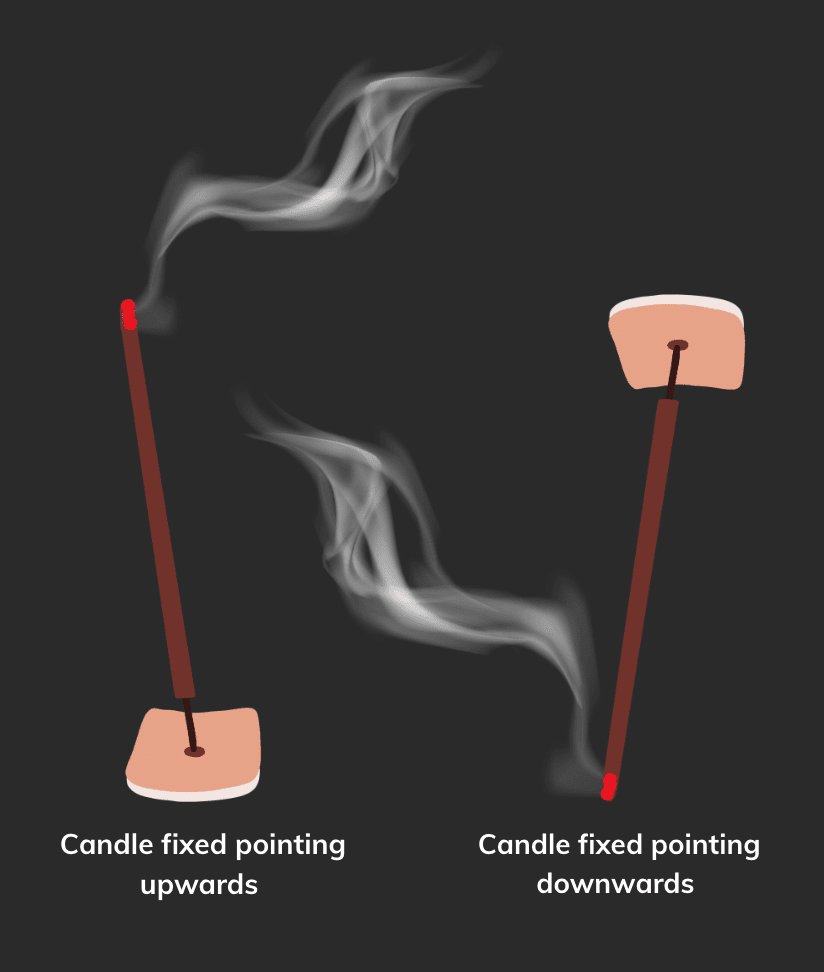
Q5: A burning incense stick is fixed pointing downwards. In which direction would the smoke move? Show with a diagram.
Ans: When an incense stick is burning and fixed pointing downwards, the smoke will move upwards. This happens because smoke rises due to convection.
As the incense stick burns, it heats the air around it, making the air less dense. The cooler, denser air pushes the hot air (and smoke) upward. So, even if the incense stick is pointing downwards, the smoke will still rise.
Diagram
Q6: Two test tubes with water are heated by a candle. Which thermometer (Fig. 7.16a or Fig. 7.16b) will show a higher temperature? Why?
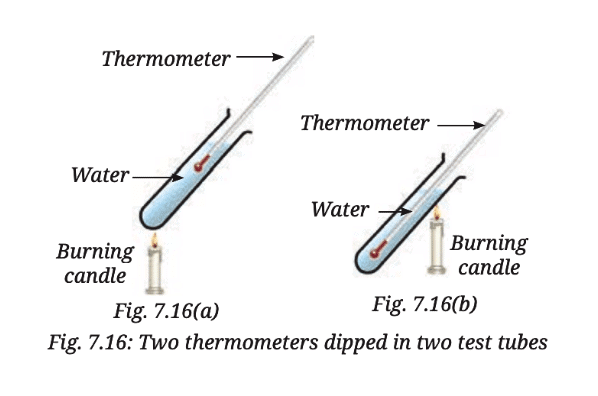
Ans: The thermometer in Fig. 7.16(a) will show a higher temperature.
Explanation: In Fig. (a), the bottom of the test tube is heated directly. Water at the bottom becomes warm, less dense, and rises, while cooler water sinks. This circulation is called a convection current. Because of convection, heat spreads throughout the water and the thermometer quickly records a higher temperature.
In Fig. (b), the upper part of the water is heated. Hot water at the top stays there and does not sink, so convection currents are not set up. Heat reaches the lower part of the water only slowly (mainly by conduction). Therefore, the thermometer shows a lower temperature.
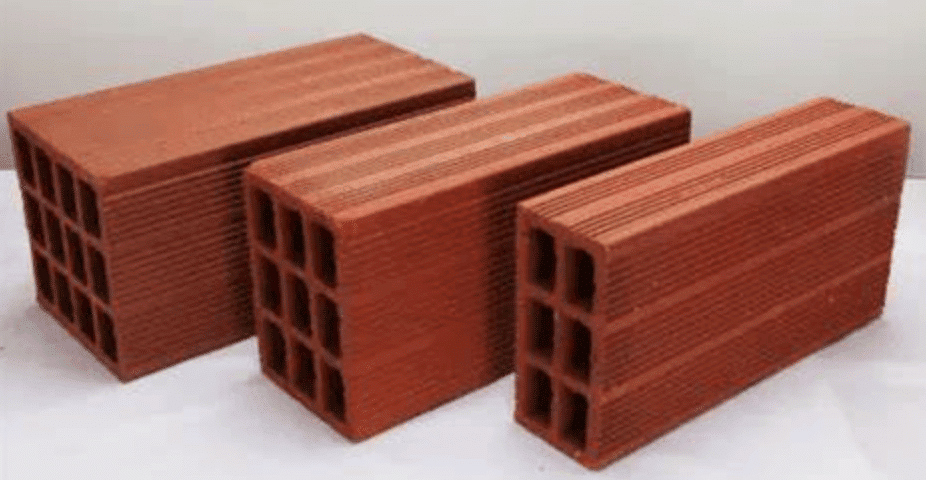
Ans: Hollow bricks are used because they trap air inside the spaces between the bricks. Air is a poor conductor of heat, meaning it does not allow heat to pass through easily. This helps to reduce heat transfer from the outside to the inside of the house. As a result, the house stays cooler in hot regions, and less cooling is needed indoors. Hollow bricks thus act as simple insulation for the walls.
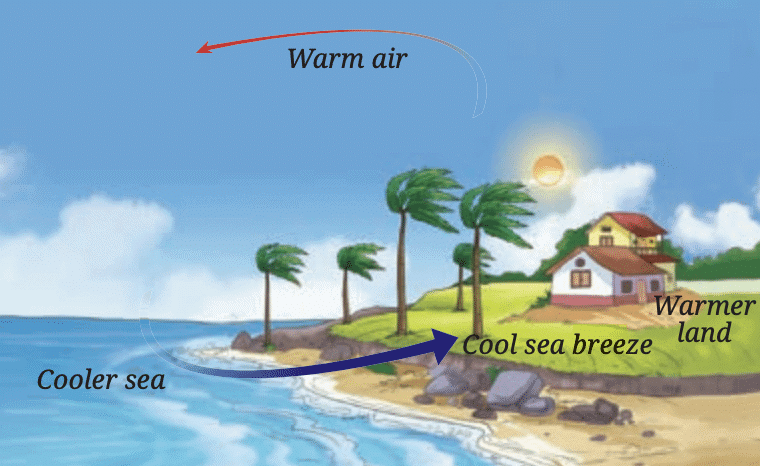
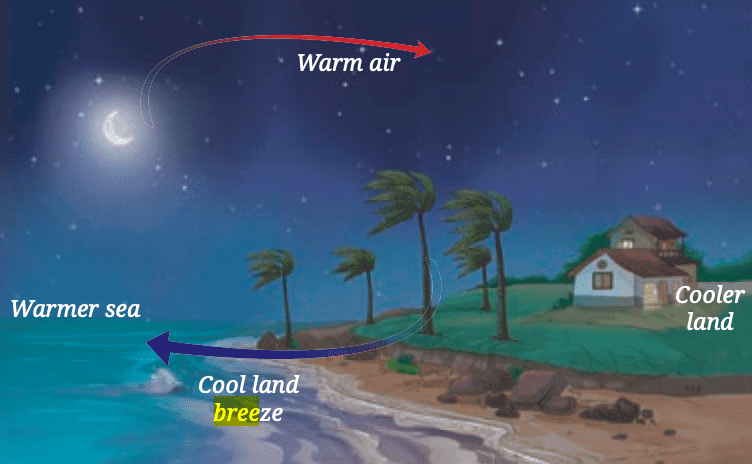
Q8: How do large water bodies prevent extreme temperatures in nearby areas?
Ans: Large water bodies heat up and cool down more slowly than land. During the day, land becomes hot faster, so warm air rises and cool air from the sea moves towards the land as sea breeze, which cools the nearby areas. At night, land cools faster than water, so cool air from land moves towards the sea as land breeze, while water releases heat slowly. In this way, large water bodies prevent extreme heat during the day and extreme cold at night.
Q9: How does water seep through the surface of the Earth and get stored as groundwater?
Ans: When it rains, water seeps into the ground through soil and rocks by a process called infiltration. It moves downward through the spaces between soil particles and cracks in rocks. This water gets collected and stored in underground layers called aquifers, where it is stored as groundwater.
Q10: The water cycle helps in the redistribution and replenishment of water on the Earth. Justify.
Ans: The water cycle (also called the hydrological cycle) continuously moves water around the Earth and refills water sources. It does this by the following steps:
1. Evaporation and Transpiration: Water from oceans, lakes and rivers turns into water vapour because of the Sun's heat. Plants also release water vapour from their leaves (transpiration). This vapour rises into the atmosphere.
2. Condensation: As water vapour rises, it cools and changes back into tiny droplets to form clouds.
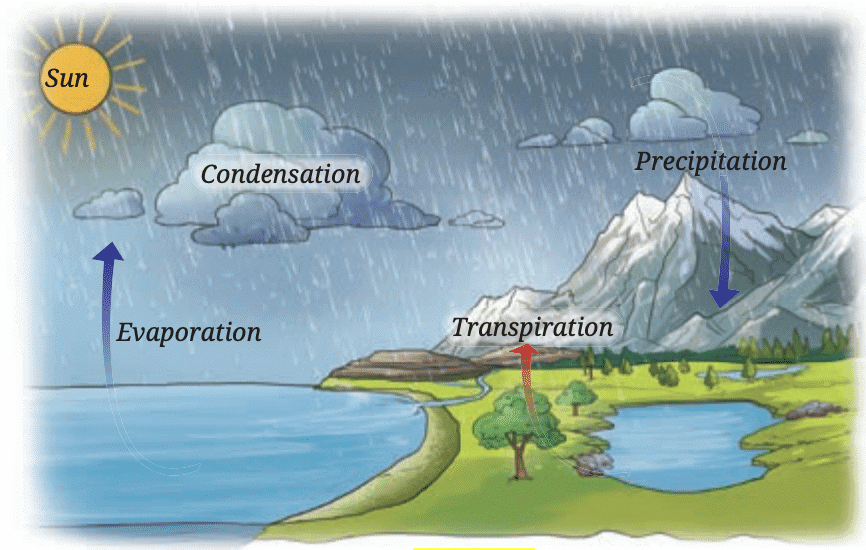
3. Precipitation: When cloud droplets join and grow heavy, they fall as rain, snow, or hail, returning water to the land and oceans.
4. Infiltration and Runoff: Some of the water that reaches the ground soaks into the soil and replenishes groundwater; the remaining water flows over the surface as runoff into rivers, lakes and seas.
All these steps together move water around the planet and refill water sources such as rivers, lakes and aquifers. This continuous circulation ensures that fresh water is redistributed and replenished, making it available for plants, animals and human use.