NCERT Solutions: Electricity: Circuits and their Components

Intext Questions
Q1. Why does the torch lamp glow in one position of its switch? (Page 24)
Ans: The torch lamp glows when the switch is in the 'ON' position because the switch closes the circuit and provides a continuous path for electric current to flow from the cells through the lamp and back to the cells. When current flows through the filament (or bulb), it heats up and produces light. When the switch is in the 'OFF' position, the circuit is open, so current cannot flow and the lamp does not glow.
Q2. In a torch, we generally use more than one cell. Are those placed in any particular order? (Page 25)
Ans: Yes, in a torch, cells are usually placed in series, so the positive terminal of one cell is connected to the negative terminal of the next. This series arrangement adds up the voltages of the individual cells, giving a higher total voltage that is sufficient to make the lamp glow brightly.
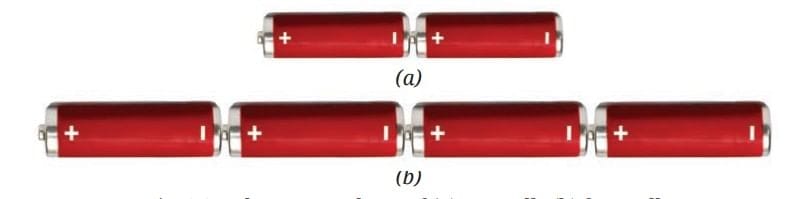 A battery made up of (a) two cells (b) four cells
Q3. How does a switch turn 'ON' or 'OFF' the torchlight? (Page 32)
Ans: The switch controls the flow of electricity in the circuit. When the switch is 'ON', it closes the circuit, allowing electricity to flow through the lamp and make it glow. When the switch is 'OFF', it opens the circuit, stopping the flow of electricity, and the lamp goes off.
Q4. Can we represent the circuit in a simpler manner? (Page 33)
Ans: Yes, the circuit (often representing components like cells, bulbs, or switches in a circuit diagram) can be represented by symbols. For example, a battery is represented by a pair of short and long parallel lines, and a lamp is represented by a circuit with an 'X' inside it.
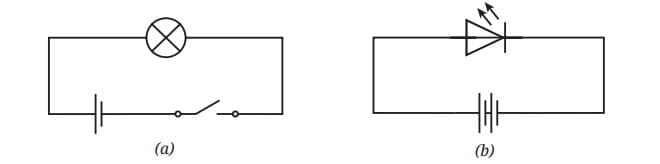 A circuit diagram (a) with an incandescent lamp (b) with an LED lamp
 Ans: Metal wires (usually copper) are used because metals are good conductors of electricity; they allow electric current to pass through them easily. Other common materials such as rubber or plastic are insulators and do not allow current to flow, so they cannot be used as connecting wires. Metals are chosen because they give a low-resistance path for current and are easy to shape into wires.
Q6. Why are electric wires covered with plastic or rubber? (Page 34)
Ans: Electric wires are covered with plastic or rubber because these materials are insulators. The covering prevents the electric current from leaking out of the wire and stops people from getting electric shocks. Insulation also stops two wires from touching each other and causing a short circuit. In short, the covering protects both the circuit and the user.
Let Us Enhance Our Learning
(i) A switch is the source of electric current in a circuit.
Ans: Incorrect.
A switch does not generate electric current; it only controls the flow of current by opening or closing the circuit. The source of electric current is a cell or battery.
(ii) A switch helps to complete or break the circuit.
Ans: Correct.
A switch can either complete (close) the circuit so current flows, or break (open) the circuit so current stops. This is how switches control electrical devices.
(iii) A switch helps us to use electricity as per our requirement.
Ans: Correct.
By turning a switch on or off we can start or stop the flow of electricity, so we use electrical devices only when needed and save energy.
(iv) When the switch is in 'OFF' position, there is an air gap between its terminals.
Ans: Correct.
In the 'OFF' position, the switch opens the circuit and creates an air gap between its contacts. This gap prevents the electric current from flowing.
Q2. Observe Fig. 3.16. With which material connected between the ends A and B, the lamp will not glow?
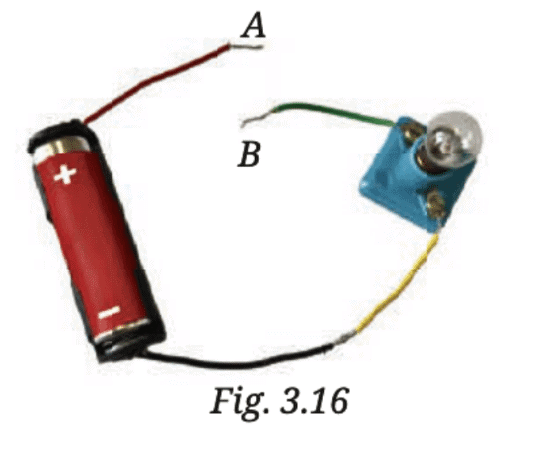
Ans: The lamp will not glow if the material placed between A and B is an insulator, for example rubber, plastic, or dry wood. Insulators do not allow electric current to pass through them, so they prevent the circuit from being completed and the lamp from lighting.
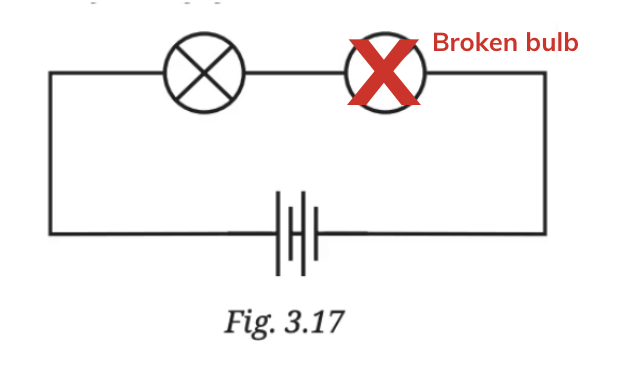
Q3. In Fig. 3.17, if the filament of one of the lamps is broken, will the other glow? Justify your answer.
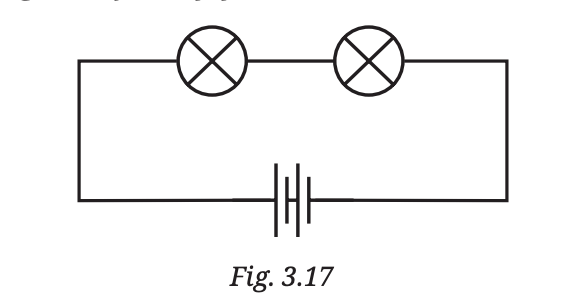
Ans: No, the other lamp will not glow if the filament of one lamp is broken.
If the filament of one lamp breaks, it creates a gap in the circuit.
This gap means that the path for the electric current is interrupted. When there is a break in the circuit, the current cannot flow through that path, so the other lamp also goes out.
Q4. A student forgot to remove the insulator covering from the connecting wires while making a circuit. If the lamp and the cell are working properly, will the lamp glow?
Ans: No, the lamp will not glow because the insulator around the wires prevents electrical contact. For the lamp to glow, the insulation must be removed only from the ends of the wires where they are connected to the cell and the lamp, so that metal parts touch and allow current to pass.
Q5. Draw a circuit diagram for a simple torch using symbols for electric components.
Ans: A simple torch circuit can be represented as:
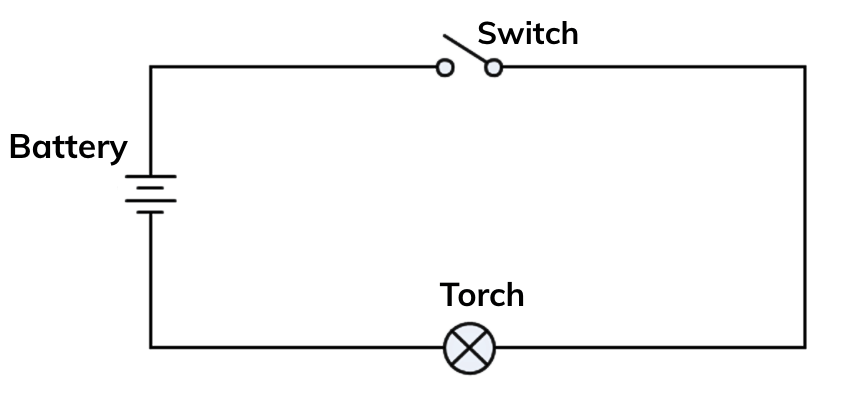
This diagram shows a series circuit: the battery (cells) supplies the voltage, the switch controls the current flow, and the lamp is connected in the same path so it glows when the switch is closed.
Q6. In Fig. 3.18:
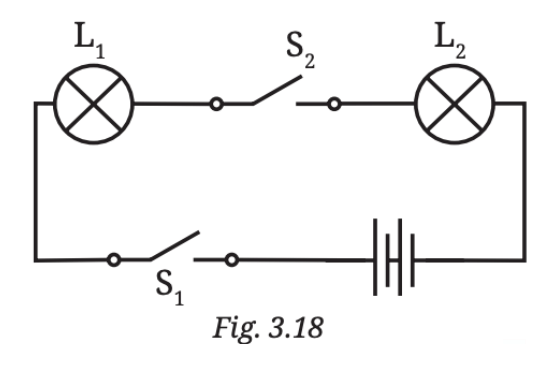
(i) If S2 is in 'ON' position, S1 is in 'OFF' position, which lamp(s) will glow?
Ans: Since S₁ is OFF, the circuit path is broken at S₁ and no current can pass through L₁ or L₂. Therefore, no lamp will glow.
(ii) If S2 is in 'OFF' position, S1 is in 'ON' position, which lamp(s) will glow?
Ans: Here, S₂ is OFF, so the circuit is open at S₂ and no current flows. Therefore, no lamp will glow.
(iii) If S1 and S2 both are in 'ON' position, which lamp(s) will glow?
Ans: Both switches are closed, so the circuit provides a complete path for current through both lamps. Therefore, both L₁ and L₂ will glow.
(iv) If both S1 and S2 are in 'OFF' position, which lamp(s) will glow?
Ans: Both switches are open, so the circuit is broken at two places and no current can flow. Therefore, no lamp will glow.
Q7. Vidyut has made the circuit as shown in Fig. 3.19. Even after closing the circuit, the lamp does not glow. What can be the possible reasons? List as many possible reasons as you can for this faulty operation. What will you do to find out why the lamp did not glow?
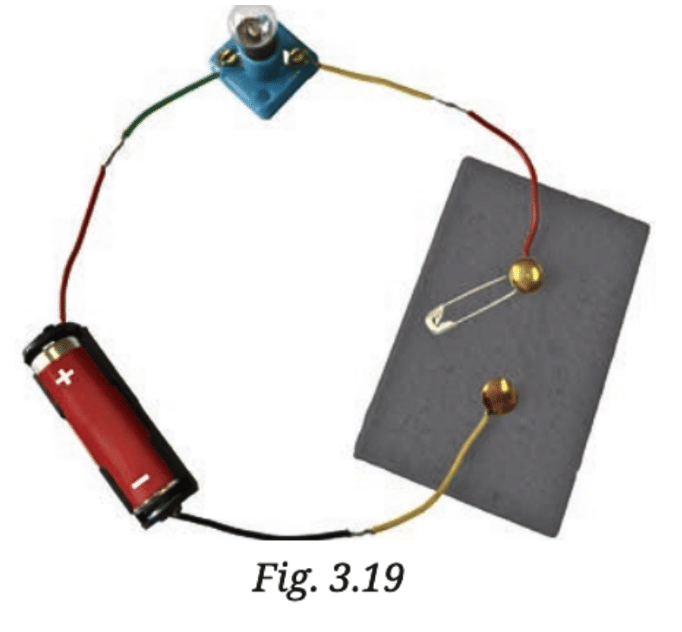
Ans: Possible reasons:
- Broken filament in the lamp (if it is an incandescent bulb).
- Loose connections or poor contact at the joints or terminals.
- Dead battery or cells placed in wrong order or with poor contact.
- Wires not stripped properly so metal parts are covered and do not touch the lamp or cell terminals.
- Open circuit due to a faulty switch or a disconnected part.
To find out why the lamp did not glow, one should:
- Check the lamp by replacing it with a known working lamp to see if the filament is broken.
- Tighten and check all connections to ensure they are secure and metal-to-metal contact is made.
- Replace the cell with a fresh one or test it in a known working circuit to confirm it has charge.
- Ensure the switch is working and is in the correct position (closed) to complete the circuit.
- Strip the wire ends properly so the bare metal touches the terminals of the cell and the lamp.
Q8. In Fig. 3.20, in which case(s) the lamp will not glow when the switch is closed?
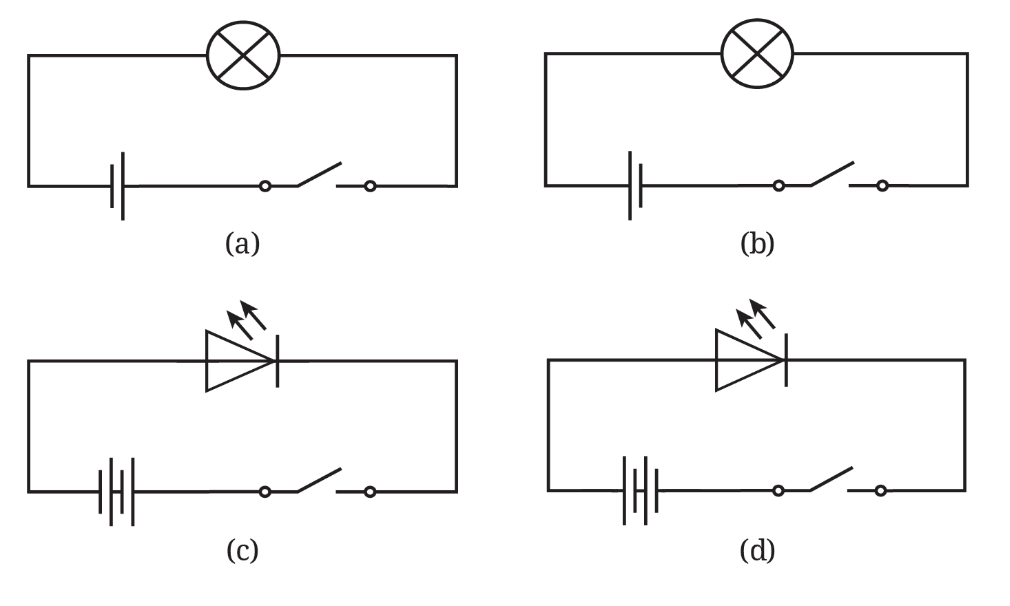
Ans: Case (a), (b), and (d) will glow when switch will be closed but Case (c) will not glow because the negative terminal of the battery is connected to the positive terminal of the LED, meaning the LED is reverse-connected. In this case, no current will flow through the LED, and it will remain off.
Q9. Suppose the '+' and '-' symbols cannot be read on a battery. Suggest a method to identify the two terminals of this battery.
Ans: To identify the battery terminals using an LED:
LED Identification: An LED has two leads:
- Longer lead: This is the positive lead (anode).
- Shorter lead: This is the negativelead (cathode).
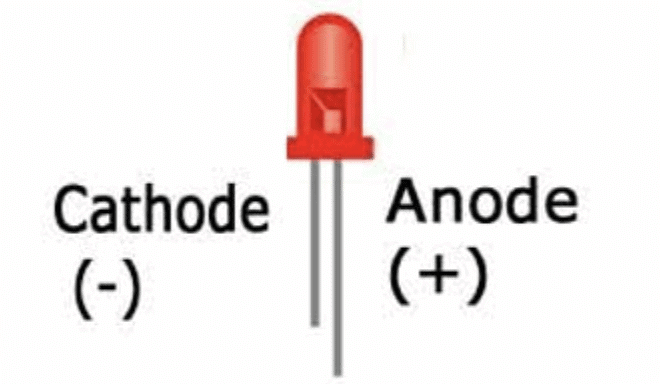
Connect the Battery: Connect the battery's terminals to the LED's leads:
Connect the longer lead of the LED to one end of the battery and the shorter lead of the LED to the other end.
Observation:
- The LED will glow only when the longer lead is connected to the positive terminal of the battery and the shorter lead to the negative terminal. If it does not glow, swap the connections; when it lights the correct polarity is found.
- If the LED still does not glow in either connection, check that the LED and battery are good and that the connections are secure.
Q10. You are given six cells marked A, B, C, D, E, and F. Some of these are working and some are not. Design an activity to identify which of them are working.
(i) Items required:
- Electric lamp.
- Wires.
- Cell holders.
- Cells A, B, C, D, E, F.
(ii) Procedure:
- Connect each cell one by one in the circuit with the lamp.
- Observe whether the lamp glows when each cell is used.
- Record which cells make the lamp glow (these are working) and which do not (these are not working).
(iii) Activity to identify the working cells:
- Test each cell individually by placing it in the holder and closing the circuit with the lamp.
- If the lamp glows, mark that cell as working. If the lamp does not glow, try the cell again or replace the cell with a known good one to confirm it is non-working.
Q11. An LED requires two cells in series to glow. Tanya made the circuit as shown in Fig. 3.21. Will the lamp glow? If not, draw the wires for correct connections.
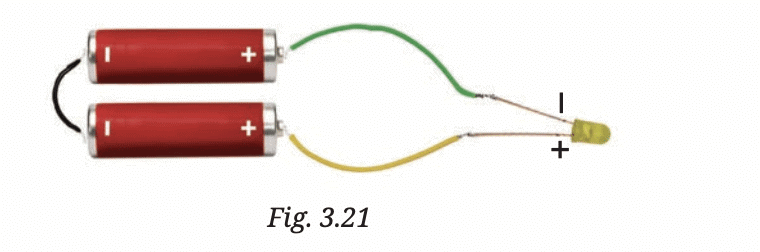
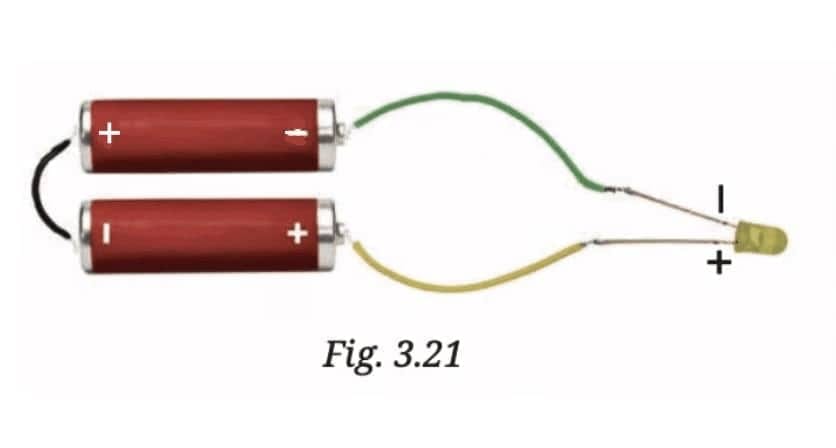
Ans:No, the LED will not glow if the cells are not connected in the correct polarity. To make the LED glow, the positive terminal of the battery should be connected to the negative terminal of the LED, and the negative terminal of the battery should be connected to the positive terminal of the LED.
Corrected connections:
FAQs on NCERT Solutions: Electricity: Circuits and their Components
| 1. What is an electric circuit and what are its main components? |  |
| 2. Why does my circuit not work when the switch is open? | |
| 3. What's the difference between series and parallel circuits in electricity? | |
| 4. How do I identify whether a bulb is connected in series or parallel using brightness? | |
| 5. What is the role of a switch in an electric circuit and how does it control current flow? | |