CBSE Class 4  >  Class 4 Notes  >  EVS (Our Wondrous World: New NCERT)  >  Worksheet: How Things Work

Worksheet: How Things Work

Multiple Choice Questions (MCQs)

Q1: What happens when a coin spins?
(a) It continues spinning forever
(b) It slows down, shakes, and stops because it loses balance
(c) It spins faster
(d) It stays upright without slowing downMultiple Choice Questions (MCQs)

Q2: What makes a square spinner appear circular when spun quickly?
(a) The edges blur
(b) It becomes larger
(c) The center becomes transparent
(d) It loses color

Q3: What is the primary factor that influences whether an object floats or sinks?
(a) Only the weight of the object
(b) The color of the object
(c) The shape of the object
(d) The temperature of the water

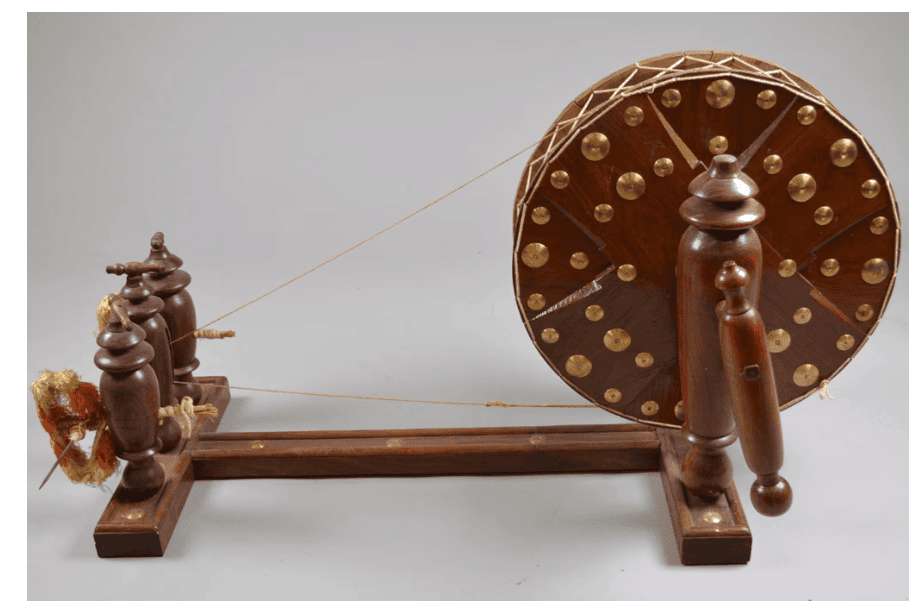
Q4: What is a charkha used for?
(a) To twist cotton into thread
(b) To create paper boats
(c) To spin wool into thread
(d) To make toysMultiple Choice Questions (MCQs)
Q5: What is one of the factors that helps objects float?
(a) Shape
(b) Color
(c) Texture
(d) Density

Fill in the Blanks

Q1: A ________ is a tool designed to investigate spinning movements, like a top or various handmade spinners.Fill in the Blanks

Q2: A ________ is an ancient Indian spinning top crafted from wood or clay.
Q3: ________ is a traditional wheel for turning cotton into thread, famously used by Mahatma Gandhi.
Q4: The ability of an object to remain on the surface of water is called ________.
Q5: Objects that are ________ are tightly packed and heavy for their size.

Match the Following
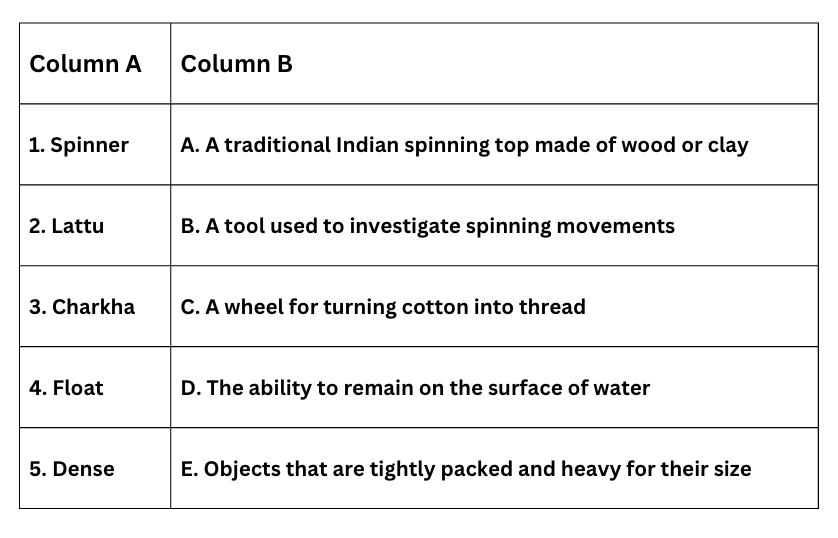
Match the Following

Short Question Answers

Q1: What happens when a coin spins?
Q2: Why does a square spinner appear circular when spun quickly?
Q3: What determines whether an object floats or sinks?Short Question Answers
Q4: How does the charkha work and what is its importance?
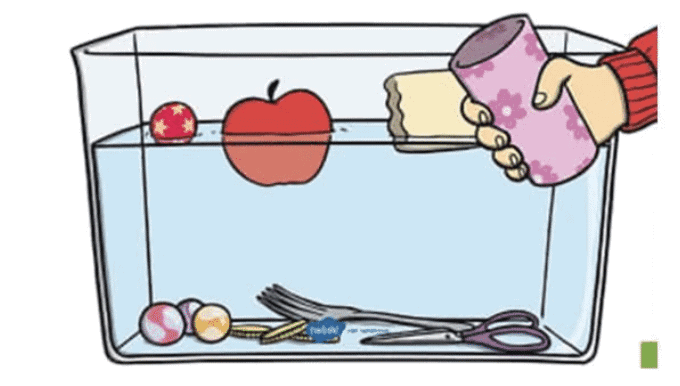
Q5: What are some examples of objects that float and sink?

Vocabulary Activity - "Guess the Word"

Q1: A sharp or spicy taste, like that of green chilli.
Q2: The way food feels in the mouth, like whether it is smooth or crunchy.
Q3: The act of something remaining on the surface of water.
Q4: A heavy object tightly packed for its size.
Q5: A traditional Indian spinning top made from wood or clay.

The document Worksheet: How Things Work is a part of the Class 4 Course EVS for Class 4 (Our Wondrous World: New NCERT).
All you need of Class 4 at this link: Class 4

FAQs on Worksheet: How Things Work

1. How do simple machines like levers and pulleys make work easier for us?
Ans. Simple machines reduce the effort needed to do work by changing how force is applied. A lever uses a pivot point to lift heavy objects with less force, while a pulley redirects force to help lift things upward. Both are fundamental tools in everyday tasks like opening tins or lifting water from wells. Understanding these mechanical advantages helps students recognise how common objects around them function efficiently.
2. What's the difference between how a wheel and axle work compared to other simple machines?
Ans. A wheel and axle system consists of a large wheel attached to a smaller axle, allowing rotation to multiply force or speed. Unlike levers that work with direct pushing, wheels convert circular motion into useful work-like in bicycles, car steering, and door handles. The larger the wheel relative to the axle, the greater the mechanical advantage gained, making tasks requiring continuous rotation much simpler for Class 4 learners to understand.
3. Why do inclined planes make it easier to push heavy things up instead of lifting them straight up?
Ans. Inclined planes distribute weight over a longer distance, reducing the force needed at any single moment. Pushing an object up a ramp requires less effort than lifting it vertically, though you must move it further. This principle applies to ramps, slides, and even staircases. Recognising this trade-off between distance and effort helps students grasp why construction workers and movers use ramps instead of direct lifting methods.
4. How do screws and wedges work as tools, and where do we use them in daily life?
Ans. Screws combine rotation with an inclined plane wrapped around a cylinder, allowing them to hold objects tightly or lift weight gradually. Wedges are triangular simple machines that split or separate materials, like axes, knives, and door wedges. Both tools convert one type of motion into another-rotational into holding force, or pushing into spreading force. Students can observe these machines functioning in kitchens, workshops, and carpentry activities around their homes.
5. What are pulley systems and how do they help us lift heavy objects with less effort?
Ans. Pulleys are wheels with grooves that hold ropes, redirecting force to make lifting easier. A single fixed pulley changes direction but doesn't reduce effort, while movable pulleys and pulley systems multiply force, allowing lighter pulling to lift heavier loads. Cranes, elevators, and flag hoists use multiple pulley arrangements. Students studying how things work benefit from visualising these systems through mind maps and flashcards showing mechanical advantage in action.
Explore Courses for Class 4 exam
Get EduRev Notes directly in your Google search
Related Searches
past year papers, video lectures, Extra Questions, Worksheet: How Things Work, practice quizzes, Worksheet: How Things Work, Summary, shortcuts and tricks, Important questions, Viva Questions, Exam, pdf , Worksheet: How Things Work, Free, mock tests for examination, Sample Paper, Previous Year Questions with Solutions, study material, ppt, Objective type Questions, MCQs, Semester Notes;