Worksheet Solutions: Sharing and Measuring

Q1. Think and Choose:
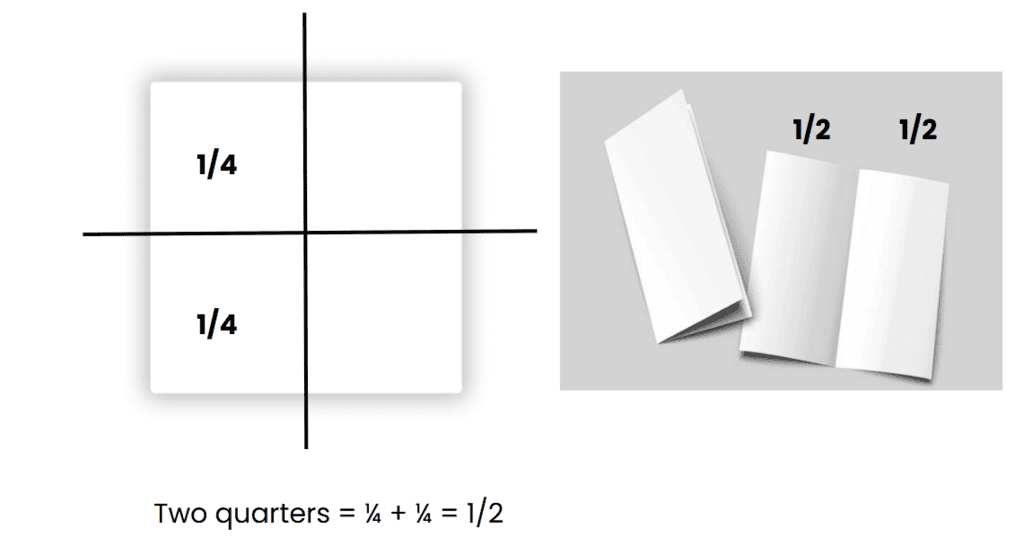
(i) Would you like one-half of a paper or two-quartersof the same paper? Why?
Ans: Both are equal. One-half means 1 out of 2 equal parts. Two quarters means 2 out of 4 equal parts. If you put the two quarters together, they make one half, so 1/2 = 2/4.
(ii)If a dhokla is shared equally among 5 children, what fraction of the dhokla does each child get?
Ans: You have 1 big dhokla (a soft, yummy snack).
Now, you want to share it equally among 5 children.
So, you cut the dhokla into 5 equal pieces.
Each child will get one of those pieces.
That one piece is 1 part out of 5, called one-fifth, and we write it as: 1/5.
(iii) Which is more?
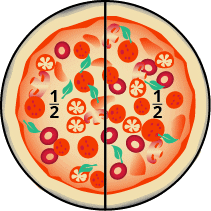
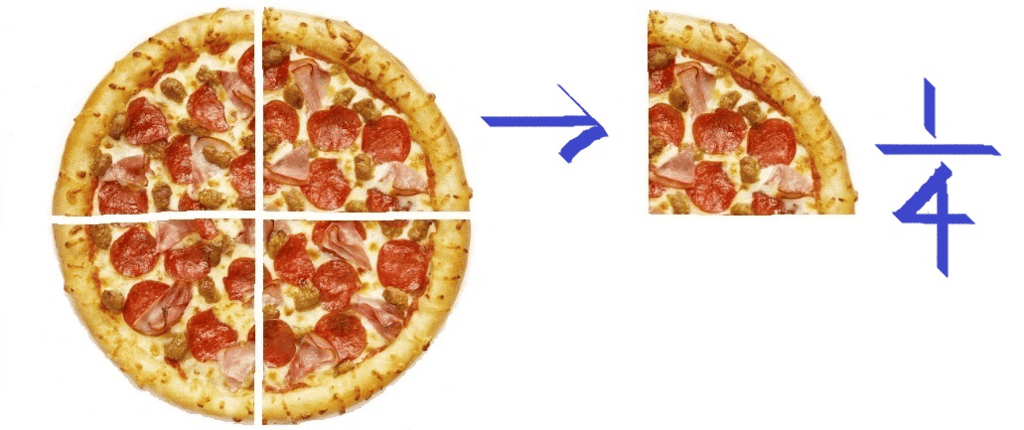
a) 1/2 or 1/4
Ans: 1/2 is more.
Imagine cutting a pizza into 2 equal pieces.
Now imagine cutting the same pizza into 4 equal pieces.The piece from 1/2 is bigger than the piece from 1/4.
So, 1/2 is more.
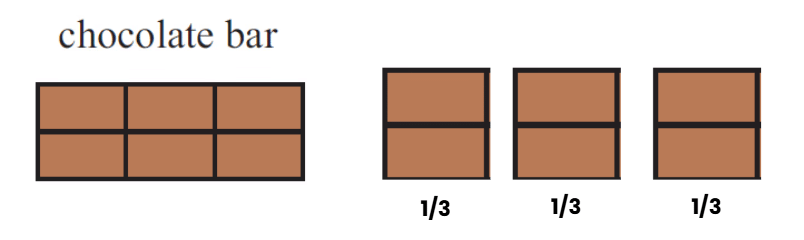
b) 1/3 or 1/6
Ans: 1/3 is more.
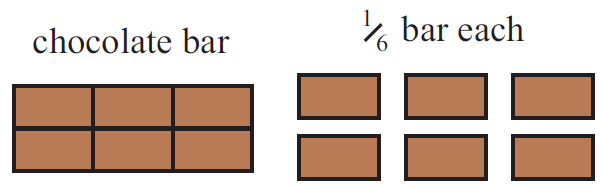
Take a chocolate bar. If you break it into 3 equal parts, each part is bigger than when you break it into 6 equal parts.
So, 1/3 is more than 1/6.
Q2. Draw and Divide:
(i) Draw a rectangle. Show 2 different ways to divide it into 2 equal halves.
Ans: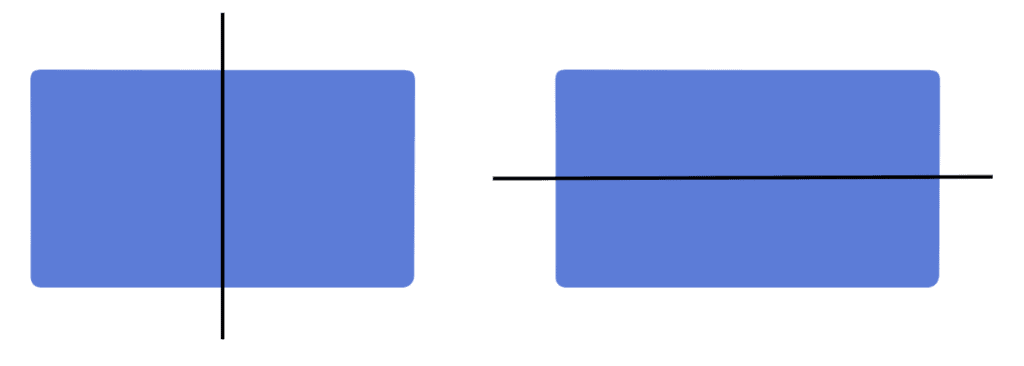 Rectangle is divided into two equal halves in two different ways
You can divide the rectangle into two halves in two simple ways:
• Draw a vertical line through the middle to get two equal left and right halves.
• Draw a horizontal line through the middle to get two equal top and bottom halves.
(ii) Draw a circle. Divide it into 4 equal parts and shade one-quarter (¼).
Ans: 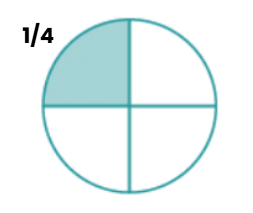 The circle is divided into 4 equal parts. One of those four parts is shaded, so the shaded part is 1/4 of the circle.
(iii) Draw a square and divide it into 8 equal parts. Shade 3/8 of it.
Ans:
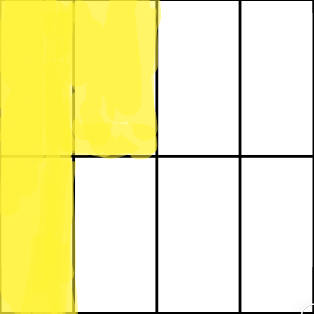
The square is split into 8 equal parts. Shade any 3 of those equal parts to show 3/8 of the square.
Q3. Food Fun Fractions:
(i) Ramu made a big paratha and cut it into 4 equal parts. He ate 1/4 and gave 2/4 to his sister.
How much of the paratha is left?
Ans: The whole paratha has 4 parts.
Ramu ate 1 part, and his sister got 2 parts.
Together they ate: 1 + 2 = 3 parts.
Parts left = 4 - 3 = 1 part out of 4, so 1/4 of the paratha is left.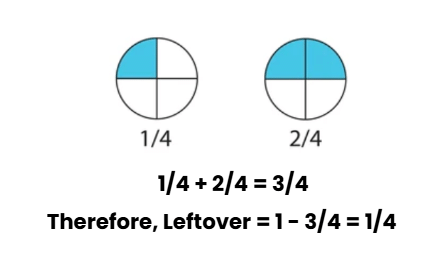
Q4. Equal or Not?
a) 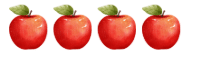 shared by 2 friends: each gets
  .
.
b)  shared by 2 friends: 1 gets
  and 1 gets
  .
.
c)  shared by 3 friends: each gets
  .
.
(i) Choose options that are divided equally:
Ans: (a) and (c) are shared equally.
In (a), each friend gets the same number of equal pieces. In (c), all three friends get the same number of equal pieces. That is why both are equal shares.
(ii) Which of the above is not shared equally?
Ans: (b) is not shared equally - one friend got more pieces than the other.
FAQs on Worksheet Solutions: Sharing and Measuring
| 1. How do I divide things equally when sharing in Class 4 maths? |  |
| 2. What's the difference between sharing and grouping in measurement problems? | |
| 3. Why do we use repeated subtraction for division in sharing problems? | |
| 4. How do I solve word problems about sharing items fairly in my worksheet? | |
| 5. What mistakes do students make when answering sharing and measurement questions? | |