CBSE Class 10 > Class 10 Notes > Science > NCERT Based Activity: Life Processes
NCERT Based Activity: Life Processes


Activity 5.1: Demonstrating that Chlorophyll is Essential for Photosynthesis
Procedure
- Take a potted plant with variegated leaves (for example, a money plant or croton) so that the same leaf has both green and non-green areas.
- Keep the plant in a dark room for three days to deplete stored starch in the leaves.
- Expose the plant to sunlight for about six hours.
- Pluck a leaf and mark the green (chlorophyll-containing) areas with a marker and trace the leaf on paper to record the original pattern.
- Boil the leaf in water for a few minutes to soften the tissues and stop metabolic activity.
- Place the leaf in a beaker containing alcohol (ethanol) and heat the beaker in a water bath until the alcohol boils; this decolourises the leaf by removing chlorophyll.
- Rinse the leaf in warm water to soften any remaining alcohol and then place a few drops of dilute iodine solution on the leaf to test for starch.
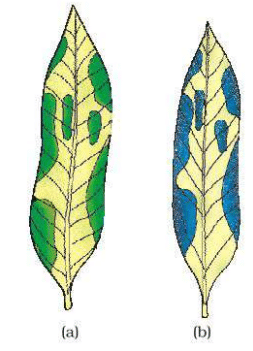
Variegated leaf (a) before and (b) after starch test
Observations
- After boiling in alcohol the leaf becomes pale or colourless as chlorophyll has been extracted; the alcohol turns green because it dissolved chlorophyll.
- On adding iodine, the areas that were originally green (and marked) turn blue-black, showing the presence of starch. The non-green areas remain pale or light brown, showing little or no starch.
Explanation
- Chlorophyll is the green pigment in leaves that captures light energy required for photosynthesis. Photosynthesis uses light energy to convert carbon dioxide and water into glucose. Excess glucose is stored as starch in chlorophyll-containing areas.
- The iodine test detects starch because iodine forms a blue-black complex with starch molecules (amylose). Areas without chlorophyll cannot carry out photosynthesis and therefore do not accumulate starch.
Conclusion
- Starch is produced only in the green parts of the leaf that contain chlorophyll. This confirms that chlorophyll is essential for photosynthesis because it absorbs sunlight needed to form glucose (stored as starch).
Activity 5.2: Demonstrating that Carbon Dioxide is Essential for Photosynthesis
Procedure
- Take two healthy potted plants of similar size and keep them in a dark room for three days to reduce stored starch.
- Place each plant on a glass plate. Place a watch-glass containing potassium hydroxide (KOH) next to one plant; KOH absorbs carbon dioxide from the air.
- Cover each plant with a separate bell-jar and seal the base of each jar to the glass plate with petroleum jelly (Vaseline) to make the setup airtight.
- Keep both assemblies in sunlight for about two hours.
- Pluck a leaf from each plant and perform the iodine test for starch (boil in water, decolourise in alcohol, and treat with iodine) and compare the results.
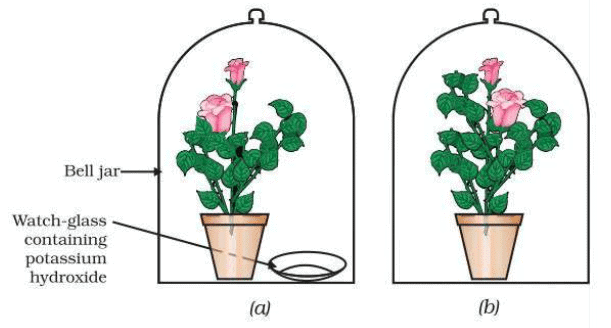
Experimental set-up (a) with potassium hydroxide (b) without potassium hydroxide
Observations
- The leaf from the plant without KOH (exposed to atmospheric CO₂) turns blue-black with iodine, indicating starch formation.
- The leaf from the plant kept with KOH (CO₂ absorbed) remains pale or light brown with iodine, indicating little or no starch.
Explanation
- Potassium hydroxide (KOH) reacts with and removes carbon dioxide from the air inside the bell-jar, so the plant under that jar has no CO₂ available for photosynthesis.
- Photosynthesis requires carbon dioxide as a raw material. Without CO₂, the plant cannot produce glucose and hence cannot form starch.
Conclusion
- Carbon dioxide is essential for photosynthesis. Plants with access to CO₂ produce starch; plants deprived of CO₂ do not.
Activity 5.3: Investigating the Action of Saliva on Starch
Procedure
- Prepare two test tubes (A and B) each containing 1 mL of 1% starch solution.
- Add 1 mL of fresh saliva to test tube A; leave test tube B as a control (no saliva).
- Allow both tubes to stand undisturbed for 20-30 minutes at room temperature.
- Add a few drops of dilute iodine solution to each test tube and observe any colour change.
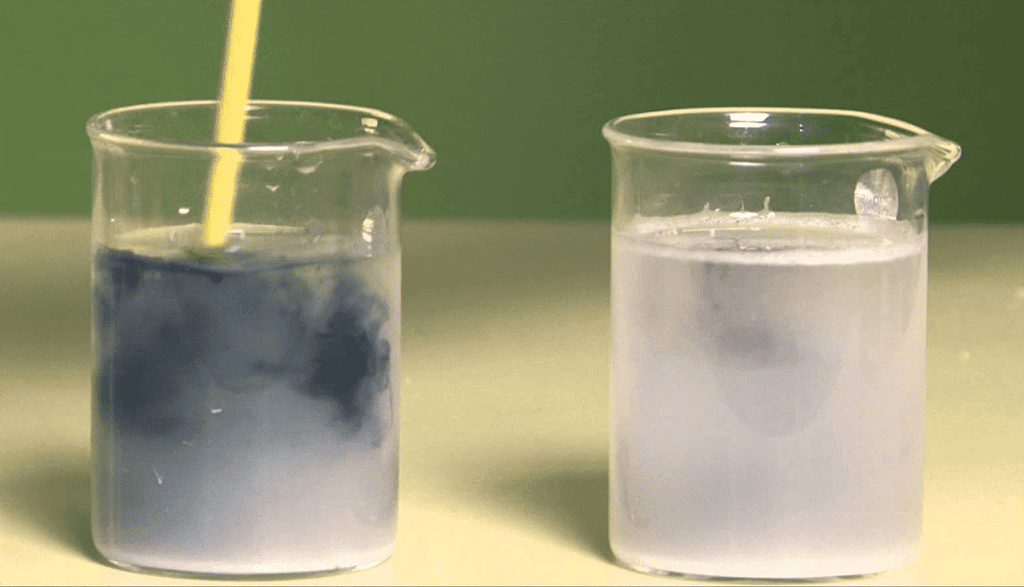
Observations
- Test tube A (with saliva) shows little or no blue-black colour with iodine (remains faint or light), indicating that most starch has been broken down.
- Test tube B (no saliva) turns blue-black with iodine, indicating the presence of undigested starch.
Explanation
- Human saliva contains the enzyme salivary amylase (ptyalin), which catalyses the hydrolysis of starch into simpler sugars such as maltose.
- When starch is broken down, it no longer gives a blue-black colour with iodine; hence the tube with saliva shows reduced or no colour change.
Conclusion
- Saliva contains an enzyme that initiates carbohydrate digestion in the mouth by breaking down starch into simpler sugars. The disappearance of the iodine-starch colour confirms starch digestion by saliva.
Activity 5.4: Comparing the Amount of Carbon Dioxide in Exhaled Air
Procedure
- Prepare fresh lime water (a clear solution of calcium hydroxide).
- Blow air gently through a straw into the lime water and note the time taken for the solution to become milky.
- In another test tube with fresh lime water, pass ambient air (from the room) through the solution using a syringe or pichkari and note the time taken for any milky appearance.
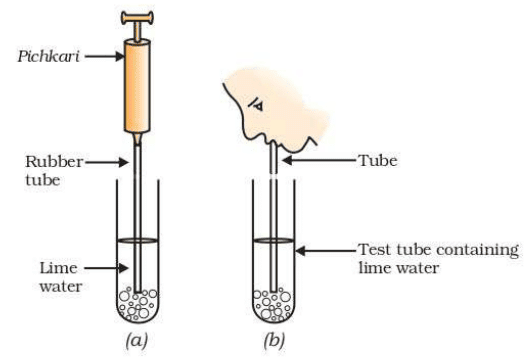
(a) Air being passed into lime water with a syringe, (b) air being exhaled into lime water
Observations
- The lime water turns milky much faster when exhaled air is blown through it (often within a few seconds) compared with ambient air passed through by syringe (which may take much longer or show little change).
Explanation
- Exhaled air contains a higher concentration of carbon dioxide (CO₂) produced by cellular respiration in the body.
- CO₂ reacts with calcium hydroxide in lime water to form calcium carbonate, a white precipitate, which makes the solution appear milky: Ca(OH)₂ + CO₂ → CaCO₃ + H₂O.
Conclusion
- Human exhaled air has more carbon dioxide than ambient air. This demonstrates that respiration produces CO₂ as a waste product.
Activity 5.5: Investigating the Products of Fermentation in Yeast
Procedure
- Mix fruit juice or a sugar solution with baker's yeast in a test tube and fit the tube with a one-holed cork.
- Attach a bent glass tube through the cork so that the free end of the bent tube is dipped into a test tube containing freshly prepared lime water.
- Leave the setup at room temperature and observe any changes in the lime water; note the time taken for change.
Observations
- After some time the lime water turns milky, indicating the release of carbon dioxide gas from the yeast culture.
Explanation
- Yeast cells can perform anaerobic respiration (fermentation) in the absence of oxygen. During fermentation glucose is converted into ethanol and carbon dioxide:
- Glucose → Ethanol + Carbon dioxide (C₆H₁₂O₆ → 2 C₂H₅OH + 2 CO₂)
Conclusion
- Fermentation by yeast produces ethanol and carbon dioxide. The formation of calcium carbonate in lime water confirms CO₂ is a product of fermentation.
Activity 5.6: Observing the Breathing Mechanism in Fish
Procedure
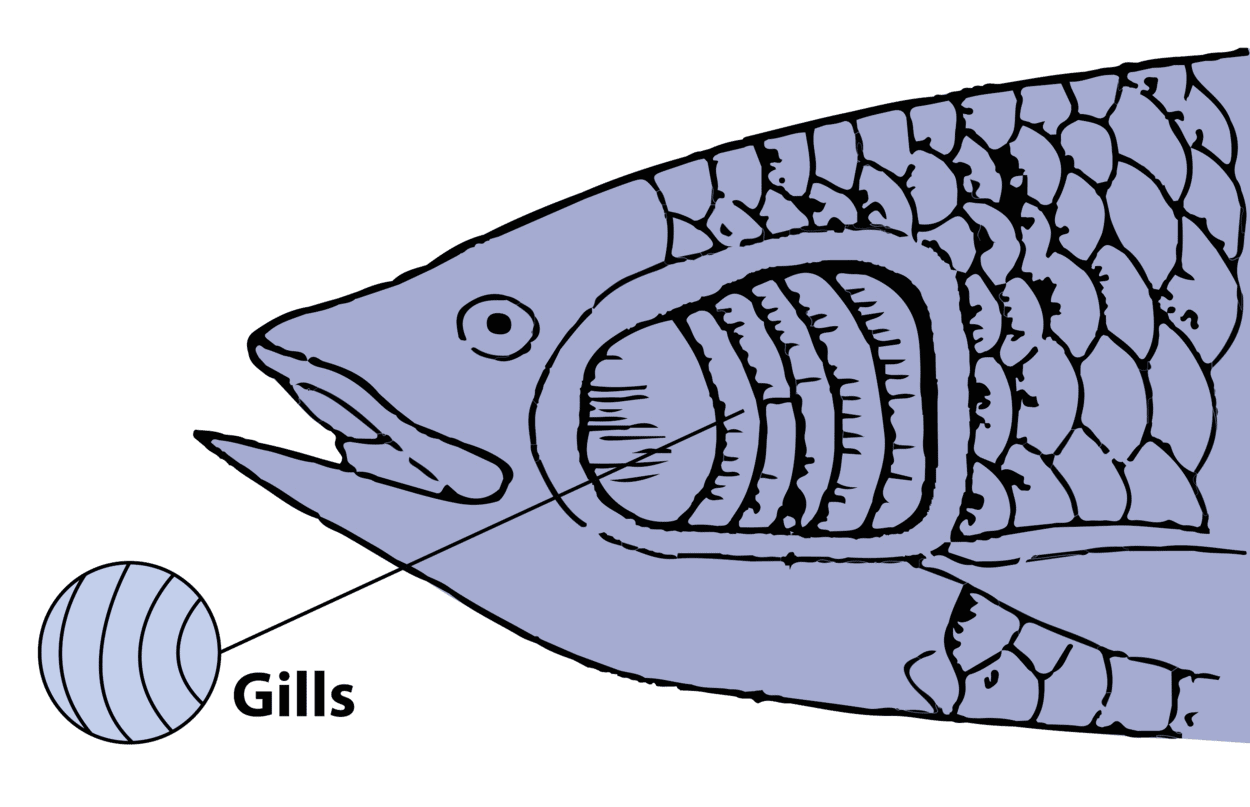
- Observe fish in an aquarium and note the opening and closing movements of their mouths and the opercula (gill covers).
- Check whether the movements of the mouth and operculum are coordinated (usually they are).
- Count how many times the fish opens and closes its mouth in one minute and compare with a human breathing rate measured per minute.
Observations
- The fish's mouth and opercula open and close in a coordinated manner so that water enters the mouth and exits over the gills.
- Many fish may open and close their mouths rapidly (for example, 50-100 times per minute), which is substantially higher than the typical human breathing rate (about 12-20 breaths per minute).
Explanation
- Fish extract dissolved oxygen from water using gills. Water flows over gill filaments where oxygen diffuses into blood and carbon dioxide diffuses out.
- Because dissolved oxygen concentration in water is lower than in air, fish often maintain a higher water flow rate (reflected in rapid mouth and operculum movements) to meet their oxygen needs.
Conclusion
- Fish breathe by passing water over gills; coordinated mouth and operculum movements ensure continuous water flow and efficient gas exchange.
Activity 5.7: Investigating Haemoglobin Content in Humans and Animals
Procedure
- Visit a health centre to record the normal haemoglobin ranges reported for humans, noting differences between children, adults, men, and women.
- Visit a veterinary clinic to obtain the normal haemoglobin range for an animal such as a buffalo or cow, noting differences for calves, males, and females if available.
- Compare and discuss reasons for observed differences in haemoglobin levels between humans and animals and among different age or sex groups.

Observations
- Humans: Typical haemoglobin ranges (approximate):
- Men: 13.5-17.5 g/dL
- Women: 12.0-15.5 g/dL
- Children: 11.0-13.0 g/dL (varies with age)
- Animals (e.g., buffalo/cow): Typical range: ~10.0-15.0 g/dL (varies by species, age and sex). Calves may have slightly lower values.
- Human males generally show higher haemoglobin values than females due to hormonal influences (testosterone promotes red blood cell production) and physiological differences such as menstruation in females.
Explanation
- Haemoglobin is the iron-containing pigment in red blood cells that binds and transports oxygen. Its concentration varies with metabolic rate, body size, age, sex and health status.
- Animals with different activity levels, metabolic demands and body sizes will have haemoglobin levels suited to their oxygen transport needs.
Conclusion
- Haemoglobin levels differ between species and within species (age and sex) according to physiological requirements. Human males typically have higher haemoglobin than females; animals such as cows show slightly different typical ranges reflecting their metabolic demands.
Activity 5.8: Demonstrating Transpiration in Plants
Procedure
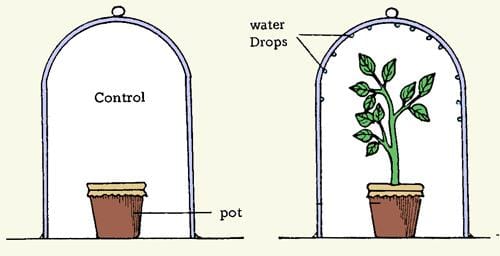
- Take two small pots containing equal amounts of soil. Plant a small potted plant in one pot; place a bare stick of similar height in the other pot.
- Cover the soil surface in both pots with a plastic sheet to prevent evaporation directly from the soil.
- Cover each whole setup (plant and stick) with a transparent plastic sheet or polythene and place both in bright sunlight for 30 minutes.
- Observe the inner surfaces of the plastic covers for water droplets.
Observations
- The plastic covering the plant shows numerous water droplets on its inner surface, indicating moisture loss from the plant.
- The plastic covering the stick shows little or no water droplets because there is no transpiration from a stick.
Explanation
- Transpiration is the loss of water vapour from plant surfaces (mainly leaves) through openings called stomata. Water absorbed by roots moves upwards through xylem vessels and evaporates from mesophyll cells into the atmosphere via stomata.
- Water droplets on the plastic are condensed transpired vapour. Covering the soil removes evaporation from the soil as a variable, isolating water loss from the plant itself.
Conclusion
- Plants lose water by transpiration through their leaves. Transpiration helps in the upward movement of water and dissolved minerals and also cools the plant.
Designing an Experiment to Demonstrate Sunlight is Essential for Photosynthesis
Procedure
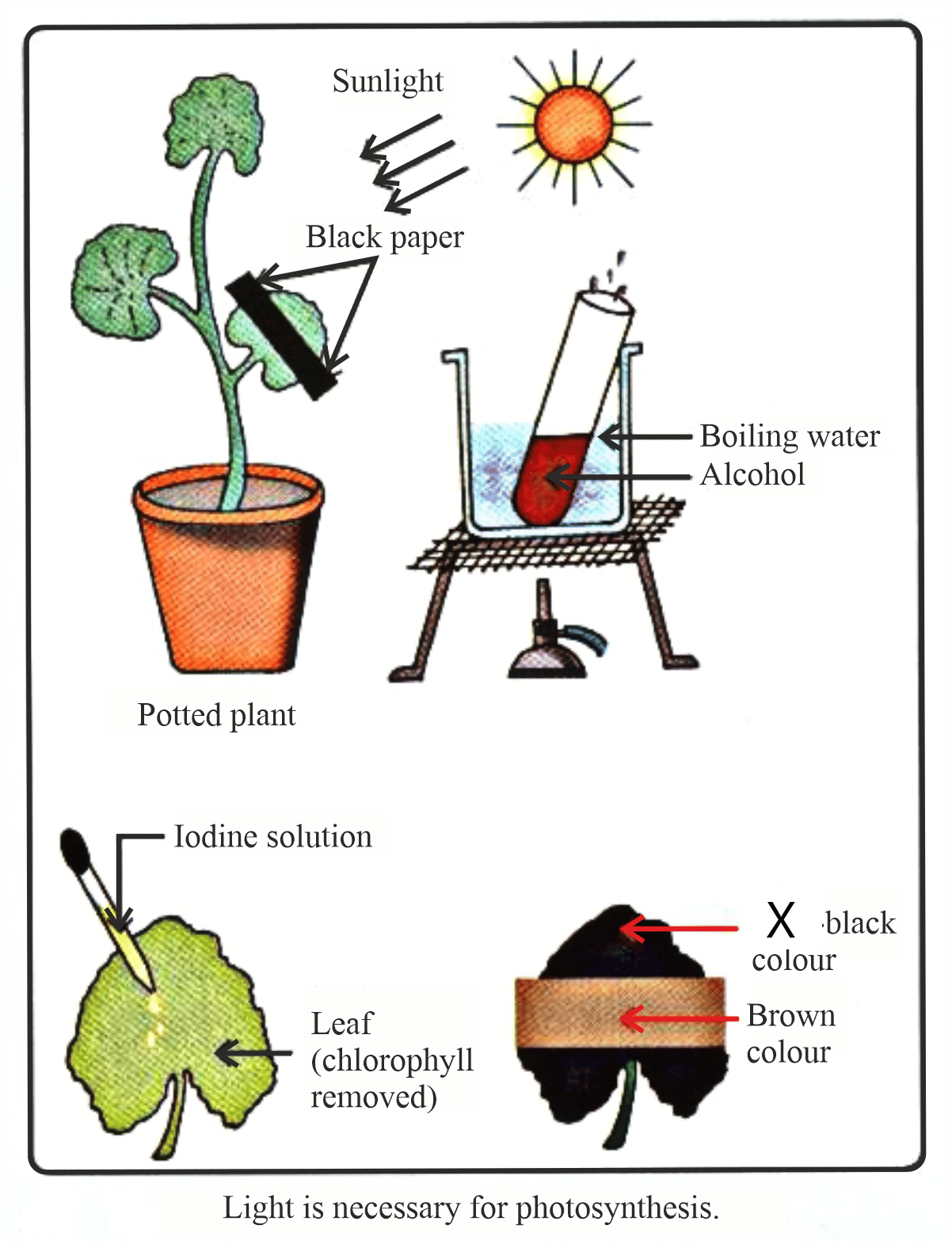
- Take two healthy potted plants of similar size and keep them in the dark for three days to deplete starch reserves.
- Place one plant in bright sunlight and keep the other in complete darkness (for example, in a dark room or covered with an opaque box) for 6-8 hours.
- Pluck a leaf from each plant and carry out the iodine test for starch: boil the leaves in water, decolourise in alcohol by heating in a water bath, rinse and then add dilute iodine solution.
Expected Observations
- The leaf from the plant kept in sunlight will turn blue-black with iodine, showing starch formation.
- The leaf from the plant kept in darkness will remain pale or light brown with iodine, indicating little or no starch formation.
Explanation and Conclusion
- Sunlight provides the energy required for the light reactions of photosynthesis. Without light, the plant cannot produce glucose and therefore cannot synthesise and store starch.
- This experiment demonstrates that sunlight is essential for photosynthesis, because only leaves exposed to light produce and store detectable amounts of starch.
The document NCERT Based Activity: Life Processes is a part of the Class 10 Course Science Class 10.
All you need of Class 10 at this link: Class 10
FAQs on NCERT Based Activity: Life Processes
| 1. What is the role of chlorophyll in photosynthesis? |  |
Ans. Chlorophyll is a green pigment found in plants that plays a crucial role in photosynthesis. It absorbs light energy, primarily from the sun, which is then used to convert carbon dioxide and water into glucose and oxygen. Without chlorophyll, plants would not be able to capture light energy, making photosynthesis impossible.
| 2. How can we demonstrate that carbon dioxide is essential for photosynthesis? | |
Ans. One way to demonstrate the necessity of carbon dioxide in photosynthesis is by using a plant in a controlled environment. By placing a plant in a sealed container with only water and light but no carbon dioxide, the plant will not produce oxygen or glucose, indicating that carbon dioxide is essential for the photosynthesis process.
| 3. What is the significance of saliva in starch digestion? | |
Ans. Saliva contains an enzyme called amylase, which begins the process of starch digestion in the mouth. Amylase breaks down starch into simpler sugars, facilitating digestion. This activity helps illustrate the importance of enzymes in biological processes and how they contribute to breaking down complex carbohydrates into usable energy forms.
| 4. Why is it important to measure carbon dioxide levels in exhaled air? | |
Ans. Measuring carbon dioxide levels in exhaled air is important for understanding respiration and metabolic processes in humans and animals. It provides insight into how efficiently the body is utilizing oxygen and producing carbon dioxide as a waste product, which is crucial for assessing respiratory health and efficiency.
| 5. What is the purpose of investigating transpiration in plants? | |
Ans. Investigating transpiration in plants is important for understanding how plants regulate water loss and maintain hydration. Transpiration is the process by which water evaporates from plant leaves, creating a vacuum that helps draw water and nutrients from the roots. This activity highlights the importance of transpiration in plant health and overall functioning.
About this Document

6.5K Views

4.93/5 Rating

Apr 25, 2026 Last updated
Document Description: NCERT Based Activity: Life Processes for Class 10 2026 is part of Science Class 10 preparation. The notes and questions for NCERT Based Activity: Life Processes have been prepared according to the Class 10 exam syllabus. Information about NCERT Based Activity: Life Processes covers topics like and NCERT Based Activity: Life Processes Example, for Class 10 2026 Exam. Find important definitions, questions, notes, meanings, examples, exercises and tests below for NCERT Based Activity: Life Processes.
Introduction of NCERT Based Activity: Life Processes in English is available as part of our Science Class 10 for Class 10 & NCERT Based Activity: Life Processes in Hindi for Science Class 10 course. Download more important topics related with notes, lectures and mock test series for Class 10 Exam by signing up for free. Class 10: NCERT Based Activity: Life Processes
Description
NCERT Based Activity: Life Processes of Science Class 10 covers all the important topics, helping you prepare for the Class 10 exam on EduRev. Start for free!
Information about NCERT Based Activity: Life Processes
In this doc you can find the meaning of NCERT Based Activity: Life Processes defined & explained in the simplest way possible. Besides explaining types of NCERT Based Activity: Life Processes theory, EduRev gives you an ample number of questions to practice NCERT Based Activity: Life Processes tests, examples and also practice Class 10 tests



Related Searches
Exam, pdf , NCERT Based Activity: Life Processes, Previous Year Questions with Solutions, Summary, Semester Notes, Free, mock tests for examination, Extra Questions, shortcuts and tricks, study material, practice quizzes, Viva Questions, MCQs, past year papers, video lectures, Important questions, Sample Paper, NCERT Based Activity: Life Processes, ppt, Objective type Questions, NCERT Based Activity: Life Processes;