Chapter Notes: Storing Memories

Introduction
The process of storing memories is a vital part of how we learn, recall, and interact with the world. This chapter explores how the brain captures, holds, and organizes information through various memory systems. It covers sensory memory, short-term memory, and long-term memory, along with techniques like rehearsal that help retain information. The chapter also discusses unique abilities like highly superior autobiographical memory and the challenges posed by memory impairments. Understanding these concepts provides insight into how our minds manage the vast amount of information we encounter daily.
Memory Storage Processes
- Memory storage involves multiple systems working together to process and retain information.
- Sensory memory captures brief sensory input for initial processing.
- Short-term memory temporarily holds a small amount of information for immediate use.
- Long-term memory stores information for extended periods, potentially a lifetime.
- Rehearsal techniques strengthen memory retention and transfer information between systems.
- Some individuals possess exceptional autobiographical memory, recalling personal events with high accuracy.
Types of Memory Storage
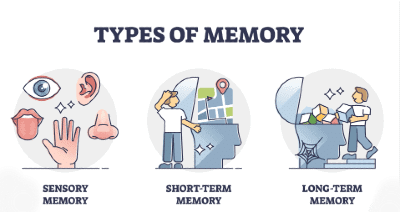
1. Sensory Memory
Sensory memory acts as the first stage of information processing, briefly storing sensory impressions.
It includes:
- Iconic memory: Retains visual information for a fraction of a second.
- Echoic memory: Holds auditory information for a few seconds.
2. Short-Term Memory (STM)
Short-term memory serves as a temporary holding area with defined constraints:
- Capacity of about 7 ± 2 items.
- Information lasts 15-30 seconds without rehearsal.
- Includes working memory for active cognitive tasks.
Working memory is the brain's dynamic processing hub, featuring:
- Central executive: Manages attention and coordinates tasks.
- Phonological loop: Processes verbal and auditory information.
- Visuospatial sketchpad: Handles visual and spatial data.
3. Long-Term Memory (LTM)
Long-term memory is the brain's durable storage system, categorized into:
- Declarative (explicit) memory:
- Semantic memory: General knowledge and facts.
- Episodic memory: Personal experiences and events.
- Nondeclarative (implicit) memory:
- Procedural memory: Skills and habits.
- Priming effects: Enhanced recognition due to prior exposure.
Rehearsal Techniques for Retention
The brain employs two main rehearsal strategies to retain information:
Maintenance Rehearsal
- Involves repetitive review, such as repeating a phone number.
- Maintains information in short-term memory.
Elaborative Rehearsal
- Creates connections between new and existing knowledge.
- Uses strategies like:
- Chunking: Grouping information into meaningful units.
- Mnemonic devices: Memory aids like acronyms.
- Visual imagery: Creating mental pictures.
- Personal connections: Relating information to one's life.
Superior Autobiographical Memory (HSAM)
Individuals with Highly Superior Autobiographical Memory (HSAM) can recall personal events, dates, weather, or news with remarkable precision.
Factors influencing autobiographical memory include:
- Personal significance of events.
- Emotional intensity.
- Self-reference effect (relating events to oneself).
- Frequency of recalling the memory.
Research indicates HSAM may involve:
- Increased gray matter in memory-related brain areas.
- Stronger connectivity among memory networks.
- Unique encoding and retrieval processes.
Memory Storage Impairments
Memory disorders can profoundly affect daily life. Common impairments include:
Amnesia
- Retrograde amnesia: Loss of memories formed before the onset.
- Anterograde amnesia: Inability to create new memories.
Alzheimer's Disease
- Begins with loss of recent memories.
- Progresses to affect older memories.
- Eventually impairs basic skills and functions.
Infantile Amnesia
- Prevents recall of events before age 3-4 for most adults.
- Caused by:
- Ongoing brain development.
- Limited language skills.
- Developing sense of self.
- Maturation of memory systems.
FAQs on Chapter Notes: Storing Memories
| 1. What are the different types of memory storage in the human brain? |  |
| 2. What are some effective rehearsal techniques for retaining information? | |
| 3. What is Highly Superior Autobiographical Memory (HSAM) and how does it differ from regular memory? | |
| 4. What are common memory storage impairments and their effects? | |
| 5. How can understanding memory storage improve learning and retention? | |