As TITA (Type In The Answer) questions gain more weight in the CAT exam, this document focuses on Functions problems to help you prepare thoroughly and secure valuable marks.
Q1: Consider two sets A={2, 3, 5, 7, 11, 13} and B = {1, 8, 27}. Let f be a function from A to B such that for every element in B, there is at least one element a in A such that f(a) = b. Then, the total number of such functions f is
Solution:
Ans: 540
Set A={2,3,5,7,11,13} so |A|=6 Set B={1, 8, 27} so |B|=3 Without any restrictions, each element in A can map to any of the 3 elements in B. Thus, the total number of functions is: Excluding Functions That Miss One Element in B: If a function does not map to an element in B, there are 2 elements in B left for mapping. The total number of such functions (for each specific element not mapped) is: Since there are 3 elements in B, the total number of such functions is:3 x 64 = 192 Adding Back Functions That Miss Two Elements in B: If a function misses two elements in B, there is only 1 element left for mapping. The total number of such functions is: 16 = 1. Since there are 3C2 ways to choose which two elements are missed, the total number of such functions is: 3 Using the inclusion-exclusion principle, the number of functions where all elements of B are mapped by at least one element of A is: 729 - 192 + 3 = 540.
Q2: A function f maps the set of natural numbers to whole numbers, such that f(xy) = f(x)f(y) + f(x) + f(y) for all x, y and f(p) = 1 for every prime number p. Then, the value of f(160000) is
Solution:
Ans: 4095 Looking at the additional information about the prime numbers should make one realise that they are the key to solving the question. f(16000) can be written as f(28 × 54) Now, we can try to find these individual values: For any prime p: f(p)=1 f(p2) = f(p)f(p)+f(p)+f(p) = 1 + 1 + 1 = 3 f(p3)=f(p2)f(p)+f(p2)+f(p) = 3 + 3 + 1 = 7 This way, we can find the function output for any prime number raised to a power. We can see that each new exponent is twice the previous output +1, solving this way till prime raised to power 8 f(p4) = 7 + 7 + 1 = 15 f(p5) = 15 + 15 + 1 = 31 f(p6) = 31 + 31 + 1 = 63 f(p7) = 63 + 63 + 1 = 127 f(p8) = 127 + 127 + 1 = 255
Using these values in the original expression of f(28 × 54) = f(28)f(54)+f(28)+f(54) we get f(28 ×54) = (255 × 15) + 255 + 15 = 4095
Q3: The area of the quadrilateral bounded by the Y-axis, the line x = 5, and the lines ∣x - y∣ - ∣x - 5∣ = 2, is
Solution:
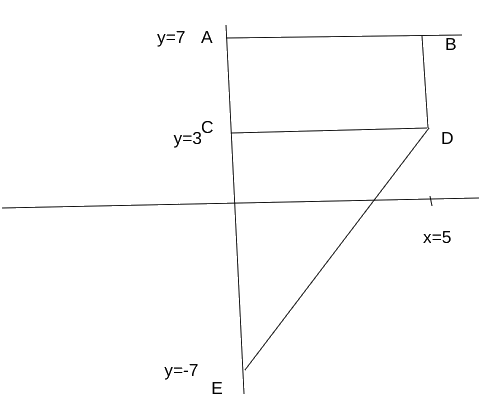
Ans: 45 From the inequality and nature of x, and y, we get the given diagram:
We need to find the area of the quadrilateral ABDE = area of rectangle ABCD + area of triangle CDE ⇒ Area of ABCD = (7-3)*5 = 20 units, and the area of triangle CDE = (1/2)*10*5 = 25 units. Hence, the area of the quadrilateral ABDE = (20+25) = 45 units.
Q4: Suppose f(x, y) is a real-valued function such that f(3x + 2y, 2x - 5y) = 19x, for all real numbers x and y. The value of x for which f(x, 2x) = 27, is
Solution:
Ans: 3 Given that f(3x + 2y, 2x - 5y) = 19x. Let us assume the function f(a,b) is a linear combination of a and b. ⇒ f(3x+2y, 2x-5y) = m(3x+2y) + n(2x-5y) = 19x ⇒ 3m + 2n = 19 and 2m - 5n = 0 Solving we get m = 5 and n = 2 ⇒ f(a,b) = 5a+2b ⇒ f(x,2x) = 5x + 2(2x) = 9x = 27 => x = 3.
Q5: Let 0 ≤ a ≤ x ≤ 100 and f(x) = ∣x - a∣ + ∣x - 100∣ +∣x - a - 50∣. Then the maximum value of f(x) becomes 100 when a is equal to
Solution:
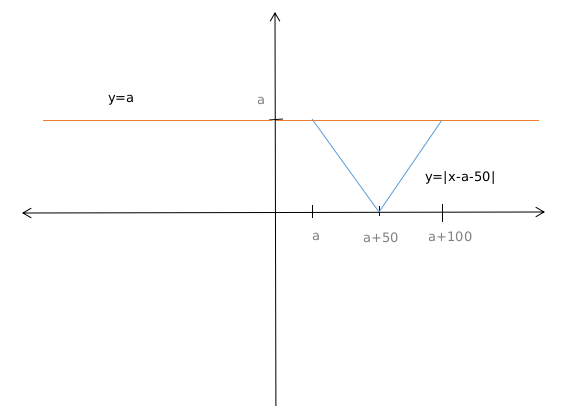
Ans: 50 x > = a, so |x - a| = x - a x < 100, so |x - 100| = 100-x f(x) = (x-a) + (100-x) + |x-a-50| =100 or, |x-a-50| = a From the graph we can can see that when x = a then |x - a - 50| = a or, a = 50 Similarly when x = a + 100 |x - a - 50| = a or, a = 50 So value of a is 50 when f(x) is 100.
Q6: Let f(x) be a quadratic polynomial in x such that f(x) ≥ 0 for all real numbers x. If f(2) = 0 and f( 4) = 6, then f(-2) is equal to
Solution:
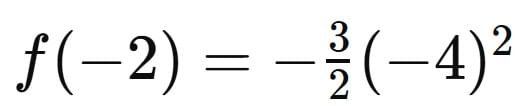
Ans: 24 f(x) ≥ 0 for all real numbers x, so D <=0 Since f(2)=0 therefore x = 2 is a root of f(x) Since the discriminant of f(x) is less than equal to 0 and 2 is a root so we can conclude that D = 0 Therefore f(x) = a(x - 2)2 f(4)=6 or, a(x - 2)2 a = 3/2 = 24
Q7: Suppose for all integers x, there are two functions f and g such that f(x)+f(x-1)-1 = 0 and g(x) = x2 . If f(x2 -x)=5, then the value of the sum f(g(5)) + g(f(5)) is
Solution:
Ans: 12 f(x)+f(x-1)=1 ...... (1) f(x2 - x) = 5 ...... (2) g(x) = x2 Substituting x = 1 in (1) and (2), we get f(0) = 5 f(1) + f(0) = 1 f(1) = 1 - 5 = -4 f(2) + f(1) = 1 f(2) = 1 + 4 = 5 f(n) = 5 if n is even and f(n) = -4 if n is odd f(g(5)) + g(f(5)) = f(25) + g(-4) = -4 + 16 = 12
Q8: Let f(x) = x2 + ax + b and g(x) = f(x + 1) - f(x - 1). If f(x) ≥ 0 for all real x, and g (20) = 72. then the smallest possible value of b is
Solution:
Ans: 4 f(x)= x2 +ax+b f(x+1) = x2 +2x+1+ax+a+b f(x-1) = x2 -2x+1+ax-a+b g(x)=f(x+1)-f(x-1)=4x+2a Now g(20)=72 from this we get a=-4 ; f(x) = x2 -4x +b For this expression to be greater than zero it has to be a perfect square which is possible for b≥ 4 Hence the smallest value of 'b' is 4.
Q9: The area of the region satisfying the inequalities ∣x∣ - y ≤ 1, y ≥ 0 and y ≤ 1 is
Solution:
Ans: 3 The area of the region contained by the lines ∣x∣ - y ≤ 1, y ≥ 0 and y ≤ 1 is the white region. Total area = Area of rectangle + 2 x Area of triangle
Hence, 3 is the correct answer.
Q10: In a group of 10 students, the mean of the lowest 9 scores is 42 while the mean of the highest 9 scores is 47. For the entire group of 10 students, the maximum possible mean exceeds the minimum possible mean by
Solution:
Ans: 4 Let x(1) be the least number and x(10) be the largest number. Now from the condition given in the question , we can say that x(2)+x(3)+x(4)+........x(10)= 47*9=423...................(1) Similarly x(1)+x(2)+x(3)+x(4)................+x(9)= 42*9=378...............(2) Subtracting both the equations we get x(10)-x(1)=45 Now, the sum of the 10 observations from equation (1) is 423+x(1) Now the minimum value of x(10) will be 47 and the minimum value of x(1) will be 2 . Hence minimum average 425/10=42.5
Maximum value of x(1) is 42. Hence maximum average will be 465/10=46.5 Hence difference in average will be 46.5-42.5 = 4 which is the correct answer
1. What are the key functions of a programming language?
Ans. A programming language serves several key functions, including enabling the creation of software applications, providing a means to automate tasks, facilitating data manipulation, and allowing for communication between the user and the computer. Additionally, it helps in implementing algorithms to solve problems efficiently.
2. How do functions improve code organization in programming?
Ans. Functions improve code organization by allowing programmers to break down complex problems into smaller, manageable parts. This modular approach makes the code more readable, reusable, and easier to debug. It also promotes a clear structure, as each function can perform a specific task, making collaboration among developers more effective.
3. What are the differences between built-in functions and user-defined functions?
Ans. Built-in functions are pre-defined functions provided by the programming language's standard library, which can be used directly without any additional coding. In contrast, user-defined functions are custom functions created by programmers to perform specific tasks tailored to their needs. User-defined functions enhance flexibility and code reusability.
4. Can you explain the concept of function parameters and return values?
Ans. Function parameters are variables that allow data to be passed into a function when it is called, enabling the function to operate on different inputs. Return values are the outputs that a function provides after execution, allowing users to capture and use the results of the function. This facilitates data flow and interaction within a program.
5. Why is it important to understand scope in relation to functions?
Ans. Understanding scope is crucial as it defines the visibility and lifetime of variables within a program. In relation to functions, scope determines where variables can be accessed and modified. Local scope refers to variables defined within a function that are not accessible outside it, while global scope allows variables to be accessed anywhere in the program. This understanding helps prevent errors and improves code maintainability.
TITA Based Questions: Functions, Viva Questions, Semester Notes, MCQs, ppt, pdf , study material, Sample Paper, Previous Year Questions with Solutions, Important questions, TITA Based Questions: Functions, shortcuts and tricks, Objective type Questions, past year papers, video lectures, practice quizzes, Summary, TITA Based Questions: Functions, mock tests for examination, Extra Questions, Free, Exam;


 From the graph we can can see that when x = a then
 = 24
= 24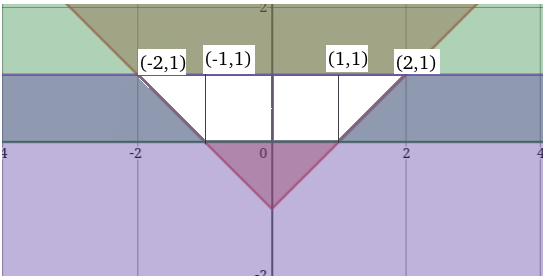 The area of the region contained by the lines ∣x∣ - y ≤ 1, y ≥ 0 and y ≤ 1 is the white region.