Chapter Notes: The Judicial Branch


Introduction
The judicial branch holds a distinct and influential position within the American governmental framework. Its primary responsibilities include interpreting legislation, settling disputes, and ensuring that governmental actions adhere to the boundaries established by the U.S. Constitution. The judiciary's authority to perform these functions stems largely from the principle of judicial review, solidified in the landmark case Marbury v. Madison (1803).
This section delves into the constitutional underpinnings of the judiciary, the establishment and application of judicial review, and the judiciary's interactions with the legislative and executive branches. Two critical foundational documents-Article III of the Constitution and Federalist No. 78-are essential for understanding the judiciary's role in the American system.
Constitutional Foundations: Article III and Federalist No. 78
Article III: The Judicial Branch in the Constitution
Article III of the U.S. Constitution institutes the federal judiciary as an equal partner alongside the legislative and executive branches.
It defines the judiciary's structure and the extent of its authority:
- Establishes the Supreme Court and grants Congress the power to create lower federal courts.
- Assigns federal courts jurisdiction over cases involving the Constitution, federal laws, treaties, and other specified areas.
- Safeguards judicial independence by providing judges with lifetime tenure, contingent on "good behavior," and prohibiting salary reductions during their service.
The Constitution's language regarding judicial power is intentionally broad, allowing its scope to evolve over time, particularly through the development of judicial review.
Federalist No. 78: The Case for Judicial Independence
Authored by Alexander Hamilton, Federalist No. 78 defends the judiciary as the "least dangerous" branch, noting its lack of control over military force (executive power) or financial resources (legislative power). The essay strongly advocates for judicial independence and the concept of judicial review.
Key arguments include:
- Judges are tasked with interpreting laws and ensuring their alignment with the Constitution.
- Lifetime tenure protects judges from political pressures, enabling impartial decision-making.
- Courts must have the authority to nullify unconstitutional laws to safeguard individual liberties.
Exam Tip: Federalist No. 78 is a required document for the AP U.S. Government exam. It is highly relevant for discussions on checks and balances, judicial independence, or the role of judicial review.
Judicial Review: Authority and Function
Definition and Power
Judicial review refers to the judiciary's authority to evaluate whether a law or executive action complies with the Constitution. When a law or action is found to be unconstitutional, courts can declare it void, effectively invalidating it.
Although not explicitly outlined in Article III, judicial review was formally established by the Supreme Court in the 1803 case Marbury v. Madison, becoming a foundational element of judicial power.
Why it matters: Judicial review strengthens the judiciary's role in the system of checks and balances, allowing it to restrain the legislative and executive branches when they overstep constitutional boundaries.
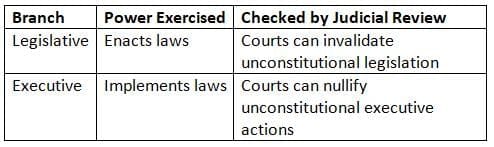
Marbury v. Madison (1803): A Foundational Precedent
In Marbury v. Madison, Chief Justice John Marshall ruled that a provision of the Judiciary Act of 1789, which permitted the Supreme Court to issue a writ of mandamus, was unconstitutional. This decision established the judiciary's authority to review and strike down laws.
Why Marbury Matters
- It made judicial review a key power of the Supreme Court.
- It showed that the Constitution has the highest authority in the U.S. legal system.
- It created a model for the Court's job in deciding what the Constitution means.
Why it matters: Mention Marbury v. Madison in FRQs or essays that focus on how the Court interprets the Constitution or limits the powers of other branches.
Structure of the Federal Court System
The judicial branch operates through a hierarchical system of federal courts, designed to promote fairness, uniformity, and accessibility in the administration of justice.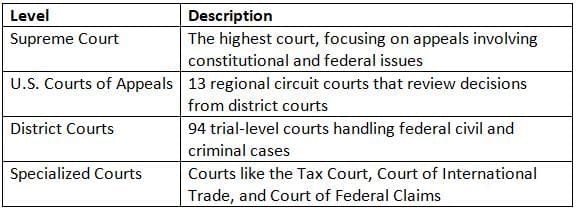
In addition to the federal system, each state maintains its own judicial structure, which parallels the federal model. State courts handle most civil and criminal cases, but cases involving federal law or constitutional issues may escalate to federal courts.
Judicial Independence and Life Tenure
Why Judges Serve for Life
Federal judges, appointed by the President and confirmed by the Senate, serve for life, provided they maintain "good behavior."
This lifetime tenure:
- Protects judges from political retribution or public opinion pressures.
- Encourages decisions grounded in legal reasoning rather than political expediency.
- Upholds the rule of law and safeguards minority rights against majority overreach.
Why it matters: In Federalist No. 78, Hamilton emphasizes that life tenure is critical for ensuring a "steady, upright, and impartial administration of the laws."
Checks on the Judiciary
Despite their independence, federal judges are subject to several checks to ensure accountability:
- Congress can propose constitutional amendments to reverse judicial rulings.
- Judges can be impeached and removed for misconduct.
- The executive and legislative branches influence the judiciary through judicial appointments and control over court jurisdiction.
Examples of Judicial Review in Action
Judicial review has profoundly influenced U.S. legal and political history through landmark cases.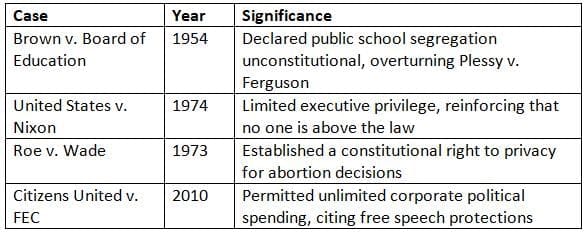
Conclusion: The Judiciary's Essential Role
The U.S. Supreme Court and the broader judicial system are vital pillars of the constitutional framework. Through judicial review, established in Marbury v. Madison and defended in Federalist No. 78, the courts act as a critical check on the legislative and executive branches. Their role extends beyond reacting to governmental actions; it is foundational to upholding constitutional principles, including individual liberties, equal protection, and limited government.
For students preparing for the AP U.S. Government exam, it is crucial to understand how to articulate:
- The justification for judicial power provided by Article III and Federalist No. 78.
- The function of judicial review as a tool for enforcing constitutional limits.
- The judiciary's ability to maintain independence while operating within the system of checks and balances.
Key Terms
- 14th Amendment: Ratified in 1868, this amendment grants citizenship to all persons born or naturalized in the U.S. and prohibits states from denying due process or equal protection under the law, shaping civil rights and federal-state relations.
- Alexander Hamilton: A Founding Father and the first U.S. Secretary of the Treasury, Hamilton was instrumental in developing the nation's financial system and advocating for a strong central government, influencing political and economic policies.
- Balance of Power: The principle of distributing authority among governmental entities to prevent any single branch or group from becoming overly dominant, ensuring equilibrium in governance and policymaking.
- Brown v. Board of Education: A 1954 Supreme Court decision that ruled racial segregation in public schools unconstitutional, overturning Plessy v. Ferguson and advancing the civil rights movement.
- Circuit Courts: Federal and state trial courts with jurisdiction over specific geographic regions, handling civil and criminal cases and serving as intermediaries between lower courts and appellate courts.
- Constitutionality: The condition of laws, actions, or policies aligning with the Constitution's provisions, ensuring adherence to constitutional standards and protecting citizens' rights through judicial review.
- Court of Federal Claims: A specialized federal court that adjudicates monetary claims against the U.S. government, such as contract disputes and takings, providing a venue for seeking compensation.
- Court of International Trade: A specialized U.S. court handling cases related to international trade and customs laws, ensuring consistent and fair application of trade regulations.
- Dispute Resolution: Processes like negotiation, mediation, or arbitration used to resolve conflicts, maintaining social order and providing structured avenues for justice within the judicial system.
- District Courts: The primary federal trial courts, with 94 courts nationwide, handling most federal civil and criminal cases as the first level of the federal judicial hierarchy.
- Equal Protection Clause: A 14th Amendment provision requiring states to provide equal protection under the law, serving as a key tool for combating discrimination and promoting fairness.
- Federalist No. 78: An essay by Alexander Hamilton emphasizing the judiciary's independence and the necessity of judicial review, portraying the courts as guardians of the Constitution.
- Individual Rights and Liberties: Fundamental freedoms outlined in the Constitution and Bill of Rights, ensuring personal autonomy and protection from government overreach, with the judiciary interpreting and safeguarding these rights.
- Judiciary Act of 1789: Legislation establishing the federal judiciary, including the Supreme Court, district courts, and circuit courts, laying the foundation for the judicial branch's structure and operations.
- Judicial Review: The courts' authority to evaluate and invalidate unconstitutional legislative or executive actions, ensuring alignment with the Constitution and protecting individual rights.
- Marbury v. Madison: A 1803 Supreme Court case establishing judicial review, empowering courts to strike down unconstitutional laws and shaping the judiciary's role in government.
- Separation of Powers: A governance model dividing authority among the legislative, executive, and judicial branches, ensuring no single branch dominates and promoting balanced governance.
- Supreme Court: The highest U.S. court, responsible for interpreting laws, ensuring justice, and checking other branches' actions through its authoritative rulings.
- Tax Court: A specialized federal court resolving disputes between taxpayers and the IRS over federal tax issues, allowing taxpayers to contest IRS decisions without prepaying disputed taxes.
- Writ of Mandamus: A court order directing a government official or entity to perform a legally required duty, reinforcing accountability and the rule of law within the judicial system.
FAQs on Chapter Notes: The Judicial Branch
| 1. What is judicial review and why is it important in the U.S. legal system? |  |
| 2. How did the case of Marbury v. Madison establish the principle of judicial review? | |
| 3. What is the structure of the judicial branch of the U.S. government? | |
| 4. What are some key terms associated with the judicial branch? | |
| 5. What are the key questions to consider when studying the judicial branch? | |