Chapter Notes: Ideology and Social Policy

Introduction
Social policy in the United States is a reflection of deep ideological divides concerning the government's proper role in addressing societal issues. Political parties and interest groups adopt stances on topics like healthcare, education, drug policy, reproductive rights, and civil liberties, guided by their philosophical perspectives on the balance between liberty, morality, and equality. These debates are shaped by whether an ideology aligns with liberal, conservative, or libertarian principles.
Government Involvement in Social Issues
Ideological perspectives drive differing views on the extent of government involvement in personal and social matters, influencing policymaking at both national and state levels.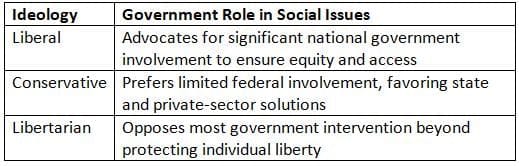
Liberal Ideology
- Liberals view government as a vital tool for addressing inequality, protecting marginalized groups, and ensuring access to essential services. They support national policies that promote:
- Increased funding for public education.
- Universal healthcare access.
- Laws to combat discrimination.
- Environmental protection measures.
- Legal access to reproductive services.
- Liberals emphasize government's role in expanding opportunities and rectifying historical injustices, prioritizing civil liberties, particularly privacy rights, and opposing laws that limit personal choices regarding sexuality, gender, or bodily autonomy.
Example: Landmark cases like Griswold v. Connecticut (1965) and Roe v. Wade (1973) align with liberal perspectives on reproductive privacy. Although Roe was overturned, it remains a significant example of liberal influence on social policy.
Conservative Ideology
- Conservatives often see government intervention as undermining social order and personal responsibility.
They advocate for a limited federal role, preferring solutions from:- State and local governments.
- Faith-based organizations.
- Families and communities.
- This ideology supports policies like school choice, religious liberty protections, and stricter regulations on issues such as drug use or abortion. Conservatives tend to favor measures that uphold traditional values and grant states greater autonomy over federal mandates.
Example: The Supreme Court's ruling in Engel v. Vitale (1962), which prohibited school-sponsored prayer, faced opposition from conservatives who argued it restricted religious expression in public schools.
Libertarian Ideology
- Libertarians advocate for minimal government involvement in both personal and social spheres, prioritizing individual autonomy and viewing state actions as threats to liberty and property rights.
They generally oppose:- Mandates for public education.
- Government-managed healthcare systems.
- Drug prohibition or moral legislation.
- Surveillance or restrictions on free speech.
- Libertarians support policies that maximize personal freedom, even if those choices are seen by others as socially detrimental.
Example: Libertarians often endorse drug legalization, same-sex marriage, and school privatization while opposing gun control, welfare programs, and mandatory vaccinations.
Ideology and Social Policy Debates
Ideological differences profoundly shape policymakers' approaches to critical social issues, including healthcare, education, reproductive rights, drug policy, and LGBTQ+ protections.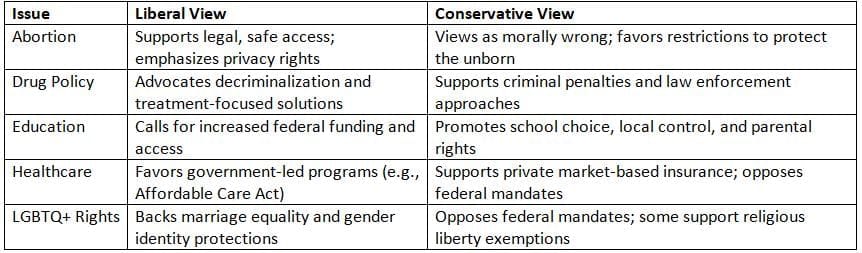
Public opinion and policy shifts often depend on which ideological perspective holds sway in government at a given time.
Policy Trends and Political Power
The success of liberal or conservative social policy objectives typically hinges on which party controls federal or state governments.
- Under liberal leadership, social policies often emphasize equity, access, and federal oversight.
- Under conservative leadership, states gain more autonomy, and social spending may be reduced in favor of personal or religious values.
Historical Examples
- Reagan Administration (1980s): Focused on personal responsibility, reduced welfare spending, promoted abstinence-based education, and prioritized state authority over federal directives.
- Obama Administration (2009-2017): Expanded healthcare via the Affordable Care Act, advanced anti-discrimination protections for LGBTQ+ individuals, and bolstered federal education initiatives.
- Recent Trends: Debates over same-sex marriage, transgender rights, and reproductive freedoms have driven significant changes in federal and state laws, particularly following the Dobbs v. Jackson Women's Health Organization (2022) decision, which shifted abortion policy authority to states.
- Key Insight: Federalism is central to these debates. Liberal federal control may override state restrictions, while conservative dominance often returns power to states.
Key Takeaways
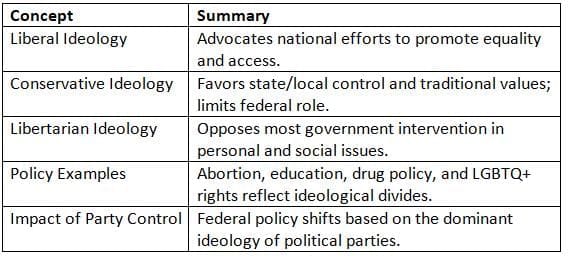
Social policy debates in the United States are rooted in fundamental disagreements about government's role, the definition of liberty, and the boundaries between public and private spheres. Whether expanding healthcare access, restricting abortion, or redefining family structures, ideological perspectives continue to shape the laws that define American society.
Key Terms
- Affordable Care Act (Obamacare): A 2010 healthcare reform law aimed at expanding insurance coverage, reducing costs, and improving care quality through mandates, subsidies, and health insurance exchanges, reflecting liberal social policy goals.
- Conservative Ideologies: Beliefs emphasizing tradition, limited government, and social stability, shaping policies that prioritize local control and traditional values.
- Decriminalizing Drugs: The removal of criminal penalties for drug possession, treating it as a public health issue, aligned with liberal and libertarian views on personal freedom.
- Democrats: A major U.S. political party advocating liberal policies, including social equality, government intervention, and protections for marginalized groups.
- Department of Education: A federal agency promoting educational excellence and equal access, influencing social policy through funding and civil rights enforcement.
- Drug Use and Drug Policy: The consumption of substances and the laws governing them, shaped by ideological debates over criminalization versus public health approaches.
- Environmental Protection Agency (EPA): A federal agency established in 1970 to enforce environmental regulations, reflecting ideological priorities on environmental stewardship.
- First Amendment of the United States Constitution: Protects freedoms of speech, religion, press, assembly, and petition, foundational to debates over civil liberties and social policy.
- Food Stamps and Medicaid: Government programs (SNAP and Medicaid) providing food and health assistance to low-income individuals, reflecting ideological views on social welfare.
- Free Market Principles: Economic ideology advocating minimal government intervention, influencing conservative and libertarian social policy stances.
- Gun Control: Laws regulating firearms, sparking ideological debates over individual rights versus public safety.
- Laissez-Faire Capitalism: An economic system with minimal government involvement, tied to conservative and libertarian opposition to social policy interventions.
- Liberal Ideologies: Beliefs emphasizing individual rights, equality, and government action to address social inequities, shaping progressive social policies.
- Libertarian Ideologies: Philosophies prioritizing personal autonomy and minimal government, opposing most social policy regulations.
- Marriage Equality: Legal recognition of same-sex marriages, reflecting liberal pushes for equal rights under the law.
- Obergefell v. Hodges: A 2015 Supreme Court decision legalizing same-sex marriage nationwide, highlighting shifts toward marriage equality in social policy.
- Obama Administration: The 2009-2017 presidency of Barack Obama, marked by progressive social reforms like the Affordable Care Act and LGBTQ+ protections.
- Policy Trends: Patterns in government approaches to social issues, reflecting ideological shifts in areas like healthcare and education.
- Reagan Administration: The 1981-1989 presidency of Ronald Reagan, characterized by conservative social policies emphasizing limited government and state autonomy.
- Reproductive Rights: Legal freedoms related to reproduction, including contraception and abortion access, central to ideological debates on autonomy.
- Republicans: A major U.S. political party advocating conservative values, limited government, and traditional social norms.
- Social Welfare Programs: Government initiatives to support disadvantaged groups, reflecting ideological divides on government's role in social equity.
- State-Level Restrictions: State laws limiting rights like voting or healthcare access, shaped by local ideological priorities.
- Tax Cuts: Reductions in tax obligations, often favored by conservatives to limit government's role in social programs.
- War on Drugs: A U.S. campaign since the 1970s to reduce illegal drug use through enforcement, reflecting conservative law-and-order policies.
FAQs on Chapter Notes: Ideology and Social Policy
| 1. What are the core principles of libertarianism in relation to government roles? |  |
| 2. How do libertarian perspectives influence social policy trends? | |
| 3. What key terms are associated with libertarianism and social policy? | |
| 4. How do libertarians view the role of taxation in society? | |
| 5. What are some common criticisms of libertarian ideology in the context of social policy? | |