Grade 10 Exam > Grade 10 Notes > AP Statistics > Chapter Notes: Sampling Distributions for Differences in Sample Means
Chapter Notes: Sampling Distributions for Differences in Sample Means

Formulas
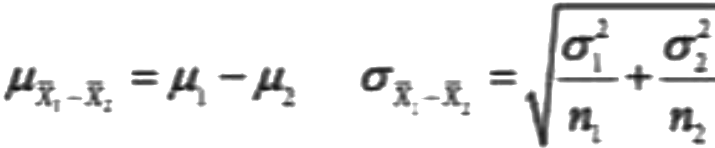
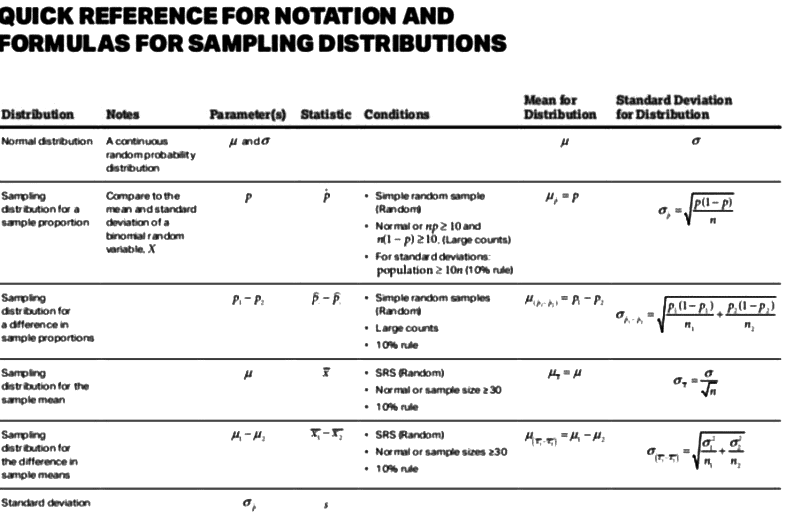
To find the standard deviation of differences in sample means, divide the variances by each sample size before square rooting to find the overall standard deviation. Just like with proportions, the Pythagorean Theorem of Statistics applies to sampling distributions for the difference in two means as well. Here are the formulas for the needed parameters for the sampling distribution of the difference of two means.

Normal Condition: Central Limit Theorem
When you are working with differences between sample means, you can use the sampling distribution of the differences to make inferences about the difference between the population means.
If the two population distributions can be modeled with a normal distribution, then the sampling distribution of the difference in sample means x̄1 - x̄2 can also be modeled with a normal distribution. This means that you can use statistical techniques that rely on normality, such as confidence intervals and hypothesis tests, to make inferences about the difference between the population means based on the sample data.
If the two population distributions cannot be modeled with a normal distribution, the sampling distribution of the difference in sample means x̄1 - x̄2 can still be approximately normal if both samples are large enough. This is due to the Central Limit Theorem, which states that the sampling distribution of the sample mean becomes approximately normal as the sample size increases, regardless of the shape of the population distribution. As a result, if both samples are large enough (e.g., have sample sizes of at least 30), you can still use normal-based techniques to make inferences about the difference between the population means.
MULTIPLE CHOICE QUESTIONTry yourself: What theorem applies to sampling distributions for the difference in two means?
Practice Problem
Suppose that you are a publisher trying to compare the sales of two different genres of books: romance novels and science fiction novels. You decide to use random samples of 50 romance novels and 50 science fiction novels from your inventory, and you collect data on the number of copies sold for each book. After analyzing the data, you find that the sample mean number of copies sold for romance novels is 500 copies with a standard deviation of 100 copies, and the sample mean number of copies sold for science fiction novels is 400 copies with a standard deviation of 150 copies.
(a) Explain what the sampling distribution for the difference in sample means represents and why it is useful in this situation.
(b) Suppose that the true population mean number of copies sold for romance novels is actually 550 copies and the true population mean number of copies sold for science fiction novels is actually 450 copies. Describe the shape, center, and spread of the sampling distribution for the difference in sample means in this case.
(c) Explain why the Central Limit Theorem applies to the sampling distribution for the difference in sample means in this situation.
(d) Discuss one potential source of bias that could affect the results of this study, and explain how it could influence the estimate of the difference in population means.
Answer:
(a) The sampling distribution for the difference in sample means represents the distribution of possible values for the difference between the sample means if the study were repeated many times. It is useful in this situation because it allows us to make inferences about the difference between the population means for the two genres of books based on the sample data.
(b) If the true population mean number of copies sold for romance novels is 550 copies and the true population mean number of copies sold for science fiction novels is 450 copies, the sampling distribution for the difference in sample means would be approximately normal with a center at 550 - 450 = 100 copies and a spread that depends on the sample sizes and the variability of the populations.
(c) The Central Limit Theorem applies to the sampling distribution for the difference in sample means in this situation because the sample sizes (n1 = 50 > 30, and n2 = 50 > 30) are large enough for the distribution to be approximately normal, even if the populations are not normally distributed.
(d) One potential source of bias in this study could be self-selection bias, which occurs when certain groups of individuals are more or less likely to choose to participate in the study. For example, if romance novel readers are more likely to buy books from certain retailers or to be members of certain book clubs, the sample of romance novels could be biased toward higher levels of sales and produce an overestimate of the population mean.
On the other hand, if science fiction novel readers are more likely to buy books online or to be members of certain online communities, the sample of science fiction novels could be biased toward lower levels of sales and produce an underestimate of the population mean. This could lead to an incorrect estimate of the difference in population means between the two genres of books.
Key Terms to Review
- Bias: Bias refers to a systematic error that leads to an incorrect or misleading representation of a population or phenomenon.
- Central Limit Theorem: The Central Limit Theorem (CLT) states that the sampling distribution of the sample mean approaches a normal distribution as the sample size increases.
- Confidence Intervals: A confidence interval is a range of values used to estimate a population parameter and indicates the level of uncertainty associated with that estimate.
- Difference in Two Means: Refers to the statistical comparison of the average values from two independent samples.
- Hypothesis Tests: Statistical methods used to determine if there is enough evidence in a sample of data to support a claim about a population parameter.
- Normal Distribution: A continuous probability distribution characterized by a symmetric, bell-shaped curve.
- Population Mean: The average value of a set of observations for an entire population.
- Sampling Distributions: The probability distribution of a statistic obtained from a large number of samples drawn from a specific population.
- Standard Deviation: A measure of the amount of variation or dispersion in a set of values.
The document Chapter Notes: Sampling Distributions for Differences in Sample Means is a part of the Grade 10 Course AP Statistics.
All you need of Grade 10 at this link: Grade 10
FAQs on Chapter Notes: Sampling Distributions for Differences in Sample Means
| 1. What is a sampling distribution for the difference in sample means? |  |
Ans. A sampling distribution for the difference in sample means represents the distribution of all possible differences between the sample means from repeated random samples of the same size from two populations. It is useful because it allows researchers to make inferences about the difference between population means based on observed sample data.
| 2. How can the Central Limit Theorem be applied when comparing two sample means? | |
Ans. The Central Limit Theorem states that the sampling distribution of the sample mean becomes approximately normal as the sample size increases, regardless of the population distribution shape. When comparing two sample means, if both sample sizes are large enough (typically n ≥ 30), the distribution of the difference between the two sample means will also be approximately normal, allowing for the use of normal-based statistical methods.
| 3. What factors influence the spread of the sampling distribution for the difference in sample means? | |
Ans. The spread of the sampling distribution for the difference in sample means is influenced by the standard deviations of the two populations and the sizes of the samples. Specifically, the standard error of the difference in means is calculated using the formula that combines the standard deviations and sample sizes, leading to a smaller spread with larger sample sizes or lower population variances.
| 4. What is the significance of having a normal distribution in hypothesis testing for differences in means? | |
Ans. Having a normal distribution in hypothesis testing for differences in means is significant because many statistical tests, such as t-tests and z-tests, rely on the assumption of normality. When the distribution of the difference in sample means is normal, it allows researchers to accurately calculate p-values and confidence intervals, leading to valid conclusions regarding the null hypothesis.
| 5. What types of bias could affect the estimation of population means in a study? | |
Ans. Various types of bias can affect the estimation of population means, including selection bias, response bias, and self-selection bias. For instance, if certain groups are overrepresented in the sample or if individuals self-select into the study based on their characteristics or preferences, this can lead to an inaccurate representation of the population and skew the results, ultimately affecting the estimated difference in population means.
About this Document

4.86/5 Rating

Apr 18, 2026 Last updated
Related Exams
Document Description: Chapter Notes: Sampling Distributions for Differences in Sample Means for Grade 10 2026 is part of AP Statistics preparation. The notes and questions for Chapter Notes: Sampling Distributions for Differences in Sample Means have been prepared according to the Grade 10 exam syllabus. Information about Chapter Notes: Sampling Distributions for Differences in Sample Means covers topics like and Chapter Notes: Sampling Distributions for Differences in Sample Means Example, for Grade 10 2026 Exam. Find important definitions, questions, notes, meanings, examples, exercises and tests below for Chapter Notes: Sampling Distributions for Differences in Sample Means.
Introduction of Chapter Notes: Sampling Distributions for Differences in Sample Means in English is available as part of our AP Statistics for Grade 10 & Chapter Notes: Sampling Distributions for Differences in Sample Means in Hindi for AP Statistics course. Download more important topics related with notes, lectures and mock test series for Grade 10 Exam by signing up for free. Grade 10: Chapter Notes: Sampling Distributions for Differences in Sample Means
Description
Chapter Notes: Sampling Distributions for Differences in Sample Means of AP Statistics with clear explanations of key concepts & important topics of the chapter, to help you underst& lessons better & revise quickly, & crack the Grade 10 exam.
Information about Chapter Notes: Sampling Distributions for Differences in Sample Means
In this doc you can find the meaning of Chapter Notes: Sampling Distributions for Differences in Sample Means defined & explained in the simplest way possible. Besides explaining types of Chapter Notes: Sampling Distributions for Differences in Sample Means theory, EduRev gives you an ample number of questions to practice Chapter Notes: Sampling Distributions for Differences in Sample Means tests, examples and also practice Grade 10 tests



Related Searches
pdf , Summary, Chapter Notes: Sampling Distributions for Differences in Sample Means, Viva Questions, mock tests for examination, past year papers, Important questions, Objective type Questions, Chapter Notes: Sampling Distributions for Differences in Sample Means, MCQs, video lectures, Chapter Notes: Sampling Distributions for Differences in Sample Means, Semester Notes, study material, Sample Paper, Exam, Extra Questions, shortcuts and tricks, Previous Year Questions with Solutions, ppt, Free, practice quizzes;