CBSE Class 10 > Class 10 Notes > Science > Infographics: Acids vs Bases
Infographics: Acids vs Bases

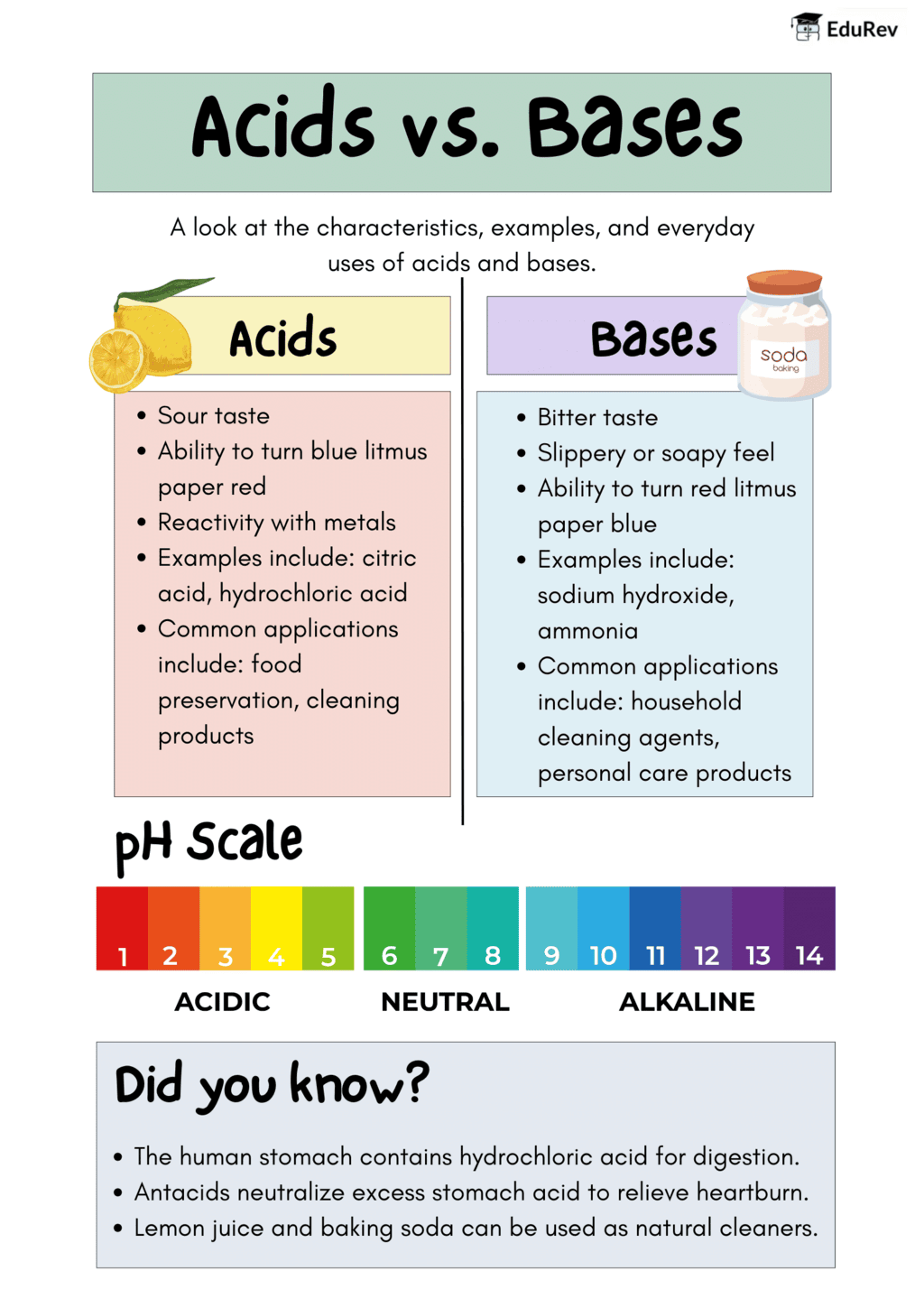
The document Infographics: Acids vs Bases is a part of the Class 10 Course Science Class 10.
All you need of Class 10 at this link: Class 10
FAQs on Infographics: Acids vs Bases
| 1. What are the main differences between acids and bases? |  |
Ans. Acids are substances that donate protons (H+) in a reaction, while bases are substances that accept protons. Acids typically have a sour taste, can conduct electricity, and turn blue litmus paper red. Bases, on the other hand, have a bitter taste, feel slippery, and turn red litmus paper blue. Additionally, acids usually have a pH less than 7, whereas bases have a pH greater than 7.
| 2. How do acids and bases affect the pH level of a solution? | |
Ans. The pH scale measures how acidic or basic a solution is, ranging from 0 to 14. Acids lower the pH of a solution (making it more acidic) by increasing the concentration of H+ ions. Conversely, bases raise the pH of a solution (making it more basic) by increasing the concentration of hydroxide ions (OH-). A pH of 7 is considered neutral.
| 3. Can you provide examples of common acids and bases found in everyday life? | |
Ans. Common acids include citric acid (found in citrus fruits), acetic acid (found in vinegar), and hydrochloric acid (found in stomach acid). Examples of common bases are sodium bicarbonate (baking soda), calcium hydroxide (lime), and ammonia (found in cleaning products). These substances are often used in cooking, cleaning, and various industrial processes.
| 4. What is the importance of the acid-base balance in the human body? | |
Ans. The acid-base balance is crucial for maintaining homeostasis in the human body. It ensures that the pH of bodily fluids remains within a narrow range, typically around 7.4 for blood. Proper pH levels are essential for enzyme function, oxygen transport, and overall metabolic processes. Imbalances can lead to conditions such as acidosis or alkalosis, which can be harmful.
| 5. How do neutralization reactions occur between acids and bases? | |
Ans. Neutralization is a chemical reaction where an acid reacts with a base to produce water and a salt. During this process, the H+ ions from the acid combine with the OH- ions from the base to form water (H2O). This reaction typically results in a solution that is closer to neutral (pH 7), demonstrating how acids and bases can counteract each other’s properties.
About this Document

2.2K Views

4.65/5 Rating

Apr 26, 2026 Last updated
Document Description: Infographics: Acids vs Bases for Class 10 2026 is part of Science Class 10 preparation. The notes and questions for Infographics: Acids vs Bases have been prepared according to the Class 10 exam syllabus. Information about Infographics: Acids vs Bases covers topics like and Infographics: Acids vs Bases Example, for Class 10 2026 Exam. Find important definitions, questions, notes, meanings, examples, exercises and tests below for Infographics: Acids vs Bases.
Introduction of Infographics: Acids vs Bases in English is available as part of our Science Class 10 for Class 10 & Infographics: Acids vs Bases in Hindi for Science Class 10 course. Download more important topics related with notes, lectures and mock test series for Class 10 Exam by signing up for free. Class 10: Infographics: Acids vs Bases
Description
Infographics: Acids vs Bases of Science Class 10 provides you one-page visual summary of the chapter covering all the important topics. Download the PDF from EduRev.
Information about Infographics: Acids vs Bases
In this doc you can find the meaning of Infographics: Acids vs Bases defined & explained in the simplest way possible. Besides explaining types of Infographics: Acids vs Bases theory, EduRev gives you an ample number of questions to practice Infographics: Acids vs Bases tests, examples and also practice Class 10 tests



Related Searches
shortcuts and tricks, Exam, Sample Paper, Previous Year Questions with Solutions, pdf , practice quizzes, Free, Infographics: Acids vs Bases, Infographics: Acids vs Bases, Summary, Objective type Questions, MCQs, Important questions, ppt, study material, past year papers, Infographics: Acids vs Bases, Extra Questions, mock tests for examination, video lectures, Viva Questions, Semester Notes;