Mnemonics: Life Processes in Animals

Parts/Pathway of the Digestive System
Mnemonic: "My Food Stays Super Long"
- My - Mouth
- Food - Food pipe (Oesophagus)
- Stays - Stomach
- Super - Small intestine
- Long - Large intestine
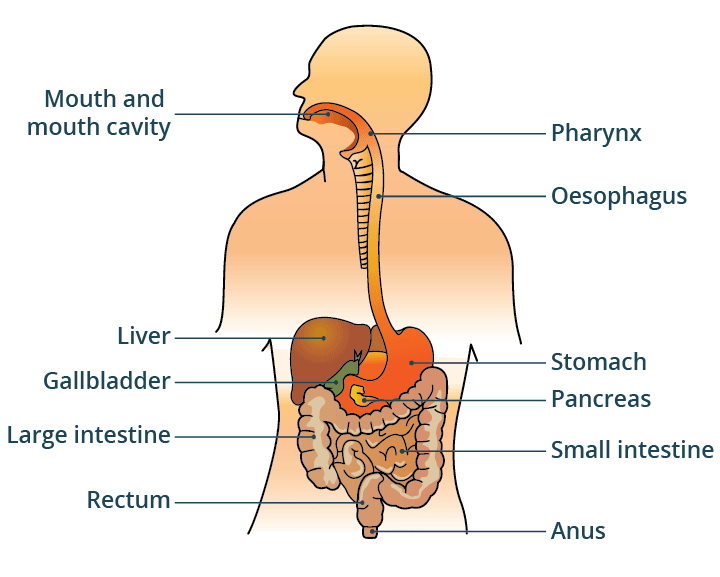
The digestive system is the pathway through which food enters the body, is broken down into smaller usable molecules, absorbed into the blood, and the unusable waste is removed. Digestion involves both mechanical actions (chewing, churning) and chemical actions (enzymes and acids).
What each part does
- Mouth - Food is taken in and chewed; saliva from salivary glands mixes with food. Saliva contains the enzyme salivary amylase which begins the digestion of starch into simpler sugars.
- Oesophagus (Food pipe) - A muscular tube that pushes chewed food to the stomach by coordinated muscle movements called peristalsis.
- Stomach - A muscular sac where food is mixed with gastric juices. Acidic conditions help proteins to be partially digested and kill many microbes in food.
- Small intestine - The main site for chemical digestion and absorption. Enzymes from the pancreas and intestinal glands act here; digested nutrients pass through the intestinal wall into the bloodstream.
- Large intestine - Water and some salts are absorbed here; remaining material becomes faeces which are stored in the rectum and expelled through the anus.
Understanding this sequence helps recall where each stage of digestion and absorption happens and which organs secrete important digestive substances.
Digestive Juices
Mnemonic: "Some Healthy People Bite Slow"
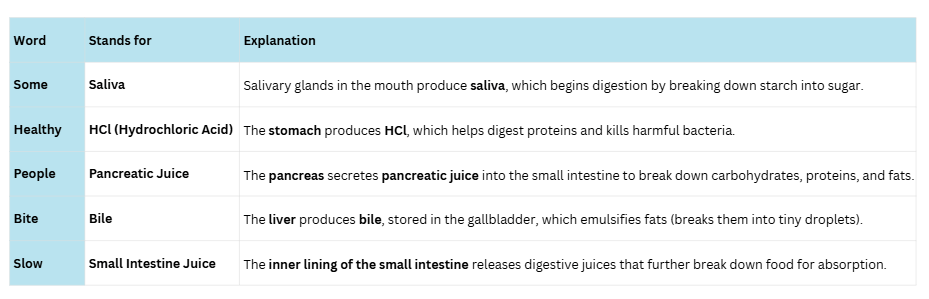
Each juice acts in a particular region and on specific types of food molecules. Together they convert complex food into simple molecules (glucose, amino acids, fatty acids, glycerol) that can be absorbed and used by the body.
Ruminant Digestion Process
Mnemonic: "Swallow, Store, Return, Re-chew"
- Swallow - Swallow food
- Store - Store in the rumen
- Return - Return to mouth
- Re-chew - Re-chew (Rumination)
Ruminants (for example, cows, buffaloes, goats, deer) have a special digestion process suited to plant material rich in cellulose. After the animal swallows grass, it is first stored in a large chamber called the rumen, where microorganisms (bacteria and protozoa) ferment the food and begin breaking down cellulose.
Later the animal returns this partially-digested food (called the cud) to the mouth, re-chews it thoroughly, and swallows it again so finer digestion can continue in other stomach chambers. This process increases the surface area of food and allows microbes to act more effectively to release nutrients.
Brief note on stomach chambers
- Ruminants have four stomach parts: rumen, reticulum, omasum, and abomasum. The rumen and reticulum are mainly for fermentation and storage; the omasum absorbs water; the abomasum is similar to the human stomach and produces acids and enzymes.
Parts of the Respiratory System
Mnemonic: "Nice Nose Takes Long Adventure"
- Nice - Nostrils
- Nose - Nasal passage
- Takes - Trachea (Windpipe)
- Long - Lungs
- Adventure - Alveoli
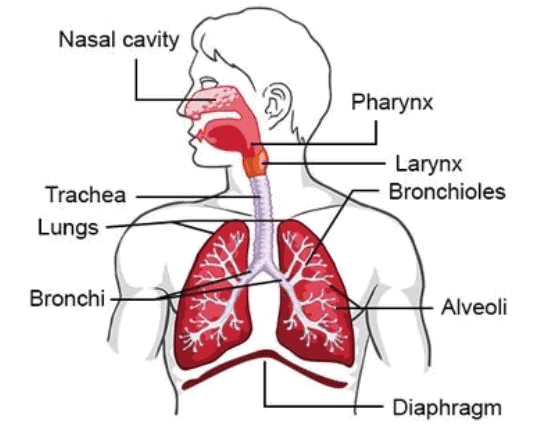
The respiratory system brings air into the body and allows exchange of gases between the air and the blood. Air enters through the nostrils where it is warmed, moistened and filtered; it then passes through the nasal passages to the trachea, which divides into bronchi leading to the lungs. Within the lungs the bronchi branch into smaller bronchioles ending in tiny sacs called alveoli.
Gas exchange at the alveoli
- Alveoli are thin-walled and surrounded by a network of capillaries. Oxygen from inhaled air diffuses across the alveolar membrane into the blood, and carbon dioxide diffuses from the blood into the alveoli to be exhaled.
- This exchange maintains oxygen supply for cells and removes carbon dioxide produced by cellular respiration.
Good respiratory health (clear airways, healthy lungs) is important for efficient gas exchange. Exercise increases the rate and depth of breathing to supply more oxygen to muscles.
Mechanism of Breathing
Mnemonic: "In Down....Out Up" : Pair of Opposites
- In - Inhale
- Down - Diaphragm moves down
- Out - Exhale
- Up - Diaphragm moves up
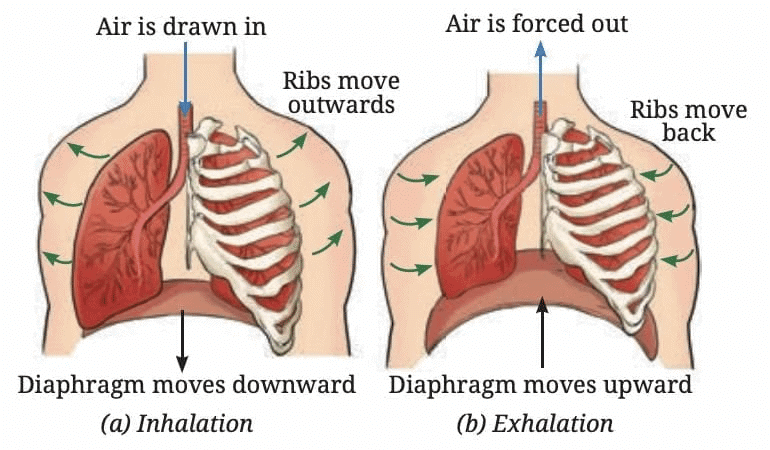
Breathing involves physical changes in the chest cavity that move air in and out of the lungs.
How inhalation and exhalation occur
- During inhalation the diaphragm contracts and moves downwards; the external intercostal muscles contract to raise and expand the ribcage. The thoracic (chest) cavity volume increases, the air pressure inside the lungs falls below atmospheric pressure, and air flows into the lungs.
- During exhalation the diaphragm relaxes and moves up; the intercostal muscles relax and the ribcage falls back. The thoracic cavity volume decreases, the pressure inside the lungs rises above atmospheric pressure, and air is pushed out.
FAQs on Mnemonics: Life Processes in Animals
| 1. What are the main parts of the digestive system and their functions? |  |
| 2. What are digestive juices, and what role do they play in digestion? | |
| 3. How does ruminant digestion differ from that of non-ruminants? | |
| 4. What are the main parts of the respiratory system? | |
| 5. What is the mechanism of breathing, and how does it work? | |